- Product Description Description
- Table of Contents TOC
- List of Table & Figure LOT
- Get Free Sample PDF Sample PDF
Market Size, 2025
$19.21 BnMarket Estimate, 2026
$20.18 BnMarket Forecast, 2034
$29.93 BnCAGR, 2026–2034
5.05%Executive Summary: Latin America Carbonated Soft Drinks Market
- Market Scope: Comprehensive regional Latin America carbonated soft drinks market analysis covering product types, flavor categories, distribution channels, country-level leadership frameworks, and urbanization/sugar-tax drivers.
- Market Valuation: Valued at USD 19.21 billion (2025), estimated at USD 20.18 billion (2026), and projected to reach USD 29.93 billion by 2034, registering a steady CAGR of 5.05% (2026–2034).
- Primary Growth Drivers: Rapid urbanization (over 80% living in cities), changing convenience-focused lifestyles, youth demographics, digital D2C transformation, and demand for low-sugar/functional alternatives.
Key Market Segment Metrics (2026–2034)
| Category | Leading Segment (2024/2025 Position) | Fastest-Growing Segment |
|---|---|---|
| By Product & Flavor | Standard CSDs (58.2% share) & Cola-Flavored Beverages (47.6% share) | Diet Carbonated Soft Drinks (7.2% CAGR) & Orange-Flavored Carbonates (6.8% CAGR) |
| By Distribution & Region | Supermarkets (45.2% share) & Brazil (34.3% regional share in 2024) | Convenience Stores (8.1% CAGR) & Chile/Argentina growth hubs |
Major Market Players & Market Structure
Market Structure: Highly competitive Latin American beverage landscape featuring global refreshment giants and regional conglomerates competing on direct-to-consumer e-commerce platforms, low-sugar product formulations, and sustainable packaging initiatives.
Key Companies: Monster Beverage Corp, Britvic PLC, Parle Agro, PepsiCo Inc, Coca-Cola Company, Cott Corporation, Dohler Group, Kraft Foods, Dr Pepper Snapple Group Inc, and AmBev.
Latin America Carbonated Soft Drinks Market Size
The Latin America carbonated soft drinks market size was valued at USD 19.21 billion in 2025, and the market size is expected to reach USD 29.93 billion by 2034 from USD 20.18 billion in 2026. The market's promising CAGR for the predicted period is 5.05%.
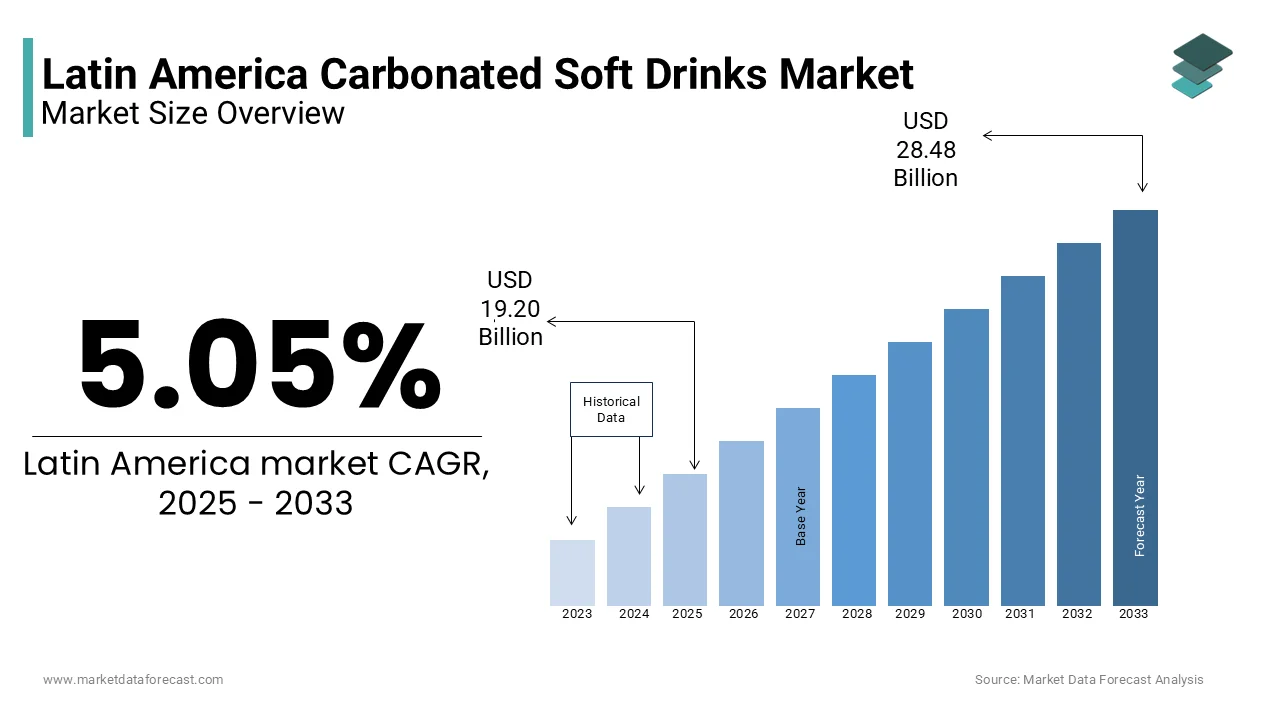
The Latin America carbonated soft drinks market has historically been dominated by multinational brands like Coca-Cola and PepsiCo, although local players have also gained traction in recent years due to increasing consumer preference for region-specific flavors and packaging. For instance, Mexico continues to lead in per capita consumption of soft drinks, with an average of over 600 eight-ounce servings annually as reported by the International Council of Beverages Associations (ICBA). Brazil, being the largest economy in the region, contributes significantly to overall volume sales, driven by a young population and expanding urbanization.
MARKET DRIVERS
Urbanization and Changing Lifestyles
The rapid pace of urbanization coupled with changing lifestyle patterns is driving the growth of the Latin America Carbonated Soft Drinks Market. As per the United Nations Economic Commission for Latin America and the Caribbean (ECLAC), over 80% of the population in the region now resides in urban areas, contributing to shifts in consumption behavior. Urban dwellers tend to rely more on convenience foods and beverages, including ready-to-drink carbonated soft drinks, which aligns with fast-paced routines and limited time for meal preparation. Moreover, rising disposable incomes in middle-class households have enabled increased spending on discretionary items such as soft drinks. In Brazil, for example, the national statistics agency IBGE reported a 7.2% rise in household consumption expenditure on packaged beverages in 2023 compared to the previous year. Retail expansion through modern trade formats such as supermarkets and convenience stores, has further facilitated easier access to these products.
Youth Demographics and Marketing Influence
The rising young population, which fosters strong brand engagement and product experimentation is also to propel the growth of the Latin America Carbonated Soft Drinks Market. As per data from the World Bank, approximately 30% of Latin America's population was under the age of 15 in 2023, while those aged between 15 and 35 constituted nearly 40%. Soft drink manufacturers leverage digital platforms, celebrity endorsements, and event sponsorships to connect with younger consumers. For instance, in Brazil, Coca-Cola partnered with popular music festivals and sports leagues to enhance brand presence among millennials and Gen Z consumers. In Mexico, PepsiCo launched targeted influencer campaigns on TikTok and Instagram, reaching millions of users daily. Additionally, youth-driven trends such as flavor innovation and limited-edition releases have contributed to sustained interest in carbonated beverages.
MARKET RESTRAINTS
Health Awareness and Regulatory Pressure
The growing public awareness regarding health risks associated with excessive sugar consumption is limiting the growth of the Latin America Carbonated Soft Drinks Market. Governments across the region have implemented policies aimed at curbing obesity and related diseases such as diabetes and cardiovascular disorders. One of the most impactful measures has been the imposition of sugar-sweetened beverage taxes. Mexico, for instance, introduced a tax of one peso per liter on sugary drinks in 2014, leading to a measurable decline in consumption. According to findings published by the National Institute of Public Health of Mexico (INSP), sales of taxed beverages fell by 7.3% in the first year after implementation, with even steeper reductions observed in lower-income households. Brazil has also seen mounting pressure from health advocacy groups and government bodies. In 2024, several states proposed legislation to introduce front-of-pack warning labels similar to those used in Chile, signaling a potential nationwide regulatory shift. These developments have led to declining volume sales in traditional sugary soda categories, forcing companies to reformulate products or pivot toward alternative offerings such as zero-sugar variants and functional beverages. However, the effectiveness of these strategies remains constrained by ongoing regulatory scrutiny and shifting consumer perceptions, both of which pose persistent challenges to market growth.
Environmental Concerns and Packaging Regulations
Environmental sustainability has emerged as a formidable restraint for the Latin America Carbonated Soft Drinks Market due to increasing scrutiny around plastic waste and unsustainable packaging practices. Beverage companies are facing pressure from governments, environmental organizations, and consumers to reduce their ecological footprint, particularly concerning single-use plastic bottles. In response, several Latin American countries have enacted stringent packaging regulations. Chile, for example, implemented its Extended Producer Responsibility (EPR) law in 2023, mandating that beverage producers achieve a minimum recycling rate of 45% by 2025. As per the Chilean Ministry of the Environment, failure to comply could result in fines or restrictions on product distribution. Consumer sentiment is also shifting rapidly. As per a survey conducted by Ipsos in 2024, 68% of respondents in Brazil and Mexico preferred brands that used eco-friendly packaging, indicating a clear link between environmental responsibility and purchasing decisions.
MARKET OPPORTUNITIES
Expansion of Low-Sugar and Functional Beverages
The growing demand for low-sugar and functional beverage alternatives is substantially to create new opportunities for the Latin America Carbonated Soft Drinks Market. Consumers are increasingly seeking healthier options that offer taste without compromising on wellness, which is creating a lucrative niche for calorie-reduced and fortified soft drinks. According to Euromonitor International, sales of zero-sugar carbonated soft drinks in Latin America grew by 9% in volume terms between 2022 and 2024, outpacing the contraction seen in full-sugar counterparts. In Mexico, where Coca-Cola Zero Sugar has become a top-selling variant, per capita consumption of diet sodas reached 22 liters in 2023, up from 17 liters in 2020.
Digital Transformation and Direct-to-Consumer Sales Channels
Digital transformation offers a transformative opportunity for the Latin America Carbonated Soft Drinks Market by enabling direct engagement with consumers and enhancing supply chain efficiency. The proliferation of e-commerce, mobile payment systems, and digital marketing tools has reshaped how beverages are marketed, sold, and distributed across the region.
In Brazil, for instance, AmBev launched its own delivery platform, Zé Delivery, in 2021, allowing consumers to order soft drinks and other beverages directly via smartphone apps. Furthermore, social commerce where purchases are made directly through social media platforms is gaining momentum. In Argentina and Colombia, beverage brands have begun partnering with WhatsApp and Facebook Shops to facilitate instant purchases by leveraging high internet penetration and mobile phone usage.
MARKET CHALLENGES
Economic Volatility and Currency Fluctuations
Economic instability poses a substantial challenge to the Latin America Carbonated Soft Drinks Market due to frequent currency fluctuations and inflationary pressures. Many countries in the region, including Argentina, Brazil, and Venezuela, have faced recurring economic crises that impact consumer purchasing power and corporate profitability. In Argentina, for instance, the Argentine peso depreciated by over 100% against the U.S. dollar in 2023, as reported by the Central Bank of Argentina. This devaluation significantly increased the cost of imported raw materials and packaging components, squeezing profit margins for beverage manufacturers. Additionally, hyperinflation eroded real wages, leading to a decline in discretionary spending, including on non-essential items like soft drinks. Currency volatility also complicates financial planning for multinational beverage companies operating in the region. Hedging against exchange rate risks becomes increasingly complex and costly, affecting investment decisions and market expansion strategies. Local bottlers often face difficulties in securing stable financing, which is further hampering production capacity and innovation efforts.
Water Scarcity and Resource Management Pressures
Water scarcity and resource management issues to degrade the growth of the Latin America Carbonated Soft Drinks Market. In regions such as northern Chile and northeastern Brazil, prolonged droughts have severely impacted water availability. According to the Inter-American Development Bank (IDB), parts of Chile experienced a "mega-drought" that persisted for over a decade, reducing freshwater reserves by nearly 30% in some basins. In São Paulo, Brazil’s industrial hub, water rationing measures were reintroduced in 2023 following below-average rainfall and reservoir depletion. As per the state’s water utility, Sabesp, industries faced mandatory cuts of up to 20% in water withdrawals, compelling beverage companies to invest in water recycling technologies and alternative sourcing strategies.
REPORT COVERAGE
| REPORT METRIC | DETAILS |
| Market Size Available | 2025 to 2034 |
| Base Year | 2025 |
| Forecast Period | 2026 to 2034 |
| CAGR | 5.05% |
| Segments Covered | By Type, Flavor, Distribution Channel and Region |
| Various Analyses Covered | Global, Regional, & Country Level Analysis; Segment-Level Analysis; DROC; PESTLE Analysis; Porter’s Five Forces Analysis; Competitive Landscape; Analyst Overview of Investment Opportunities |
| Regions Covered | Latin America include Brazil, Argentina, Mexico, and the Rest of Latin America |
| Market Leaders Profiled | Monster Beverage Corp, Britvic PLC, Parle Agro, PepsiCo Inc, Coca-Cola Company, Cott Corporation, Dohler Group, Kraft Foods, Dr Pepper Snapple Group, Inc, and others. |
SEGMENTAL ANALYSIS
By Type Insights
The standard carbonated soft drinks segment was accounted in holding 58.2% of the Latin America Carbonated Soft Drinks Market in 2024. The entrenched cultural preference for sweetened beverages, particularly in countries like Mexico and Brazil where sugary soda consumption remains high despite growing health concerns is prompting the growth of the segment. According to the International Council of Beverages Associations (ICBA), Mexico alone consumed more than 600 servings per capita annually in 2023, with standard variants making up the majority of this intake. Additionally, affordability plays a crucial role in sustaining demand for standard carbonates. In lower-income demographics, which constitute a significant portion of the Latin American population, these beverages remain more accessible due to their lower price points compared to diet or premium alternatives.
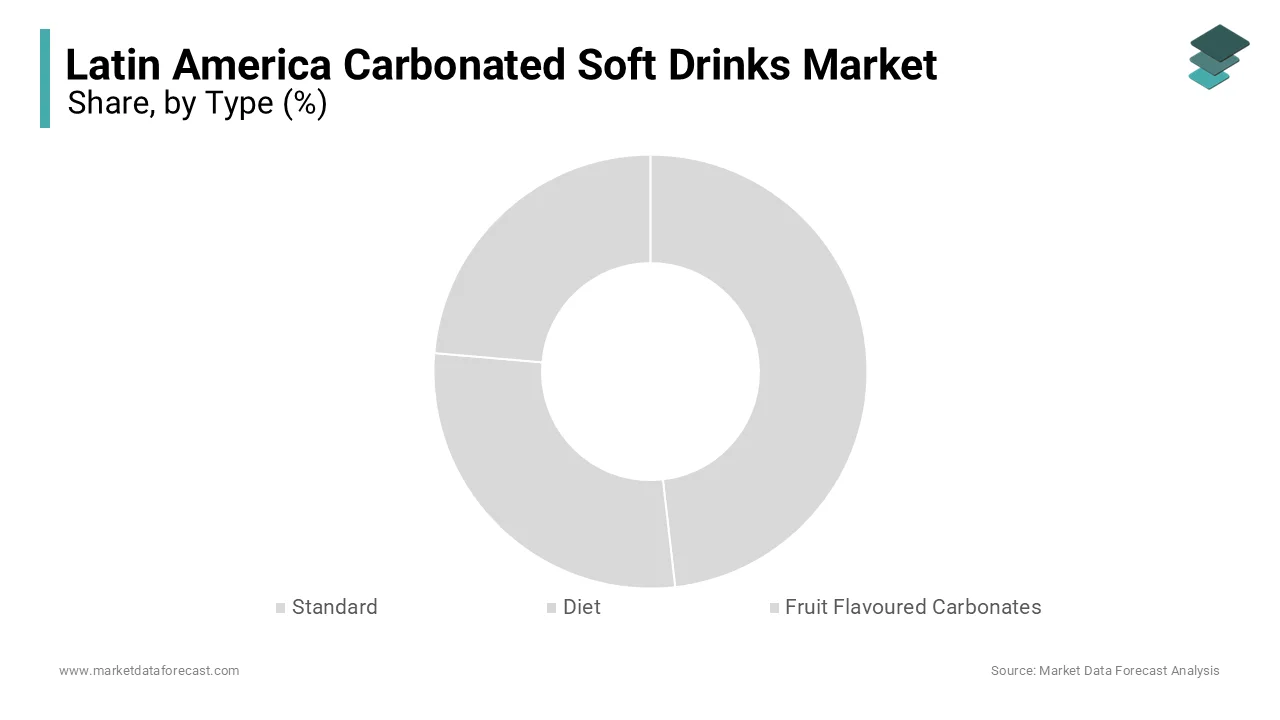
The diet carbonated soft drinks segment is swiftly growing with an expected CAGR of 7.2% during the forecast period. The increasing prevalence of lifestyle-related diseases such as obesity and diabetes, prompting consumers to seek low-calorie alternatives is fueling the growth of the Latin America Carbonated Soft Drinks Market. According to the Pan American Health Organization (PAHO), nearly 60% of adults in Latin America were overweight or obese in 2023, reinforcing the urgency for healthier beverage choices. In response, major manufacturers have intensified product innovation and reformulation efforts, with Coca-Cola Zero Sugar becoming one of the fastest-selling variants in Mexico and Brazil.
By Flavor Insights
The cola-flavored beverages held 47.6% of the Latin America Carbonated Soft Drinks Market share in 2024. The widespread popularity of cola can be attributed to the long-standing presence of global brands like Coca-Cola and PepsiCo, which have maintained extensive marketing campaigns and localized bottling partnerships across the region. In Brazil, for instance, Coca-Cola accounts for over 60% of cola beverage sales, according to internal company data released in 2024, reflecting its entrenched market position. The brand loyalty reinforced through decades of advertising, sponsorships, and community engagement ensures continuous demand. Cola’s adaptability into different formats are ranging from standard cans to flavored variations like cherry cola is also to boost the growth of the segment.
The orange-flavored carbonates segment is anticipated to register a CAGR of 6.8% from 2025 to 2033. The increasing demand for natural flavors and citrus-infused beverages among younger population is majorly accelerating the growth of the segment. According to Euromonitor International, orange-flavored carbonates saw a 12% increase in new product launches across Latin America between 2022 and 2024, with brands such as Fanta, Sukita, and private-label offerings gaining traction. In addition, the rise of hybrid beverages that blend orange with herbal extracts or sparkling water has broadened appeal beyond conventional soda consumers. Marketing initiatives leveraging seasonal promotions and festive packaging have further boosted visibility.
By Distribution Channel Insights
The supermarkets segment was the largest and held 45.2% of the Latin America Carbonated Soft Drinks Market share in 2024. According to NielsenIQ, modern trade channels including supermarkets and hypermarkets have seen a steady rise in beverage sales, driven by improved supply chain efficiencies and enhanced store formats. Moreover, the proliferation of private-label carbonated beverages in supermarket chains has contributed to increased footfall and repeat purchases. Retailers such as Walmart de México y Centroamérica and Carrefour Argentina have leveraged exclusive brand partnerships to offer competitive pricing, attracting cost-conscious consumers. Additionally, the integration of loyalty programs and digital payment options in large-format stores has strengthened consumer retention.
The convenience stores segment is esteemed to witness a CAGR of 8.1% from 2025 to 2033. According to GSMA Intelligence, over 75% of Latin Americans reside in urban centers, where proximity-driven shopping behavior favors quick-service retail formats. In cities like São Paulo and Bogotá, convenience store density has grown significantly, with OXXO, Alcampo Express, and Shell Select expanding aggressively to meet on-the-go consumer needs. Furthermore, extended operating hours and strategic placement near transit hubs and office districts make convenience stores an ideal point-of-sale for working professionals and students.
REGIONAL ANALYSIS
Brazil
Brazil was the top performer in the Latin America Carbonated Soft Drinks Market by accounting for 34.3% of share in 2024. The growth of the market in this country is driven by high urbanization levels, with over 87% of the population residing in cities, as reported by the Brazilian Institute of Geography and Statistics (IBGE). Urban dwellers exhibit strong purchasing power, especially in metropolitan areas such as São Paulo and Rio de Janeiro, where modern trade and convenience store formats thrive. Additionally, Brazil’s youth demographic fuels demand for branded and innovative soft drinks. Major players like AmBev, Coca-Cola Femsa, and PepsiCo have invested heavily in local production and logistics infrastructure. In 2023, AmBev expanded its Zé Delivery platform to over 500 cities, boosting direct-to-consumer beverage sales and strengthening last-mile distribution efficiency.
Argentina
Argentina Carbonated Soft Drinks Market held 16.2% of share in 2024. According to the National Institute of Statistics and Census (INDEC), Argentina recorded a soft drink consumption rate of approximately 180 liters per person in 2023, reflecting sustained demand despite economic volatility. Buenos Aires and Córdoba serve as major consumption hubs, where modern trade and convenience stores facilitate easy access to branded products. Local bottlers have ramped up production capacity to meet demand, supported by government incentives aimed at boosting industrial activity. In 2023, Quilmes Industrial (part of Heineken Group) expanded its beverage bottling operations, increasing output by 12%, as per company disclosures.
Chile
Chile Carbonated Soft Drinks Market growth is deemed to have significant growth opportunitie sin the next coming years. As per the National Institute of Statistics (INE), Chile’s per capita soft drink consumption stood at around 150 liters in 2023, slightly lower than regional averages but reflective of policy interventions targeting sugar reduction. The country implemented front-of-pack warning labels in 2016, followed by stricter nutritional advertising restrictions in 2022, leading to a notable shift toward low-sugar and functional beverages.
KEY MARKET PLAYERS AND COMPETITIVE LANDSCAPE
Key Players In Latin America Carbonated Soft Drinks Market are Monster Beverage Corp, Britvic PLC, Parle Agro, PepsiCo Inc, Coca-Cola Company, Cott Corporation, Dohler Group,Kraft Foods, Dr Pepper Snapple Group, Inc.
The competition in the Latin America Carbonated Soft Drinks Market is marked by a blend of global dominance and regional adaptability. Multinational corporations like The Coca-Cola Company and PepsiCo hold significant influence due to their long-standing presence, strong branding, and extensive distribution networks. However, regional players such as AmBev continue to challenge these giants by leveraging local insights, cost-efficient production models, and innovative marketing strategies. The market remains highly fragmented in certain areas, especially where independent bottlers and private-label brands have gained traction. Competitive dynamics are further shaped by ongoing shifts toward healthier beverage alternatives, regulatory pressures, and the increasing importance of sustainability. Companies must continuously innovate and adjust to changing consumer behaviors, economic fluctuations, and environmental concerns to retain or expand their market positions.
TOP PLAYERS IN THE MARKET
- The Coca-Cola Company holds a dominant position in the Latin America Carbonated Soft Drinks Market. Its extensive portfolio includes flagship brands such as Coca-Cola, Sprite, and Fanta, which are deeply embedded in local consumer culture.
- PepsiCo is a major competitor in the Latin American carbonated soft drinks sector, offering a diverse range of products including Pepsi, 7UP, and Mirinda. The company has consistently adapted to changing consumer demands by introducing low-sugar and flavored variants tailored to regional tastes. PepsiCo has enhanced its brand appeal and operational efficiency with a strong emphasis on sustainability and digital transformation. Its investments in modern trade and direct-to-consumer platforms have strengthened its market positioning across key countries in the region.
- AmBev plays a pivotal role in the Latin American beverage landscape in Brazil and other South American markets. AmBev’s carbonated soft drinks portfolio includes popular local and international brands such as Guaraná Antarctica, Sukita, and Pepsi known for distributing both alcoholic and non-alcoholic beverages. The company focuses on innovation, digital integration, and expanding its reach through e-commerce channels. AmBev’s deep understanding of regional consumer behavior enables it to effectively compete with global giants while maintaining a strong domestic presence.
TOP STRATEGIES USED BY KEY MARKET PLAYERS
One of the primary strategies employed by leading players in the Latin America Carbonated Soft Drinks Market is product diversification and reformulation that aimed at catering to evolving consumer health preferences. Companies are increasingly launching low-sugar, zero-calorie, and functional beverages that align with regulatory changes and shifting dietary habits.
Another critical approach is expanding digital engagement and omnichannel distribution. Beverage manufacturers are investing in e-commerce platforms, mobile-based delivery services, and data-driven marketing to enhance customer experience and improve supply chain responsiveness across urban and rural areas.
Sustainability and environmental responsibility have become central to corporate strategy. Major players are adopting eco-friendly packaging, which is reducing carbon footprints, and engaging in water stewardship initiatives to meet regulatory expectations and consumer demand for responsible business practices.
RECENT HAPPENINGS IN THE MARKET
- In February 2024, Coca-Cola launched a new line of locally inspired fruit-flavored carbonated beverages in Brazil, which is aiming to capture the growing demand for natural and refreshing options among younger consumers.
- In May 2024, PepsiCo expanded its direct-to-consumer delivery platform in Mexico by enhancing last-mile logistics and strengthening its presence in the fast-growing e-commerce beverage segment.
- In September 2023, AmBev introduced a fully recyclable aluminum can packaging solution for its soft drink brands in Argentina, which is reinforcing its commitment to sustainability and aligning with regional environmental regulations.
- In January 2024, The Coca-Cola Company partnered with a leading digital payments provider in Colombia to integrate cashless vending solutions across high-traffic urban locations by improving accessibility and convenience for consumers.
- In July 2023, PepsiCo acquired a minority stake in a Brazilian start-up specializing in plant-based flavor extracts, which is signaling its intent to innovate within the carbonated beverage space and develop cleaner-label products tailored to Latin American tastes.
MARKET SEGMENTATION
This Research Report on Latin America carbonated soft drinks market is segmented and sub segmented into the following categories
By Type
- Standard
- Diet
- Fruit flavoured carbonates
By Flavor
- Cola
- Lime
- Orange
By Distribution Channel
- Supermarkets
- Independent retailers
- Convenience stores
By Country
- Argentina
- Brazil
- Mexico
- rest of Latin America