- Product Description Description
- Table of Contents TOC
- List of Table & Figure LOT
- Get Free Sample PDF Sample PDF
Market Size, 2025
$2.73 BnMarket Estimate, 2026
$3.35 BnMarket Forecast, 2034
$17.37 BnCAGR, 2026–2034
22.83%Executive Summary: Latin America Cloud-Based Contact Center Market
- Market Scope: Comprehensive Latin American cloud-based contact center market analysis covering cloud computing adoption, e-commerce expansion, omnichannel customer engagement, scalability, flexibility, and operational cost reduction.
- Market Valuation: Valued at USD 2.73 billion (2025), estimated at USD 3.35 billion (2026), and projected to reach USD 17.37 billion by 2034, registering a robust CAGR of 22.83% (2026–2034).
- Primary Growth Drivers: Cloud computing adoption, omnichannel engagement demand, lower infrastructure costs, and customer experience enhancements. Key challenges include data security concerns, regulatory compliance hurdles, and offshore outsourcing pressures.
Key Market Segment Metrics (2026–2034)
| Category | Leading Segment (Position) | Fastest-Growing Segment |
|---|---|---|
| By Solution, Organization Size & Country | CTI solution segment (largest market share) & Large enterprises (dominant by organization size) & Brazil (largest market share in 2025) | Argentina (projected to witness the fastest growth with a CAGR of 28.8%) alongside cloud-enabled AI customer service solutions |
| By Regional Leadership | Brazil (accounted for largest market share in 2025 and expected to maintain leadership throughout forecast period) | Argentina (fastest-growing regional country market) |
Major Market Players & Market Structure
Market Structure: Highly competitive Latin American enterprise software and cloud communications landscape featuring major technology vendors driving cloud innovation, AI-powered customer service, and omnichannel platforms.
Key Companies: 8x8 Inc., Five9, Cisco Systems, Genesys, Oracle, NewVoiceMedia, Connect First, Aspect Software, and 3CLogic.
Latin America Cloud-Based Contact Center Market Size
The size of the Latin America cloud-based contact center market was worth USD 2.73 billion in 2025. The Latin America market is expected to grow from USD 3.35 billion in 2026 to USD 17.37 billion by 2034, growing at a CAGR of 22.83% from 2026 to 2034.
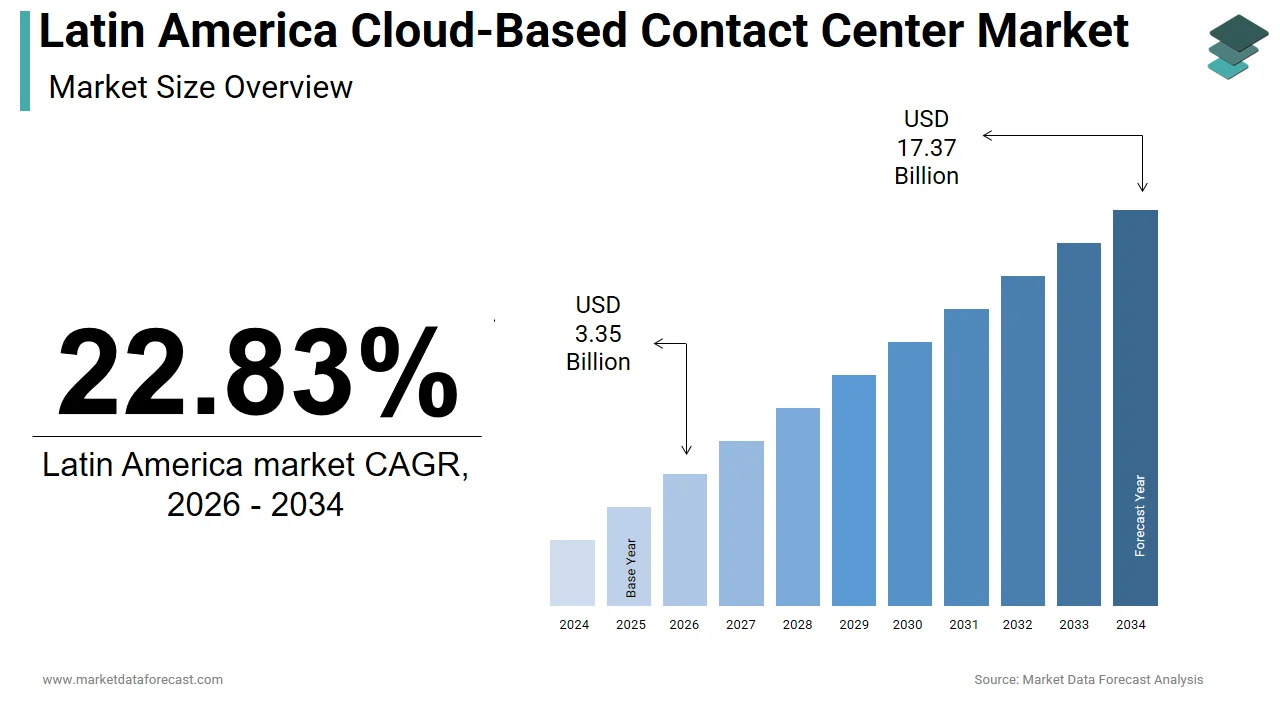
Latin America is experiencing a digital transformation driven by the need for omnichannel customer engagement strategies that provide seamless experiences across multiple touchpoints. According to the International Telecommunication Union, internet penetration in Latin America reached 72% in 2023, creating a robust infrastructure foundation for cloud services. The widespread use of mobile devices further accelerates demand as consumers increasingly prefer messaging apps and social platforms for customer support interactions. As per the Economic Commission for Latin America and the Caribbean, small and medium enterprises constitute over 99% of all businesses in the region and are rapidly adopting cloud solutions to compete with larger corporations. The rise of remote work models following the global pandemic has also normalized distributed workforce operations, making cloud-based systems essential for managing agents located in different geographic areas. Government initiatives in countries like Brazil and Mexico to improve broadband connectivity support this transition. Furthermore, the integration of artificial intelligence and automation into these platforms allows companies to handle high volumes of inquiries efficiently. This convergence of technological readiness, economic necessity, and changing consumer behavior defines the current landscape of the cloud-based contact center sector in Latin America.
MARKET DRIVERS
Rapid Digital Transformation and Adoption of Omnichannel Strategies
The accelerating pace of digital transformation across Latin American enterprises is a key factor propelling the Latin American cloud-based contact center market growth as organizations strive to meet evolving customer expectations for seamless omnichannel support. Consumers in the region increasingly interact with brands through diverse channels, including WhatsApp, Facebook Messenger, Instagram, and email, requiring unified platforms that consolidate these interactions into a single interface. According to regional digital reports, the number of social media users in Latin America exceeded 450 million in 2023, with WhatsApp being the dominant communication tool for both personal and business interactions. This high engagement rate necessitates contact center solutions that can integrate seamlessly with popular messaging applications to provide real-time responses. As per data from the Inter-American Development Bank, businesses that implement Omnichannel strategies report a 20% increase in customer satisfaction scores compared to those using single-channel approaches. Cloud-based platforms offer the agility required to add new communication channels quickly without significant infrastructure investments. The ability to track customer journeys across multiple touchpoints enables personalized interactions, which are crucial for retention in competitive markets. Furthermore, the scalability of cloud solutions allows companies to adjust resources based on fluctuating demand patterns, such as seasonal peaks or promotional events. This strategic alignment with consumer behavior and operational efficiency drives sustained demand for advanced cloud-based contact center technologies in the region.
Cost Efficiency and Operational Flexibility for Small and Medium Enterprises
The compelling cost efficiency and operational flexibility offered by cloud-based contact center solutions are further contributing to the Latin American cloud-based contact center market expansion. Traditional on-premises systems require substantial upfront capital expenditure for hardware, software licenses, and maintenance, which is often prohibitive for smaller businesses with limited financial resources. In contrast, cloud-based models operate on a subscription basis, allowing companies to pay only for the features and agent seats they use, thereby converting capital expenses into predictable operational expenses. According to the World Bank, SMEs account for approximately 60% of total employment in Latin America, making them a critical segment for technology adoption. The elimination of physical infrastructure reduces overhead costs related to space, power, and cooling, while also minimizing the need for specialized IT staff. As per a survey by regional business associations, over 70% of SMEs cited cost reduction as the primary reason for migrating to cloud services. Additionally, the flexibility to scale up or down based on business needs enables these enterprises to respond quickly to market changes without being burdened by unused capacity. Remote access capabilities allow businesses to hire talent from various locations, expanding their recruitment pool and reducing office space requirements. This economic advantage, combined with operational agility, makes cloud-based contact centers an attractive solution for the vast SME sector in Latin America.
MARKET RESTRAINTS
Inconsistent Internet Infrastructure and Connectivity Issues
The uneven quality of internet infrastructure and frequent connectivity issues in certain parts of Latin America are a significant restraint to the Latin American cloud-based contact center market. While urban centers in countries like Brazil, Chile, and Colombia have relatively robust broadband networks, rural areas and smaller cities often suffer from limited bandwidth, latency, and intermittent outages. According to the International Telecommunication Union, although average internet speeds in the region have improved, disparities remain significant, with some countries averaging below 20 Mbps, which can hinder real-time voice and video communications. For contact centers that depend on continuous uptime to serve customers, any disruption in connectivity can lead to dropped calls, delayed responses, and decreased customer satisfaction. As per data from regional digital development studies, reliability concerns deter many businesses from fully migrating to cloud platforms, especially those handling high-volume critical communications. The cost of upgrading local network infrastructure to support cloud operations can be prohibitive for smaller organizations. Furthermore, power instability in certain regions exacerbates connectivity challenges, requiring additional investments in backup systems. Until internet infrastructure becomes more uniform and reliable across the region, the risk of service disruption will continue to limit the confidence of enterprises in adopting cloud-based contact center solutions, particularly in less developed areas.
Data Privacy Concerns and Regulatory Compliance Complexities
Growing concerns regarding data privacy and the complexity of navigating varying regulatory frameworks across Latin American countries are another substantial restraint to the cloud-based contact center market in Latin America. Customer data, including personal information and conversation records, are sensitive assets that must be protected against breaches and unauthorized access. According to the Organization of American States, several countries in the region have enacted or are updating data protection laws, such as Brazil's General Data Protection Law (LGPD), which imposes strict requirements on how personal data is collected, stored, and processed. Compliance with these regulations requires cloud providers to implement robust security measures and ensure data residency within specific jurisdictions, which can complicate service delivery. As per reports from local cybersecurity firms, many businesses lack the technical expertise to assess the compliance status of cloud vendors, leading to hesitation in adoption. The fear of legal penalties and reputational damage in the event of a data breach discourages some organizations from moving sensitive customer interactions to the cloud. Additionally, cross-border data transfers are subject to stringent rules requiring careful legal review. The fragmented regulatory landscape means that multinational companies must navigate different compliance requirements in each country, increasing administrative burdens and costs. These legal and security uncertainties slow down decision-making and restrict the pace of market expansion for cloud-based contact center providers.
MARKET OPPORTUNITIES
Integration of Artificial Intelligence and Automation Technologies
The integration of artificial intelligence (AI) and automation technologies into cloud-based contact centers is a significant opportunity for the Latin American cloud-based contact center market. AI-powered features, such as chatbots, virtual assistants, and sentiment analysis, enable businesses to handle routine inquiries automatically, freeing human agents to focus on complex issues. According to industry technology forecasts, the adoption of AI in customer service is expected to grow by 25% annually in emerging markets as companies seek to reduce response times and operational costs. Natural language processing capabilities allow these systems to understand and respond to queries in Spanish, Portuguese, and other local languages with increasing accuracy. As per a study on automation efficiency, AI-driven automation can resolve up to 80% of simple customer requests without human intervention, significantly improving scalability. Cloud platforms facilitate the easy deployment of these advanced tools through application programming interfaces (APIs), allowing businesses to customize solutions to their specific needs. Predictive analytics help anticipate customer needs and personalize interactions, leading to higher satisfaction and loyalty. The ability to analyze large volumes of interaction data provides valuable insights for business strategy and product improvement. By leveraging AI and automation, companies can deliver superior service at lower costs, creating a competitive advantage. This technological evolution opens new revenue streams for providers and enhances value for enterprise clients, driving market growth.
Expansion of Business Process Outsourcing Services
The expansion of business process outsourcing (BPO) services in Latin America offers a lucrative opportunity for the cloud-based contact center market as the region emerges as a preferred destination for nearshore outsourcing. Countries such as Colombia, Mexico, and Costa Rica are attracting global companies seeking cost-effective and culturally aligned customer support solutions due to their proximity to North America and shared time zones. According to the Colombian Association of Information Technology and Telecommunications Companies, the BPO sector in Colombia has grown by 15% annually, driven by demand for multilingual support services. Cloud-based contact centers enable outsourcing providers to scale operations rapidly and manage distributed teams efficiently without the constraints of physical infrastructure. As per data from nearshore industry reports, the flexibility of cloud platforms allows providers to offer specialized services, such as technical support, sales, and customer care, to international clients with minimal setup time. The ability to integrate with various client systems through the cloud enhances service delivery and reporting capabilities. Furthermore, the rise of remote work has expanded the talent pool, allowing providers to recruit skilled agents from across the region. This growth in the BPO sector drives demand for robust and scalable cloud contact center solutions. Providers that offer advanced features and reliable performance can capture a significant share of this expanding market, fostering long-term partnerships and revenue stability.
MARKET CHALLENGES
Shortage of Skilled Technical Talent and Training Gaps
The shortage of skilled technical talent and adequate training programs poses a major challenge to the Latin America cloud-based contact center market as organizations struggle to find personnel capable of managing and optimizing these complex systems. Implementing and maintaining cloud-based contact centers requires expertise in network administration, cybersecurity, data analytics, and software integration, which is currently in short supply in the region. According to the Inter-American Development Bank, there is a significant skills gap in the technology sector, with many workers lacking the necessary digital competencies to support advanced cloud operations. This scarcity leads to higher recruitment costs and increased reliance on external consultants, which can strain budgets. As per surveys by local industry associations, over 60% of IT managers report difficulty in finding qualified candidates for cloud-related roles. The rapid evolution of cloud technologies further exacerbates the problem, as existing staff require continuous upskilling to keep pace with new features and security protocols. Without adequate training programs, employees may underutilize the capabilities of cloud platforms, leading to suboptimal performance and return on investment. Educational institutions and private training providers have not yet fully aligned their curricula with industry needs. This talent deficit hinders the effective adoption and utilization of cloud-based contact center solutions, limiting their potential impact on business efficiency and customer service quality.
Resistance to Change and Cultural Barriers in Traditional Organizations
Resistance to change and deep-rooted cultural barriers within traditional organizations present a significant challenge to the adoption of cloud-based contact centers in Latin America. Many established businesses are accustomed to on-premises systems and hierarchical management structures that prioritize control and visibility over flexibility and innovation. According to organizational behavior studies in the region, decision-makers often exhibit risk aversion, preferring familiar technologies despite their limitations and higher costs. The shift to cloud-based models requires a change in mindset towards trusting external providers with critical data and operations, which can be difficult for leaders accustomed to direct oversight. As per interviews with industry executives, fear of job displacement among IT staff and resistance from middle management who lose control over infrastructure contribute to slow adoption rates. Additionally, the perception that cloud services are less secure than on-premises solutions persists despite evidence to the contrary. Changing these entrenched attitudes requires extensive change management efforts, including leadership buy-in, employee engagement, and clear communication of benefits. Without addressing these cultural hurdles, organizations may delay migration or implement cloud solutions inadequately, failing to realize their full potential. This internal resistance slows down market penetration and requires vendors to invest heavily in education and support services to overcome skepticism and build trust in cloud technologies.
REPORT COVERAGE
| REPORT METRIC | DETAILS |
| Market Size Available | 2025 to 2034 |
| Base Year | 2025 |
| Forecast Period | 2026 to 2034 |
| Segments Covered | By Solution, Service, Application, Deployment Mode, Organization Size, Vertical, and Country. |
| Various Analyses Covered | Global, Regional, and Country-Level Analysis, Segment-Level Analysis, Drivers, Restraints, Opportunities, Challenges; PESTLE Analysis; Porter’s Five Forces Analysis, Competitive Landscape, Analyst Overview of Investment Opportunities |
| Regions Covered |
|
| Market Leaders Profiled | 8x8 Inc., Five9, Amazon Web Services Inc., Cisco Systems, Genesys, Oracle, NewVoiceMedia, Connect First, Aspect Software, 3CLogic, and Others. |
SEGMENTAL ANALYSIS
By Solution Insights
The interactive voice response (IVR) segment dominated the market by holding 28.8% of the Latin American market share in 2025 due to its critical role in automating initial customer interactions and reducing operational costs and the high volume of inbound calls in sectors such as banking, telecommunications, and utilities, where customers frequently seek basic information or account updates. According to the Inter-American Development Bank, automated self-service solutions can handle up to 70% of routine inquiries, allowing human agents to focus on complex issues that require empathy and problem-solving skills. This efficiency is crucial in Latin America, where labor costs are rising, but budget constraints remain tight for many enterprises. As per industry data, IVR systems integrated with cloud platforms enable seamless escalation to live agents when necessary, ensuring a balanced approach to customer service. The widespread adoption of smartphones has also increased consumer comfort with navigating automated menus, making IVR a preferred first point of contact. Furthermore, cloud-based IVR solutions offer greater flexibility in updating scripts and routing logic compared to on-premises systems, allowing businesses to respond quickly to changing promotional campaigns or service alerts. The ability to support multiple languages, including Spanish, Portuguese, and indigenous dialects, further enhances its utility in the diverse linguistic landscape of the region. This combination of cost savings, operational efficiency, and technological adaptability sustains the leadership of IVR in the regional market.
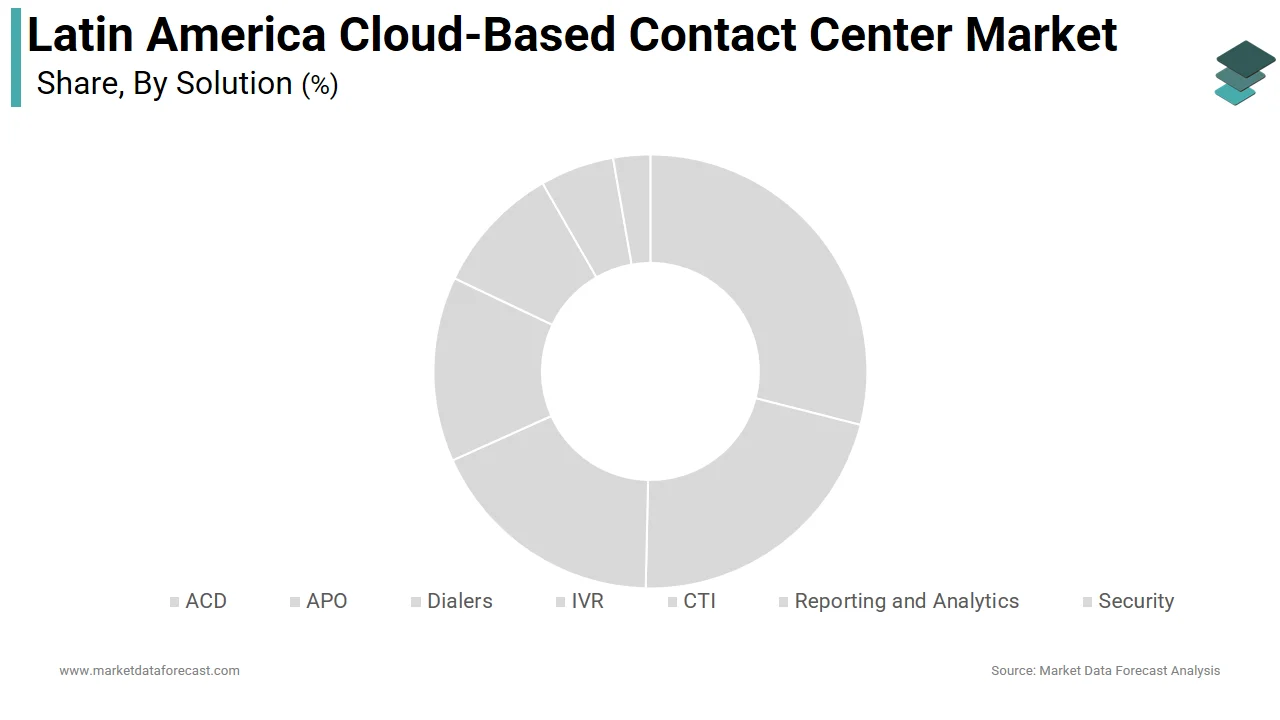
On the other hand, the reporting and analytics segment is anticipated to record a promising CAGR of 19.4% over the forecast period in the global market owing to the increasing need for data-driven decision-making and performance optimization in customer service operations. The rapid growth is fueled by the vast amounts of customer interaction data generated by cloud-based contact centers, which businesses are eager to leverage for insights into consumer behavior, agent performance, and service quality. According to technology performance assessments, organizations that utilize advanced analytics in their contact centers report a 25% improvement in customer satisfaction scores and a 15% increase in agent productivity. Cloud platforms facilitate the real-time collection and processing of this data, enabling managers to identify trends and address issues proactively. As per organizational studies, predictive analytics can forecast call volumes and customer churn risks, allowing companies to allocate resources more effectively and personalize interactions. The integration of artificial intelligence and machine learning algorithms enhances the depth of analysis by uncovering hidden patterns in unstructured data, such as voice recordings and chat transcripts. Businesses in competitive sectors like retail and finance are increasingly investing in these tools to gain a strategic advantage. The scalability of cloud-based analytics solutions makes them accessible to small and medium enterprises, further accelerating adoption. This demand for actionable intelligence positions reporting and analytics as the fastest-growing segment in the market.
By Service Insights
The professional services segment captured 58.9% of the Latin American market share in 2025. The dominance of this segment in the Latin American market is primarily driven by the lack of in-house technical expertise among many Latin American enterprises, particularly small and medium-sized businesses that are transitioning from legacy on-premises systems. According to the Latin American Software Industry Association, over 75% of companies require external assistance for system integration, configuration, and staff training to ensure successful deployment of cloud contact center solutions. Professional services include consulting, design, and implementation, which are critical for aligning technology with specific business processes and regulatory requirements. As per enterprise service evaluations, organizations that engage professional services for cloud migrations experience 40% fewer implementation delays and achieve faster time to value. The diversity of regulatory environments across countries like Brazil, Mexico, and Argentina necessitates localized legal and compliance advice, which professional service providers are well-equipped to offer. Furthermore, the customization of workflows and integration with existing enterprise resource planning (ERP) or customer relationship management (CRM) systems requires specialized knowledge that internal IT teams often lack. This reliance on expert guidance for initial setup and ongoing optimization sustains the leading position of professional services in the regional market.
On the other hand, the managed services segment is emerging as the fastest-growing segment and is predicted to expand at a CAGR of 17.4% over the forecast period in the Latin American market owing to the desire of businesses to outsource ongoing maintenance, monitoring, and support to reduce operational burdens and ensure high availability. The rapid growth is attributed to the increasing complexity of cloud environments and the need for continuous security updates and performance tuning, which can be challenging for internal teams to manage effectively. According to a survey by information systems audit organizations, 60% of Latin American IT leaders cite security and compliance management as top concerns, prompting them to seek specialized managed service providers. These providers offer 24/7 monitoring, incident response, and proactive maintenance, ensuring that contact center operations remain uninterrupted and secure. As per reports from local technology firms, managed services allow companies to convert variable IT costs into predictable fixed expenses, improving financial planning and resource allocation. The shortage of specialized cybersecurity professionals in the region further accelerates the adoption of managed services as businesses struggle to recruit and retain talent capable of handling advanced threat detection and mitigation. Additionally, managed service providers often bring best practices and industry benchmarks that help organizations optimize their contact center performance. This shift towards operational outsourcing for efficiency and security positions managed services as the most dynamic growth vector in the service segment.
COUNTRY-LEVEL ANALYSIS
Brazil Cloud-Based Contact Center Market Analysis
Brazil led the market in Latin America in 2025 with 34.5% of the regional market share and is expected to maintain robust economic expansion and lead regional digital adoption over the next few years. The market in Brazil is characterized by a high level of competition in sectors such as banking, retail, and telecommunications, which drives the adoption of sophisticated customer engagement tools. According to the Brazilian Association of Information and Communication Technology Companies, the country has seen a 20% annual increase in cloud service adoption among enterprises seeking to improve operational efficiency. The widespread use of WhatsApp for business communications has prompted contact center providers to integrate messaging APIs into their cloud platforms, catering to local preferences. As per data from the National Telecommunications Agency (Anatel), broadband penetration continues to expand, facilitating reliable cloud connectivity for businesses across major urban centers. Regulatory frameworks such as the General Data Protection Law (LGPD) have heightened the focus on security and compliance, encouraging the use of reputable cloud providers with robust data protection measures. The presence of major global and local technology vendors ensures a competitive landscape with diverse solution offerings. This combination of market size, technological readiness, and regulatory maturity maintains Brazil’s position as the dominant force in the regional cloud-based contact center market.
Mexico Cloud-Based Contact Center Market Analysis
Mexico is poised for steady growth and accelerated nearshore business integration in the coming years. Mexico represents the second-largest market for cloud-based contact centers in Latin America, driven by its strong manufacturing sector, growing service industry, and proximity to the United States, which influences technology adoption trends. The market in Mexico is defined by increasing investment in customer experience initiatives as companies seek to differentiate themselves in a competitive domestic market. According to the Mexican Internet Association, internet usage has reached over 80 million users, creating a large digital audience that expects seamless omnichannel support. The rise of nearshore business process outsourcing has also boosted demand for cloud contact center solutions as international companies establish service hubs in Mexico to leverage cost advantages and cultural alignment. As per data from the Ministry of Economy, the BPO sector has grown steadily, requiring scalable and flexible communication platforms to manage multilingual support operations. Government initiatives to improve digital literacy and broadband access in rural areas are expanding the potential customer base for cloud services. Local enterprises are increasingly migrating from legacy systems to cloud platforms to reduce IT overhead and enhance agility. The integration of social media channels into contact center workflows is particularly strong in Mexico, reflecting high social media engagement rates. This dynamic economic environment and strategic positioning sustain Mexico’s significant role in the regional market.
Argentina Cloud-Based Contact Center Market Analysis
Argentina is likely to experience resilient technological adaptation and increased cloud investment supported by its skilled developer talent pool over the next few years. Argentina holds a notable position in the Latin America cloud-based contact center market, characterized by a highly educated workforce and a strong tradition in software development and IT services. The market in Argentina is influenced by economic volatility, which drives businesses to seek cost-effective and scalable cloud solutions that minimize upfront capital expenditure. According to the Argentine Chamber of Software and IT Services, the country has a robust talent pool of developers and IT professionals who support the implementation and customization of cloud contact center platforms. The devaluation of the local currency has made imported software licenses expensive, further incentivizing the adoption of cloud models with local payment options or regional pricing. As per data from the National Communications Entity (ENACOM), internet infrastructure in major cities like Buenos Aires and Cordoba supports reliable cloud connectivity for enterprise users. The financial and insurance sectors are key adopters of cloud contact centers due to strict regulatory requirements for recording and compliance, which cloud providers can meet through certified data centers. Startups and tech companies in Argentina are also early adopters of innovative contact center features such as AI and automation. This combination of technical expertise, economic necessity, and sector-specific demand maintains Argentina’s relevance in the regional market.
COMPETITIVE LANDSCAPE
The competition in the Latin American cloud-based contact center market is characterized by intense rivalry among global technology giants and specialized regional providers who strive to capture market share through innovation and localized service offerings. Major players leverage their extensive cloud infrastructure and brand recognition to attract large enterprise clients seeking comprehensive omnichannel solutions. Regional competitors differentiate themselves by offering personalized support, flexible pricing, and deep understanding of local business practices and regulatory nuances. The market is fragmented, with numerous small vendors targeting niche segments or specific industries such as healthcare and finance. Price sensitivity remains a key factor influencing purchasing decisions, particularly among small and medium enterprises, which constitute the majority of businesses in the region. Strategic alliances with telecommunications companies and system integrators are crucial for expanding distribution networks and enhancing service delivery. The rapid evolution of artificial intelligence and automation technologies drives continuous product development and feature enhancements. Companies must balance global scalability with local responsiveness to succeed. This dynamic environment fosters innovation but requires participants to remain agile and customer-centric to maintain relevance and profitability in the growing Latin American market.
KEY MARKET PLAYERS
The leading companies operating in the Latin America cloud-based contact center market include:
- 8x8 Inc.
- Five9
- Amazon Web Services Inc.
- Cisco Systems
- Genesys
- Oracle
- NewVoiceMedia
- Connect First
- Aspect Software
- 3CLogic
TOP PLAYERS IN THE MARKET
- Genesys is a dominant force in the Latin America cloud-based contact center market, offering comprehensive omnichannel customer experience and employee engagement solutions. The company leverages its robust Genesys Cloud platform to enable seamless interactions across voice, chat, email, and social media channels for enterprises in the region. Recent actions include expanding local data centers in Brazil and Mexico to ensure low latency and compliance with regional data sovereignty laws. Genesys has strengthened partnerships with major telecommunications providers to bundle cloud contact center services with connectivity packages. The company actively invests in artificial intelligence capabilities to enhance automation and personalization for Latin American businesses. These strategic initiatives have solidified its reputation as a leader in innovation and reliability while supporting digital transformation efforts across various industries, including banking, retail, and telecommunications throughout the continent.
- Amazon Web Services Inc plays a pivotal role in the Latin American cloud-based contact center market through its Amazon Connect service, which provides a scalable and cost-effective cloud contact center solution. The company leverages its extensive global infrastructure, including local regions in Sao Paulo and Buenos Aires, to deliver high availability and low-latency services. Recent developments include integrating advanced machine learning features such as real-time translation and sentiment analysis tailored for Spanish and Portuguese languages. AWS has collaborated with local system integrators to facilitate easier deployment and customization for small and medium enterprises. The pay-as-you-go pricing model appeals to businesses seeking flexibility and reduced upfront costs. By continuously enhancing security protocols and compliance certifications, AWS strengthens its position as a trusted provider for organizations prioritizing data protection and operational efficiency in their customer service operations.
- Cisco Systems Inc contributes significantly to the Latin America cloud-based contact center market with its Webex Contact Center platform that unifies communications and collaboration tools. The company focuses on delivering secure and intelligent customer experiences by integrating artificial intelligence and analytics into its cloud offerings. Recent actions involve launching localized support teams and training programs in key markets like Chile and Colombia to accelerate adoption among enterprise clients. Cisco has partnered with regional technology distributors to expand reach and provide tailored implementation services. The integration of Webex Contact Center with existing Cisco networking and security infrastructure offers a cohesive solution for large organizations. By emphasizing hybrid work capabilities and robust security features, Cisco reinforces its commitment to helping Latin American businesses adapt to evolving customer expectations and operational demands in a digital-first environment.
TOP STRATEGIES USED BY THE KEY MARKET PARTICIPANTS
Key players in the Latin America cloud-based contact center market primarily employ strategies focused on localization and regulatory compliance to address specific regional needs and legal requirements. Companies invest heavily in establishing local data centers to ensure data sovereignty and reduce latency, which is critical for real-time voice and video interactions. Strategic partnerships with local telecommunications providers and system integrators facilitate broader market penetration and customized implementation services for diverse industry verticals. Product differentiation through advanced artificial intelligence features such as natural language processing for Spanish and Portuguese enhances user experience and operational efficiency. Flexible pricing models, including pay-as-you-go options, cater to the budget constraints of small and medium enterprises, driving wider adoption. Continuous investment in cybersecurity and compliance certifications builds trust among risk-averse enterprises. Educational initiatives and training programs help bridge the skills gap, ensuring successful deployment and utilization of cloud technologies. These multifaceted approaches enable vendors to navigate complex market dynamics and sustain competitive advantage.
MARKET SEGMENTATION
This research report on the Latin American cloud-based contact center market has been segmented and sub-segmented based on the following categories.
By Solution
- ACD
- APO
- Dialers
- IVR
- CTI
- Reporting and Analytics
- Security
By Service
- Professional
- Managed
By Application
- Call Routing and Queuing
- Data Integration and Recording
- Chat Quality and Monitoring
- Real-Time Decision-Making
- Workforce Optimization (WFO)
By Deployment Mode
- Public Cloud
- Private Cloud
- Hybrid Cloud
By Organization Size
- Small and Medium-sized Enterprises
- Large Enterprises
By Vertical
- Banking, Financial Services, and Insurance
- Consumer goods and retail
- Government and public sector
- Healthcare and life sciences
- Manufacturing
- Media and entertainment
- Telecommunication and Information Technology Enabled Services
- Others
By Country
- Brazil
- Argentina
- Venezuela
- Chile
- Uruguay
- Peru
- Rest of Latin America