- Product Description Description
- Table of Contents TOC
- List of Table & Figure LOT
- Get Free Sample PDF Sample PDF
Market Size, 2025
$0.87 BnMarket Estimate, 2026
$0.91 BnMarket Forecast, 2034
$1.25 BnCAGR, 2026–2034
4.07%Latin America Commercial Seaweed Market Size, Share, Trends & Forecast (2026–2034)
- Market Scope: Regional analysis of the Latin American commercial seaweed industry, evaluating product applications, algae types, physical formats, and country-level developments across Brazil, Chile, Argentina, and others.
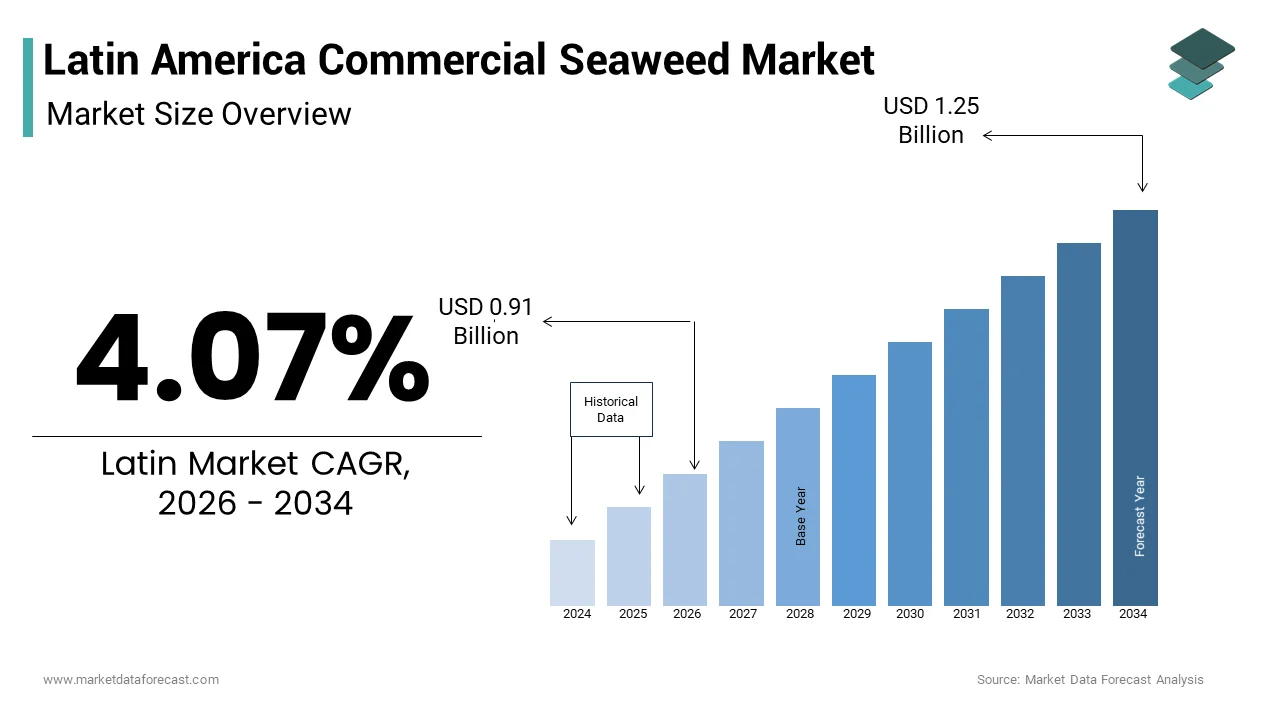
- Market Valuation: Valued at USD 0.87 billion in 2025, estimated at USD 0.91 billion in 2026, and projected to reach USD 1.25 billion by 2034, growing at a compound annual growth rate (CAGR) of 4.07% during the forecast period from 2026 to 2034.
- Primary Growth Drivers: Escalating investments by multinational entities, intensive R&D exploring novel applications, rising health-conscious consumer demand for nutrient-rich diets, and the region's high growth potential as an emerging global market.
Latin America Commercial Seaweed Market Segment Metrics (2026–2034)
| Category | Leading Segment (2025 Position) | Fastest-Growing Segment |
|---|---|---|
| By Application | Human Feed / Food & Beverages (capturing primary demand via nutritional and culinary integration) | Agriculture & Animal Feed (scaling rapidly through sustainable biofertilizers and livestock feed solutions) |
| By Type | Brown & Red Seaweed (driving commercial carrageenan and hydrocolloid extraction processes) | Green Seaweed (expanding via specialty health supplements and bio-active derivatives) |
| By Form & Country | Powdered & Liquid Formats, alongside Chile & Brazil as the cornerstone regional hubs | Flakes & Specialized Liquid Extracts, supported by emerging activity in Argentina |
Major Industry Players & Market Structure
Market Structure: Highly competitive landscape characterized by major global agribusiness and ingredient corporations alongside established regional processors driving innovation and supply chain integration.
Key Companies: Cargill, Incorporated (U.S.), Roullier Group (France), E. I. du Pont de Nemours and Company (U.S.), Gelymar SA (Chile), Biostadt India Limited (India), Acadian Seaplants Limited (Canada), Compo GmbH (Germany), CP Kelco (U.S.), and Seasol International Pty. Ltd. (Australia).
Latin America Commercial Seaweed Market Size
The Latin America commercial seaweed market size will reach USD 0.87 billion in 2025 and is anticipated to reach USD 0.91 billion in 2026 to reach USD 1.25 billion by 2034, growing at a CAGR of 4.07% from 2026 to 2034.
Seaweed is the collective name given to the plethora of species of macroscopic, multicellular marine algae present in the world’s oceans. The broad categorization is on the basis of colour and they are segmented as red, brown and green algae.
Commercial Seaweed has many applications in human food, pharmaceutical production, cosmetics, animal feed, agricultural production, alternative fuel sources, and management of waste, among others. The figures in recent years show that Indonesia is the world’s largest seaweed producer, with the Philippines coming in second. In more specific applications, alginates are commonly used in wound dressings and the production of dental molds in the medical field. Also, applications in microbiology research are found for agar — a plant-based goo similar to gelatin and made from seaweed — which is extensively used as a culture medium.
The growth of the Commercial Seaweed market is mainly driven by an increase in investments from several multinational manufacturers, and extensive R&D initiatives have been taken to explore the applications of seaweeds in several fields. Seaweeds are also used on a large scale for human consumption due to their high nutritive value, and applications of seaweed in Chinese, Japanese, and Korean cuisines are quite popular, providing additional impetus for market growth. As for the restraints of the market, the high costs, as well as the fact that the market remains a specialty sector, are the main problems faced by the industry.
Based on geography, the Latin America market is divided into Argentina, Brazil and Mexico. The Latin American region is one that offers immense scope for development in the forecast years as is evident from the high growth rate of the region. In spite of having only a minor market share, the CAGR of the region is the second highest globally, only behind Asia-Pacific. This market is one that shows promise in the coming years.
REPORT COVERAGE
| REPORT METRIC | DETAILS |
| Market Size Available | 2025 to 2034 |
| Base Year | 2025 |
| Forecast Period | 2026 to 2034 |
| CAGR | 7.36% |
| Segments Covered | By Application, Type, Form, And Country |
| Various Analyses Covered | Global, Regional, and country-level analysis; Segment-Level Analysis, DROC, PESTLE Analysis, Porter’s Five Forces Analysis, Competitive Landscape, Analyst Overview of Investment Opportunities |
| Country's Covered | The United States, Canada, and the Rest of North America |
| Market Leaders Profiled | Cargill, Incorporated. (U.S.), Roullier Group (France), E. I. du Pont de Nemours and Company (U.S.), Gelymar SA (Chile), Biostadt India Limited (India), Acadian Seaplants Limited (Canada), Compo GmbH (Germany), CP Kelco (U.S.), and Seasol International Pty. Ltd. (Australia). |
KEY MARKET PLAYERS
The Commercial Seaweed market is highly competitive with a large number of players. Key market players dominating the market with their products are
- Cargill, Incorporated. (U.S.)
- Roullier Group (France)
- E. I. du Pont de Nemours and Company (U.S.)
- Gelymar SA (Chile)
- Biostadt India Limited (India)
- Acadian Seaplants Limited (Canada)
- Compo GmbH (Germany)
- CP Kelco (U.S.)
- Seasol International Pty. Ltd. (Australia).
MARKET SEGMENTATION
This research report on the Latin America Commercial Seaweed Market is Segmented and sub-segmented into the following categories.
By Applications
- Agriculture
- Animal Feed
- Human Feed
- Other
By Type
- Brown
- Red
- Green Seaweed
By Form
- Liquid
- Powdered
- Flakes
By Country
- Brazil
- Chile
- Argentina
- Others