- Product Description Description
- Table of Contents TOC
- List of Table & Figure LOT
- Get Free Sample PDF Sample PDF
Market Size, 2025
$0.79 BnMarket Estimate, 2026
$0.83 BnMarket Forecast, 2034
$1.28 BnCAGR, 2026–2034
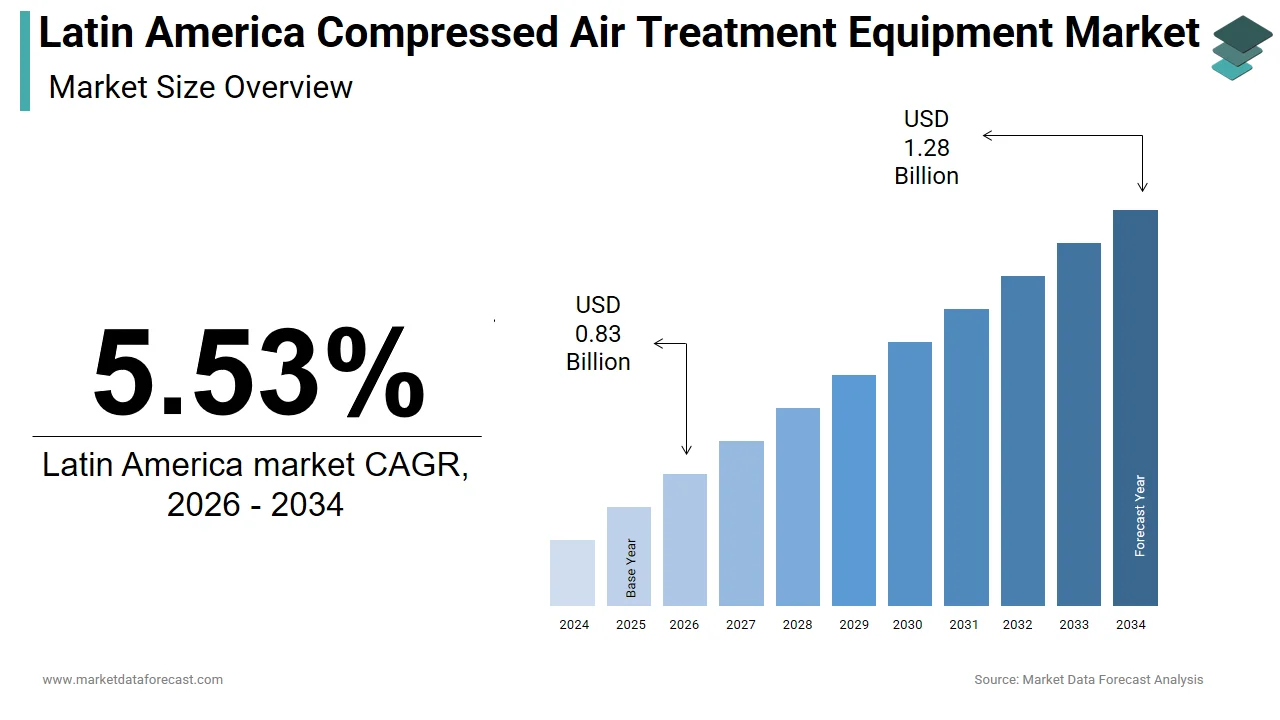
5.53%Latin America Compressed Air Treatment Equipment Market Size
The size of the Latin America compressed air treatment equipment market was valued at USD 0.79 billion in 2025. This market is expected to grow at a CAGR of 5.53% from 2026 to 2034 and be worth USD 1.28 billion by 2034 from USD 0.83 billion in 2026.
Air treatment equipment is a range of technologies designed to purify, dry, and filter compressed air used in industrial applications. These include air dryers, filters, condensate management systems, and aftercoolers that ensure optimal performance, prevent contamination, and protect downstream equipment across manufacturing, food processing, pharmaceuticals, automotive, and energy sectors.
As industries in Latin America modernize production lines and adopt automation, the demand for high-quality compressed air has surged, driving the need for advanced treatment solutions. In addition, as per national industrial associations in Brazil and Mexico, increasing awareness regarding energy savings, product quality, and equipment longevity has led to greater investments in compressed air treatment infrastructure. Government initiatives promoting industrial energy efficiency and environmental compliance are further contributing to market expansion.
MARKET DRIVERS
Expansion of Industrial Manufacturing and Process Industries
The steady expansion of industrial manufacturing and process-based industries, particularly in Brazil, Mexico, and Argentina is one of the primary drivers of the Latin America compressed air treatment equipment market. The growth of sectors such as automotive, food and beverage, pharmaceuticals, and chemicals has significantly increased reliance on clean and dry compressed air to maintain operational efficiency and product integrity. Moreover, in Mexico, the automotive sector’s continued expansion has driven demand for precision air treatment systems. With ongoing industrialization and rising emphasis on quality assurance, the compressed air treatment equipment market is expected to remain robust across Latin America.
Rising Emphasis on Energy Efficiency and Regulatory Compliance
The growing emphasis on energy efficiency and regulatory compliance, particularly in response to stricter environmental and industrial safety standards is another significant driver of the Latin America compressed air treatment equipment market. Governments across the region have introduced policies encouraging industries to reduce energy waste and carbon emissions, prompting businesses to invest in optimized compressed air systems.
According to the International Energy Agency (IEA), industrial energy efficiency programs in Latin America have gained momentum since 2021, with Brazil, Mexico, and Colombia launching targeted initiatives to promote best practices in compressed air system management. In Brazil, the Ministry of Mines and Energy launched the "Efficient Industry Program" in 2022, offering tax incentives for companies adopting energy-saving technologies, including variable speed drives and high-efficiency dryers. In addition, several multinational corporations operating in Mexico have committed to zero-waste and low-emission facility management strategies, integrating advanced compressed air filtration and condensate recovery systems into their operations.
MARKET RESTRAINTS
High Initial Investment and Cost Sensitivity Among SMEs
The high initial investment required for advanced air dryers, filters, and condensate management systems is a key restraint facing the Latin America compressed air treatment equipment market. Many small and medium-sized enterprises (SMEs) struggle to justify the upfront costs associated with upgrading compressed air infrastructure, especially in cost-sensitive environments. In addition, budget constraints remain a critical challenge for industrial operators seeking to implement comprehensive compressed air treatment solutions. Many companies continue to rely on outdated or minimal filtration systems due to limited financial resources, particularly in smaller cities and rural areas across Ecuador, Peru, and Bolivia. Also, financing options for industrial equipment remain underdeveloped in several Latin American countries, further hindering adoption.
Limited Technical Expertise and After-Sales Support
The lack of widespread technical expertise and after-sales service networks is also a significant constraint on the Latin America compressed air treatment equipment market. Unlike in developed markets, where manufacturers offer comprehensive support, service availability remains uneven across Latin American countries, affecting equipment reliability and customer satisfaction. In countries like Guatemala and Honduras, the absence of authorized service centers forces operators to send equipment back to the country of origin for repairs, delaying operations and increasing costs. Until manufacturers expand their service footprints and invest in workforce training programs, inadequate technical support will continue to hinder the widespread adoption of professional compressed air treatment equipment in Latin America.
MARKET OPPORTUNITIES
Growth of Green and Sustainable Air Treatment Technologies
The growing adoption of green and sustainable air treatment technologies is one of the most promising opportunities for the Latin America compressed air treatment equipment market. As environmental concerns intensify and regulatory frameworks evolve, both public and private sector buyers are prioritizing energy-efficient and low-emission compressed air systems. According to the United Nations Environment Programme (UNEP), Latin American countries have been actively aligning with global sustainability goals, prompting industries to reduce energy consumption and carbon emissions. Moreover, several multinational corporations operating in Mexico have committed to zero-emission facility management strategies, integrating variable-speed compressors and condensate recovery systems into their operations. Hence, the transition toward sustainable compressed air treatment equipment presents a substantial growth avenue for manufacturers aiming to capture both domestic and international markets in Latin America.
Digital Integration and Smart Compressed Air Systems
The increasing integration of digital technologies and smart automation into compressed air systems is a further opportunity for the Latin America compressed air treatment equipment market. The emergence of IoT-enabled monitoring, predictive maintenance, and remote diagnostics is transforming how industrial facilities manage air quality, energy efficiency, and system performance. The intelligent solutions use real-time data analytics to detect leaks, monitor pressure levels, and adjust filtration settings automatically. Moreover, cloud-connected air dryers and filtration units that allow remote monitoring and diagnostics have gained traction among facility managers in major metropolitan areas. So, Latin America is poised to witness a surge in demand for intelligent compressed air treatment solutions that enhance performance while reducing operational costs and improving energy efficiency.
MARKET CHALLENGES
Technological Gaps and Low Awareness Among End Users
The technological gap between regional users and global best practices, compounded by limited awareness regarding the benefits of modern air treatment systems, is a significant challenge confronting the Latin America compressed air treatment equipment market. Many industrial operators continue to rely on outdated or minimal filtration and drying solutions due to a lack of knowledge about available technologies and their long-term advantages. Moreover, awareness campaigns and educational programs targeting engineers, plant managers, and maintenance teams remain underdeveloped in several countries. In nations like Paraguay and Nicaragua, only a small percentage of manufacturing facilities have been exposed to advanced compressed air treatment solutions beyond basic filters. Additionally, misconceptions about equipment complexity and maintenance requirements deter potential buyers from investing in high-performance air dryers and filtration systems. Even when budget permits, hesitation persists due to perceived difficulties in operation and servicing.
Intense Competition from Informal and Low-Cost Equipment Suppliers
Strong competition from informal and low-cost equipment suppliers offering unbranded or counterfeit products at significantly lower prices than established brands is also affecting the Latin America compressed air treatment equipment market. These alternative offerings appeal to price-sensitive buyers, particularly in SMEs and local government tenders, undermining sales of premium and technologically superior machines. In addition, these products often bypass quality certifications and safety regulations, posing risks in terms of performance, durability, and user safety. Furthermore, many low-cost suppliers leverage informal distribution networks and online marketplaces to reach customers without providing adequate after-sales support, leading to higher long-term maintenance costs and customer dissatisfaction. This competitive pressure from unregulated players complicates market growth for legitimate manufacturers striving to promote durable, compliant, and high-performance compressed air treatment equipment across Latin America.
REPORT COVERAGE
| REPORT METRIC | DETAILS |
| Market Size Available | 2025 to 2034 |
| Base Year | 2025 |
| Forecast Period | 2026 to 2034 |
| Segments Covered | By Product, Application, End-user, and Region. |
| Various Analyses Covered | Global, Regional and Country-Level Analysis, Segment-Level Analysis, Drivers, Restraints, Opportunities, Challenges; PESTLE Analysis; Porter’s Five Forces Analysis, Competitive Landscape, Analyst Overview of Investment Opportunities |
| Countries Covered | Brazil, Mexico, Argentina, Chile, Rest of Latin America |
| Market Leaders Profiled | Airfilter Engineering, Alpha-Pure Corporation, Atlas Copco AB, BOGE KOMPRESSOREN Otto Boge GmbH & Co. KG, Donaldson Company Inc., Ingersoll Rand Inc., Kaeser Compressors Inc., Mann+Hummel, Mattei Compressors Inc., Parker-Hannifin Corporation, Pentair plc, and Pneumatech. |
SEGMENTAL ANALYSIS
By Product Insights
The filters segment represented the largest category in the Latin America compressed air treatment equipment market by accounting for 37.2% of the total value in 2024. This dominance of the segment is primarily attributed to the widespread use of particulate and coalescing filters across industrial applications to remove contaminants such as dust, oil, and moisture from compressed air systems. The growing emphasis on maintaining product quality and equipment longevity in manufacturing sectors such as food and beverage, pharmaceuticals, and automotive is also contributing to the growth of the filters segment.
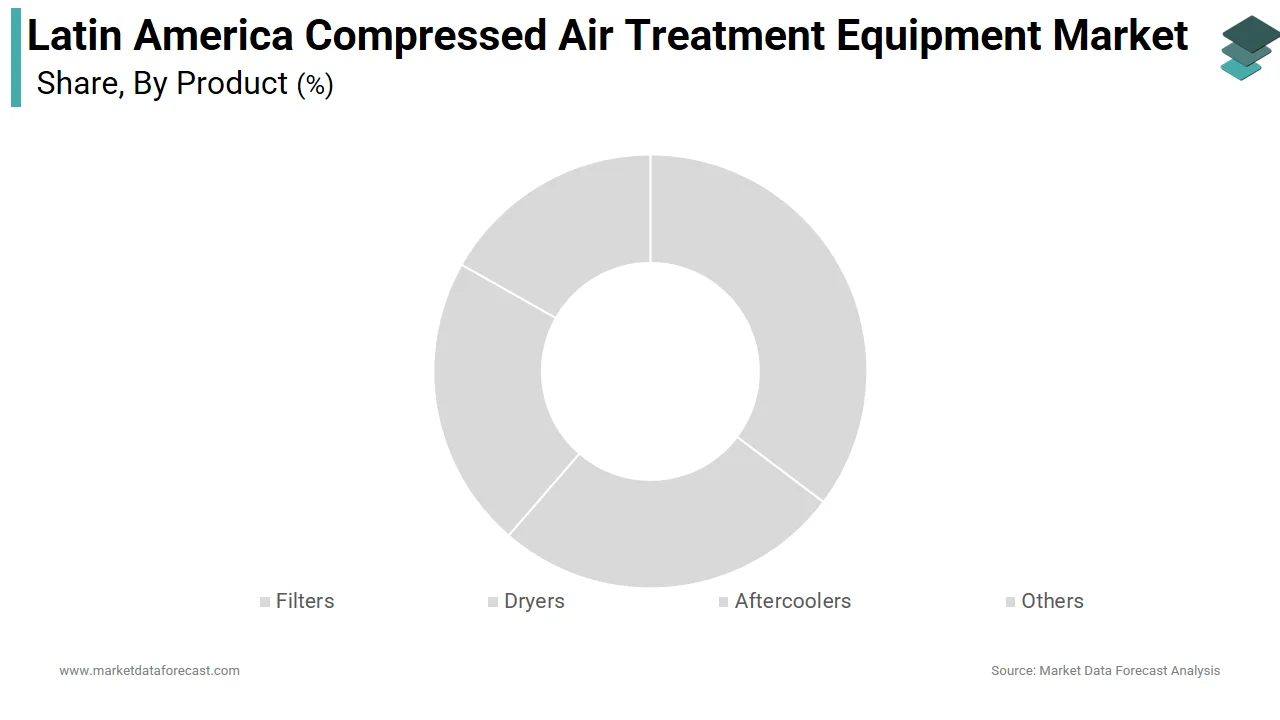
The dryers segment is emerging as the fastest-growing within the Latin America compressed air treatment equipment market and is projected to expand at a CAGR of 7.4%. This rapid growth of segment is largely driven by the increasing adoption of refrigerated and desiccant dryers in industries where moisture-sensitive processes require consistently dry air. In Brazil, the food and beverage sector has been a major contributor to this trend, with companies investing in low-dewpoint dryers to prevent microbial contamination and maintain hygiene standards. Ongoing industrial modernization and tightening quality control norms positioned dryers for sustained high-growth performance in the Latin American compressed air treatment equipment market.
By Application Insights
The plant air segment was the dominant application in the Latin America compressed air treatment equipment market by capturing an estimated 42.1% of the total share in 2024. This dominance of the segment is attributed to the extensive use of compressed air in general manufacturing, utilities, and maintenance operations across industrial plants. The expansion of manufacturing infrastructure, particularly in Brazil and Mexico, where plant air systems support a wide range of production activities, including material handling, automation, and pneumatic controls, is another factor propelling the growth of the plant air segment. Also, plant air systems in automotive and electronics factories require continuous purification to prevent equipment wear and production downtime. So, plant air remains the cornerstone of Latin America’s compressed air treatment equipment utilization.
The breathing air segment is the fastest-growing application in the Latin America compressed air treatment equipment market, expanding at a CAGR of 8.1% in the coming years. This growth of the segment is primarily fueled by increasing safety regulations mandating clean and contaminant-free breathing air in hazardous work environments such as mining, firefighting, chemical handling, and healthcare settings. The growing emphasis on worker safety and stricter enforcement of occupational health standards made the breathing air segment poised for sustained expansion across Latin America.
By End User Insights
The food and beverage industry held the largest share in the Latin America compressed air treatment equipment market, i.e., 28.4% of total consumption in 2024. This progress of the segment is primarily attributed to the critical need for contaminant-free compressed air in food processing, packaging, and bottling operations. The growing implementation of Hazard Analysis and Critical Control Points (HACCP) and ISO 22000 food safety standards, which mandate strict air quality controls, is another factor propelling the development of the food and beverage industry. Moreover, dairy and beverage producers in Mexico invested heavily in oil-free and sterile air treatment systems to maintain product integrity and extend shelf life.
The pharmaceuticals segment is the fastest-growing end-user category in the Latin America compressed air treatment equipment market and is projected to expand at a CAGR of 8.6% between 2025 and 2033. This rapid growth of the segment is primarily driven by the region’s expanding pharmaceutical manufacturing base, especially in Brazil, Argentina, and Colombia, where drug production requires ultra-clean and sterile compressed air to prevent contamination. The pharmaceutical industry is expected to remain a key growth engine for compressed air treatment equipment in Latin America due to the increasing regional focus on vaccine production, biologics, and generic medicines.
COUNTRY-LEVEL ANALYSIS
Brazil Compressed Air Treatment Equipment Market Insights
Brazil commanded the Latin America compressed air treatment equipment market by accounting for 35.3% of regional consumption in 2024. Positioned as both a major manufacturer and consumer, Brazil hosts a well-established industrial base that supports domestic production and imports of compressed air treatment solutions. The country’s demand is primarily driven by the automotive, chemical, and food processing sectors, where large-scale manufacturing facilities rely on high-quality compressed air to maintain process integrity and product consistency.
Mexico Compressed Air Treatment Equipment Market Insights
Mexico stands as a significant consumer of compressed air treatment equipment in Latin America. Positioned as a key manufacturing hub, Mexico leverages its proximity to the U.S. and participation in trade agreements such as USMCA to support both domestic and export-oriented industrial operations. The country’s demand is primarily driven by the automotive and electronics sectors, where compressed air plays a crucial role in precision manufacturing. In addition, Mexico has emerged as a regional exporter of compressed air treatment systems, particularly to Central America and the Caribbean.
Argentina Compressed Air Treatment Equipment Market Insights
Argentina is placing itself as a growing player in regional consumption. The primary driver of compressed air treatment equipment demand in Argentina is the pharmaceutical sector, which has seen increased government spending on drug manufacturing and export certifications. Also, Argentina’s food and beverage industry has shown rising interest in high-purity air systems, particularly in dairy and wine production. Though still modest compared to Brazil and Mexico, Argentina’s compressed air treatment equipment demand is steadily increasing, supported by evolving regulatory frameworks and expanding pharmaceutical exports.
Chile Compressed Air Treatment Equipment Market Insights
Chile represents a smaller yet stable segment of the Latin America compressed air treatment equipment market. Unlike larger markets, Chile does not utilize compressed air extensively in mass production but focuses on specialized applications such as mining, healthcare, and high-end manufacturing. Moreover, Chile has shown growing interest in green industrial practices, particularly in pharmaceutical and laboratory settings adopting zero-emission compressed air systems. Despite its relatively minor market size, Chile maintains consistent equipment consumption patterns, supported by premium industrial applications and niche scientific uses.
Rest of Latin America
The Rest of Latin America (ROLA), encompassing countries such as Colombia, Peru, Ecuador, and Central American nations, collectively accounts for a notable share of the regional compressed air treatment equipment market. This diverse group exhibits varied levels of production and consumption, with Colombia emerging as a key player in the region. Also, Colombia has been actively expanding its pharmaceutical and food processing industries, particularly in Bogotá and Medellín. Peru and Ecuador have also shown rising interest in industrial air purification, particularly in breweries and chemical plants where air quality directly impacts product consistency. Central American nations, particularly Costa Rica and Guatemala, are leveraging their strategic locations to develop small-scale distribution networks.
COMPETITIVE LANDSCAPE
The Latin America compressed air treatment equipment market is characterized by a competitive landscape shaped by the coexistence of multinational corporations, regional distributors, and domestic suppliers. While global brands like Atlas Copco, Ingersoll Rand, and Donaldson dominate large-scale industrial applications with their technologically advanced products, local players offer cost-effective alternatives tailored to specific market segments.
Competition is intensifying as demand grows across industries such as food and beverage, pharmaceuticals, automotive, and mining. Established international firms often lead in innovation and sustainability, whereas smaller regional players leverage proximity and adaptability to cater to niche applications and price-sensitive customers.
Market participants face increasing pressure to innovate, improve sustainability, and comply with evolving regulations. Consumer awareness around energy efficiency and product quality is driving demand for high-performance air treatment systems, prompting companies to invest in research and development.
Additionally, trade dynamics, economic fluctuations, and government policies play a significant role in shaping competitive positioning. As Latin American countries continue to develop their industrial infrastructure, competition is expected to evolve, requiring companies to balance affordability, quality, and technological advancement to maintain relevance and drive long-term growth.
KEY MARKET PLAYERS
Noteworthy Companies dominating the Latin America compressed air treatment equipment market profiled in the report are
- Airfilter Engineering
- Alpha-Pure Corporation
- Atlas Copco AB
- BOGE KOMPRESSOREN Otto Boge GmbH & Co. KG
- Donaldson Company Inc.
- Ingersoll Rand Inc.
- Kaeser Compressors Inc.
- Mann+Hummel
- Mattei Compressors Inc.
- Parker-Hannifin Corporation
- Pentair plc
- Pneumatech
TOP LEADING PLAYERS IN THE MARKET
Atlas Copco is a globally recognized leader in compressed air solutions, with a strong presence in the Latin America market through its extensive distribution and service network. The company offers a comprehensive range of compressed air treatment equipment including dryers, filters, and condensate management systems tailored for industrial applications.
In Latin America, Atlas Copco plays a pivotal role in supporting industries such as automotive, pharmaceuticals, and food processing by providing high-efficiency and energy-saving air treatment technologies. Its commitment to innovation and sustainability aligns with regional efforts to enhance industrial productivity while reducing environmental impact.
Through localized support and continuous investment in customer education, Atlas Copco has become a trusted partner for manufacturers seeking reliable and advanced compressed air treatment solutions across Latin America.
Ingersoll Rand is a major participant in the Latin America compressed air treatment equipment market, known for its robust portfolio of filtration and drying systems designed for demanding industrial environments. The company serves a wide range of sectors including chemical processing, manufacturing, and healthcare.
In Latin America, Ingersoll Rand contributes significantly by offering customized compressed air purification systems that meet international quality standards. It supports local industries in complying with regulatory requirements related to air purity, particularly in food and pharmaceutical production where contamination risks are critical.
The company's strategic partnerships with regional distributors and focus on after-sales service have strengthened its market position. Ingersoll Rand continues to expand its footprint by introducing smart and energy-efficient air treatment technologies that cater to evolving industrial needs in the region.
Donaldson Company Inc. is a leading provider of filtration solutions, playing an essential role in the Latin America compressed air treatment equipment market. Known for its high-performance particulate and coalescing filters, Donaldson ensures clean, contaminant-free air for industries requiring precision and safety.
In Latin America, Donaldson supports key sectors such as mining, food processing, and pharmaceuticals by delivering durable and efficient filtration products that enhance system performance and prolong equipment life. Its presence in the region is reinforced by technical expertise and a growing network of local representatives.
By focusing on product reliability and environmental responsibility, Donaldson helps Latin American companies maintain compliance with global air quality standards. Its emphasis on research and development further positions it as a trusted name in industrial air purification across the region.
TOP STRATEGIES USED BY KEY MARKET PARTICIPANTS
One of the primary strategies adopted by key players in the Latin America compressed air treatment equipment market is localized service expansion and technical support enhancement. Companies are investing in regional service centers and training programs to ensure timely maintenance, troubleshooting, and repair services, addressing a major challenge in equipment adoption across smaller cities and industrial hubs.
Another crucial approach is product customization and modular system offerings, where manufacturers develop cost-effective, scalable air treatment solutions suited to the diverse operational needs of small and medium-sized enterprises. This includes compact dryers and multi-stage filtration units that provide essential functionality without excessive costs.
Lastly, firms are focusing on digital integration and predictive maintenance capabilities, incorporating IoT-enabled monitoring and remote diagnostics into their equipment. These smart features allow industrial users to optimize performance, reduce downtime, and improve energy efficiency, aligning with broader trends toward Industry 4.0 and sustainable manufacturing practices across Latin America.
RECENT MARKET DEVELOPMENTS
- In March 2023, Atlas Copco expanded its service center network in Brazil, opening new technical support hubs in São Paulo and Rio de Janeiro to enhance after-sales assistance and reduce equipment downtime for industrial clients.
- In August 2023, Ingersoll Rand launched a regional training initiative in Mexico, collaborating with technical institutions to certify engineers in operating and maintaining advanced compressed air treatment systems, aiming to improve service reliability and workforce skills.
- In January 2024, Donaldson Company Inc. introduced a new line of high-efficiency particulate air filters specifically designed for mid-sized food processing plants in Colombia, targeting breweries, dairy producers, and packaging facilities seeking affordable yet reliable contamination control.
- In May 2024, Atlas Copco partnered with a Chilean mining firm to deploy smart-connected compressed air treatment systems in copper extraction operations, enabling real-time performance tracking and optimizing maintenance schedules.
- In October 2024, Ingersoll Rand initiated a pilot program in Argentina to promote energy-saving refrigerated dryers among pharmaceutical manufacturers, supporting broader efforts toward sustainable drug production and regulatory compliance.
MARKET SEGMENTATION
This Latin America compressed air treatment equipment market research report is segmented and sub-segmented into the following categories.
By Product
- Filters
- Particulate filter/pre-filter
- Coalescing filter/oil removal
- Activated Carbon Filter
- Filtered Centrifugal Separator
- Others
- Dryers
- Refrigerated dryers
- Desiccant air dryers
- Membrane dryers
- Others
- Aftercoolers
- Others
By Application
- Plant Air
- Instrument Air
- Process Air
- Breathing Air
- Others
B End User
- Chemical
- Paper
- Food and Beverage
- Pharmaceuticals
- Healthcare
- Others
By Country
- Brazil
- Mexico
- Argentina
- Chile
- Rest of Latin America