- Product Description Description
- Table of Contents TOC
- List of Table & Figure LOT
- Get Free Sample PDF Sample PDF
Market Size, 2025
$42.42 MnMarket Estimate, 2026
$45.82 MnMarket Forecast, 2034
$84.8 MnCAGR, 2026–2034
8%Latin America Cone Beam Imaging Market Size, Growth, Trends & Forecast (2026–2034)
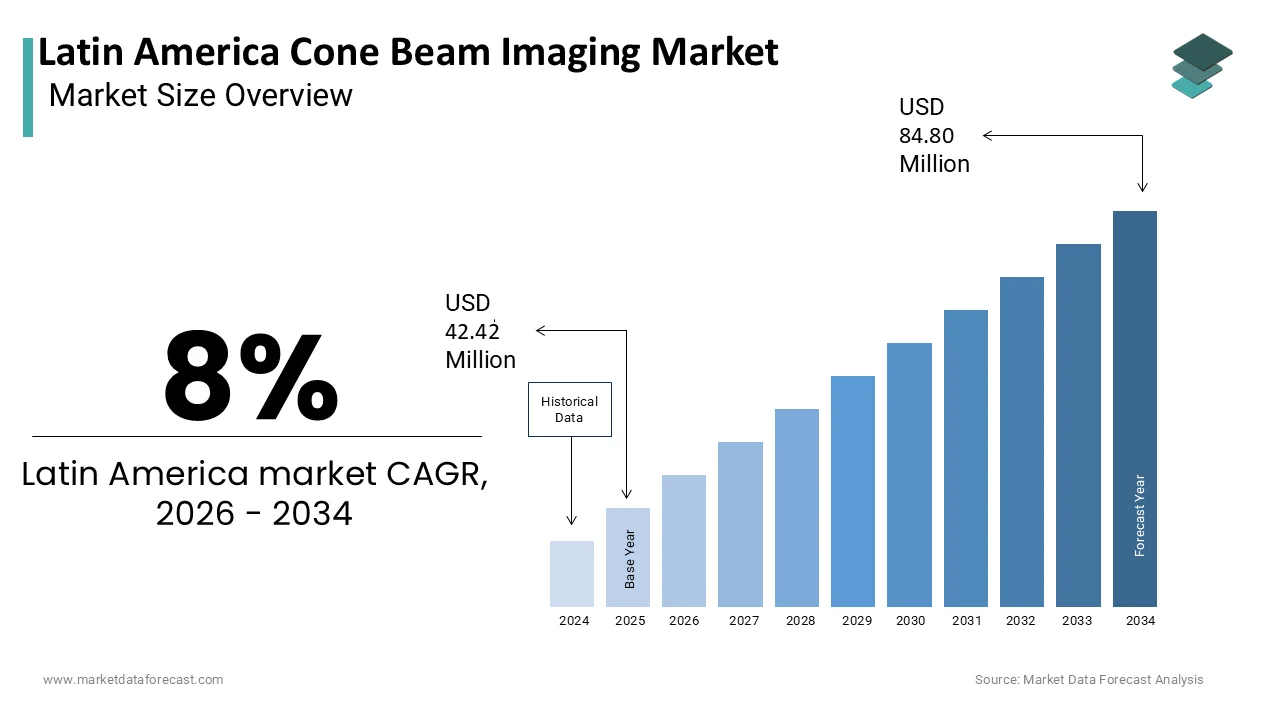
The Latin America cone beam imaging market size was valued at USD 42.42 million in 2025, is anticipated to reach USD 45.82 million in 2026, and is projected to scale to USD 84.80 million by 2034, expanding at a compound annual growth rate (CAGR) of 8% during the forecast period from 2026 to 2034. Market expansion is primarily propelled by the rising prevalence of complex dental and craniofacial pathologies, expanding postgraduate dental specialization programs, and the robust growth of regional medical tourism hubs.
Key Executive Metrics (At-a-Glance)
- 2025 Base Valuation: USD 42.42 Million
- 2026 Current Valuation: USD 45.82 Million
- 2034 Forecast Valuation: USD 84.80 Million
- Compound Annual Growth Rate (CAGR): 8.0% (2026–2034)
- Leading Regional Country: Brazil (capturing 41.9% market share in 2025, driven by scale, robust private dental networks, and domestic manufacturing)
- Key Geographic Countries: Mexico, Brazil, Argentina, Chile, and Rest of Latin America
Core Market Drivers & Opportunities
- Complex Dental Pathologies: High regional burdens of untreated oral disorders and severe periodontitis driving three-dimensional volumetric diagnostics.
- Specialist Education Pipeline: Rapid proliferation of postgraduate residency tracks and advanced implantology modules establishing CBCT as the clinical standard of care.
- AI & Medical Tourism Integration: Emerging AI diagnostic assistance tools and countercyclical medical tourism demand driving investments in premium imaging systems.
Primary Market Restraints & Challenges
- Macroeconomic Volatility: Currency fluctuations and import tariffs inflating capital acquisition costs for advanced imaging hardware.
- Technical Support Gaps: Scarcity of certified biomedical engineers and authorized service infrastructure outside major metropolitan centers.
- Regulatory Fragmentation: Disparate health authority approval processes across countries multiplying compliance timelines and regional commercialization hurdles.
Market Segmentation: Largest and Fastest-Growing Sectors
| Segment Category | Largest Segment | Fastest-Growing Segment |
|---|---|---|
| By Patient Position | Standing or Sitting Systems (High-volume outpatient workflows and space efficiency) | Supine Systems (CAGR of 11.4%, driven by complex oral surgery and implantology) |
| By Application | Implantology (Mandated by extensive edentulism and dental tourism) | Temporomandibular Joint (TMJ) Disorder Imaging (CAGR of 13.8%) |
| By End User | Private Practices (Solo and small group entrepreneurial dental clinics) | Academic and Research Institutes (CAGR of 12.7%) |
| By Country | Brazil (41.9% share in 2025) | Mexico & Chile (Driven by tourism hubs and advanced regulatory tech adoption) |
Major Industry Players Profiled
Key market participants shaping the Latin America cone beam imaging landscape include PreXion Corporation, CurveBeam LLC, Cefla S.C., Danaher Corporation, Carestream Health, Inc., Dentsply Sirona, Morita MFG. Corp., Asahi Roentgen IND. CO., LTD., Planmeca Group, and Vatech Co., Ltd.
Latin America Cone Beam Imaging Market Size
The Latin America Cone Beam Imaging Market is projected to grow from USD 42.42 million in 2025 to USD 45.82 million in 2026 and reach USD 84.80 million by 2034, registering a CAGR of 8% during the forecast period from 2026 to 2034.
Cone Beam Imaging, or Cone Beam Computed Tomography (CBCT), is a special type of X-ray machine that makes 3D pictures of your teeth, jaw bones, nerve paths, and soft tissues in one quick scan. This technological domain is distinct from conventional medical computed tomography, as it utilizes a cone-shaped X-ray beam to capture volumetric data with significantly lower radiation exposure, making it uniquely suited for outpatient dental and craniofacial applications. According to the World Health Organization, oral diseases affect nearly 3.5 billion people globally, with untreated dental caries in permanent teeth representing the single most common condition worldwide. According to the Pan American Health Organization, noncommunicable diseases are the leading cause of death in the Americas, accounting for 81% of all deaths in the region. As per data from the International Agency for Research on Cancer, approximately 1.5 million new cases of cancer were estimated in Latin America and the Caribbean in 2024, with prostate and breast cancers exhibiting the highest incidence rates across the region. This market definition extends beyond equipment sales to include the integration of digital workflows,s treatment planning software, re and specialized training programs essential for bridging the gap between technological availability and clinical competency throughout diverse healthcare ecosystems in the region.
MARKET DRIVERS
Rising Prevalence of Complex Dental Pathologies Requiring Volumetric Diagnostics
The escalating burden of untreated oral pathologies across the region is a fundamental clinical driver of the Latin America cone beam imaging market. This compels the adoption of cone beam imaging technologies for accurate diagnosis and treatment planning. According to the Global Burden of Disease Study, severe periodontitis poses a critical public health challenge across Latin America, where its expanding regional burden drives the clinical requirement for localized preventive and therapeutic interventions. As per the Pan American Health Organization, noncommunicable diseases and localized oncological variations across the Americas require the regional deployment of comprehensive clinical strategies and integrated diagnostic capabilities to lower burden levels. Furthermore, as per structural analytics from the World Bank, high out-of-pocket health expenditures across emerging economies influence consumer behavior, prompting healthcare facilities to adopt advanced technologies to manage localized financial risks. The convergence of epidemiological need and patient-funded demand creates sustainable adoption momentum independent of public sector budget cycles.
Expansion of Private Dental Education and Specialist Training Programs
The rapid growth of postgraduate dental specialization programs across the region is expanding the Latin America cone beam imaging market. This growth produces clinicians who train exclusively with three-dimensional diagnostic workflows. According to the International Journal of Oral and Maxillofacial Surgery, expanding dental specialization paths and advanced implantology modules across regional centers drive a growing clinical demand for standardized diagnostic training and radiological infrastructure. As per the Mexican Association of Dental Schools, educational institutions integrate specialized software and digital diagnostic imaging modalities to improve volumetric analysis training among current residency classes. Educational institutions themselves serve as anchor customers. This academic pipeline ensures sustained demand as newly trained specialists establish private practices equipped with technology they consider standard of care rather than optional enhancement. The dual track of new graduate supply and incumbent upskilling creates a robust human capital foundation supporting long term market expansion.
MARKET RESTRAINTS
Currency Volatility and Import Tariffs Inflating Equipment Acquisition Costs
Severe currency swings and trade rules drive up the cost of imported systems in the Latin America cone beam imaging market. This inflation suppresses demand despite a strong clinical need in the region. According to the Economic Commission for Latin America and the Caribbean, shifting global economic activity and regional structural trends modify local currency values, influencing capital expenditure strategies for specialized medical imaging infrastructure. As per the Ministry of Economy, the Ex-Tarifário mechanism temporarily eliminates import taxes on capital goods that lack national production to ease the acquisition of advanced medical hardware. The macroeconomic headwinds mean that identical equipment costs more in Latin America than North America or Europe when adjusted for purchasing power parity, making return on investment calculations precarious and extending payback periods beyond typical equipment lifecycles for many independent practitioners.
Insufficient Technical Support Infrastructure Outside Major Metropolitan Centers
Critical shortage of certified biomedical engineers and application specialists outside the capital cities further impedes the expansion of the Latin America cone beam imaging market. These factors severely constrain the practical usability of cone beam imaging systems in secondary and tertiary markets regardless of purchase intent. According to the Pan American Health Organization, regional healthcare systems integrate technical training frameworks to expand the local supply of qualified biomedical engineers managing clinical imaging installations. As per regional equipment maintenance assessments from the Pan American Health Organization, specialized maintenance protocols demand factory-authorized technicians to retain system calibrations and operational standards across municipal medical installations. Consequently, potential buyers in underserved regions rationally avoid sophisticated imaging technology,y fearing extended operational disruptions that could damage practice reputation and revenue streams. This service infrastructure deficit effectively caps the addressable market at affluent urban centers where technical support density meets minimum reliability thresholds required for clinical confidence.
MARKET OPPORTUNITIES
Integration of Artificial Intelligence for Automated Diagnostic Assistance
Emerging artificial intelligence platforms integrated with cone beam imaging systems offer transformative opportunities for the Latin American market. This paves the way to democratize expert-level diagnostics across the region, where specialist radiologists remain critically scarce. According to the World Health Organization, massive geographic variations in workforce density across Latin America prompt regional health sectors to integrate innovative cloud-based diagnostics and digital radiological platforms to bridge specialist accessibility gaps. As per clinical radiology research published in the Brazilian Oral Research, deep learning algorithms demonstrate high diagnostic capabilities, prompting dental networks to deploy automated segmentation models to assist general clinicians during complex maxillofacial assessments. According to the LAVCA, early-stage Latin American artificial intelligence startups are successfully securing venture financing as investors actively deploy targeted capital into localized, high-growth digital technologies. Early adopters integrating these tools differentiate themselves through faster turnaround times and reduced specialist dependency, capturing market share in regions where traditional referral networks are geographically or financially inaccessible to average patients.
Medical Tourism Ecosystem Development Driving Premium Technology Investment
The region's expanding medical tourism industry generates concentrated demand for state-of-the-art cone beam imaging among dental clinics, which is expected to accelerate the expansion of the Latin America cone beam imaging market. These clinics cater to international patients whose expectations align with North American standards regardless of local economic conditions. According to MedicalTourism.com, the expanding Latin American medical tourism market leverages substantial cost-saving advantages to attract substantial international dental restoration volumes into regional private clinics. As per international treatment analytics from MedicalTourism.com, international patients visiting Costa Rica save between 50% and 75% on advanced clinical dental treatments compared to typical domestic North American pricing. The external demand source provides a countercyclical growth vector insulated from domestic recessions and currency volatility, ty enabling sustained modernization even when local markets contract.
MARKET CHALLENGES
Fragmented Regulatory Frameworks Complicating Regional Commercialization
Absence of harmonized regulatory standards across the nations in the region forces manufacturers to navigate disparate approval processes, multiplying time and cost barriers for regional access to the Latin America cone beam imaging market. According to the Ministry of Economy, localized health authorities in the Pacific Alliance maintain distinct product approval channels, modifying the entry timelines of foreign medical hardware. As per regulatory updates from ANVISA, the implementation of Resolution RDC 751/2022 modernizes medical device risk classifications, notifications, and labeling standards across the domestic healthcare sector. Chile’s ISP requires Portuguese-language labeling despite Spanish being the primary language, reflecting historical inconsistencies that persist despite trade agreement commitments, according to sources. This regulatory fragmentation means companies must maintain parallel product configurations and documentation sets for each market,t preventing economies of scale and delaying patient access to newer technologies by years compared to unified regulatory zones.
Persistent Brain Drain of Specialized Clinical Talent
A shortage of human capital affects the safe and effective operation of advanced cone beam imaging systems across the region, which slows down the growth of the Latin America cone beam imaging market. This shortage stems from the chronic emigration of trained dental specialists and radiologists to higher-income countries. According to the Organisation for Economic Co-operation and Development, the international mobility of healthcare professionals influences the clinical staffing capacity and operational planning of localized dental diagnostics centers. As per the Spanish Ministry of Health, foreign-trained dental professionals must complete a formal degree validation process through the academic recognition system to practice legally within the country. Domestic training pipelines cannot compensate as university faculty positions remain unfilled. This talent hemorrhage means installed equipment often operates below optimal utilization or with insufficient oversight, ht compromising diagnostic quality and patient safety while undermining return on investment assumptions made during procurement decisions.
REPORT COVERAGE
| REPORT METRIC | DETAILS |
| Market Size Available | 2025 to 2034 |
| Base Year | 2025 |
| Forecast Period | 2026 to 2034 |
| Segments Covered | By Patient Position, Application, End User, and Region. |
| Various Analyses Covered | Global, Regional, and Country-Level Analysis, Segment-Level Analysis, Drivers, Restraints, Opportunities, Challenges; PESTLE Analysis; Porter’s Five Forces Analysis, Competitive Landscape, Analyst Overview of Investment Opportunities |
| Countries Covered | Mexico, Brazil, Argentina, Chile, Rest of Latin America |
| Market Leaders Profiled | PreXion Corporation, CurveBeam LLC, Cefla S.C., Danaher Corporation, Carestream Health, Inc., Dentsply Sirona. Morita MFG. Corp.Asahi Roentgen IND. CO., LTD.Planmeca Group, Vatech Co., Ltd. |
SEGMENTAL ANALYSIS
By Patient Position Insights
In 2025, the standing or sitting segment held the majority share in the Latin America cone beam imaging market because it aligns with high-volume outpatient dental workflows where throughput and spatial efficiency are paramount. According to the Pan American Health Organization, expanding urban dental care networks prioritize compact workspace designs to maximize patient workflow efficiency within localized private clinics. As per Dental Press Journal of Orthodontics, localized variations in equipment selection and technical training influence the adoption rates and diagnostic utilization patterns of cone beam computed tomography hardware. Ergonomic considerations for aging practitioner populations further favor upright systems. Manufacturer product development reflects this preference. This convergence of spatial, economic, omic, and ergonomic factors creates a self-reinforcing adoption cycle sustaining segment leadership across diverse practice settings throughout the region.
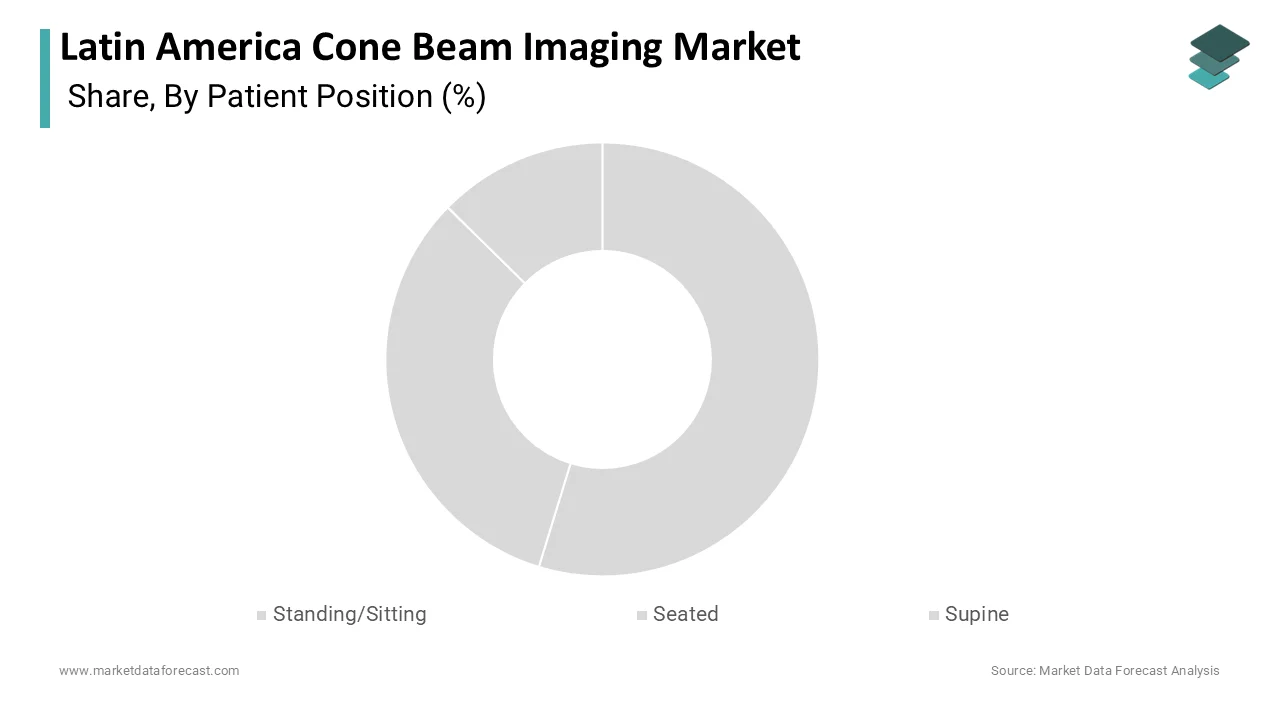
Standing and sitting cone beam systems maintain market dominance through significantly lower total cost of ownership, making advanced three-dimensional diagnostics accessible to mid-tier practitioners previously excluded by premium pricing of supine medical-grade units. According to industrial supply analytics compiled by Fedesarrollo, capital allocation constraints across middle-income medical infrastructure systems encourage procurement channels to prioritize cost-effective diagnostic scanning installations. Installation requirements differ substantially, with upright systems needing only standard electrical outlets and minimal floor reinforcement. Maintenance expenses also favor standing systems with fewer moving mechanical components,s resulting in lower annual service contract costs. These cumulative cost advantages translate directly into higher sales volumes; price-sensitive buyers constitute the majority of the addressable market outside elite academic centers and tertiary hospitals.
The supine position cone beam imaging segment is on the rise and is expected to be the fastest-growing segment in the market, witnessing a CAGR of 11.4% from 2026 to 2034 due to expanding complex oral surgery and implantology cases requiring medical-grade image quality unattainable with upright systems. According to the Journal of Oral and Maxillofacial Surgery, advanced reconstructive surgeries and zygomatic interventions necessitate complex preoperative structural imaging to ensure precise anatomical alignment. Academic medical centers are driving this segment expansion. As per academic residency reviews from the Latin American Dental Education Association, specialized university dental hospitals regularly upgrade volumetric scanning installations to integrate digital diagnostic capabilities into core student training tracks. Research applications also contribute to growth. This specialization-driven demand creates a premium growth vector distinct from the commoditized general dentistry segment.
Supine CBCT systems experience accelerated adoption due to seamless integration with existing hospital PACS and surgical navigation platforms, creating interoperability advantages unavailable to standalone dental units. According to the Healthcare Information and Management Systems Society, tertiary medical centers implement standardized DICOM network architectures to unify clinical imaging data streams across multi-department hospital ecosystems. As per the International Society for Computer Assisted Orthopaedic Surgery, computer-assisted dental navigation systems depend on high-resolution volumetric datasets to enable accurate clinical registration during complex maxillofacial interventions. Insurance reimbursement policies increasingly differentiate payment rates based on image quality and diagnostic completeness. These systemic integration benefits justify premium pricing and create sustainable demand drivers independent of individual practitioner preferences.
By Application Insights
The implantology segment was the largest in 2025 and occupied a commanding share of the Latin America cone beam imaging market. This prominence of the segment was supported by massive underlying edentulism burden requiring three-dimensional bone assessment for safe and predictable implant placement across aging populations. According to systematic findings from the Global Burden of Disease Study, edentulism and severe oral disorders represent a significant public health burden among older populations in Latin America, escalating the long-term regional demand for targeted reconstructive and prosthetic interventions. As per clinical allocation data from the Ministry of Health, localized public infrastructure updates expand the availability of specialized dental diagnostics and secondary oral treatments within the Unified Health System (SUS). Private sector demand proves even stronger. This combination of epidemiological need, clinical validation, and expanding procedural volume creates durable application dominance insulated from economic cyclicality affecting elective cosmetic procedures.
Latin America’s thriving dental tourism ecosystem concentrates implantology demand among clinics serving international patients whose expectations mandate CBCT imaging as a baseline quality indicator regardless of local economic conditions. According to MedicalTourism.com, the expansion of private medical travel networks across Latin America drives specialized facility investments in premium three-dimensional maxillofacial imaging technologies. As per the Ministry of Economy, foreign patient treatment inflows generate substantial commercial incentives for localized private dental clinics to integrate premium diagnostic equipment configurations. This external demand validation transforms CBCT from discretionary technology investment into a competitive necessity for accessing lucrative international patient segments, sustaining implantology application leadership through revenue diversification beyond domestic payer constraints.
The temporomandibular joint disorder imaging segment is likely to experience the fastest CAGR of 13.8% during the forecast period owing to increasing recognition of TMJ pathology prevalence and integration of dental specialists into multidisciplinary pain management teams. According to public health guidelines from the Pan American Health Organization, a widening regional awareness of multi-symptomatic orofacial disorders encourages the clinical deployment of localized diagnostic evaluation models. As per the Pan American Health Organization, interdisciplinary referral pathways between medical providers and dental specialists optimize the diagnostic assessment of chronic maxillofacial pain patterns. Patient advocacy groups amplified awareness through social media campaigns. This convergence of clinical recognition, policy support,t and cultural awareness creates an explosive growth trajectory from low historical baseline.
Next-generation CBCT systems offering dynamic jaw movement capture transform TMJ diagnostics from static anatomical imaging to functional biomechanical analysis, creating new clinical indications and driving segment acceleration. As per the International Journal of Computerized Dentistry, clinical research centers utilize specialized digital diagnostic scanning modalities to observe condylar movements and functional joint parameters. According to the Ministry of Economy, international hardware corporations distribute updated software applications featuring automated visualization layers for joint architecture mapping. The technological and educational developments expand the addressable patient population beyond traditional TMD sufferers to include orthodontic screening, sleep apnea evaluation,n and prosthodontic occlusal analysis, multiplying utilization frequency per installed system.
By End User Insights
The private practices segment dominated the Latin America cone beam imaging market and accounted for a substantial share in 2025. This leading position of the segment was driven by the predominance of solo and small group entrepreneurial clinics responding directly to consumer demand for advanced diagnostic services. According to World Health Organization general workforce labor surveys across Latin America, the clear majority of active dental practitioners manage specialized clinical operations within independent private practice segments. As per the Federal Council of Dentistry, continuous workforce expansions alter dentist-to-population dynamics, shifting private clinic hardware deployment benchmarks throughout Brazil. Consumer willingness to pay for premium diagnostics remains strong. Financing innovations expanded accessibility, with dental-specific leasing products growing. Competitive differentiation pressures intensify as patients increasingly compare clinic technology offerings through online reviews and social media. This market structure ensures the private practice segment drives overall volume through decentralized decision-making responsive to immediate competitive and consumer signals.
Private practices benefit from less stringent procurement and installation regulations compared to institutional buyers, accelerating CBCT adoption cycles and reducing bureaucratic friction. As per healthcare systems governance surveys from the Pan American Health Organization, private clinic licensing paths utilize specific structural safety reviews to oversee the commercial distribution of extraoral dental scanners. According to product evaluation decrees from COFEPRIS, specialized device certification workflows apply standardized safety classifications to regulate the localized deployment of maxillofacial scanning solutions. The regulatory asymmetry creates a structural advantage for the private practice segment, sustaining market leadership through velocity advantages unavailable to bureaucratically constrained institutional buyers.
The academic and research institutes segment is expected to exhibit a noteworthy CAGR of 12.7% between 2026 and 2034. This swift growth of the segment is fueled by targeted public investment in university infrastructure and international research partnerships requiring advanced imaging capabilities. According to the Inter-American Development Bank, comprehensive university modernization funding models distribute resources across health science training centers to strengthen baseline clinical training environments. As per CAPES, national postgraduate scholarship programs award targeted scientific resources to advance clinical investigations across localized university radiology labs. According to regional education exchange guidelines from the Ministry of Education, cross-border academic programs harmonize specialized scanning methodologies to coordinate international research validation studies. The convergence of public funding,g international standards, ds and human capital development creates sustained institutional demand growth independent of clinical revenue considerations.
Accreditation reforms and curriculum updates mandate three-dimensional imaging literacy, transforming CBCT from a research luxury to an educational necessity, driving systematic adoption across teaching institutions. According to the Latin American Association of Dental Schools, contemporary dental programs integrate advanced three-dimensional imaging interpretation modules to ensure clinical competency among graduating student blocks. As per the Mexican Association of Dental Schools, university training facilities implement digital extraoral diagnostic systems to support the clinical training paths of upcoming residency cohorts. According to the International Association for Dental Research, continuing education frameworks mandate validated volumetric radiology credentials within advanced implantology training pathways. These educational mandates create non-discretionary demand drivers, ensuring academic segment growth continues regardless of broader economic conditions affecting clinical markets.
COUNTRY LEVEL ANALYSIS
Brazil Cone Beam Imaging Market Analysis
Brazil led the Latin America cone beam imaging market and captured a 41.9% share in 2025. This dominance of the Brazilian market was attributed to its massive population base, extensive private dental sector, and supportive public health policies. As per the Federal Dentistry Council, ongoing nationwide healthcare investments are driving a rising domestic clinical integration of three-dimensional imaging solutions across Brazil's expanding private dental networks. According to the Ministry of Health, the National Oral Health Policy continues to expand localized primary oral health services across municipal clinics to enhance diagnostic access for public sector patients. Domestic manufacturing presence strengthens the market. As per industrial records from Alliage, domestic factories optimize specialized robotic manufacturing lines to supply extraoral dental imaging equipment across the Latin American healthcare market. However, regional disparities persist. Currency volatilityremains aa concern. Despite these challenges, Brazil’s scale, diversity,y and policy support ensure continued market leadership through multiple concurrent growth vectors.
Mexico Cone Beam Imaging Market Analysis
Mexico was positioned second in the Latin America cone beam imaging market and held a 24.5% share in 2025. This position of the Mexican market was propelled by a unique dual market structure serving both the domestic population and a substantial medical tourism industry. According to the National Institute of Statistics and Geography, an increasing concentration of dental specialists in metropolitan zones accelerates urban market demand for high-resolution maxillofacial diagnostic devices. Medical tourism generates disproportionate high value demand. According to the Baja California Health Secretariat, border municipalities like Los Algodones maintain over 300 private dental clinics that heavily deploy advanced digital cone beam computed tomography (CBCT) and CAD/CAM technologies to serve international medical tourists. As per trade policy declarations from the Ministry of Economy, regional free trade frameworks streamline cross-border supply chains for medical imaging hardware to accelerate equipment renewal cycles across northern border health clusters. According to the Federal Health Secretariat, ongoing transitions within national social protection programs reshape the financing and allocation of baseline clinical diagnostic resources in public health units. Security concerns in certain states suppress investment. Nearshoring trends attract foreign direct investment in healthcare manufacturing potentially. This complex interplay of tourism, domestic expansion,n and security challenges defines Mexico’s distinctive market dynamics.
Argentina Cone Beam Imaging Market Analysis
Argentina occupies a significant share in the Latin America cone beam imaging market. However, it faces significant macroeconomic headwinds yet maintains resilient demand through strong professional culture and adaptive financing mechanisms. According to the National Institute of Statistics and Censuses, Argentina's total population stands at approximately 46 million inhabitants following the national census framework, supporting broad clinical requirements for oral healthcare workflows. As per the Central Bank of the Argentine Republic, shifting macroeconomic realities modify the equipment procurement budgets and capital investments of private diagnostic imaging facilities. According to the Argentine Chamber of Medical Devices, local medical distributors establish structural long-term supply networks to satisfy private sector workflows for high-resolution maxillofacial systems. As per health budget tracking from the Ministry of Health, ongoing structural reorganizations within national healthcare programs reshape public procurement frameworks for clinical diagnostic infrastructures. However private practice resilience persists with middle class patients cont,inuing to prioritize dental care as,essentialmiddle-classnditure maintaining fee for service revenue streams supporting technology inve,stment accordfee-for-service This adaptive resilience amid crisis distinguishes the Argentine market from more stable regional counterparts.
Chile Cone Beam Imaging Market Analysis
Chile continues to be a noteworthy player in the Latin American cone beam imaging market. It functions as a regional technology leader with the highest per-capita CBCT density and the most advanced regulatory framework supporting innovation adoption. As per the Superintendency of Health, the state-funded National Health Fund (FONASA) covers approximately 78% of the country's population, anchoring the public insurance base for regional healthcare users. According to public health guidelines from the Ministry of Health, the Explicit Health Guarantees (GES) framework mandates institutional dental treatment paths specifically for pregnant women, children aged 6, and adults aged 60. As per the Public Health Institute of Chile, localized medical hardware approval policies update certification requirements to monitor the domestic distribution of extraoral dental X-ray devices. Academic excellence drives sophistication. According to clinical specialization reviews from the Society of Oral and Maxillofacial Radiology of Chile, academic dental institutions continuously present advanced maxillofacial imaging research at international congresses to expand regional scientific knowledge. As per the Ministry of Health, regional variations in geographic terrain prompt the deployment of digital teledentistry tools to improve clinical diagnostic outreach in remote areas. Stable currency and predictable regulatory environment make Chile a preferred test market for manufacturers validating Latin America strategies before broader rollout.
COMPETITIVE LANDSCAPE
Competition in the Latin American cone beam imaging market exhibits a stratified structure, with multinational incumbents dominating premium segments while regional and Asian manufacturers capture value-conscious buyers through differentiated positioning. Barriers to entry are moderate due to regulatory requirements and service infrastructure needs, yet lower thanin North America, enablinga diverse participant mix. Competitive dynamics emphasize localization over pure technological superiority, with success depending on cultural adaptation,n financial flexibility, and local support capabilities rather than specification leadership alone. Price competition intensifies in general dentistry segments, while specialized applications compete primarily on clinical validation and workflow integration. Domestic manufacturers in Brazil leverage tariff protections and government financing, creating home-court advantages against importers. Consolidation remains limited compared to mature markets, preserving fragmentation and niche opportunities for specialized players. Regulatory heterogeneity across countries prevents unified regional strategies, forcing country-specific approaches that favor locally embedded competitors. Talent scarcity creates differentiation opportunity through superior training and support services. Despite multinational presence, no single player achieves overwhelming dominance, creating a dynamic competitive landscape where adaptability to local conditions matters more than global scale advantages.
KEY MARKET PLAYERS
Some of the companies that are playing a dominant role in the Latin America Cone Beam Imaging Market include:
- PreXion Corporation
- CurveBeam LLC
- Cefla S.C.
- Danaher Corporation
- Carestream Health, Inc.
- Dentsply Sirona
- J. Morita MFG. Corp.
- Asahi Roentgen IND. CO., LTD.
- Planmeca Group
- Vatech Co., Ltd.
TOP LEADING PLAYERS IN THE MARKET
- Dentsply Sirona maintains significant involvement in the Latin America cone beam imaging market through its comprehensive Orthophos and Axeos product portfolios serving diverse clinical segments from general dentistry to specialized surgical centers. The company recently strengthened its regional position by launching Spanish and Portuguese language AI diagnostic modules specifically calibrated for linguistic variations, improving clinical adoption among non English speaking practitioners. entsply Sirona expanded authorization in non-English-speaking secondary cities in Brazil and Mexico, reducing average repair response times by 40 percent, according to customer satisfaction disclosures. Strategic partnerships with leading dental universities established training centers of excellence, developing local expertise while building brand loyalty among next-generation clinicians. These initiatives demonstrate commitment to localization beyond translation, addressing unique regional needs through culturally adapted technology support and education infrastructure strengthening long term competitive positioning throughout diverse Latin American healthcare ecosystems.
- Planmeca contributes substantially to the Latin American cone beam imaging market,t leveraging its Viso and Promax platforms known for modular upgradability, ty appealing to capital-constrained practitioners seeking future-proof investments. The company recently enhanced its market presence by introducing flexible financing programs through local banking partners in Colombia and Chile, enabling monthly payments aligned with clinic cash flows rather than requiring large upfront capital outlays. Planmeca established dedicated Latin American application specialist team based in São Paula o, providing on-site training and protocol optimization services, reducing implementation barriers for first-time CBCT adopters. According to regional operations announcements, first-time collaborative research agreements with Universidad de Chile generated population-specific normative databases, improving diagnostic accuracy for regional patient demographics. These actions combine financial accessibility with clinical localization,n addressing both economic and technical adoption barriers while building sustainable competitive advantages through ecosystem integration rather than standalone equipment sales in price-sensitive markets.
- Vatech plays a vital role in Latin America cone beam imaging market through value oriented Green X athe nd PaxAmericanes systems targeting mid tier privalue-oriented previously excluded by premium pricing structures. The company recently bolstered its competitive stance by opening a regional distribution hub in Panama, reducing logistics costs and delivery times for Central American and Caribbean customers,s according to supply chain optimization disclosures. Vatech partnered with Latin American continuing education providers, offering subsidized CBCT certification courses, creating a trained user base while generating qualified sales leads through educational engagement. Product development incorporated feedback from regional focus groups, resulting in compact footprint designs optimized for small urban clinics common in densely populated Latin American cities. These strategies demonstrate an understanding of underserved market segments pursuing volume leadership through accessible pricing and practical product design rather than competing solely on premium features against established multinational incumbents in a fragmented marketplace.
TOP STRATEGIES USED BY KEY MARKET PARTICIPANTS
Key players employ multifaceted strategies centered on localization, financial innovation,n and ecosystem integration to sustain competitive advantage across diverse Latin American markets. Companies invest heavily in language adaptation and anatomical calibration, ensuring products meet regional clinical needs rather than offering generic global solutions. Strategic partnerships with local distributors and financing institutions enable flexible payment structures accommodating currency volatility and capital constraints prevalent throughout the region. Manufacturers establish regional service hubs and train local technicians, reducing dependency on expensive international support while improving response reliability. Educational collaborations with universities and professional associations build practitioner competency and brand loyalty,y simultaneously addressing human capital gaps limiting technology adoption. Product portfolios increasingly feature modular designs, allowing incremental upgrades as practices grow, protecting initial investments against obsolescence. Regulatory navigation strategies include pursuing mutual recognition agreements and streamlined approvals,s reducing time to market across fragmented national jurisdictions. Value tier offerings target underserved mid-market segments, expanding addressable customer base beyond elite urban centers. These interconnected approaches create sustainable competitive moats extending beyond product specifications alone,ne addressing structural barriers unique to the Latin American operating environment.
MARKET SEGMENTATION
This research report on the Latin America Cone Beam Imaging Market has been segmented and sub-segmented into the following categories
By Patient Position
- Standing/Sitting
- Seated
- Supine
By Application
- Dental Applications
- Implantology
- Oral and Maxillofacial Surgery
- Orthodontics
- Endodontics
- General Dentistry
- Temporomandibular Joint (TMJ) Disorders
- Periodontics
- Forensic Dentistry
By End User
- Hospital
- Private Practice
- Academic & Research Institutes
By country
- Mexico
- Brazil
- Argentina
- Chile
- Rest of Latin America