Latin America Cosmetics Market Size, Share, Growth, Trends, And Forecast Report By Product, End-User, Distribution Channel, And By Country (Brazil, Chile, Argentina, Mexico, and Colombia, etc), Industry Analysis From 2026 To 2034
Market Size, 2025
$24.84 BnMarket Estimate, 2026
$26.46 BnMarket Forecast, 2034
$43.82 BnCAGR, 2026–2034
6.51%Latin America Cosmetics Market Size
The Latin America cosmetics market was valued at USD 24.84 billion in 2025, is estimated to reach USD 26.46 billion in 2026, and is projected to reach USD 43.82 billion by 2034, growing at a CAGR of 6.51% from 2026 to 2034.

Cosmetics are a broad range of personal care and beauty products, including skincare, haircare, fragrances, colour cosmetics, and men’s grooming. This market has been evolving rapidly due to shifting consumer preferences, increasing disposable incomes, and rising awareness about personal grooming and wellness. The region's vibrant youth population, urbanization, and growing influence of social media have significantly contributed to the demand for both premium and affordable cosmetic offerings.
In addition, Argentina and Chile are witnessing steady growth due to regulatory reforms and increased marketing efforts by international players. Moreover, there is a noticeable shift toward clean beauty, sustainability, and ethical sourcing, which is reshaping brand strategies across the region. Local manufacturers are increasingly adopting eco-friendly packaging and natural ingredients to align with global trends. Despite economic fluctuations in certain countries, the overall market continues to expand.
MARKET DRIVERS
Increasing Disposable Incomes and Urbanization
The rise in disposable incomes and rapid urbanization, particularly in Brazil, Mexico, and Colombia, is one of the primary drivers of the Latin American cosmetics market. With more people moving into urban centers, exposure to global beauty trends and access to retail infrastructure have improved dramatically. The expansion of modern retail formats such as supermarkets, hypermarkets, and specialty beauty stores has made it easier for consumers to explore a wide array of products. Besides, financial inclusion initiatives have enabled broader access to credit and installment-based purchasing options, making premium cosmetics more accessible. These factors strengthen the upward trajectory of the Latin American cosmetics industry.
Influence of Social Media and Digital Marketing
The growing influence of social media and digital marketing, which has transformed how consumers discover and engage with beauty brands, is another significant driver of the Latin American cosmetics market. Platforms like Instagram, TikTok, and YouTube have become powerful tools for brand promotion, product launches, and direct consumer interaction. In addition, there is a major shift in consumer behaviour in Latin America, with social media content significantly influencing beauty-related purchasing decisions. Also, Brazil leads in this trend, where influencers and beauty bloggers play a crucial role in shaping brand perception and driving sales. In Mexico, e-commerce platforms have leveraged targeted digital advertising to reach younger audiences, resulting in a surge in online cosmetic sales. Moreover, local brands are increasingly investing in digital campaigns and collaborating with micro-influencers to build authenticity and trust. These developments show the critical role of digital engagement in sustaining market growth across the region.
MARKET RESTRAINTS
Economic Volatility and Currency Fluctuations
The persistent economic volatility and currency fluctuations that impact both import costs and consumer purchasing power are a major restraint affecting the Latin American cosmetics market. Several countries in the region, including Argentina, Brazil, and Peru, have experienced inflationary pressures and unstable exchange rates, making imported raw materials and finished products more expensive. According to the International Monetary Fund, Argentina faced an annual inflation rate exceeding 200% in 2023, severely limiting consumer spending capacity and forcing companies to either raise prices or reduce profit margins. These financial challenges have led to cautious consumer behaviour, particularly among mid- to lower-income groups who are more price-sensitive.
Regulatory Complexity and Product Compliance Challenges
Regulatory complexity poses a significant challenge to the Latin American cosmetics market, as varying compliance requirements across countries create operational inefficiencies for both local and international players. Each country in the region has distinct regulatory frameworks governing ingredient approvals, labeling standards, and safety certifications, making market entry and product launches more cumbersome. According to the Pan American Health Organization, Latin America lacks a unified regulatory body for cosmetics, leading to inconsistent enforcement and prolonged approval timelines. Besides, in Brazil, Anvisa (National Health Surveillance Agency) enforces stringent regulations for cosmetics. All cosmetic products must be either notified or registered with Anvisa before being launched on the market, with requirements that include clear labeling, ingredient disclosure, and compliance with safety standards such as microbiological control. Similarly, in Argentina, regulatory authorities update labeling and ingredient restrictions, requiring continuous compliance adjustments from manufacturers. Mexico, despite being relatively more streamlined, still imposes specific health and safety evaluations under COFEPRIS (Federal Commission for the Protection Against Sanitary Risk).
MARKET OPPORTUNITY
Growth of Clean Beauty and Sustainable Products
The rising demand for clean beauty and sustainable products is a significant opportunity emerging in the Latin American cosmetics market. Consumers are becoming more conscious of ingredient transparency, environmental impact, and ethical sourcing, prompting brands to reformulate their offerings and adopt eco-friendly practices. Also, Brazil stands at the forefront of this movement, with local brands leading the way in green formulations and recyclable packaging. In addition, social media and influencer advocacy have played a crucial role in promoting clean beauty, further accelerating its adoption across the region.
Expansion of E-Commerce and Direct-to-Consumer Channels
The expansion of e-commerce and direct-to-consumer (DTC) channels presents a major opportunity for the Latin American cosmetics market, offering brands a scalable and cost-effective way to reach a broader customer base. Online beauty sales have surged in recent years, supported by improving digital infrastructure, rising smartphone penetration, and growing consumer trust in online transactions. Also, in Brazil, digital-first brands have capitalized on mobile commerce, leveraging AI-powered recommendation engines and personalized shopping experiences to boost conversions. Similarly, in Mexico, MercadoLibre and Amazon Mexico have expanded their beauty verticals, introducing exclusive brand collaborations and same-day delivery options to enhance convenience. As reported by AMIPCI (Asociación Mexicana de Internet), online beauty sales in Mexico grew by 32% year-on-year in 203, signaling strong momentum. These developments indicate that e-commerce will continue to be a pivotal growth engine for the cosmetics sector in Latin America.
MARKET CHALLENGES
Intense Competition and Market Saturation
Intense competition and market saturation represent a significant challenge in the Latin American cosmetics market, as numerous domestic and international players vie for consumer attention and shelf space. Established multinational corporations such as L’Oréal, Estée Lauder, and Unilever compete alongside regional giants like Natura and Grupo Bimbo’s Belleza division, creating a crowded marketplace where differentiation becomes increasingly difficult.
This competitive landscape has led to aggressive pricing strategies, frequent promotional campaigns, and heavy reliance on influencer marketing to capture consumer interest. Additionally, private-label brands offered by supermarket chains and drugstores have gained traction, further complicating the positioning of independent cosmetic companies. Furthermore, market saturation in urban centers has forced companies to seek growth in semi-urban and rural regions, where distribution challenges and lower purchasing power persist.
Consumer Preference Shifts Toward Personalization and Premiumization
The rapid evolution of consumer preferences toward personalization and premiumization, which demands greater investment in research, customization, and brand storytelling, is a growing challenge for the Latin American cosmetics market. Modern consumers, especially younger demographics, expect tailored product recommendations, bespoke formulations, and high-performance ingredients that align with their individual needs and values.
Premiumization has also gained momentum, with consumers willing to pay higher prices for luxury skincare, clean beauty, and performance-driven products. This shift has created pressure on mid-tier brands to either elevate their offerings or risk losing relevance in a market increasingly dominated by high-quality, aspirational products. However, fulfilling these expectations requires substantial R&D expenditure, supply chain agility, and digital integration, which many smaller or traditional players may struggle to achieve.
REPORT COVERAGE
| REPORT METRIC | DETAILS |
| Market Size Available | 2025 to 2034 |
| Base Year | 2025 |
| Forecast Period | 2026 to 2034 |
| Segments Covered | By Product, End-User, Distribution Channel, and Region. |
| Various Analyses Covered | Global, Regional and Country Level Analysis, Segment-Level Analysis, DROC, PESTLE Analysis, Porter’s Five Forces Analysis, Competitive Landscape, Analyst Overview of Investment Opportunities |
| Regions Covered | Brazil, Chile, Argentina, Mexico, and Colombia etc |
| Market Leaders Profiled | Coty Inc., L’Oréal Group, Estee Lauder Companies, Inc., Revlon Consumer Products LLC, Avon Products, Inc., Unilever, Company 7, Godrej Group, Procter & Gamble, Beiersdorf AG, Henkel AG & Co KGaA, Kao Corporation, Hoyu Co., Ltd. |
SEGMENTAL ANALYSIS
By Product Insights
The skin Care segment dominated the market by accounting for 54.5% of total revenue in 2025. The rising consumer awareness about skin health, increasing concerns related to pollution and sun exposure, and growing demand for anti-aging and personalized skincare solutions are primarily driving the growth of the skin Care segment. Also, the popularity of natural ingredients such as aloe vera, green tea, and Amazonian botanicals has further fueled growth, with local brands like Natura and O Boticário leading the way in clean beauty formulations. Besides, social media and influencer marketing have played a pivotal role in shaping consumer preferences toward premium and functional skincare.
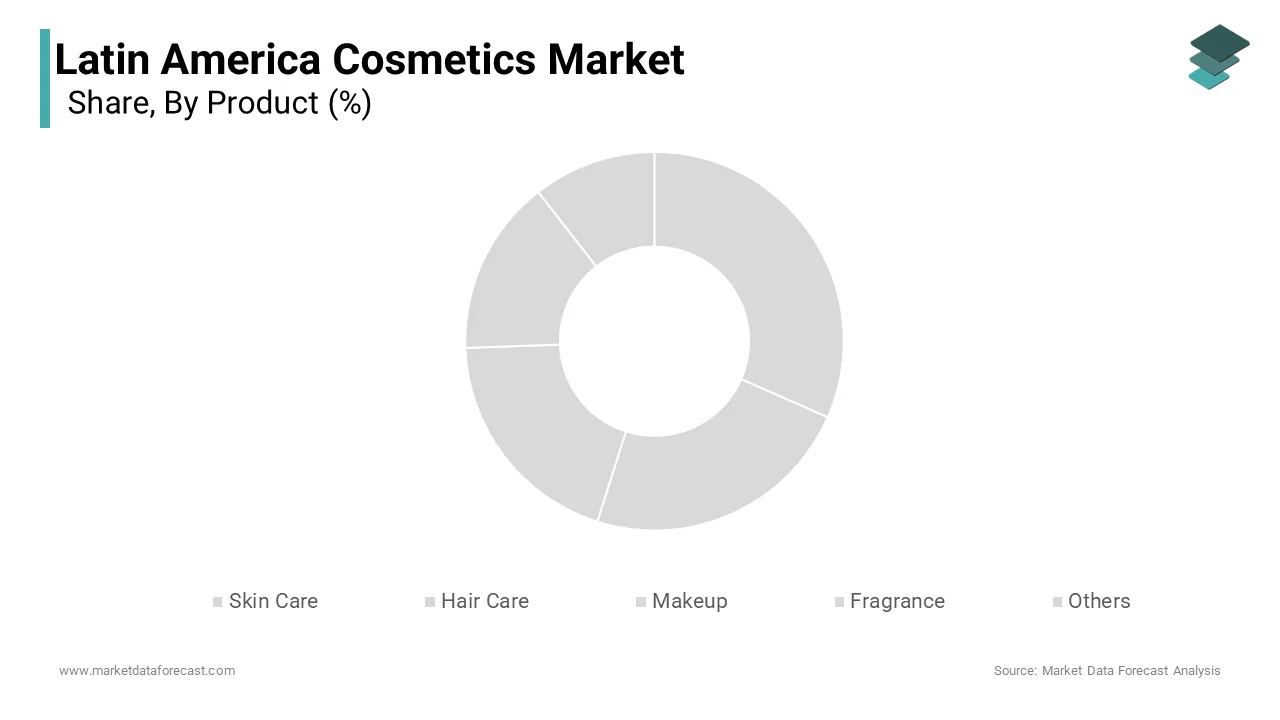
The fastest-growing segment in the Latin American cosmetics market is the Hair Care segment and is projected to expand at a CAGR of 9.2%. The shifting consumer focus toward hair wellness, scalp health, and styling innovations, particularly in response to the increasing prevalence of hair damage caused by environmental stressors and chemical treatments, is propelling the growth of the hair care segment. In Brazil, the hair care business saw strong performance, driven by the popularity of sulfate-free shampoos, keratin treatments, and plant-based conditioners. Local players and international brands alike are launching region-specific formulations tailored to diverse hair types, including curly and textured hair, which is prevalent across the population. Mexico also experienced significant momentum, with online beauty retailers reporting an increase in hair care product sales. Consumers are increasingly opting for salon-quality home treatments, especially those infused with argan oil, coconut extracts, and biotin. Besides, men’s grooming products within the hair care category, such as beard oils and styling gels, are gaining traction, contributing to sustained market expansion.
By End-User Insights
The women's segment commanded the market by accounting for 76.3% in 2025. This dominance of end-users is primarily driven by long-standing cultural emphasis on female beauty, personal grooming, and self-expression through makeup and skincare, particularly in countries like Brazil and Mexico. Brazil's vibrant fashion industry, coupled with high social media engagement, continues to drive frequent product trials and brand loyalty. Also, working women in urban centers are investing more in premium and multi-functional beauty products that offer convenience and efficacy. Similarly, in Mexico, the rise of dual-income households and greater financial independence among women has led to higher discretionary spending on beauty and personal care. As reported by INEGI, female labour force participation was approximately 46.1%–46.5% at the end of 2023, contributing to increased purchasing power and consumption of branded cosmetics. Furthermore, beauty influencers and digital marketing campaigns have significantly influenced buying behavior, particularly among younger demographics seeking curated and trend-driven products.
The fastest-growing end-user segment in the Latin American cosmetics market is the women's segment and is projected to grow at a CAGR of 10.5% in the coming years. The shifting societal perceptions around male grooming, increased emphasis on personal hygiene, and the influence of celebrity endorsements and digital content creators promoting men’s beauty products are majorly contributing to the growth of the men's segment. In Brazil, men’s grooming has evolved beyond basic shaving and deodorants to include skincare routines, facial cleansers, and anti-aging creams. Brands like Natura and Johnson & Johnson have launched dedicated men’s lines targeting concerns such as acne, oiliness, and post-shave irritation. Also, in Mexico, the growth of men’s cosmetics has been particularly notable in urban areas, where young professionals are adopting premium grooming products and fragrances. Moreover, sports and fitness culture have encouraged men to invest in body care and wellness-oriented products, further expanding the market base.
By Distribution Channel Insights
The offline channel led the market by capturing 67.3% in 2025. This superiority is largely due to the continued reliance on traditional retail formats such as supermarkets, hypermarkets, specialty stores, and direct selling models, particularly in countries with lower digital trust and limited e-payment infrastructure. In Brazil, offline retail remains the preferred mode of purchase for a majority of consumers, especially in semi-urban and rural regions where physical stores provide immediate access and personalized service. Apart from these, in Mexico, drugstores and perfumeries like Perfumes y Más and Sephora continue to play a crucial role in driving foot traffic and impulse purchases. Besides, direct-selling brands such as Avon maintain a large presence in Latin America, leveraging door-to-door sales and independent representatives to reach remote customer bases.
The fastest-growing distribution channel in the Latin American cosmetics market is the nonline segment and is expected to expand at a CAGR of 14.3% during the forecast period. The improving internet penetration, rising smartphone adoption, and increasing consumer confidence in digital transactions, particularly among younger, tech-savvy demographics, are primarily driving the online segment. In Brazil, e-commerce beauty sales surged in 2023, with platforms like Beleza na Web and Mercado Livre leading the charge. These developments highlight the transformative impact of digital retail on the cosmetics landscape in Latin America.
COUNTRY-LEVEL ANALYSIS
Brazil spearheaded the Latin American cosmetics market by accounting for 39.2% in 2025. As the most populous and economically developed country in the region, Brazil has a well-established beauty ecosystem supported by strong domestic brands, a robust retail network, and a deep-rooted cultural appreciation for personal grooming. Local companies like Natura, The Body Shop Brazil, and O Boticário have successfully leveraged sustainability and natural ingredients to capture market share, while global players such as L’Oréal and Estée Lauder continue to invest in premium skincare and color cosmetics. Moreover, the expansion of e-commerce beauty platforms has enabled wider product accessibility, particularly among younger consumers.
Mexico is one of the fastest-growing beauty markets in the region. eMexicobenefits from a youthful demographic, rising disposable incomes, and an expanding middle class that is increasingly prioritizing personal care and grooming. Urbanization and digital transformation have played a crucial role in shaping purchasing behaviours, with cities like Mexico City, Guadalajara, and Monterrey serving as major hubs for beauty innovation and retail expansion. E-commerce has also seen strong growth, with platforms like Amazon Mexico and MercadoLibre expanding their beauty offerings to cater to digitally native consumers. In addition, the rise of clean beauty and sustainable packaging has prompted both local and international brands to reformulate their offerings to align with evolving consumer expectations.
Argentina maintains a strong beauty culture, with consumers demonstrating a consistent interest in skincare, fragrances, and colour cosmetics. Although inflationary pressures affected pricing strategies, brands adapted by offering smaller-sized or value-packaged alternatives to maintain affordability without compromising quality. Local brands such as Pura Vida and Neogenic have capitalized on the clean beauty movement, incorporating natural ingredients and cruelty-free formulations into their product lines. Also, the influence of social media and digital influencers has played a key role in shaping beauty trends and driving brand engagement, particularly among younger audiences in Buenos Aires and Córdoba.
Chile is known for its relatively stable economy and high levels of digital literacy. It has emerged as a key player in the regional beauty industry, particularly in skincare and premium personal care products. The country’s regulatory environment is also conducive to international brand entry, attracting premium players such as L’Oréal and Clarins, which have expanded their presence in recent years. Platforms like Falabella and Paris.cl have enhanced their digital offerings with virtual try-ons and personalized recommendations, catering to a tech-savvy consumer base. Besides, sustainability initiatives, including refillable packaging and cruelty-free certifications, have gained traction, positioning Chile as a progressive market within Latin America.
The rest of Latin America collectively accounts for a notable share of the regional cosmetics market, encompassing countries such as Colombia, Peru, Ecuador, and Central American nations. While individually these markets are smaller, they are experiencing steady growth driven by rising disposable incomes, expanding youth populations, and increasing digital connectivity. Colombia has emerged as a key growth hub, with Bogotá and Medellín witnessing rising demand for premium skincare and men’s grooming products. In Peru, the beauty sector is benefiting from government-backed trade agreements that facilitate easier importation of cosmetic raw materials and finished goods, as noted by PromPerú. Central American countries such as Costa Rica and Panama are also making strides, with local and international brands focusing on digital-first strategies to engage younger consumers.
KEY MARKET PLAYERS
Key market players that are dominating the Latin America cosmetics market.
- Coty Inc.
- L'Oréal Group
- Estée Lauder Companies Inc.
- Revlon Consumer Products LLC
- Avon Products, Inc.
- Unilever
- Company 7
- Godrej Group
- Procter & Gamble
- Beiersdorf AG
- Henkel AG & Co. KGaA
- Kao Corporation
- Hoyu Co., Ltd.
Top Players in the Market
- One of the leading players in the Latin American cosmetics market is Natura &C, a Brazilian multinational beauty and personal care conglomerate. As the parent company of Natura, The Body Shop, Avon, and Aesop, it has established a strong regional presence while contributing significantly to global sustainable beauty initiatives. Its emphasis on ethical sourcing, natural ingredients, and inclusive branding has positioned it as a pioneer in conscious consumerism.
- Another major player is L’Oréal, which has a substantial footprint across Latin America through its diverse portfolio that includes L’Oréal Paris, Maybelline, Lancôme, and Kiehl’s. The company invests heavily in localized product development, digital engagement, and eco-conscious formulations, reinforcing its leadership in both premium and mass-market segments while influencing global beauty trends.
- Estée Lauder Companies also plays a crucial role in shaping the Latin American cosmetics landscape. With brands like Estée Lauder, Clinique, MAC, and Origins, the company focuses on high-performance skincare and prestige fragrances tailored for local consumers. Its strategic retail partnerships and omnichannel marketing have strengthened its appeal among affluent urban consumers in key markets such as Mexico and Brazil.
Top Strategies Used By Key Market Participants
- A primary strategy employed by key players in the Latin American cosmetics market is localized product innovation, where companies develop formulations that cater specifically to regional skin types, climate conditions, and cultural preferences. This approach enhances brand relevance and consumer loyalty, particularly in diverse markets like Brazil and Mexico.
- Another critical tactic is leveraging digital platforms and influencer marketing to engage younger, tech-savvy consumers. Brands are investing in social commerce, virtual try-ons, and personalized recommendations to enhance customer experience and drive online sales, especially on platforms like Instagram, TikTok, and YouTube.
- Lastly, expanding direct-to-consumer channels and e-commerce capabilities has become essential for maintaining a competitive advantage. Companies are strengthening their digital infrastructure, forming strategic alliances with local online retailers, and optimizing mobile-first shopping experiences to capture growing demand from digitally native consumers across the region.
COMPETITION OVERVIEW
- The Latin American cosmetics market is highly competitive, characterized by the coexistence of global giants, regional powerhouses, and emerging local brands vying for consumer attention and market share. Established multinational corporations such as L’Oréal, Estée Lauder, and Natura &Co dominate with extensive distribution networks and well-recognized brand portfolios. However, domestic players and niche startups are increasingly challenging their influence by offering differentiated products that align with evolving consumer values such as sustainability, inclusivity, and clean beauty.
- This dynamic environment fosters continuous innovation, with brands frequently launching new formulations, leveraging influencer partnerships, and adapting packaging and pricing strategies to meet diverse consumer needs. The rise of digital-first beauty brands further intensifies competition, as they bypass traditional retail models and engage directly with consumers through social media and e-commerce platforms. Additionally, private-label offerings from supermarket chains and drugstores add another layer of complexity, appealing to budget-conscious shoppers.
- To maintain relevance, market participants must continuously refine their value propositions, whether through product differentiation, ethical sourcing, or enhanced digital engagement. As consumer expectations evolve, the ability to adapt quickly and authentically will be a decisive factor in securing long-term success in this vibrant and rapidly shifting market.
RECENT HAPPENINGS IN THE MARKET
- In January 2023, Natura &Co launched a new line of plant-based skincare products developed specifically for the Brazilian market, emphasizing Amazonian botanicals and eco-friendly packaging to reinforce its commitment to sustainability and regional biodiversity.
- In August 2023, L’Oréal expanded its digital presence in Mexico by partnering with a leading influencer agency to create targeted beauty content, aiming to strengthen consumer engagement and boost brand awareness among Gen Z and millennial audiences.
- In March 2025, Estée Lauder opened a regional innovation center in São Paulo, Brazil, dedicated to formulating products tailored to Latin American skin types and environmental conditions, enhancing its ability to deliver customized beauty solutions.
- In November 2023, Avon Latin America introduced a revamped direct-selling app with AI-powered product recommendations and real-time inventory tracking, improving the experience for independent representatives and customers alike.
- In May 2025, The Body Shop partnered with a Chilean environmental organization to launch a refill station initiative across Santiago stores, promoting circular beauty practices and reinforcing its global sustainability commitments within the Latin American market.
MARKET SEGMENTATION
This research report on the Latin American cosmetics market is segmented and sub-segmented into the following categories.
By Product Type
- Skin Care
- Hair Care
- Makeup
- Fragrance
- Others
By End-user Channel
- Men
- Women
By Distribution Channel
- Offline
- Online
By Country
- Brazil
- Mexico
- Argentina
- Colombia
- Chile
- Others
Frequently Asked Questions
What defines the cosmetics market in Latin America?
The Latin American cosmetics market encompasses a wide range of beauty and personal care products, including skincare, haircare, makeup, fragrances, sun protection, and men’s grooming items. It's driven by evolving consumer preferences, rising disposable incomes, and a strong cultural emphasis on appearance and self-care across the region.
Which countries are leading the growth in the Latin American cosmetics industry?
Brazil and Mexico are the largest markets due to their sizeable populations, developed retail ecosystems, and strong domestic brands. Argentina, Colombia, and Chile are also showing steady growth, supported by urbanization, digital commerce expansion, and increasing awareness about personal grooming and wellness.
What role do natural and organic cosmetics play in the Latin American market?
There's a growing demand for clean beauty products made with natural, sustainable, and cruelty-free ingredients. Consumers—especially younger generations—are becoming more health-conscious and environmentally aware. This has led to an increase in local startups and eco-friendly brands offering vegan, organic, and ethically sourced cosmetics.
How is e-commerce impacting the cosmetics sector in Latin America?
E-commerce is revolutionizing the way people shop for beauty products in the region. With improved internet access and mobile penetration, more consumers are turning to online platforms for convenience, variety, and exclusive deals. Social commerce via Instagram, TikTok, and WhatsApp is especially influential among Gen Z and millennials.
Are local beauty brands competitive against international players?
Yes, they are! While global giants like L’Oréal, Estée Lauder, and Unilever have a strong presence, homegrown brands such as Natura (Brazil), Payan Berland (Colombia), and Kaia Naturals (Mexico) are gaining ground. These brands often offer culturally relevant products, affordable pricing, and localized customer engagement, giving them a unique edge in the market.
What impact has the pandemic had on the cosmetics market in Latin America?
The pandemic initially disrupted supply chains and retail operations, but it also accelerated digital adoption and changed beauty routines. There was a decline in makeup sales during lockdowns, while skincare, hand sanitizers, and at-home haircare products saw increased demand. Post-pandemic, the market has rebounded with renewed interest in self-expression through beauty.
Related Reports
Access the study in MULTIPLE FORMATS
Purchase options starting from
$ 1600
Didn’t find what you’re looking for?
TALK TO OUR ANALYST TEAM
Need something within your budget?
NO WORRIES! WE GOT YOU COVERED!
Call us on: +1 888 702 9696 (U.S Toll Free)
Write to us: sales@marketdataforecast.com