- Product Description Description
- Table of Contents TOC
- List of Table & Figure LOT
- Get Free Sample PDF Sample PDF
Market Size, 2025
$61.49 BnMarket Estimate, 2026
$64.53 BnMarket Forecast, 2034
$94.98 BnCAGR, 2026–2034
4.95%Latin America Fast Food Market Summary
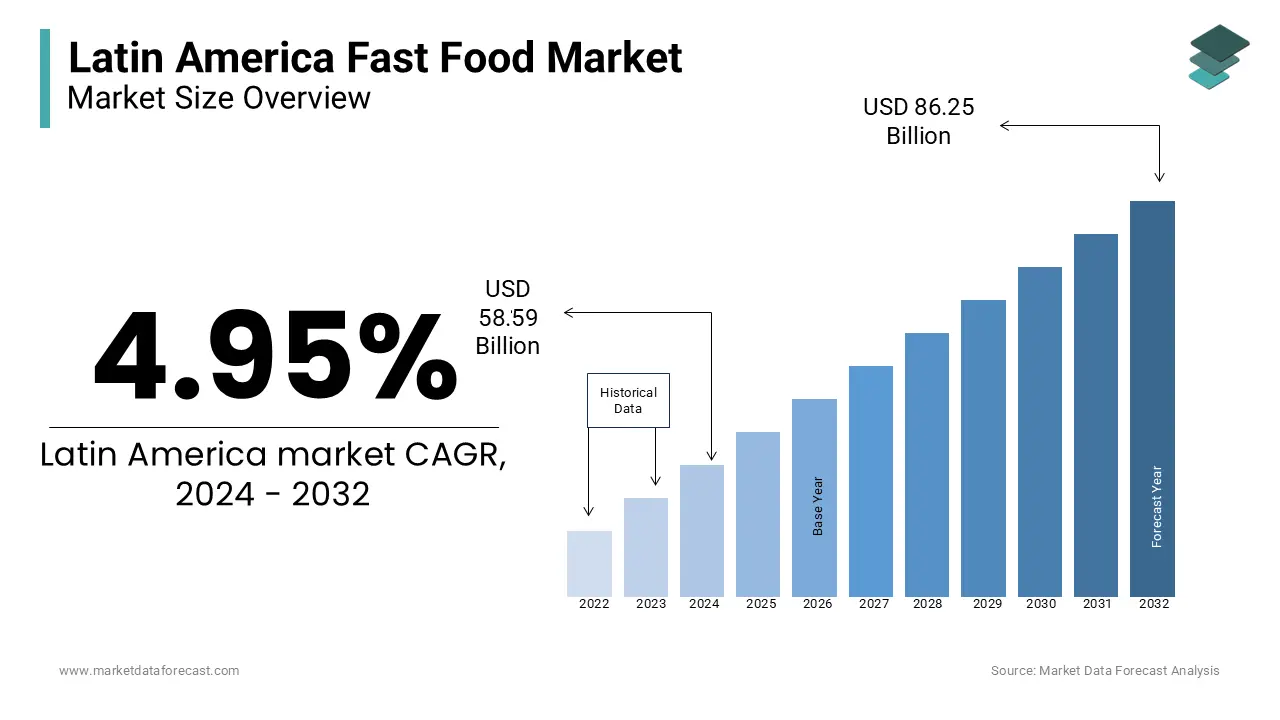
The fast food market size in Latin America was calculated to be USD 61.49 billion in 2025 and is anticipated to be worth USD 94.98 billion by 2034 from USD 64.53 billion in 2026, growing at a CAGR of 4.95% during the forecast period. The growth of the Latin American fast food market is driven by rising urbanization, increasing disposable incomes, and changing consumer lifestyles that favor convenience and quick-service dining. The expansion of international QSR chains, coupled with strong demand for burgers, pizzas, and sandwiches, is further fueling market growth.
Key Market Trends
- The growing dominance of quick service restaurants (QSRs) across major cities.
- Rising consumer demand for affordable and convenient meal options.
- Expansion of delivery apps and online ordering platforms.
- Increasing emphasis on local flavor innovations by global QSR brands.
- Emerging focus on healthier fast food alternatives in urban markets.
Segmental Insights
- Based on type, the burgers and sandwiches segment dominated the market with 37.4% share in 2025, reflecting strong consumer preference for quick and filling meals.
- Based on distribution channel, the quick service restaurant (QSR) segment held the largest share at 55.3% in 2025, supported by the growing penetration of international and regional QSR chains.
Regional Insights
- Brazil stood as the largest national market in Latin America, accounting for 35.1% of regional revenue in 2025, driven by its large population and strong presence of global fast food chains.
- Mexico demonstrated strong growth, supported by urban dining culture and increasing QSR expansion.
- Argentina is showing steady adoption, driven by rising consumer demand for affordable and accessible meals.
- Chile and Colombia are emerging markets with fast-growing fast food consumption and investment in modern retail formats.
Competitive Landscape
Major players in the Latin America fast food market include Domino’s Pizza, Burger King, KFC, Subway, Dunkin’ Donuts, McDonald’s, Hardee’s, Pizza Hut, Firehouse Subs, and Auntie Anne’s. These companies are focusing on regional menu customization, expansion of delivery services, and strategic partnerships to capture a larger consumer base.
Latin America Fast Food Market Size
The fast food market size in Latin America was calculated to be USD 61.49 billion in 2025 and is anticipated to be worth USD 94.98 billion by 2034 from USD 64.53 billion in 2026, growing at a CAGR of 4.95% during the forecast period.
Fast Food refers to the ready-to-eat meals, including burgers, fried chicken, pizza, sandwiches, and localized fast food variants. This market is shaped by shifting consumer behaviors, urbanization trends, and the proliferation of international and regional fast food chains across countries such as Brazil, Mexico, Colombia, Chile, and Argentina. Unlike traditional dining, fast food in Latin America emphasizes convenience, affordability, and speed, catering to an increasingly mobile and time-constrained population. The region's diverse culinary heritage has led to the integration of indigenous flavors into global fast food formats, creating hybrid offerings that appeal to local palates.
As of 2023, over 60% of Latin America’s population resides in urban centers, a significant factor influencing consumption patterns, as per data published by the Economic Commission for Latin America and the Caribbean (ECLAC). Additionally, the International Labour Organization indicates that service sector employment in Latin America accounts for nearly 65% of total employment, reinforcing demand for time-efficient meal solutions. The rise of digital infrastructure has further accelerated delivery services, with high mobile internet penetration across the region, enabling fast food operators to expand their reach beyond physical outlets.
MARKET DRIVER
Urbanization and Changing Lifestyles
Urbanization in Latin America has fundamentally reshaped dietary habits and food consumption dynamics, serving as a pivotal force behind the expansion of the fast food industry. As of 2023, approximately 81% of the region’s population lives in urban areas, a figure significantly higher than the global average, according to the United Nations Department of Economic and Social Affairs. This concentration of people in cities fosters environments where time scarcity and fast-paced routines are prevalent, increasing reliance on convenient meal options. The growing participation of women in the workforce further amplifies this trend; female labor force participation in Latin America reached 52.3% in 2022, as per the International Labour Organization, leading to reduced time for home cooking. Fast food chains have capitalized on this shift by offering value meals, drive-thru services, and extended operating hours. Moreover, the densification of urban populations enables efficient logistics and lower operational costs for restaurant chains, encouraging market penetration. As cities continue to grow, particularly in countries like Colombia and Peru, the demand for quick, affordable, and accessible food solutions is expected to rise proportionally, solidifying urbanization as a cornerstone driver of the fast food sector’s growth trajectory across Latin America.
Youth Demographics and Cultural Shifts Toward Westernized Eating Habits
The youthful demographic composition of Latin America plays a crucial role in shaping the fast food landscape, with individuals under the age of 30 constituting a significant share of the region’s population. This substantial youth cohort exhibits distinct consumption preferences, favoring convenience, novelty, and brand experiences—elements central to the fast food model. In countries like Argentina and Chile, a notable share of teenagers consume fast food at least once a week. The influence of digital media and global pop culture has further accelerated the adoption of Western-style diets among younger consumers, who increasingly associate fast food with modernity and social engagement. Platforms such as Instagram and TikTok are frequently used by major chains like McDonald’s and Burger King to launch localized campaigns, contributing to brand loyalty among adolescents and young adults. Additionally, the expansion of delivery apps such as Rappi and iFood, has further embedded fast food into daily routines. With educational institutions and corporate hubs becoming key locations for outlet placement, fast food brands are strategically aligning with the lifestyles of young professionals and students. This generational shift, underpinned by evolving tastes and digital connectivity, ensures sustained demand and long-term market viability.
MARKET RESTRAINTS
Rising Public Health Concerns and Government Regulatory Interventions
The rapid expansion of the fast food industry in Latin America has coincided with escalating public health challenges, particularly concerning diet-related non-communicable diseases. These have prompted governments to implement stringent regulatory measures targeting high-calorie, high-sodium, and high-sugar food products commonly associated with fast food. Chile, for example, introduced comprehensive front-of-package warning labels in 2016, which led to a 24% reduction in the purchase of sugary drinks and high-fat snacks, as documented in a 2021 study published in The Lancet. Similar policies have been adopted in Uruguay and Peru, where mandatory labeling laws now require clear warnings on processed foods. In Mexico, a 10% tax on sugary beverages implemented in 2014 resulted in a sustained decline in consumption, as reported by the National Institute of Public Health of Mexico. These interventions not only affect consumer behavior but also increase compliance costs for fast food operators, who must reformulate products or face declining sales. Furthermore, public awareness campaigns funded by health ministries have altered perceptions of fast food, especially among middle-class families. Such regulatory and behavioral shifts constrain market growth by discouraging frequent consumption and forcing brands to invest heavily in healthier menu development, thereby increasing operational complexity.
Economic Volatility and Income Inequality
Economic instability across Latin America presents a persistent barrier to the uniform expansion of the fast food market, as fluctuating inflation rates, currency depreciation, and uneven income distribution limit consumer purchasing power. Even in relatively stable economies like Brazil and Colombia, real wage growth has stagnated, with average monthly income failing to keep pace with food price increases. As per data from the Economic Commission for Latin America and the Caribbean, the region’s Gini coefficient remains one of the highest globally, with Brazil and Colombia registering values of 0.53 and 0.54 respectively, indicating deep income disparities. This inequality means that while affluent urban consumers continue to patronize international fast food chains, a large segment of the population cannot afford regular visits. Additionally, currency devaluation in countries like Argentina has forced multinational chains to raise prices or reduce portion sizes to maintain margins, further alienating cost-sensitive customers. The reliance on imported ingredients for certain menu items exacerbates vulnerability to exchange rate fluctuations. These economic pressures create a bifurcated market where premium fast food thrives in select urban enclaves while broader expansion is hindered by affordability constraints.
MARKET OPPORTUNITIES
Expansion of Digital Platforms and Delivery Ecosystems
The proliferation of digital technologies and on-demand delivery networks has opened transformative opportunities for the Latin America fast food market, enabling brands to transcend physical limitations and reach underserved populations. This digital foundation has fueled the rise of food delivery platforms such as Rappi, iFood, and PedidosYa, which collectively operate in several countries and serve millions of active users annually. Fast food chains have leveraged these platforms to launch virtual kitchens, delivery-only outlets that minimize overhead costs while maximizing geographic coverage. Moreover, integration with digital payment systems like Mercado Pago and Pix has streamlined transactions, reducing friction in the customer journey. The ability to collect and analyze consumer data through these platforms also allows for hyper-personalized marketing and dynamic pricing strategies. The digital channel remains vastly underpenetrated, offering substantial room for growth. For fast food operators, investing in omnichannel strategies represents a critical pathway to market expansion, particularly in secondary cities where physical restaurant density remains low.
Localization and Culinary Innovation
Fast food operators in Latin America are increasingly capitalizing on the region’s rich culinary diversity by integrating local ingredients, flavors, and traditional dishes into their menus, creating a competitive edge through cultural relevance. This strategy of localization not only enhances consumer appeal but also differentiates global brands from generic competitors. Similarly, McDonald’s Brazil offers the “McCheddar,” a sandwich featuring Brazilian cheese and regional sauces, which accounts for nearly 15% of all burger sales in the country. In Colombia, chains like Papa John’s have incorporated arepas into their menu offerings, aligning with local breakfast habits. Furthermore, the use of locally sourced ingredients supports sustainability goals and reduces supply chain risks. Culinary innovation also extends to plant-based and health-conscious adaptations, with brands like Burger King launching the “Rebel Whopper” using plant-based patties from Marfrig Global Foods, a Brazilian producer. These localized and innovative offerings not only strengthen brand loyalty but also attract health-aware and culturally conscious consumers, positioning fast food as an adaptable and evolving segment rather than a static import.
MARKET CHALLENGES
Supply Chain Vulnerability and Ingredient Sourcing Risks
The Latin America fast food market faces significant operational challenges due to the fragility of its supply chains, particularly in the procurement of consistent, high-quality ingredients amid climatic, logistical, and geopolitical disruptions. Many fast food chains rely on a mix of local agriculture and imported commodities, making them susceptible to volatility in both domestic production and international trade. This directly impacted the cost and availability of cooking oil and protein-based menu items. Similarly, Argentina’s prolonged economic crisis has led to export restrictions on beef, a staple in many fast food offerings, limiting supply for regional chains. Infrastructure deficits further exacerbate the issue. Inland transportation delays, port congestion, and inadequate cold chain facilities result in spoilage rates for perishable goods in countries like Peru and Bolivia. Additionally, dependence on imported packaging materials, often priced in U.S. dollars, increases exposure to currency fluctuations. These systemic inefficiencies force fast food operators to maintain higher inventory buffers or engage in costly supplier diversification, complicating scalability and standardization across markets.
Intensifying Competition from Informal and Street Food Sectors
The formal fast food industry in Latin America contends with robust competition from a deeply entrenched informal food sector, which offers comparable convenience, lower prices, and strong cultural resonance. Street food vendors and small-scale eateries constitute a dominant segment of the region’s foodservice landscape, employing millions of people and generating significant annual revenue. In cities like Lima, Mexico City, and São Paulo, consumers frequently opt for tacos, empanadas, and arepas from street stalls due to their affordability and authenticity. These vendors operate with minimal overhead, enabling them to price items lower than branded fast food outlets. Moreover, informal vendors often enjoy greater flexibility in adapting to local tastes and operating hours, enhancing their competitive advantage. Regulatory leniency in many municipalities allows these operators to thrive without the compliance burdens faced by formal chains. While some multinational brands have attempted to replicate street food offerings, such as KFC’s “Taco Twister” in Mexico, consumer skepticism about authenticity persists. This competitive pressure forces formal fast food operators to continuously innovate and justify premium pricing, complicating market penetration, especially in lower-income urban neighborhoods where informal food remains the default choice.
REPORT COVERAGE
| REPORT METRIC | DETAILS |
| Market Size Available | 2025 to 2034 |
| Base Year | 2025 |
| Forecast Period | 2026 to 2034 |
| CAGR | 4.95% |
| Segments Covered | By Type, Distribution Platform, and Region |
| Various Analyses Covered | Global, Regional, & Country Level Analysis; Segment-Level Analysis; DROC; PESTLE Analysis; Porter’s Five Forces Analysis; Competitive Landscape; Analyst Overview of Investment Opportunities |
| Regions Covered | Latin America include Brazil, Argentina, Mexico, and the Rest of Latin America |
| Market Leaders Profiled | Domino's Pizza, Burger King, KFC, Subway, Dunkin' Donuts, McDonald's, Hardee's, Pizza Hut, Firehouse Subs, Auntie Anne's, and others. |
SEGMENTAL ANALYSIS
By Type Insights
The Burgers and sandwiches segment commanded the largest share of the Latin America fast food market with 37.4% of total revenue in 2025. This dominance is anchored in the widespread presence of global quick-service chains such as McDonald’s, Burger King, and Subway, which have established deep-rooted brand recognition and operational scalability across urban centers. The segment’s leadership is primarily driven by consistent consumer demand for standardized, portable, and protein-rich meals that align with active urban lifestyles. The brand’s localized adaptations, such as the McPollo in Mexico and the Pão de Queijo Burger in Brazil, have significantly enhanced consumer engagement, contributing to a year-on-year increase in foot traffic in high-density metropolitan areas. Additionally, the sandwich format offers inherent versatility, allowing for rapid menu innovation and cost-effective production. The integration of combo meals and loyalty programs has further reinforced purchasing frequency. Moreover, the rise of premium burger concepts, such as Qualy in Argentina and Deliburger in Chile, has expanded the segment’s appeal beyond mass-market consumers, capturing a growing appetite for elevated yet convenient dining experiences. A further critical factor sustaining the segment’s market leadership is its dominance in digital and delivery channels. The format’s compatibility with drive-thru operations also enhances efficiency. This operational advantage enables sustained profitability even amid inflationary pressures. Additionally, strategic partnerships with delivery aggregators have expanded reach into suburban and secondary markets where physical store penetration remains limited. The segment’s ability to balance global consistency with regional customization, coupled with its logistical efficiency and digital traction, ensures its continued supremacy in the evolving Latin American fast food ecosystem.
The Asian/Latin American food segment is expanding at the fastest CAGR of 9.4% between 2026 and 2034. This growth is propelled by rising interest in fusion cuisine and the increasing visibility of Asian flavors integrated with regional ingredients, creating hybrid offerings that resonate with younger, urban consumers. The culinary evolution is supported by the proliferation of niche chains in Colombia, which have reported annual sales growth over the past years. The adaptability of Asian cooking techniques, particularly stir-frying, steaming, and noodle-based formats, enables rapid preparation and scalability within fast food environments. Furthermore, the perception of Asian cuisine as lighter and more health-conscious aligns with shifting dietary preferences.
A further pivotal driver of this segment’s accelerated growth is the strategic localization of Asian concepts to reflect Latin American tastes. Digital platforms have amplified this trend. Social media influence plays a crucial role, with TikTok campaigns by brands like Yo! Sushi Brazil generating millions of views and driving trial among Gen Z audiences. Additionally, the entry of global players such as Jollibee, underscores confidence in the segment’s long-term potential.
By Distribution Platform Insights
The Quick Service Restaurant (QSR) segment led the Latin America fast food market by representing a 55.3% of total revenue in 2025. This dominance is due to the entrenched presence of branded chains that offer standardized menus, consistent quality, and recognizable customer experiences across major urban centers. The QSR model thrives on high foot-traffic locations, particularly in shopping malls, business districts, and transportation hubs, where consumers prioritize speed, hygiene, and reliability. The structured operational framework of QSRs enables efficient workforce management, inventory control, and compliance with food safety regulations,factors that distinguish them from informal vendors. McDonald’s, Burger King, and Domino’s have leveraged this model to establish thousands of outlets across the region, with franchise networks contributing to rapid scalability. A further foundational element of QSR dominance is their investment in infrastructure and customer experience innovation. Drive-thru adoption has surged, particularly in countries with high car ownership rates such as Chile and Argentina. Additionally, digital kiosks and self-ordering systems have been rolled out across major chains, reducing wait times. These technological upgrades enhance throughput during peak hours, directly boosting revenue per square foot. The QSR model also benefits from strong brand equity and marketing budgets. Moreover, QSRs are increasingly incorporating sustainability initiatives, such as biodegradable packaging and energy-efficient kitchens, to appeal to environmentally conscious consumers.
The online food delivery segment is the fastest-growing distribution platform in the Latin America fast food market and is registering a CAGR of 14.8% from 2026 to 2034. This explosive growth is fueled by the convergence of digital adoption, mobile connectivity, and changing consumer expectations around convenience and time efficiency. The surge in remote work and hybrid employment models has further entrenched delivery as a core component of daily dining. The integration of real-time tracking, digital wallets, and AI-driven recommendations has enhanced user experience, increasing order frequency. A further critical driver of this segment’s acceleration is the rapid expansion of delivery-only kitchens, also known as cloud or ghost kitchens, which minimize overhead and maximize geographic reach. These virtual outlets have proven particularly effective in mid-sized cities like Monterrey and Curitiba, where demand exists but physical chain presence is limited. Additionally, partnerships between delivery platforms and financial institutions have expanded access. The scalability of online delivery, combined with its alignment with digital-native consumer behavior, positions it as the most dynamic channel in the region’s fast food ecosystem.
REGIONAL ANALYSIS
Brazil Fast Food Market Analysis
Brazil stood as the largest national market for fast food in Latin America by capturing 35.1% of the regional revenue share in 2025. Its position is underpinned by a combination of demographic scale, economic centrality, and advanced urban infrastructure. Brazil accounts for nearly half of Latin America’s population. The country’s service sector dominates employment, fostering demand for quick meal solutions. McDonald’s, Subway, and Giraffas, Brazil’s largest homegrown chain. Additionally, Brazil leads in digital adoption, with 78% of fast food transactions now involving delivery or mobile ordering, as per data from iFood. The country’s robust agricultural sector also supports stable ingredient sourcing; 85% of beef and poultry used in fast food is domestically produced, according to the Brazilian Ministry of Agriculture, reducing import dependency and price volatility.
Mexico Fast Food Market Analysis
Mexico is also a key player in the fast food market in Latin America. Its strategic position is defined by strong brand penetration, cultural affinity for quick meals, and a deeply embedded informal food economy that coexists with formal chains. The country’s culinary heritage has also enabled successful localization; chains like Toks and Vips integrate Mexican staples such as salsas, tortillas, and mole into their menus, increasing relevance. Digital transformation is accelerating. However, regulatory pressures, including front-of-package warning labels and soda taxes, have prompted menu reformulations. Despite economic volatility, consumer demand remains resilient, particularly in metropolitan areas where brand trust and convenience outweigh cost concerns.
KEY MARKET PLAYERS AND COMPETITIVE LANDSCAPE
Companies playing a major role in the Latin American fast food market include Domino's Pizza, Burger King, KFC, Subway, Dunkin' Donuts, McDonald's, Hardee's, Pizza Hut, Firehouse Subs and Auntie Anne's.
The competitive landscape of the Latin America fast food market is marked by a dynamic interplay between global giants, regional chains, and informal vendors, each vying for consumer attention in a culturally diverse and economically varied region. International brands like McDonald’s, Burger King, and Domino’s dominate through extensive networks, strong branding, and operational sophistication, but face persistent challenges from homegrown competitors that offer culturally resonant and often more affordable alternatives. The market is further complicated by the pervasive presence of street food vendors, which remain the default choice for millions due to accessibility, price, and authenticity. This informal sector exerts constant pressure on formal chains to justify their premium positioning through added value in hygiene, consistency, and convenience. At the same time, digital platforms have leveled the playing field, enabling smaller players and virtual brands to compete effectively without physical infrastructure. Brand differentiation is increasingly achieved through menu innovation, localized marketing, and superior customer experience rather than price alone. The race to integrate technology—especially in delivery, ordering, and loyalty programs—has intensified, with digital fluency becoming a key determinant of market relevance. As urbanization and youth demographics continue to shape consumption patterns, competition is shifting from mere presence to engagement, speed, and cultural alignment, making adaptability the most critical asset for long-term success.
TOP PLAYERS IN THE MARKET
McDonald’s
McDonald’s maintains a commanding presence across Latin America, operating as a cultural and commercial benchmark in the fast food landscape. The company has successfully embedded itself into urban consumer routines by blending global brand consistency with localized menu innovations and digital engagement. Its widespread network of company-owned and franchised outlets spans major economies such as Brazil, Mexico, and Chile, where it leverages strong supply chain integration and brand trust. McDonald’s has also been a pioneer in adopting digital platforms, from mobile ordering to delivery partnerships, ensuring relevance among younger, tech-savvy demographics. The brand’s emphasis on operational efficiency, workforce training, and sustainability initiatives further solidifies its leadership. Its influence extends beyond sales, shaping consumer expectations around speed, hygiene, and service quality throughout the region.
Burger King
Burger King has established a robust footprint in Latin America by focusing on bold branding, aggressive marketing, and strategic franchise expansion. Known for its flame-grilled identity, the brand differentiates itself through product innovation and value-oriented promotions that appeal to price-sensitive yet quality-conscious consumers. It has capitalized on urban growth by entering high-traffic commercial zones and forming alliances with delivery platforms to amplify reach. The company consistently adapts its offerings to reflect regional tastes, integrating local ingredients and flavors to enhance authenticity. Burger King’s franchise model has enabled rapid scalability across diverse markets, from Argentina to Central America. Its sustained investment in digital transformation and customer experience has allowed it to remain competitive against dominant players, positioning it as a key influencer in shaping fast food trends across the region.
Domino’s
Domino’s has carved a distinct niche in Latin America by positioning itself as a delivery-first brand, aligning perfectly with the region’s growing demand for convenience. The company has built a reputation for reliability, speed, and technological integration, operating through a network of independently owned stores that adhere to centralized quality standards. Its success lies in mastering last-mile logistics and leveraging digital ordering ecosystems, making it a preferred choice for at-home consumption. Domino’s has expanded aggressively in urban centers, introducing localized menu items while maintaining its core pizza offerings. The brand’s focus on operational precision and customer satisfaction has enabled it to thrive in both mature and emerging markets. By prioritizing delivery infrastructure and digital engagement, Domino’s has become a key player in transforming how fast food is accessed and consumed across Latin American households.
TOP STRATEGIES USED BY THE KEY MARKET PLAYERS
One of the primary strategies employed by leading fast food operators in Latin America is deep localization of menu offerings. Companies are increasingly tailoring their food portfolios to reflect regional tastes, culinary traditions, and ingredient availability, ensuring greater consumer resonance. This goes beyond simple flavor adjustments, encompassing structural changes to formats, proteins, and even meal timing to align with local habits. By integrating indigenous ingredients and culturally familiar dishes, brands enhance authenticity and foster emotional connections with customers, reducing reliance on purely imported concepts.
Another critical strategy is the intensification of digital and delivery integration. Major players are investing heavily in partnerships with third-party delivery platforms, developing proprietary apps, and launching cloud kitchens to expand reach beyond physical storefronts. This omnichannel approach enables brands to serve a broader demographic, particularly younger, urban consumers who prioritize convenience and speed. The emphasis on seamless digital experiences—from ordering to payment to tracking—has become central to customer retention and brand competitiveness.
A third strategic focus is franchise expansion and market penetration in secondary cities. Rather than concentrating solely on capital cities, companies are leveraging franchise models to enter mid-sized urban centers with rising disposable incomes and lower competitive saturation. This decentralized growth strategy allows for scalable, capital-efficient expansion while building brand awareness in underserved regions. Franchisees benefit from established supply chains and marketing support, enabling rapid operational rollout and long-term market entrenchment.
RECENT HAPPENINGS IN THE MARKET
- In March 2023, McDonald’s launched a region-wide digital loyalty program across Brazil, Mexico, and Chile, integrating mobile ordering, personalized rewards, and delivery tracking to enhance customer retention and engagement.
- In July 2023, Burger King partnered with Rappi to expand delivery coverage in Colombia and Peru, introducing dedicated cloud kitchens to improve order fulfillment speed and market reach.
- In October 2023, Domino’s opened its 500th store in Latin America, located in Medellín, Colombia, marking a strategic milestone in its delivery-focused expansion across secondary cities.
- In January 2025, Jollibee Foods Corporation acquired a controlling stake in Chilean rotisserie chain Rotiseria 20, aiming to leverage its local presence to introduce Asian-Latin fusion concepts.
- In February 2025, Subway initiated a comprehensive store modernization campaign in Argentina and Brazil, upgrading interiors, introducing digital kiosks, and revamping menu offerings to attract younger consumers.
MARKET SEGMENTATION
This research report on the Latin American fast food market has been segmented and sub-segmented based on the following categories.
By Type
- Burgers & Sandwiches
- Pizzas & Pasta
- Asian/Latin American Food
- Chicken/Seafood
By Distribution Platform
- Quick Service Restaurant (QSR)
- Street Vendors
- Food Delivery Services
- Online Food Delivery
By Country
- Brazil
- Argentina
- Mexico
- Rest of Latin America