Latin America Food Testing Market By Food Tested (Meat & Poultry, Dairy, Processed Foods, And Fruits & Vegetables), Target Tested (Pathogens, Pesticides, GMOs, And Toxins), Technology (Traditional And Rapid), And By Country (Brazil, Mexico, Argentina, Chile and Rest of Latin America) – Size, Share, Trends, Growth, Forecast (2026 to 2034)
Market Size, 2025
$1.69 BnMarket Estimate, 2026
$1.83 BnMarket Forecast, 2034
$3.40 BnCAGR, 2026–2034
8.06%Latin America Food Testing Market Size
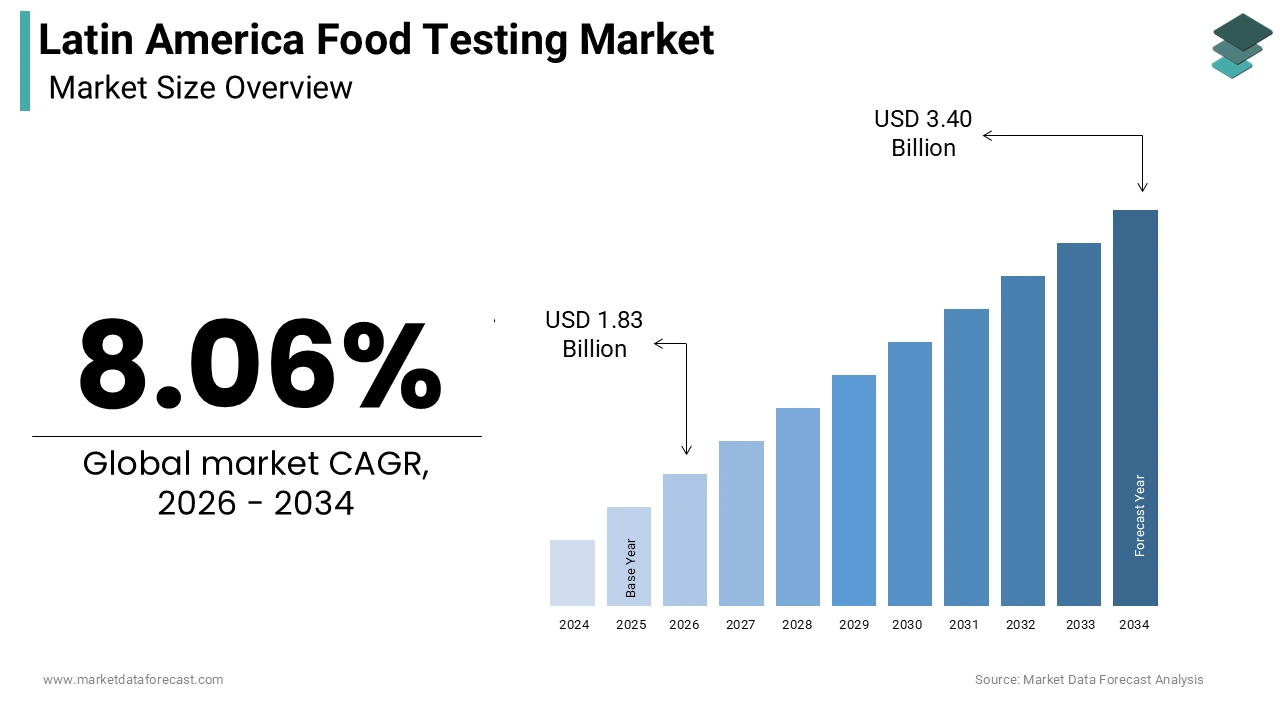
The Latin America Food Testing Market Size was calculated to be USD 1.69 billion in 2025 and is anticipated to be worth USD 3.40 billion by 2034 from USD 1.83 billion In 2026, growing at a CAGR of 8.06% during the forecast period.
Food safety is a primary concern for consumers owing to the constant threat of foodborne illness. Food testing is essential to achieve a certificate of analysis of raw food products and ready to eat foods at numerous stages of food processing. Customers are provided with food safety labels on food products to safeguard quality and safety of products. As per World Health Organization (WHO), over 2.5 million people died from diarrheal diseases in 2014 due to contaminant diet. In the U.S., approximately 75 million cases are witnessed for the same each year which is resulting in over 325 thousand hospitalizations and nearly 5 thousand deaths.
Market Drivers
Factors such as rapid increase in foodborne illness outbreaks, globalization of food supply, implementation of stringent food safety regulations, media influence on consumer awareness regarding food safety, and availability of advanced technology which has significantly quickened up the testing process are anticipated to drive the market growth.
Market Restraints
However, the lack of food control infrastructure, limited resources in emerging economies, and moderate awareness among the consumers are some of the restraints faced by this market. Nevertheless, the vendors operating in the global food safety testing market are expected to gain new opportunities in the developing countries due to an increase in the awareness among the consumers.
SEGMENTAL ANALYSIS
Latin America Food Testing Market By food Tested
- Meat & Poultry
- Dairy
- Processed Foods
- Fruits & Vegetables
Latin America Food Testing Market By Target Tested
- Pathogens
- Pesticides
- GMOs
- Toxins
The pathogen segment is estimated to account for the largest market share in the food safety testing market. E. coli, Listeria, Salmonella, and Campylobacter are some of the main pathogens responsible for food contamination and toxicity. They account for major contaminants found in food and account for a major number of food safety testing. An increase in the instances of foodborne illness, globally, due to pathogen outbreaks is driving the pathogen segment.
Latin America Food Testing Market By Technology
- Traditional
- Rapid
In accurate quantitative results, along with risk to perishable food spoilage due to time consuming traditional testing process is a key factor driving the industry towards advanced and upgraded technologies. PCR-based techniques, biosensors, ELISA, Immunoassay and rapid culture detection are repeatedly used technologies in the food testing market. Efficiency to monitor the count, type, and metabolites micro-organisms pertaining to spoilage, preservation, fermentation, safety, and pathogens are key features fueling technology adoption.
Latin America Food Testing Market By Region
- Brazil
- Mexico
- Argentina
- Chile
- Rest of Latin America
The share of Latin-American countries currently remains restricted because of a low awareness about food allergens and intolerance testing. Lack of government initiatives, poor economy and above all lack of awareness among individuals regarding safety related to food are going to hinder the market, though its untapped potential and increasing number of food related problems among people are going to help the growth of market.
Key Players in the Market
Major Key Players in the Latin America Food Testing Market are SGS SA, Eurofins Scientific, Intertek Group plc, Bureau Veritas SA, ALS Limited, Mérieux NutriSciences, TÜV SÜD, TÜV Nord Group, AsureQuality Ltd, Microbac Laboratories Inc, Genetic ID NA Inc, and Laboratory Corporation of America Holdings
Frequently Asked Questions
1. What factors are driving the growth of the Latin America food testing market?
Increasing food safety concerns, stricter government regulations, rising food exports, growing consumer awareness, and the expansion of the food and beverage industry are key growth drivers.
2. What are the major types of food testing conducted in the market?
Food testing commonly includes microbiological testing, allergen testing, chemical and pesticide residue testing, GMO testing, nutritional analysis, and food authenticity testing.
3. Why is food testing important in the food industry?
Food testing helps ensure product safety, maintain quality standards, prevent contamination, comply with regulations, and protect consumer health.
4. Which segment holds the largest market share in food testing?
Microbiological testing accounts for a significant market share due to the need to detect harmful pathogens and ensure food safety.
5. What role do food exports play in the food testing market?
Export-oriented food producers rely on comprehensive testing services to meet international safety and quality standards, thereby driving market demand.
6. What challenges does the Latin America food testing market face?
High testing costs, limited laboratory infrastructure in some regions, and evolving regulatory requirements are among the key challenges.
7. How is technology transforming the food testing industry?
Advanced analytical techniques, rapid testing methods, automation, and molecular diagnostics are improving testing accuracy, speed, and efficiency.
8. Who are the primary end-users of food testing services?
Food manufacturers, beverage producers, food exporters, retailers, government agencies, and foodservice companies are the primary end-users.
9. How is the growing processed food industry affecting the market?
The expansion of processed and packaged food production increases the need for quality assurance and safety testing throughout the supply chain.
10. What is the future outlook for the Latin America Food Testing Market?
The market is expected to grow steadily due to increasing food safety regulations, rising export activities, technological advancements in testing methods, and growing consumer awareness regarding food quality and safety.
Related Reports
Access the study in MULTIPLE FORMATS
Purchase options starting from
$ 1600
Didn’t find what you’re looking for?
TALK TO OUR ANALYST TEAM
Need something within your budget?
NO WORRIES! WE GOT YOU COVERED!
Call us on: +1 888 702 9696 (U.S Toll Free)
Write to us: sales@marketdataforecast.com