- Product Description Description
- Table of Contents TOC
- List of Table & Figure LOT
- Get Free Sample PDF Sample PDF
Market Size, 2025
$1.38 BnMarket Estimate, 2026
$1.64 BnMarket Forecast, 2034
$6.51 BnCAGR, 2026–2034
18.81%Executive Summary: Latin America Healthcare Cybersecurity Market
- Market Scope: Comprehensive market assessment of the Latin American healthcare cybersecurity sector, spanning offerings (solutions and services), threat types, security layers, end users, deployment modes, and country-level performance.
- Market Valuation: Valued at USD 1.38 billion in 2025, estimated at USD 1.64 billion in 2026, and projected to reach USD 6.51 billion by 2034, expanding at a robust compound annual growth rate (CAGR) of 18.81% from 2026 to 2034.
- Primary Growth Drivers: Escalating cyber-attacks and data breaches in healthcare, rapid digitization and telehealth adoption, increasing foreign direct investment (FDI) in pharma and biotech, and government mandates to protect personal health data.
Key Market Segment Metrics (2026–2034)
| Category | Leading Segment Focus | High-Impact Focus |
|---|---|---|
| By Offering | Solutions (IAM, SIEM, Encryption, Antivirus/Antimalware) | Services (Professional & Managed Services) |
| By Threat Type | Ransomware, Phishing, & Malware | DDoS, APTs, & Lost/Stolen Devices |
| By Security Type | Network Security & Cloud Security | Application Security & Endpoint/IoT Security |
| By Deployment Mode | Cloud-Based | On-Premises |
Country-Level Insights & Market Dynamics
Mexico: Captures a substantial share of the regional market, driven by rising healthcare investments and economic activity. However, it faces high vulnerabilities, including frequent mailing and web-based cyberattacks, ransomware targeting pharma/biotech, and historic data exposure incidents.
Brazil: Registers healthy growth, witnessing significant website hacking and patient data breaches (impacting millions of records), alongside surging smartphone phishing attacks via messaging apps (such as WhatsApp) and web application attacks on pharmaceutical firms.
Argentina: Demonstrates notable growth driven by rising medical device data breaches and an increased demand for healthcare cybersecurity across the medical and pharmaceutical sectors.
Market Challenges: High rates of hacking incidents, severe data breaches, patient privacy disruptions, and initial gaps in cybersecurity investment relative to rapid digital transformation.
Key Companies: McAfee LLC, FireEye, Atos SE, Palo Alto Networks, Inc., Cisco Systems, Inc., Fortified Health Security, Lockheed Martin Corporation, Booz Allen Hamilton, Inc., and IBM Corporation.
 Download Free Sample Report
Latin America Healthcare Cybersecurity Market Size
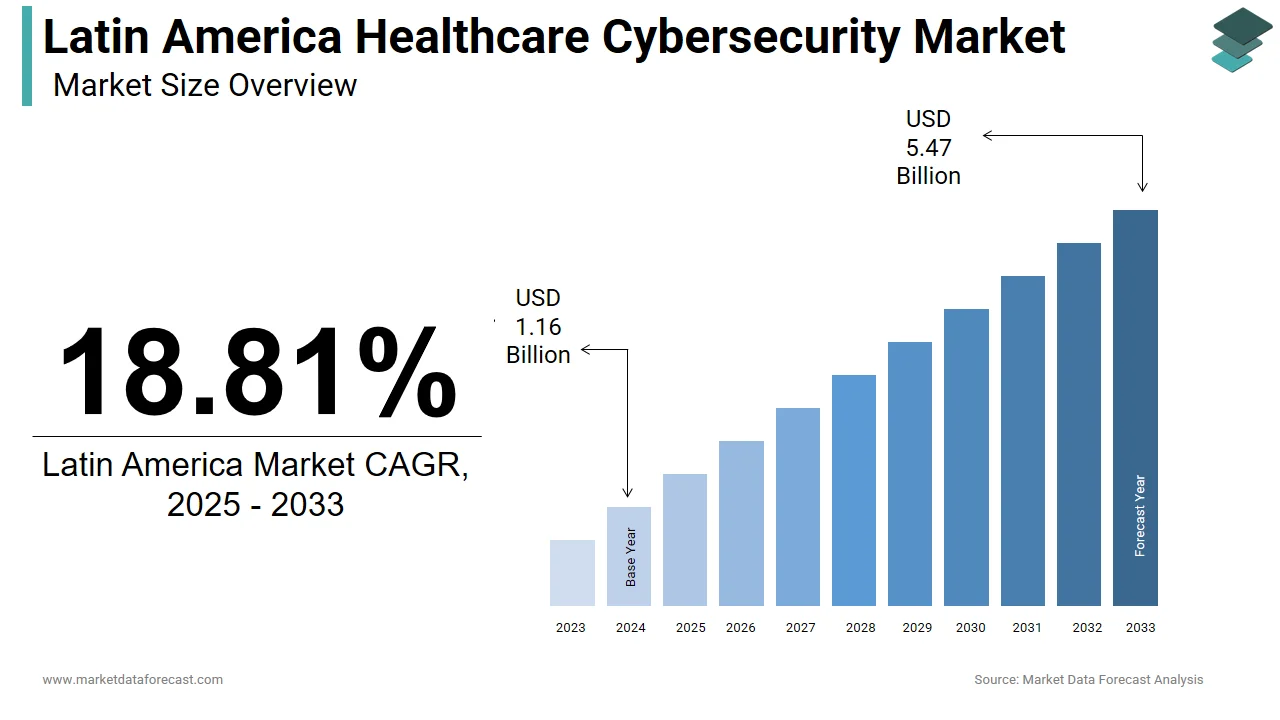
The Latin America healthcare cybersecurity market was valued at USD 1.38 billion in 2025. The market is estimated at USD 1.64 billion in 2026 and is projected to reach USD 6.51 billion by 2034, growing at a CAGR of 18.81% from 2026 to 2034.
MARKET DRIVERS
Rising Cyber Threats and Digital Healthcare Adoption Fuel Market Growth
The rapidly growing healthcare sector in Latin America is demanding cybersecurity solutions due to the need to privatize patient personal data, which is one of the key factors propelling the healthcare cybersecurity market growth in Latin America. In addition, the presence of emerging economies and developed countries and increasing healthcare expenditure in the Latin American region are further contributing to the growth of the Latin American market. Furthermore, the governments of Latin American countries have been putting significant efforts and investments to safeguard the privacy of the public and data security due to the rising number of cyber-attacks on life’s sciences and healthcare as well as medical services, which is anticipated to boost the growth rate of the Latin American healthcare cybersecurity market. Furthermore, rising networking in digital healthcare services such as telemedicine and telehealth services, increasing adoption of eHealth and growing adoption of technological developments in upgrading the capabilities in hospitals, and rapidly increasing medical devices demand for cybersecurity are promoting the growth of the healthcare cybersecurity market in Latin America.
MARKET RESTRAINTS
Rising Data Breaches and IT Vulnerabilities Hinder Market Progress
In Latin America, most hacking incidents happen each year in healthcare sectors; increasing IT applications such as software and smartphone applications or mobility in healthcare services are challenging factors in front of the Latin America healthcare cybersecurity market. Also, data breaches and patient privacy disturbance are the second leading causes in this region.
REPORT COVERAGE
| REPORT METRIC | DETAILS |
| Market Size Available | 2025 to 2034 |
| Base Year | 2025 |
| Forecast Period | 2026 to 2034 |
| Segments Covered | By Offering, Threat Type, Security Type, End User, Deployment Mode, and Country. |
| Various Analyses Covered | Global, Regional and Country-Level Analysis, Segment-Level Analysis, Drivers, Restraints, Opportunities, Challenges; PESTLE Analysis; Porter’s Five Forces Analysis, Competitive Landscape, Analyst Overview of Investment Opportunities |
| Country Covered | UK, France, Spain, Germany, Italy, Russia, Sweden, Denmark, Switzerland, Netherlands, Turkey, Czech Republic & Rest of Europe. |
| Market Leaders Profiled | McAfee, LLC, FireEye, Atos SE, Palo Alto Networks, Inc., Cisco Systems, Inc., Fortified Health Security, Lockheed Martin Corporation, Palo Alto Networks, Inc., Booz Allen Hamilton, Inc., and IBM Corporation. |
COUNTRY LEVEL ANALYSIS
The Latin American region occupied a considerable share of the global market in 2025 and is anticipated to witness a steady CAGR during the forecast period.
The Mexican market is expected to capture a substantial share of the Latin American region during the forecast period. Mexico has a high rate of economic status in which rising government support for healthcare expenditure annually welcomes healthcare cyber-attacks. According to world cybersecurity services, most of the hacking incidence happens in Mexico. A total of 33% of cyber-attack happens via mailing, and 30% of hacking and data breaches occur due to websites, many of which are seen in the healthcare and life sciences sectors. Rising pharmaceutical and Biotechnology industries in Mexico region witnessed the Ransomware cyber-attacks in Mexico. FDI is increasing rapidly in pharmaceutical industries, but lack of investment in cybersecurity said WHO. According to the German cybersecurity authority, 2.3 million Mexican private records unprotected in the last years gained, and the HOVA health telemedicine company industry exposed 2373764 patient data without any security. Mexico has weak cybersecurity services.
The Brazilian market is anticipated to register a healthy CAGR during the forecast period. Brazil also shows significant healthcare cyber-attack due to increasing website hacking incidents in which most of the incident related to patient data breaches registered. In 2017, 5.5 million and in 2018, 15 million patients were impacted by data breaking and almost a three-time high in one year. Total of 33% of cyber-attack via mailing and 31% via web attacks registered in recent years. Ransomware is the most prevalent healthcare cyberattack seen in Brazil. In the Covid-19 Outbreak, most cyber-attacks are registered through smartphones in Brazil. 124% phishing attacks by WhatsApp, and 7112 web application attacks in pharmaceutical industries in one year.
The market in Argentina is estimated to grow at a notable CAGR in the coming years. The cyber-attacks have impacted Argentina in the pharma and healthcare sector, with 73% of data breaches in medical device data accounted for in Argentina between 2018 to 19, which is demanding healthcare cybersecurity in this country.
KEY MARKET PLAYERS
Companies playing a leading role in the Latin American healthcare cybersecurity market profiled in this report are McAfee, LLC, FireEye, Atos SE, Palo Alto Networks, Inc., Cisco Systems, Inc., Fortified Health Security, Lockheed Martin Corporation, Palo Alto Networks, Inc., Booz Allen Hamilton, Inc., and IBM Corporation.
MARKET SEGMENTATION
This Latin America healthcare cybersecurity market research report is segmented and sub-segmented into the following categories.
By Offering
-
Solutions
-
Identity and Access Management (IAM)
-
Risk and Compliance Management
-
Antivirus and Antimalware
-
DDoS Mitigation
-
Security Information and Event Management (SIEM)
-
Intrusion Detection/Prevention Systems (IDS/IPS)
-
Encryption and Tokenization
-
Patch Management
-
Other Solutions (e.g., data backup and recovery, asset identification)
-
-
Services
-
Professional Services
-
Managed Services
-
By Threat Type
- Malware
- Ransomware
- Phishing
- Distributed Denial of Service (DDoS)
- Advanced Persistent Threats (APT)
- Spyware
- Lost or Stolen Devices
- Other Threats (e.g., unauthorized access, code injection)
By Security Type
- Network Security
- Cloud Security
- Application Security
- Endpoint and IoT Security
- Content Security
By End User
- Hospitals and Healthcare Facilities
- Medical Device Manufacturers
- Pharmaceuticals and Biotechnology Companies
- Health Insurance Providers and Payers
- Telehealth and Digital Health Providers
- Government Healthcare Agencies
- Others
By Deployment Mode
- On-Premises
- Cloud-Based
By Country
- Brazil
- Mexico
- Argentina
- Chile
- Rest of Latin America