- Product Description Description
- Table of Contents TOC
- List of Table & Figure LOT
- Get Free Sample PDF Sample PDF
Market Size, 2025
$120.80 MnMarket Estimate, 2026
$140.97 MnMarket Forecast, 2034
$484.96 MnCAGR, 2026–2034
16.7%Latin America Hydroponics Market Size, Growth, Trends & Forecast (2026–2034)
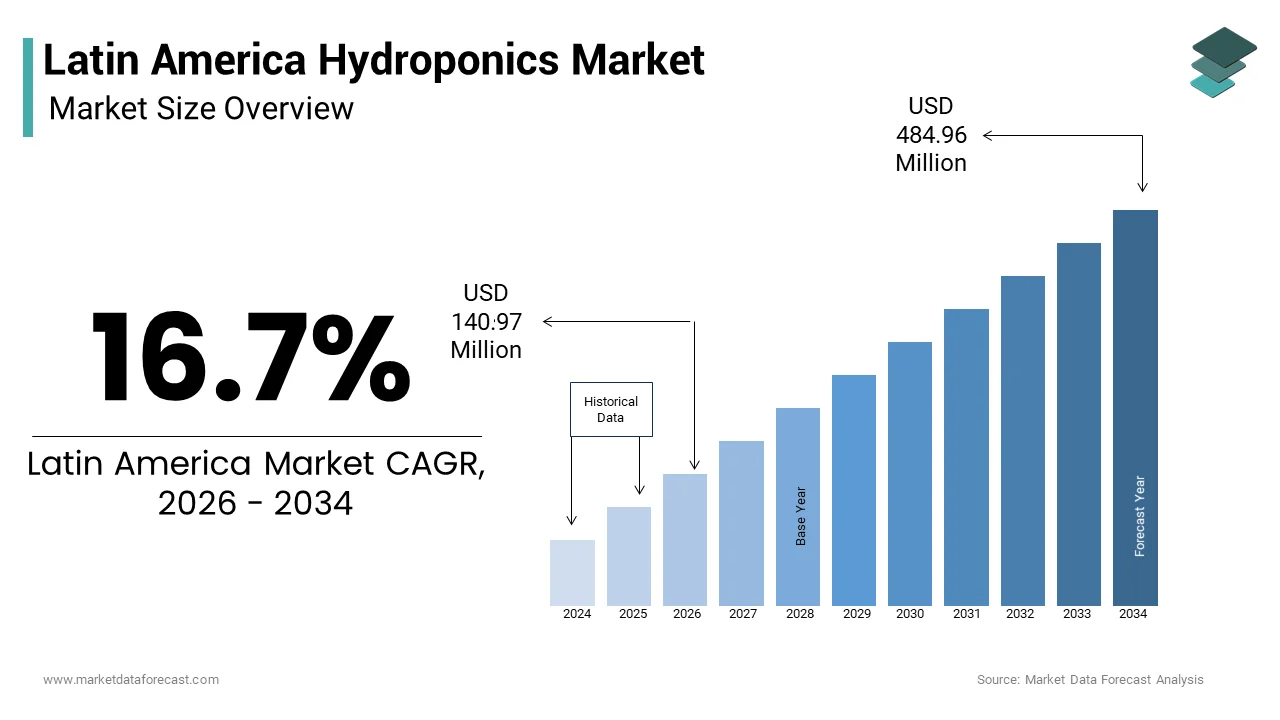
The Latin America hydroponics market size was valued at USD 120.80 million in 2025, is anticipated to reach USD 140.97 million in 2026, and is projected to scale up to USD 484.96 million by 2034, registering a compound annual growth rate (CAGR) of 16.7% during the forecast period from 2026 to 2034. Fueled by high metropolitan urbanization, escalating water scarcity pressures, and rising export demand for premium controlled-environment produce, the hydroponics sector continues to experience steady expansion across the region.
Key Executive Metrics (At-a-Glance)
- 2025 Base Valuation: USD 120.80 Million
- 2026 Current Valuation: USD 140.97 Million
- 2034 Forecast Valuation: USD 484.96 Million
- Compound Annual Growth Rate (CAGR): 16.7% (2026–2034)
- Dominant System Type: Aggregate Systems & Drip Irrigation (holding major market shares due to lower technical complexity and high resource efficiency)
- Dominant Application/Crop Segment: Tomatoes (commanding a 32.7% market share supported by high export potential and premium pricing)
- Fastest-Growing Application/Crop Segment: Lettuce & Leafy Vegetables (expanding at a 19.2% CAGR driven by short growth cycles and urban consumer demand)
- Dominant Regional Hubs: Brazil, Mexico, and Argentina (leading regional adoption through agricultural modernization and greenhouse expansion)
Core Market Drivers
- Escalating Urbanization: Over 81% urban population concentration driving localized food systems and reducing food transport miles near major metropolitan centers like São Paulo and Mexico City.
- Water Scarcity Pressures: Agricultural water consumption accounting for up to 70–86% of regional freshwater withdrawals, accelerating adoption of systems that reduce water use by up to 90%.
- Export Market Opportunities: Growing international demand for pesticide-free, residue-controlled produce complying with stringent North American and European phytosanitary standards.
Primary Market Restraints & Challenges
- High Capital Intensity & Skills Gap: Startup expenses ranging from USD 800,000 to over USD 1.5 million per hectare, restricting smallholder participation alongside a shortage of specialized agronomic training.
Latin America Hydroponics Market Segmentation Breakdown
| Segment Category | Leading Sub-Segment (2025 Base) | Fastest-Growing Sub-Segment (2026–2034) |
|---|---|---|
| By Equipment | HVAC Systems (dominant 28.8% share ensuring critical temperature and humidity regulation) | LED Grow Lights (fastest-growing at 18.4% CAGR due to energy efficiency and spectrum customization) |
| By System Type | Aggregate Systems (leading with 52.9% share for physical support and lower technical complexity) | Liquid Systems (fastest-growing at 14.4% CAGR driven by water efficiency and automation compatibility) |
| By Crop Type | Tomatoes (leading with 32.7% share backed by high yields, export demand, and disease reduction) | Lettuce & Leafy Vegetables (expanding at a 19.2% CAGR propelled by short 25–35 day cycles) |
| By Input Type | Nutrient Solutions (largest share due to essential continuous plant nutrition requirements) | Growth Medium (fastest-growing at 16.8% CAGR driven by sustainable peat-free coir adoption) |
| By Liquid / Closed | Nutrient-Film Technique (NFT) & Drip Systems (leading commercial adoption across regional farms) | Aeroponics (projected at a 21.3% CAGR driven by extreme water savings and high-value crops) |
Major Industry Players Profiled
Key enterprises shaping the competitive Latin American hydroponics market include Argus Control Systems, Koninklijke Philips NV, Greentech Agro LLC, Logiqs B.V., and Lumigrow, Inc..
Latin America Hydroponics Market Size
The Latin America hydroponics market size was valued at USD 120.80 million in 2025 and is anticipated to reach USD 140.97 million in 2026 and USD 484.96 million by 2034, growing at a CAGR of 16.7% from 2026 to 2034.
Current Introduction and Definition
Hydroponics is an agricultural technique that grows plants in a water-based, nutrient-rich solution rather than traditional soil. This innovative agricultural approach addresses fundamental environmental constraints while supporting food production in increasingly urbanized landscapes. Latin America and the Caribbean hold approximately 31 percent of global freshwater resources yet these supplies distribute unevenly across territories according to the Food and Agriculture Organization. Agriculture consumes between 43 percent and 86 percent of available water in regional nations as per comprehensive water consumption studies. Urbanization rates are approximately 81% across Latin America and the Caribbean, making it the second most urbanized region globally (behind Northern America) according to United Nations demographic data. Climate variability intensifies pressure on traditional farming as precipitation patterns shift and drought frequency increases in vulnerable zones. The region faces the imperative to raise agricultural output by 50 percent by 2050 while managing water extraction growth of 35 percent as per FAO projections. Hydroponic systems offer precise water application reducing consumption by up to 90 percent compared to conventional field agriculture. These controlled environment techniques enable year round production independent of seasonal rainfall while minimizing land footprint requirements. Hydroponics facilitates localized food production as population density concentrates in metropolitan centers. This approach significantly reduces transportation emissions and enhances supply chain resilience for perishable crops.
MARKET DRIVERS
Escalating Urban Population Density Driving Localized Food Production Demand
Rising urban populations are fueling the need for localized food systems, which propels the growth of the Latin America hydroponics market. Latin America exhibits an urbanization rate of 82.04 percent positioning the region among the most urbanized globally according to United Nations demographic statistics. This concentration creates sustained demand for fresh produce within metropolitan boundaries where traditional agricultural land remains scarce. Hydroponic installations in urban settings reduce food miles by enabling production within 50 kilometers of consumption centers. Cities like São Paulo and Mexico City face logistical challenges delivering perishable vegetables from rural zones with average transport distances exceeding 300 kilometers. Hydroponic facilities in vertical configurations achieve yield densities of 350 to 500 kilograms per square meter annually compared to 2 to 5 kilograms for field grown lettuce according to agricultural productivity research. Urban consumers demonstrate willingness to pay premium prices for locally harvested produce with freshness premiums ranging from 15 percent to 30 percent as per consumer behavior studies in major Latin American markets. Municipal governments increasingly support urban agriculture initiatives through zoning incentives and technical assistance programs. The proximity advantage of hydroponics aligns with growing consumer preference for traceable food sources and reduced carbon footprints.
Water Scarcity Pressures Accelerating Adoption of Efficient Irrigation Technologies
The escalation of water scarcity is compelling the widespread adoption of high-efficiency irrigation systems, which further boosts the expansion of the Latin America hydroponics market. Agricultural water consumption in Latin America and the Caribbean represents approximately 70% to 71% of total regional freshwater withdrawals according to UN ECLAC data. Traditional flood irrigation methods exhibit efficiency rates below 50 percent resulting in substantial resource wastage as per FAO technical evaluations. Hydroponic systems deliver nutrients through recirculating solutions achieving water use efficiency improvements of 70 percent to 90 percent compared to conventional field agriculture. Hydroponic installations require 90 percent less water per kilogram of produce than soil based systems enabling production continuity during drought periods. Investment in water saving technologies receives policy support through agricultural modernization programs in Chile Colombia and Peru.
MARKET RESTRAINTS
High Initial Capital Investment Requirements Limiting Smallholder Participation
High startup costs prevent small-scale farmers from participating, which hampers the growth of the Latin America hydroponics market. Establishing a fully commercial, automated hydroponic greenhouse facility requires a much higher investment, typically ranging from USD 800,000 to over USD 1.5 million per hectare. This financial threshold excludes many small scale farmers who represent approximately 80 percent of agricultural producers in Latin America as per regional agricultural census data. Equipment costs for nutrient delivery systems climate control infrastructure and monitoring technology constitute 65 percent to 75 percent of total startup expenses. Technical expertise requirements for system operation and crop management necessitate specialized training programs that remain underdeveloped in rural communities. Annual maintenance for sophisticated components like high-precision water pumps, pH/EC sensors, and automated controls requires an ongoing budget closer to USD 30,000 to USD 60,000 per hectare (roughly 3% to 5% of the total initial setup capital). A budget of USD 8,000 to 15,000 is only enough to cover tiny, artisanal, or small hobbyist operations. Energy consumption for artificial lighting and climate regulation represents 20 percent to 35 percent of operational expenditures in controlled environment facilities. Smallholder farmers typically operate on margins below 15 percent making debt service for hydroponic investments financially unviable without subsidy mechanisms. Government support programs for agricultural technology adoption allocate less than 5 percent of budgets to soilless cultivation initiatives according to ministry of agriculture expenditure reviews limiting accessibility for resource constrained producers.
Limited Technical Expertise and Knowledge Transfer Infrastructure
A shortage of specialized skills combined with an inadequate framework for sharing knowledge hinders the expansion of the Latin America hydroponics market. Successful hydroponic operation requires specialized competencies in nutrient chemistry plant physiology and environmental control systems that remain scarce across Latin American agricultural workforces. Regional reports confirm that hydroponic training is largely absent from formal agronomy degrees, forcing most growers to rely on private courses, online platforms, or peer-to-peer learning rather than university instruction. Data indicates that over 80% of agricultural holdings in Latin America are family farms, yet the vast majority lack access to any formal technical assistance. Public extension services primarily target staple crops (corn, beans) or export commodities, leaving small-scale high-tech growers with near-zero public support. The knowledge gap manifests in suboptimal system performance with nutrient solution mismanagement causing crop losses in novice operated facilities. Language barriers further complicate knowledge transfer as most advanced technical documentation originates in English while Spanish and Portuguese dominate regional agricultural communications. Training program availability remains concentrated in urban centers with fewer certified hydroponics instructors serving the entire Latin American region. Digital literacy constraints limit adoption of remote monitoring and decision support tools among traditional farming communities. Knowledge dissemination networks lack integration between research institutions commercial operators and smallholder producers creating information asymmetries that impede technology diffusion. Technical complexity will continue constraining market expansion beyond early adopter segments. Coordinated capacity building initiatives are essential to overcome this.
MARKET OPPORTUNITIES
Integration with Renewable Energy Systems Enhancing Operational Sustainability
Incorporating renewable energy systems boosts operational sustainability, which offers major opportunities for the Latin America hydroponics market. The region possesses exceptional renewable energy potential with solar irradiance averaging 5 to 7 kilowatt hours per square meter daily across most agricultural zones according to regional energy agency assessments. Hydroponic facilities require consistent electrical power for pumps lighting and climate control creating synergy with photovoltaic installations. Hybrid solar hydroponic systems reduce operational energy costs by 40 percent to 60 percent compared to grid dependent operations according to pilot project evaluations in Chile and Colombia. Government incentives for renewable energy adoption include tax credits covering a portionof solar installation expenses in Brazil Mexico and Argentina. Battery advancements have greatly improved power reliability, but achieving a completely grid-independent 24-hour commercial system is rarely financially viable for large facilities due to the extreme capital cost of massive battery banks. Instead, commercial farms use batteries to ride out brief blackouts or balance out peak energy costs while remaining grid-tied. Carbon credit mechanisms provide additional revenue streams with hydroponic renewable energy projects generating some tons of carbon offsets per hectare annually. Agribusiness investors increasingly prioritize environmental sustainability metrics with a portion of institutional capital allocations considering renewable energy integration as a selection criterion. The convergence of declining solar panel costs and rising electricity tariffs improves the economic case for energy autonomous hydroponic operations. According to regional development banks and international energy agencies, renewable energy capacity in Latin America is projected to expand at an annual pace of around 8% to 10%. This rapid green grid expansion drastically strengthens the economic and environmental case for clean-energy-powered, soilless cultivation systems.
Export Market Expansion for Premium Quality Controlled Environment Produce
Exporting top-tier controlled environment produce to other regions is likely to accelerate the expansion of the Latin America hydroponics market. Broader agricultural trade data confirms a steady rise in high-value, protected-culture exports (like tomatoes and berries) driven by international demand for consistent, year-round quality. Controlled environment cultivation enables production of pesticide free produce meeting stringent phytosanitary requirements of North American and European markets. Hydroponic tomatoes lettuce and herbs command price premiums in export channels compared to conventional field grown equivalents. Achieving GLOBALG.A.P. certification is mandatory to sell to premium international supermarkets. Certification acts as a entry ticket to maintain market access rather than a guarantee of a sale. Proximity to United States markets reduces transportation time to 48 to 72 hours for air freighted produce preserving freshness attributes valued by high end consumers. Trade agreements like USMCA and EU Mercosur negotiations reduce tariff barriers for agricultural exports from participating Latin American nations. Investment in post harvest cold chain infrastructure supports export quality maintenance with temperature controlled logistics networks expanding annually. E commerce platforms enable direct to consumer export models bypassing traditional distribution intermediaries and capturing additional margin for producers. As global demand for traceable sustainable produce grows at 9 percent annually according to consumer market research Latin American hydroponic exporters position to capture expanding premium market segments.
MARKET CHALLENGES
Climate Variability Impacting Controlled Environment System Performance
Increasing frequency of extreme weather events challenges hydroponic facility resilience across the region, which impedes the growth of the Latin America hydroponics market. Temperature fluctuations exceeding design parameters disrupt nutrient solution chemistry and plant metabolic processes reducing yield consistency. Heavy precipitation events cause flooding risks for ground level installations. Humidity variations affect transpiration rates and disease pressure requiring adaptive environmental control strategies that increase operational complexity. Climate models project precipitation variability will intensify across Central America with rainfall reductions in Pacific coastal zones. Heat waves exceeding 35 degrees Celsius challenge cooling system capacity in greenhouse hydroponic installations increasing energy consumption by 20 percent to 40 percent during peak stress periods. Wind events with velocities above 80 kilometers per hour threaten structural integrity of greenhouse facilities requiring reinforced construction specifications that elevate capital costs. Seasonal shifts in daylight duration affect supplemental lighting requirements for year round production planning. Adaptation investments for climate resilient infrastructure add 15 percent to 25 percent to facility establishment expenses according to agricultural engineering assessments. Comprehensive climate risk modeling and adaptive design protocols are essential for modern farming. Without them, hydroponic operations face production volatility that undermines commercial viability in unpredictable conditions.
Supply Chain Vulnerabilities for Specialized Inputs and Equipment
Vulnerabilities in sourcing niche inputs and specialized machinery are holding back the expansion of the Latin America hydroponics market. Hydroponic production depends on consistent availability of specialized inputs including nutrient formulations substrate materials and precision irrigation components that face supply chain constraints across Latin America. Import dependency for advanced growing media and sensor technology exposes operations to currency volatility and logistical disruptions with lead times extending 45 to 90 days for international shipments according to agricultural input distributor surveys. Regional manufacturing capacity for hydroponic specific equipment remains limited with fewer specialized producers serving the entire Latin American market. Transportation infrastructure gaps in rural areas increase delivery costs by 15 percent to 30 percent compared to urban centers according to logistics cost analyses. Nutrient solution components require precise chemical specifications with quality variations causing crop performance issues in a portion of production cycles. Spare parts availability for imported equipment creates maintenance delays averaging 14 to 21 days during system failures according to facility operator reports. Local technical service networks for complex hydroponic systems remain underdeveloped with response times exceeding 72 hours in non metropolitan locations. Regulatory frameworks for agricultural input registration vary across national jurisdictions creating compliance complexity for multi country operators. Supply chain diversification strategies require inventory holding costs of 8 percent to 12 percent of annual input expenditures according to operational finance assessments. Input supply vulnerabilities will continue to constrain hydroponic market scalability across Latin America. Overcoming this requires strengthening regional manufacturing and distribution networks.
REPORT COVERAGE
| REPORT METRIC | DETAILS |
| Market Size Available | 2025 to 2034 |
| Base Year | 2025 |
| Forecast Period | 2026 to 2034 |
| CAGR | 16.7% |
| Segments Covered | By Equipment, By Type, Crop Type, Input Type, Aggregate Hydroponics Systems, Liquid Hydroponic Systems, Closed Systems, and Country |
| Various Analyses Covered | Global, Regional & Country Level Analysis, Segment-Level Analysis, DROC, PESTLE Analysis, Porter’s Five Forces Analysis, Competitive Landscape, Analyst Overview on Investment Opportunities |
| Regions Covered | Brazil, Argentina, Mexico |
| Market Leaders Profiled | Argus Control Systems, Koninklijke Philips NV, Greentech Agro LLC, Logiqs B.V., and Lumigrow, Inc. |
By Equipment Insights
The HVAC systems segment dominated the Latin America hydroponics market and accounted for a 28.8% share in 2025. This dominance of the segment was driven by its critical role in maintaining optimal temperature and humidity levels for soilless cultivation. Latin America experiences diverse climatic conditions ranging from tropical humidity to arid zones requiring precise environmental regulation for consistent crop yields. Commercial hydroponic facilities invest heavily in HVAC technology to mitigate heat stress which can reduce lettuce productivity. Energy efficient HVAC units with variable speed drives reduce operational costs by 20 percent to 35 percent compared to conventional systems as per energy consumption analyses in controlled environment agriculture. Government incentives for energy conservation in agricultural operations further accelerate HVAC adoption with tax rebates covering 15 percent to 25 percent of installation expenses in Brazil and Mexico according to ministry of agriculture policy documents. The integration of smart sensors with HVAC systems enables real time climate adjustments improving resource efficiency and crop quality metrics. As extreme weather events increase frequency across the region according to meteorological agency records the reliability advantage of advanced HVAC infrastructure strengthens its market leadership position substantially.
On the other hand, the LED grow light segment is predicted to witness the highest CAGR of 18.4% from 2026 to 2034 due to superior energy efficiency and spectrum customization capabilities. LED fixtures consume 40 percent to 60 percent less electricity than traditional high pressure sodium lamps while delivering equivalent photosynthetic photon flux according to horticultural lighting research. Spectrum adjustable LEDs enable growers to manipulate plant morphology and secondary metabolite production enhancing nutritional value and market appeal of hydroponic produce. Urban farming initiatives across São Paulo Mexico City and Bogotá increasingly adopt LED technology for vertical cultivation achieving yield densities higher than field agriculture according to sources. Declining LED component costs annually improve return on investment timelines for commercial operators. Integration with IoT platforms allows remote monitoring and automated light scheduling reducing labor requirements according to studies.
By Type Insights
The aggregate systems segment led the Latin America hydroponics market and captured a 52.9% share in 2025. This leading position of the segment was attributed to its versatility adaptability and lower technical complexity compared to liquid based alternatives. Aggregate media including coconut coir perlite and rockwool provide physical root support while enabling precise nutrient delivery through drip or ebb and flow mechanisms. Small and medium scale farmers representing 80 percent of agricultural producers in the region prefer aggregate systems due to reduced risk of system failure and easier troubleshooting according to agricultural extension service reports. Coconut coir consumption in Latin America grows annually driven by sustainability preferences and local production capacity according to research. Aggregate systems tolerate wider pH fluctuations reducing nutrient management complexity for operators with limited technical training. Initial investment requirements for aggregate configurations remain 25 percent to 40 percent lower than sophisticated liquid recirculation systems according to agricultural engineering cost assessments. The compatibility of aggregate media with existing greenhouse infrastructure facilitates incremental technology adoption among traditional growers transitioning to soilless cultivation. Technical support networks are expanding across rural Latin America, which gives aggregate systems a distinct accessibility advantage. Consequently, this benefit reinforces their dominant position in the market.
However, the liquid systems segment is estimated to register the fastest CAGR of 14.4% during the forecast period owing to superior water use efficiency and automation compatibility. Nutrient film technique and deep water culture configurations achieve water consumption reductions of 85 percent to 95 percent compared to conventional agriculture according to FAO water productivity assessments. Commercial operations targeting export markets prefer liquid systems for consistent quality control and traceability attributes valued by international buyers. Automation integration with liquid systems enables precise nutrient dosing pH adjustment and solution monitoring reducing labor costs according to sources. Investment in liquid hydroponics receives policy support through agricultural modernization programs in Chile Colombia and Peru with subsidy mechanisms covering a portion of technology acquisition expenses according to studies. The scalability of liquid configurations from pilot installations to commercial scale facilities attracts venture capital funding with agricultural technology investments in Latin America growing annually according to surveys. Commercial growers face tight water allocation restrictions as droughts intensify across arid regions. To adapt, these operations are increasingly adopting liquid hydroponics for its resource-saving benefits.
By Crop Insights
The tomato production segment held the majority share of 32.7% of the Latin America hydroponics market in 2025. This supremacy of the segment was credited to high market demand export potential and favorable agronomic characteristics under soilless cultivation. Hydroponic tomato yields reach 400 to 600 tons per hectare annually compared to 60 to 80 tons for field cultivation according to productivity research from agricultural universities. Premium pricing for pesticide free hydroponic tomatoes in export channels generates margins higher than conventional produce. Mexico and Brazil lead regional tomato hydroponics adoption. Greenhouse tomato exports from Latin America to North America grew annually. Disease pressure reduction in controlled environments decreases crop loss incidents by 60 percent to 75 percent compared to open field production according to plant pathology studies. Investment in high wire tomato cultivation systems receives financing support through agricultural development banks offering preferential interest rates. Global demand for consistent quality tomatoes is expanding. Thus, the production reliability of hydroponic systems strengthens market leadership for this crop segment.
But the lettuce and leafy vegetable segment is anticipated to witness the fastest CAGR of 19.2% between 2026 and 2034. This swift growth of the segment is propelled by short growth cycles urban demand and nutritional positioning. Hydroponic lettuce achieves harvest readiness in 25 to 35 days compared to 45 to 60 days for soil based production according to horticultural research institutes. Urban consumers in metropolitan centers demonstrate willingness to pay freshness premiums of 20 percent to 35 percent for locally harvested leafy greens according to consumer behavior studies in major Latin American markets. Vertical farming configurations for leafy vegetables achieve space utilization efficiency higher than traditional agriculture. Investment in leafy green hydroponics attracts venture capital with agricultural technology funding in the region growing annually according to surveys. Integration with e commerce platforms enables direct to consumer sales models capturing additional margin for producers according to digital agriculture market analyses. Health consciousness is rising across Latin American populations. Hence, the nutritional positioning of hydroponic leafy vegetables is accelerating adoption among both commercial operators and urban farming initiatives.
By Input Insights
The nutrient segment was the largest in the Latin America hydroponics market and occupied a substantial share in 2025. This prominence of the segment was supported by its essential role in plant nutrition and recurring purchase requirements. Commercial hydroponic operations consume nutrient formulations depending on crop type and growth stage according to agronomic application guidelines. Premium nutrient brands with chelated micronutrients command price premiums of 15 percent to 25 percent due to enhanced uptake efficiency and yield performance according to input supplier market analyses. Local manufacturing capacity for hydroponic nutrients remains limited with import dependency exceeding 70 percent for specialized formulations according to agricultural input trade statistics. Investment in nutrient blending facilities receives policy support through agricultural industrialization programs in Brazil and Mexico with tax incentives covering some of equipment expenditures. Technical training programs for nutrient management reach fewer than 30 percent of small scale hydroponic operators according to agricultural extension service reports creating opportunities for value added advisory services. Hydroponic cultivation area is rapidly expanding across the region. Hence, the recurring demand profile for nutrient inputs reinforces their dominant market position within the input segment.
On the contrary, the growth medium segment is likely to experience the fastest CAGR of 16.8% over the forecast period. This rapid expansion of the segment is fuelled by sustainability preferences and local production advantages. Coconut coir consumption in Latin America grows annually supported by regional production capacity in Colombia Ecuador and Central America. Organic certification requirements for export markets accelerate adoption of peat free growing media with certified organic substrates commanding price premiums. Investment in substrate processing facilities receives financing support through agricultural development programs with preferential interest rates. Reusability characteristics of certain growth media including expanded clay and rockwool reduce long term input costs by 25 percent to 35 percent according to operational finance analyses. Environmental regulations are tightening across Latin American nations. As a result, the sustainability benefits of renewable growth media are accelerating their adoption by commercial hydroponic operators in premium markets.
By Aggregate Hydroponics Systems Insights
The closed aggregate hydroponic systems segment was the top performer in the regional market and secured a significant share in 2025. Factors such as superior resource efficiency and environmental compliance attributes are contributing to the segment’s top position. Recirculating nutrient solutions in closed configurations achieve water use reductions of 90 percent compared to open systems according to FAO water productivity evaluations. Regulatory frameworks increasingly mandate nutrient runoff containment for commercial agricultural operations accelerating closed system adoption. Investment in closed system infrastructure receives policy support through sustainable agriculture programs. Operational cost advantages of closed systems include fertilizer savings of 30 percent to 50 percent due to nutrient recapture according to agricultural input cost analyses. Technical complexity of closed configurations requires specialized training programs reaching fewer than 35 percent of small scale operators according to agricultural extension service reports creating opportunities for value added technical support services. Water scarcity is rapidly intensifying across drought-prone regions. Thus, the resource-conservation advantages of closed aggregate systems reinforce their dominant market position.
On the other hand, the open systems segment is on the rise and is expected to be the fastest growing segment in the market by witnessing a CAGR of 13.5% from 2026 to 2034 due to lower initial investment requirements and operational simplicity. Entry level open system configurations require capital expenditures 40 percent to 60 percent lower than closed recirculation alternatives according to agricultural engineering cost assessments. Small scale farmers representing 80 percent of agricultural producers in the region prefer open systems due to reduced technical complexity and easier troubleshooting according to agricultural census data. Drain to waste nutrient management in open systems eliminates pH stabilization requirements reducing operational monitoring needs. Technical support networks are rapidly expanding across rural Latin America. This accessibility advantage of open aggregate systems accelerates adoption among resource-constrained producers transitioning to soilless cultivation.
By Liquid Hydroponic Systems Insights
The nutrient-film technique segment spearheaded the Latin American market and held a 45.8% share in 2025 because of versatility, scalability, and proven performance across diverse crop types. NFT channels enable efficient root zone oxygenation while minimizing solution volume requirements reducing pump energy consumption. Commercial lettuce and herb producers favor NFT systems for rapid harvest cycles and consistent quality attributes valued by retail channels according to supply chain management studies. Investment in NFT infrastructure receives policy support through agricultural modernization programs in Mexico and Colombia. As urban farming initiatives expand across Latin American metropolitan centers, the space efficiency advantage of NFT configurations becomes clear. Consequently, this reinforces their dominant market position within liquid hydroponic systems.
However, the aeroponic segment is expected to exhibit a noteworthy CAGR of 21.3% during the forecast period owing to superior resource efficiency and premium crop positioning. Aeroponic misting achieves water consumption reductions of 95 percent compared to conventional agriculture according to FAO water productivity evaluations. High value crops including strawberries medicinal herbs and specialty greens command price premiums in export channels when produced via aeroponics. Investment in aeroponic technology attracts venture capital funding with agricultural technology investments in Latin America growing annually. Integration with IoT monitoring platforms enables precise misting control and nutrient delivery reducing labor requirements. As sustainability certifications gain importance in global supply chains, the environmental advantage of aeroponic systems becomes undeniable. This is accelerating adoption among commercial operators targeting premium market segments.
By Closed Systems Insights
The drip irrigation segment secured the top position in the regional market and accounted for a 58.5% share in 2025. This dominance of the segment was driven by reliability adaptability and compatibility with diverse aggregate media. Drip emitters deliver precise nutrient volumes directly to root zones reducing solution waste by 30 percent to 50 percent compared to flood methods according to agricultural water management studies. Commercial tomato cucumber and pepper producers favor drip systems for consistent yield performance and disease pressure reduction according to crop production research. Investment in drip infrastructure receives policy support through irrigation modernization programs in Brazil and Argentina. Drought-prone regions are facing increasingly severe water allocation restrictions. This environmental pressure highlights the precision application advantage of drip closed systems, which reinforces their dominant market position.
On the contrary, the Ebb and flow closed systems segment is predicted to witness the highest CAGR of 15.7% between 2026 and 2034. This growth is supported by automation compatibility and labor efficiency attributes. Timed flood cycles enable uniform nutrient distribution across growing beds reducing manual intervention requirements. Commercial leafy green and herb producers favor ebb and flow configurations for rapid crop turnover and consistent quality attributes valued by retail channels. Integration with sensor networks enables automated cycle adjustment based on environmental conditions improving resource efficiency by 20 percent to 30 percent according to agricultural technology assessments. Labor costs are rising across Latin American agricultural sectors, causing commercial operators to seek operational scalability. Therefore, the automation advantage of ebb and flow closed systems is rapidly accelerating their adoption among these growers.
COUNTRY ANALYSIS
Brazil Hydroponics Market Analysis
Brazil dominated Latin America hydroponics market and captured a 42.7% share in 2025. This leading position of the Brazilian market was propelled by extensive agricultural infrastructure research capacity and domestic consumption scale. Hydroponic cultivation area in Brazil exceeds 850 hectares with concentrated activity in São Paulo Minas Gerais and Rio Grande do Sul states according to national agricultural census data. Government support through EMBRAPA research initiatives accelerates technology adaptation for tropical conditions with public investment. Urban farming initiatives in São Paulo and Rio de Janeiro receive municipal incentives including zoning flexibility and technical assistance programs according to city planning agency reports. Export oriented hydroponic operations target North American and European markets. Investment in hydroponic technology receives financing support through BNDES development bank offering preferential interest rates of 8 percent to 12 percent according to agricultural credit evaluations. Domestic demand for premium fresh produce is expanding. Consequently, the production capacity advantage of Brazilian hydroponics reinforces its regional leadership position substantially.
Mexico Hydroponics Market Analysis
Mexico was positioned second in the regional market and held a 28.5% share in 2025. This growth was driven by export orientation proximity to United States markets and favorable climate conditions. Trade agreement provisions under USMCA facilitate tariff free export of hydroponic vegetables to North American markets generating revenues 30 percent to 50 percent higher than domestic channels according to international commerce analyses. Technical training partnerships with United States agricultural universities accelerate knowledge transfer for advanced cultivation techniques according to extension service reports. As United States demand for year round fresh produce expands the geographic advantage of Mexican hydroponics reinforces its strong regional market position substantially.
Argentina Hydroponics Market Analysis
Argentina is another key player in the Latin America hydroponics market due to agricultural expertise export infrastructure and favorable exchange rate dynamics. Export oriented operations target European and Middle Eastern markets. Investment in hydroponic technology receives financing support through research initiatives with public private partnerships covering equipment expenditures. Training is available but remains fragmented, often driven by private companies and specific INTA extension modules rather than a centralized university network. As global demand for sustainable produce expands the quality positioning of Argentine hydroponics reinforces its solid regional market position substantially.
Chile Hydroponics Market Analysis
Chile plays a key role in the Latin America hydroponics market owing to export orientation climate diversity and strong regulatory frameworks. According to the 2021 National Census of Agriculture and Forestry, the recorded area for hydroponic cultivation is approximately 81 hectares (spread across ~216 holdings). Activity is indeed concentrated in the central regions. Chile is a global leader in counter-seasonal fruit exports (cherries, grapes, berries), but these are largely soil-grown or substrate-based fruit crops. Hydroponic vegetables (lettuce, leafy greens) are highly perishable and are almost exclusively consumed in the domestic market. Certification programs for Global GAP and organic standards enhance market access with certified facilities achieving notable acceptance rates in premium retail channels. As Northern Hemisphere demand for off season fresh produce expands the counter seasonal advantage of Chilean hydroponics reinforces its growing regional market position substantially.
COMPETITIVE LANDSCAPE
Competition within Latin America hydroponics market features a dynamic landscape combining multinational technology providers with emerging regional specialists. Established global players leverage comprehensive product portfolios and technical expertise to serve large commercial operations while regional firms focus on localized solutions and cost effective offerings for small scale producers. Market fragmentation remains moderate with top five participants collectively holding approximately 45 percent of regional value according to industry assessments. Competitive differentiation centers on technology integration capabilities technical support infrastructure and adaptation to tropical growing conditions. Price competition intensifies in equipment segments with local manufacturing initiatives reducing import dependency and improving affordability for resource constrained operators. Innovation competition focuses on automation IoT integration and sustainability certifications enhancing operational efficiency and market access for hydroponic produce. Strategic partnerships between technology providers and agricultural distributors expand market reach while accelerating knowledge transfer across diverse production scales. As hydroponic cultivation area expands across Latin America competitive dynamics increasingly favor participants offering comprehensive solutions combining hardware software and agronomic support. Through continuous innovation and strategic positioning market participants navigate evolving competitive landscape while supporting sustainable growth of soilless cultivation across the region.
KEY MARKET PLAYERS
Major Players dominating the market are
- Argus Control Systems
- Koninklijke Philips NV
- Greentech Agro LLC
- Logiqs B.V.
- Lumigrow, Inc.
Top Players In The Market
- Argus Control Systems maintains significant influence within Latin America hydroponics market through comprehensive environmental control solutions and technical support infrastructure. The company provides integrated hardware and software platforms enabling precise climate monitoring nutrient management and automation for commercial hydroponic facilities. Recent strategic initiatives include partnerships with regional distributors in Brazil Mexico and Argentina to expand service coverage and local technical support capacity. The organization invests in training programs for agricultural technicians enhancing adoption of advanced control systems among medium and large scale hydroponic operators. Product development focuses on cloud based monitoring capabilities enabling remote facility management reducing operational labor requirements. Argus Control Systems collaborates with research institutions to adapt control algorithms for tropical growing conditions improving system performance across diverse Latin American climates. The company participates in agricultural technology exhibitions across the region strengthening brand visibility and customer engagement. Through continuous innovation in environmental control technology Argus Control Systems strengthens its contribution to global hydroponics market advancement while supporting sustainable production growth across Latin America.
- Koninklijke Philips NV leverages its lighting expertise to deliver specialized LED grow light solutions for Latin America hydroponics market. The company provides spectrum customizable fixtures enabling growers to optimize plant morphology nutritional content and harvest timing for diverse crop types. Recent strategic initiatives include joint ventures with regional agricultural technology firms to establish local assembly operations reducing import costs and delivery timelines. The organization invests in research collaborations with Latin American universities to develop light recipes adapted to tropical growing conditions improving yield performance and energy efficiency. Product development focuses on IoT integration enabling remote monitoring and automated light scheduling reducing operational complexity for commercial operators. Koninklijke Philips NV participates in sustainability certification programs enhancing market access for hydroponic produce grown with energy efficient lighting technology. The company provides technical training for facility managers accelerating adoption of advanced lighting strategies among regional hydroponic producers. Through continuous innovation in horticultural lighting Koninklijke Philips NV strengthens its contribution to global hydroponics market advancement while supporting resource efficient production growth across Latin America.
- Greentech Agro LLC maintains strong presence within Latin America hydroponics market through comprehensive nutrient formulations and technical advisory services. The company provides specialized fertilizer blends optimized for soilless cultivation across diverse crop types and growth stages. Recent strategic initiatives include establishment of regional blending facilities in Brazil and Mexico reducing import dependency and improving product availability for commercial growers. The organization invests in agronomic research partnerships with Latin American agricultural institutions to develop nutrient protocols adapted to regional water quality and climate conditions. Product development focuses on organic certified formulations enhancing market access for hydroponic produce targeting premium retail channels. Greentech Agro LLC provides on site technical support and training programs accelerating adoption of advanced nutrient management strategies among regional hydroponic operators. The company participates in sustainability certification initiatives strengthening environmental positioning of hydroponic production systems. Through continuous innovation in plant nutrition science Greentech Agro LLC strengthens its contribution to global hydroponics market advancement while supporting high quality sustainable production growth across Latin America.
Top Strategies Used By Key Market Participants
Key market participants in Latin America hydroponics sector employ strategic approaches including regional distribution partnerships to expand market reach and technical support capacity. Companies invest in local assembly operations reducing import costs and improving delivery timelines for equipment and inputs. Strategic collaborations with agricultural research institutions enable adaptation of technologies to tropical growing conditions enhancing performance across diverse Latin American climates. Product development focuses on IoT integration and automation capabilities reducing operational labor requirements for commercial hydroponic facilities. Participants pursue sustainability certification programs enhancing market access for hydroponic produce targeting premium retail and export channels. Technical training initiatives for facility managers and agricultural technicians accelerate adoption of advanced cultivation strategies among regional producers. Companies participate in agricultural technology exhibitions strengthening brand visibility and customer engagement across Latin American markets. Strategic pricing models with financing options improve accessibility for small and medium scale hydroponic operators. Through these coordinated strategies market participants strengthen competitive positioning while supporting sustainable growth of soilless cultivation across Latin America.
MARKET SEGMENTATION
This research report on the Latin America hydroponics market is segmented and sub-segmented into the following categories.
By Equipment
- HVAC
- LED Grow Light
- Communication Technology
- Irrigation Systems
- Material Handling
- Control Systems
By Type
- Aggregate & Liquid
By Crop Type
- Tomato
- Lettuce & Leafy Vegetables
- Cucumber
- Pepper & Strawberry
By Input Type
- Nutrients
- Growth Medium
By Aggregate Hydroponics Systems
- Closed Systems
- Open Systems
By Liquid Hydroponic Systems
- Nutrient Film Technique (NFT)
- Floating Hydroponics
- Aeroponics
By Closed Systems
- The Water Culture System
- The EBB and Flow System
- Drip Systems
- The Wick System
By Country
- Brazil
- Argentina
- Mexico