- Product Description Description
- Table of Contents TOC
- List of Table & Figure LOT
- Get Free Sample PDF Sample PDF
Market Size, 2025
$0.90 TnMarket Estimate, 2026
$1.03 TnMarket Forecast, 2034
$3.04 TnCAGR, 2026–2034
14.48%Latin America Insurance Market Size
The Latin America insurance market was valued at USD 0.90 trillion in 2025, is estimated to reach USD 1.03 trillion in 2026, and is projected to reach USD 3.04 trillion by 2034, growing at a CAGR of 14.48% from 2026 to 2034.
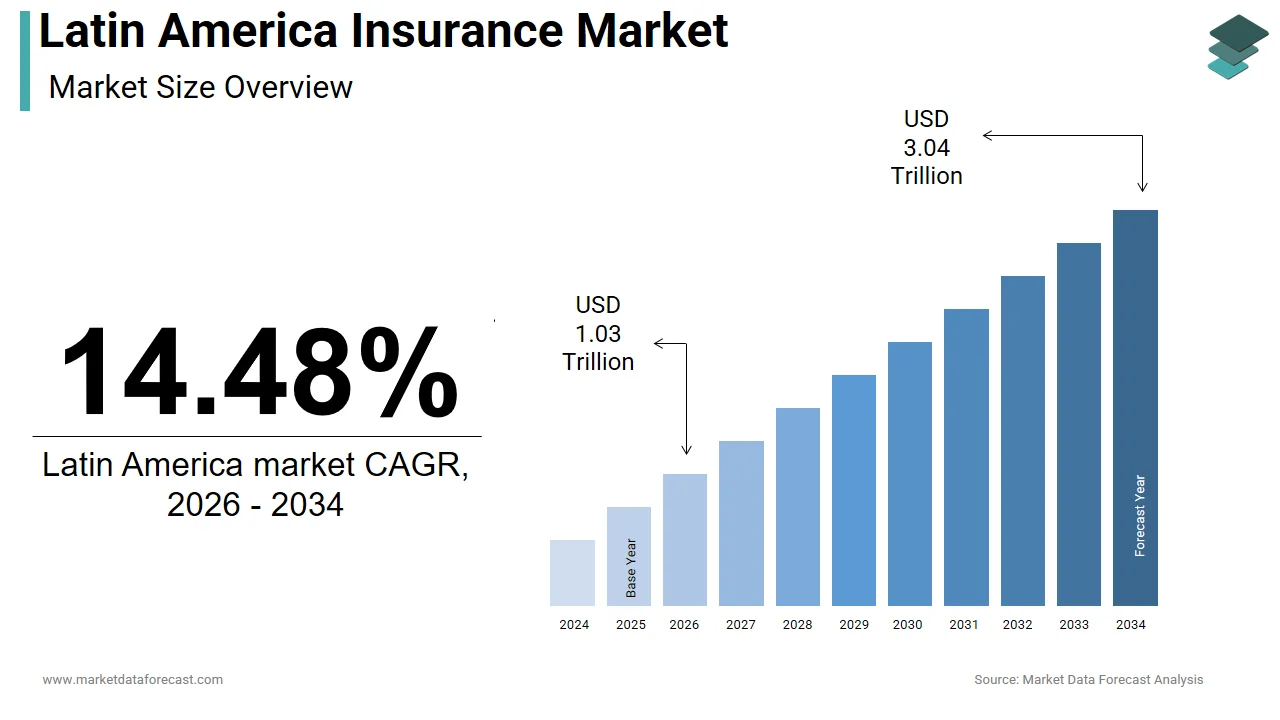
The insurance is a wide range of risk mitigation and financial protection products, including life, health, property and casualty, motor, and specialty insurance. The insurance sector in the region has been evolving due to increasing awareness of financial security, regulatory reforms, and technological advancements. However, insurance penetration remains relatively low compared to global averages, presenting both challenges and growth potential. Additionally, the economic volatility in countries like Argentina and Venezuela has historically impacted insurance demand, while nations such as Chile and Mexico have demonstrated more stable growth due to stronger regulatory frameworks and higher financial inclusion rates.
MARKET DRIVERS
Rising Awareness and Financial Inclusion Initiative
The increasing awareness of financial security and the expansion of financial inclusion initiatives across the region is fuelling the growth of the Latin America insurance market. Governments and regulatory bodies in several Latin American countries have been actively promoting financial literacy programs to encourage individuals and businesses to adopt formal risk management tools such as insurance. The National Council of Private Insurance (CNSP) reported that in 2023, microinsurance products accounted for an increasing share of the market in health and crop insurance segments. Moreover, digital banking and mobile financial services have played a crucial role in expanding insurance reach.
Regulatory Reforms and Market Liberalization
The implementation of regulatory reforms aimed at modernizing the sector and encouraging foreign investment. Several countries in the region have undertaken structural changes to improve transparency, enhance risk-based capital requirements, and promote competition. According to the International Monetary Fund (IMF), as of 2023, Argentina had implemented a series of regulatory updates to align its insurance framework with international standards, which is attracting greater participation from global insurers. Additionally, regional integration efforts have facilitated cross-border insurance operations. The Latin American Insurance Forum, established by several national regulators, has been instrumental in harmonizing regulatory practices across the region.
MARKET RESTRAINTS
Low Insurance Penetration and Underdeveloped Risk Culture
The region’s persistently low insurance penetration and underdeveloped risk culture is limiting the growth of the Latin America insurance market. According to the International Association of Insurance Supervisors (IAIS), in 2023, the insurance penetration rate in Latin America stood at only 2.9% of GDP, significantly lower than the global average of 6.8%. This indicates that insurance remains a relatively minor component of the region’s financial ecosystem. In countries like Bolivia and Paraguay, where informal economic activity dominates, individuals and small businesses rarely purchase insurance due to limited trust in formal financial institutions. The World Bank reported that in 2023, over 50% of workers in these countries were engaged in informal employment, making it difficult to introduce structured insurance products. Additionally, cultural perceptions of insurance as an unnecessary expense rather than a financial safeguard contribute to low adoption rates.
Economic Volatility and Currency Instability
The economic volatility and currency instability across several Latin American countries pose a major challenge to the growth of the insurance market. Many nations in the region experience high inflation, fluctuating exchange rates, and periodic financial crises, which directly impact the affordability and profitability of insurance products. The National Council of Private Insurance (CNSP) reported that in 2023, several insurers were forced to raise premiums or reduce coverage due to currency-related cost pressures. Moreover, economic instability deters foreign investment in insurance markets. In Peru, despite regulatory reforms, investor confidence has been shaken by currency fluctuations and political uncertainty, as reported by the Superintendence of Banking, Insurance, and Private Pension Fund Administrators (SBS).
MARKET OPPORTUNITIES
Digital Transformation and Insurtech Innovation
The rapid digital transformation and emergence of insurtech startups are reshaping the industry landscape. The increasing adoption of smartphones, expanding internet penetration, and rising consumer demand for convenience have created a conducive environment for digital insurance solutions. As per the National Council of Private Insurance (CNSP) in 2023, digital insurance policies accounted for nearly 20% of all new motor and health insurance sales, indicating a growing shift in consumer behavior. Moreover, the integration of blockchain technology and parametric insurance models is gaining traction in the region.
Expansion of Microinsurance and Social Protection Programs
The growing emphasis on microinsurance and government-backed social protection programs is enhancing the growth of the Latin America insurance market. These initiatives aim to extend insurance coverage to low-income populations and informal workers who traditionally lack access to formal risk management tools. According to the International Labour Organization (ILO), in 2023, over 50% of the labor force in Latin America worked in the informal sector, which makes them particularly vulnerable to economic shocks and health emergencies. In response, governments and development agencies have been promoting microinsurance schemes that offer affordable coverage for health, life, and property risks. In Guatemala, the Ministry of Finance collaborated with international organizations to introduce crop insurance programs for smallholder farmers affected by climate-related risks. The expansion of such initiatives is expected to drive broader insurance adoption and contribute to the long-term growth of the Latin America insurance market.
MARKET CHALLENGES
Regulatory Fragmentation and Compliance Complexity
The regulatory fragmentation across the region, which complicates compliance, is posing challenges for the growth of the Latin America insurance market. Each country has its own set of insurance laws, supervisory frameworks, and reporting requirements, making it difficult for insurers to operate seamlessly across borders. In countries like Argentina and Brazil, frequent changes in insurance regulations create uncertainty for market participants. The National Council of Private Insurance (CNSP) in Brazil reported that in 2023, over 30% of insurance firms faced compliance challenges due to evolving solvency and capital adequacy rules. Additionally, differences in taxation policies across the region add to the complexity. In Mexico, for example, insurance premiums are subject to different tax treatments depending on the type of coverage, as reported by the Comisión Nacional de Seguros y Fianzas (CNSF). This variability affects pricing strategies and market competitiveness, making it difficult for insurers to develop standardized products for regional deployment.
Fraud and Underwriting Risks
The fraud and underwriting risks pose a significant challenge to the Latin America insurance market. Insurance fraud, including staged accidents, false claims, and identity theft, is a persistent issue in several countries, which is leading to increased costs and stricter underwriting practices. According to the Latin American Insurance Fraud Prevention Network (LIFPN), in 2023, fraudulent claims accounted for nearly 8% of total insurance payouts in the region, with motor and health insurance being the most vulnerable segments. Moreover, underwriting risks are exacerbated by limited access to reliable data and credit histories, particularly in rural and informal sectors. In countries like Ecuador and Bolivia, where formal financial records are scarce, insurers struggle to assess risk accurately, often leading to either overpricing or exclusion of potential policyholders.
REPORT COVERAGE
| REPORT METRIC | DETAILS |
| Market Size Available | 2025 to 2034 |
| Base Year | 2025 |
| Forecast Period | 2026 to 2034 |
| Segments Covered | By Type, Distribution Channel, and Region. |
| Various Analyses Covered | Global, Regional and Country-Level Analysis, Segment-Level Analysis, Drivers, Restraints, Opportunities, Challenges; PESTLE Analysis; Porter’s Five Forces Analysis, Competitive Landscape, Analyst Overview of Investment Opportunities |
| Countries Covered | Brazil, Mexico, Argentina, Chile, Rest of Latin America |
| Market Leaders Profiled | Centene Corporation, Zurich Ins Group, Allianz SE, UnitedHealth Group Incorporated, Progressive Corporation, State Farm Group, Elevance Health, Inc., AXA S.A., HDI V.a.G., MetLife Inc., and others. |
SEGMENTAL ANALYSIS
By Type Insights
The life insurance segment held 52.3% of the Latin America insurance market share in 2024. According to the National Council of Private Insurance (CNSP), life insurance premiums accounted for nearly 40% of all insurance revenues in 2023. The segment’s growth is supported by the integration of life insurance with banking products, particularly in pension-linked policies and mortgage insurance. Additionally, demographic shifts such as urbanization and rising middle-class populations are contributing to the demand for life insurance. According to the United Nations Economic Commission for Latin America and the Caribbean (ECLAC), life expectancy in the region increased by nearly 4 years between 2010 and 2023.
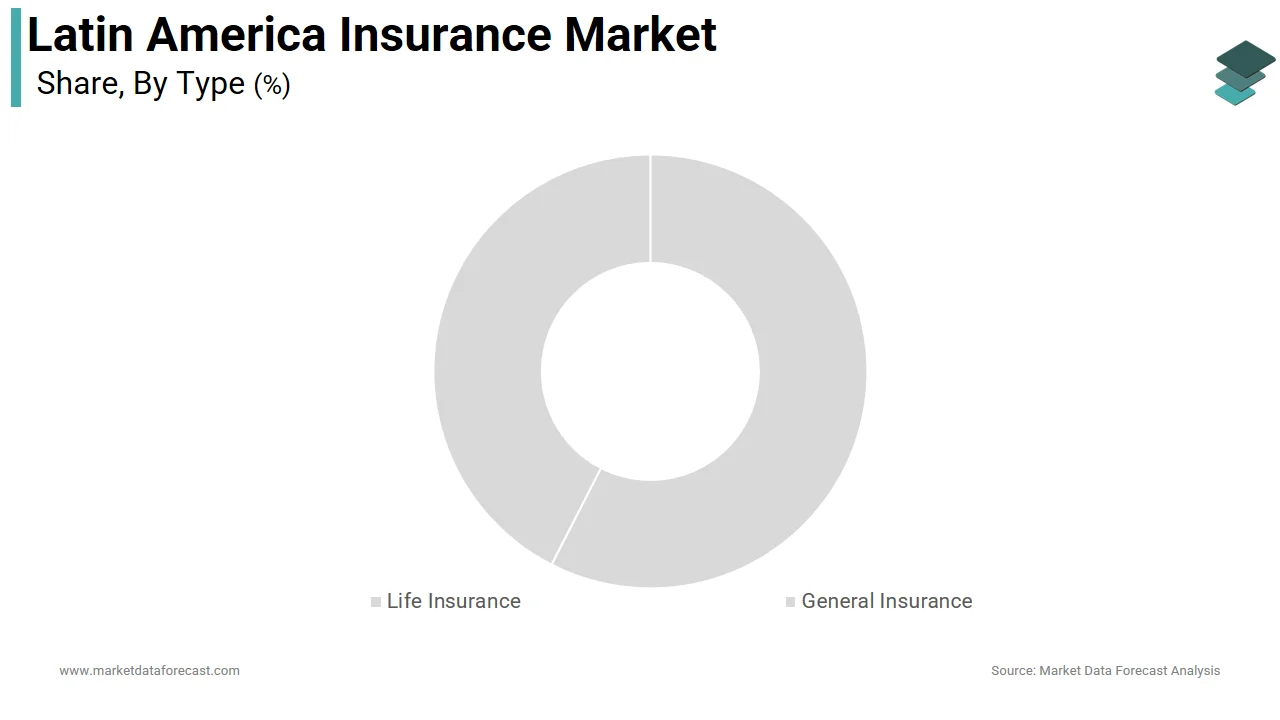
The general insurance segment is lucratively growing with a CAGR of 7.4% from 2026 to 2034 with the expansion of mandatory insurance policies, particularly in the motor insurance sector. In Brazil, where motor insurance is legally required, the CNSP reported that motor premiums grew by 8% in 2023, supported by rising vehicle ownership and digital insurance platforms. Additionally, the impact of climate-related risks has increased the demand for property and agricultural insurance. In Mexico, the CNSF noted a 10% increase in property insurance claims due to extreme weather events in 2023, prompting greater awareness and policy adoption.
By Distribution Channel Type Insights
The direct sales segment accounted in holding 45.3% of the Latin America insurance market share in 2024 due to the growing preference for direct engagement with insurance providers, especially in urban areas where brand recognition and digital accessibility play a crucial role.
In Brazil, the National Council of Private Insurance (CNSP) reported that in 2023, over 50% of life insurance policies were sold directly through insurer websites or mobile applications. This trend is supported by the expansion of digital insurance platforms that offer streamlined policy purchasing and claims management. Moreover, the presence of well-established insurance companies with nationwide operations contributes to the strength of this channel.
The banking channel segment is projected to register a CAGR of 8.1% from 2026 to 2034. Bancassurance, the practice of selling insurance products through bank branches and digital banking platforms, has gained traction across the region. In Brazil, the Central Bank of Brazil reported that in 2023, over 30% of insurance policies were sold through banking channels, particularly in life and credit protection insurance linked to loans and mortgages. Similarly, in Colombia, the Financial Superintendence noted that bancassurance accounted for nearly 25% of total insurance sales, with major banks such as Banco de Bogotá and Bancolombia expanding their insurance offerings.
Additionally, regulatory support for bancassurance models has contributed to this segment’s growth. In Mexico, the CNSF reported that partnerships between banks and insurers increased by 15% in 2023, with products such as health and motor insurance being bundled with banking services.
COUNTRY-LEVEL ANALYSIS
Brazil Insurance Market Insights
Brazil was the largest contributor to the Latin America insurance market by accounting for 34.3% of the share in 2024. According to the National Council of Private Insurance (CNSP), total insurance premiums in Brazil reached USD 125 billion in 2023, with life insurance and motor insurance being the most prominent segments. The integration of insurance with banking services has played a significant role in market expansion, with major banks such as Itaú Unibanco and Bradesco offering bundled insurance products to their extensive customer base. Moreover, Brazil has seen a surge in digital insurance adoption, with insurtech startups like Dock Seguros and Lemon expanding their reach through mobile platforms. The Central Bank of Brazil reported that in 2023, over 20% of new insurance policies were purchased online, reflecting a shift in consumer behavior toward digital engagement.
Mexico Insurance Market Insights
Mexico insurance market was next with 18.2% of the Latin America insurance market share in 2024. The CNSF also reported that bancassurance accounted for nearly 30% of insurance sales, driven by partnerships between banks and insurance companies to offer bundled products. Additionally, Mexico has seen an increase in mandatory insurance requirements in the health and motor insurance sectors. The Ministry of Health reported that in 2023, nearly 60% of the population had some form of health insurance, including both public and private coverage.
Argentina Insurance Market Insights
Argentina insurance market is expected to have a significant CAGR during the forecast period. According to the Superintendence of Insurance (SSN), total insurance premiums in Argentina reached USD 18 billion in 2023, with life insurance and health insurance being the primary contributors. The SSN also noted that employer-sponsored insurance programs in the private sector have driven growth in health insurance coverage. Moreover, Argentina has seen an increase in microinsurance initiatives aimed at expanding coverage to low-income populations. The Ministry of Economy reported that in 2023, over 15% of insurance policies were targeted at informal workers and small businesses, reflecting efforts to improve financial inclusion.
Chile Insurance Market Insights
Chile insurance market is characterized by high financial inclusion, strong regulatory oversight, and a growing emphasis on digital insurance solutions. According to the Superintendence of Banks and Insurance (SBIF), total insurance premiums in Chile reached USD 15 billion in 2023, with life insurance and pension-linked policies accounting for a significant portion of the market. Additionally, Chile has been at the forefront of adopting parametric insurance models, particularly in the agricultural and property sectors. The Ministry of Finance reported that in 2023, over 20% of property insurance policies in high-risk areas were parametric by allowing for faster claims processing based on predefined triggers.
Colombia Insurance Market Insights
Colombia insurance market growth is driven by a growing middle class, expanding financial inclusion, and increasing government efforts to promote insurance adoption. According to the Financial Superintendence of Colombia, total insurance premiums reached USD 13 billion in 2023, with health insurance and motor insurance being the most significant contributors. Furthermore, Colombia has been actively promoting microinsurance initiatives to extend coverage to low-income and rural populations.
COMPETITIVE LANDSCAPE
The Latin America insurance market is marked by a diverse and dynamic competitive environment, where multinational insurers, regional players, and local firms coexist. While global and regional companies bring scale, financial strength, and technological expertise, domestic insurers often have a deeper understanding of local consumer behavior and regulatory nuances. This balance fosters a competitive yet collaborative market, where bancassurance and digital innovation are reshaping distribution models. The presence of numerous small and mid-sized insurers further intensifies competition, particularly in general insurance and microinsurance segments. At the same time, regulatory reforms and economic volatility create both challenges and opportunities, prompting companies to adapt their strategies to remain resilient. Insurtechs are also entering the space, offering agility and innovation that traditional insurers are increasingly adopting through partnerships or internal transformation.
KEY MARKET PLAYERS
Some of the noteworthy companies in the Latin America insurance market profiled in this report are
- Centene Corporation
- Zurich INS Group
- Allianz SE
- UnitedHealth Group Incorporated
- Progressive Corporation
- State Farm Group
- Elevance Health, Inc.
- AXA S.A.
- HDI V.a.G.
- MetLife Inc.
TOP LEADING PLAYERS IN THE MARKET
- Mapfre S.A. is a leading Spanish insurer with a strong presence in Latin America that plays a pivotal role in the region’s insurance landscape. The company operates across multiple countries, including Brazil, Argentina, and Mexico, offering a wide range of products such as motor, health, life, and agricultural insurance. Mapfre’s deep understanding of local markets, combined with its commitment to customer-centric solutions, has allowed it to maintain a strong foothold in both urban and rural segments. Its focus on sustainability and digital transformation has further enhanced its regional reputation by making it a key player in shaping the insurance industry’s evolution in Latin America.
- BBVA Insurance, part of the global BBVA Group, is a major force in the Latin American insurance market in Mexico, Colombia, and Peru. The company leverages its banking heritage to offer integrated insurance solutions through bancassurance models, making insurance products easily accessible to a large customer base. BBVA Insurance emphasizes digital innovation and personalized risk management, aligning insurance offerings with broader financial services. Its ability to seamlessly integrate insurance into banking operations has enabled it to expand its market share and reinforce customer loyalty across the region.
- Grupo Sura, through its insurance and pension subsidiaries, is a dominant player in the Latin American insurance market in Colombia, Chile, and Panama. The company offers a comprehensive portfolio of life, health, and general insurance products, supported by a robust financial services ecosystem. Grupo Sura’s long-term investment approach, combined with its emphasis on customer education and financial planning, has positioned it as a trusted provider in the region.
TOP STRATEGIES USED BY KEY MARKET PARTICIPANTS
Integration with Financial Services through Bancassurance Models
A core strategy employed by leading insurers in Latin America is the integration of insurance products with banking services through bancassurance partnerships. Insurers can distribute products more efficiently and enhance customer acquisition by leveraging the extensive customer networks of banks. This model allows for cross-selling opportunities in life and credit insurance, and strengthens brand trust by associating insurance offerings with established financial institutions.
Digital Transformation and Insurtech Collaborations
To remain competitive and meet evolving consumer expectations, key players are investing heavily in digital transformation. Insurers are developing mobile applications, online claims processing systems, and AI-driven underwriting tools to enhance user experience. Additionally, partnerships with insurtech startups are enabling traditional insurers to adopt agile business models, introduce innovative products, and improve operational efficiency in emerging markets with high mobile penetration.
Expansion of Microinsurance and Inclusive Products
Recognizing the large informal economy and underserved populations in the region, major insurers are expanding their microinsurance portfolios. These products are designed to be affordable and accessible to low-income individuals and small businesses, often distributed through digital platforms or community-based networks. This strategy not only supports financial inclusion but also opens new growth avenues for insurers seeking to tap into previously unreachable market segments.
RECENT MARKET DEVELOPMENTS
- In February 2023, Mapfre S.A. launched a digital insurance platform tailored for the Colombian market, aimed at simplifying policy management and claims processing for both individual and business clients. This initiative was designed to enhance customer experience and accelerate digital adoption in a region with rising smartphone usage.
- In July 2023, BBVA Insurance expanded its bancassurance network in Mexico by integrating insurance offerings into the mobile banking app of BBVA Bancomer by allowing customers to purchase and manage policies directly from their banking interface. This move was intended to strengthen customer engagement and increase insurance penetration among digital-first users.
- In November 2023, Grupo Sura introduced a new line of microinsurance products in Peru, which is targeting informal workers and small business owners. This initiative was aimed at broadening financial inclusion by offering affordable coverage for health, accident, and property risks through digital and agent-based distribution channels.
- In March 2024, a leading regional insurer partnered with a major insurtech startup in Brazil to develop an AI-driven underwriting system that enhances risk assessment and personalizes insurance offerings. This collaboration was intended to improve operational efficiency and attract a younger, tech-savvy demographic.
- In September 2024, a consortium of Latin American insurers formed a regional alliance to share data and develop standardized parametric insurance models for climate-related risks. This initiative was designed to improve resilience in high-risk areas and enable faster claims processing through automated triggers based on environmental data.
MARKET SEGMENTATION
This Latin America insurance market research report is segmented and sub-segmented into the following categories.
By Type
- Life Insurance
- General Insurance
By Distribution Channel
- Insurers
- Insurance Brokers and Agencies
- Banks
- Others
By Country
- Brazil
- Mexico
- Argentina
- Chile
- Rest of Latin America