Latin America Two-Wheeler Market Size, Share, Growth, Trends, And Forecast Research Report, Segmented By Vehicle Type, Fuel Type, Engine Capacity, Technology, And Country (India, China, Japan, South Korea, Australia, New Zealand, Thailand, Malaysia, Vietnam, Philippines, Indonesia, Singapore and Rest of APAC), Industry Analysis From (2026 to 2034)
Market Size, 2025
$1.21 BnMarket Estimate, 2026
$1.37 BnMarket Forecast, 2034
$3.60 BnCAGR, 2026–2034
12.89%Latin America Two-Wheeler Market Size
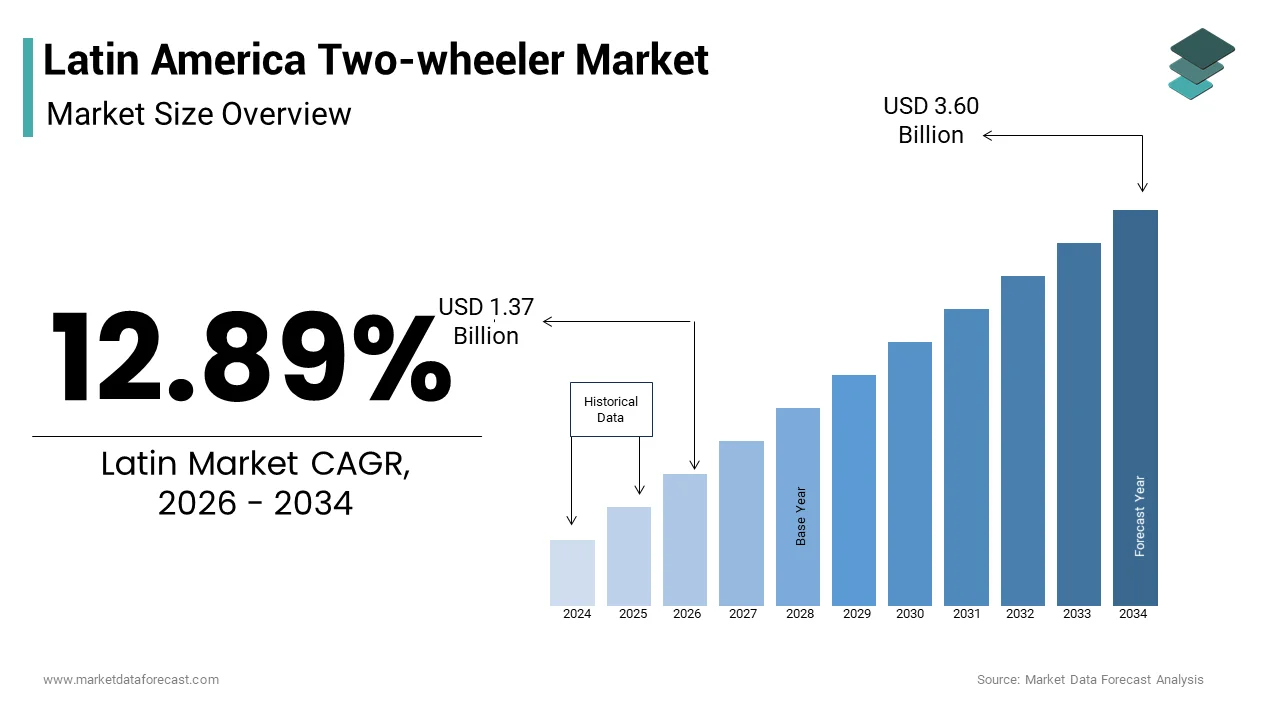
The Latin American two-wheeler market size was valued at USD 1.21 billion in 2025 and is anticipated to reach USD 1.37 billion in 2026 to reach USD 3.60 billion by 2034, growing at a CAGR of 12.89% during the forecast period from 2026 to 2034.
MARKET DRIVERS
Urbanization and Rising Demand for Personal Mobility
The rapid urbanization is the key factor for the growth of the Latin American two-wheeler market. As per the United Nations Department of Economic and Social Affairs (UN DESA), over 80% of Latin America's population resides in urban areas, a figure significantly higher than the global average. This rapid urbanization has led to increased traffic congestion and a strain on public transport systems, prompting consumers to seek faster, more flexible, and cost-effective commuting alternatives. For instance, in Mexico City, where the average commute time exceeds 60 minutes, motorcycle ownership has risen sharply, with approximately 3.2 million registered motorcycles as of 2023.
Favorable Government Policies and Incentives
The governments across Latin America have introduced supportive policies and financial incentives to promote the adoption of two-wheelers, especially electric models, as part of broader environmental and economic development strategies. These initiatives have played a pivotal role in shaping the region’s two-wheeler market dynamics. This policy has contributed to a surge in electric two-wheeler sales, with over 12,000 units sold in 2023 alone, according to the Colombian Association of Automotive Industries (ANDI). Brazil has also taken steps to support the motorcycle industry through the "Rota 2030" program, a long-term automotive policy that includes incentives for cleaner and more efficient vehicles. Additionally, in Mexico, federal and state-level governments have introduced low-interest loan schemes for two-wheeler purchases, especially targeting low-income groups.
MARKET RESTRAINTS
Economic Volatility and Currency Fluctuations
The economic instability across several Latin American countries has emerged as a significant restraint on the growth of the two-wheeler market. Countries like Argentina, Venezuela, and even Brazil have experienced high inflation rates, currency devaluation, and fluctuating GDP growth, all of which affect consumer purchasing power and investment in the automotive sector. Moreover, Brazil, the largest two-wheeler market in the region, has seen a decline in consumer confidence due to macroeconomic uncertainties.
Regulatory and Infrastructure Limitations
The regulatory challenges and inadequate infrastructure development are restricting the growth of the Latin American two-wheeler market. While some countries have introduced progressive policies to support two-wheeler adoption, others lag in terms of traffic management, road safety laws, and dedicated infrastructure for two-wheeler users. In Brazil, despite the large two-wheeler base, infrastructure remains underdeveloped. Only 15% of major roads are equipped with designated motorcycle parking or lanes, according to the Brazilian Traffic Engineering Institute (IBET). This lack of infrastructure discourages potential buyers and increases the risk of congestion-related accidents.
Furthermore, regulatory inconsistencies across countries complicate market expansion for manufacturers. For example, Argentina enforces strict emission norms that are not harmonized with neighboring countries, increasing production complexity and cost.
MARKET OPPORTUNITIES
Expansion of E-Mobility and Green Transportation Initiatives
The growing emphasis on sustainability and environmental consciousness has created a significant opportunity for the Latin American two-wheeler market. Several governments and private players are investing in green mobility solutions to reduce carbon emissions and dependence on fossil fuels. In Colombia, the capital city Bogotá has launched a national electric mobility strategy, aiming to have 500,000 electric vehicles, including two-wheelers, on the road by 2030. Brazil is also witnessing a surge in e-mobility adoption, with major manufacturers such as Motocaddy and Unick launching locally produced electric scooters.
Growth of Ride-Hailing and Delivery Services
The rapid expansion of ride-hailing and last-mile delivery services across Latin America has created a robust demand for two-wheelers in urban centers is another factor prompting the growth of the two-wheeler market. Companies like Uber, Didi, and Rappi have significantly increased their fleet sizes, relying heavily on motorcycles and scooters for efficient and cost-effective operations. Moreover, the rise of micro-mobility platforms offering shared scooter rentals has further boosted two-wheeler adoption. In Santiago, Chile, companies like Grin and Yellow have deployed thousands of shared electric scooters, catering to short-distance commuters. This demand from the service sector has encouraged manufacturers to develop specialized models tailored for commercial use, including high-range electric scooters and durable motorcycles with enhanced load-carrying capacity.
MARKET CHALLENGES
High Insurance and Maintenance Costs
High insurance and maintenance costs pose a significant challenge to the two-wheeler market growth in Latin America. According to the Mexican Insurance Chamber (CNSF), over 60% of motorcycle owners operate without insurance due to cost constraints, exposing them to financial risks in the event of accidents or theft. Maintenance costs also add to the burden. In Brazil, where motorcycles are widely used for daily commuting, the average annual maintenance cost for a mid-range scooter is approximately USD 400, according to the Brazilian Automotive Service Association (SINDIREPA). Additionally, the lack of standardized spare parts and after-sales service networks in rural areas further increases repair costs and downtime. In countries like Peru and Ecuador, access to certified service centers is limited outside major cities, leading to reliance on informal repair shops that may offer substandard services.
Fuel Price Volatility and Operating Cost Uncertainty
The fuel price volatility with the cost-effectiveness of these vehicles. While two-wheelers are generally more fuel-efficient than cars, fluctuating fuel prices have introduced financial uncertainty for consumers, especially in countries where fuel subsidies have been reduced or eliminated. In Colombia, fuel prices rose by nearly 30% in 2023 following the government’s decision to phase out subsidies. As reported by the National Hydrocarbons Agency (ANH), the average cost of a liter of gasoline reached USD 1.30, making fuel a major expense for two-wheelers. In Brazil, despite having a more stable fuel market, the state-controlled oil company Petrobras has implemented frequent price adjustments, causing fluctuations in operating costs.
REPORT COVERAGE
| REPORT METRIC | DETAILS |
| Market Size Available | 2025 to 2034 |
| Base Year | 2025 |
| Forecast Period | 2026 to 2034 |
| CAGR | 12.89% |
| Segments Covered | By Vehicle Type, Fuel Type, Engine Capacity, Technology, Country |
| Various Analyses Covered | Global, Regional & Country Level Analysis, Segment-Level Analysis, DROC, PESTLE Analysis, Porter’s Five Forces Analysis, Competitive Landscape, Analyst Overview on Investment Opportunities |
| Regions Covered | India, China, Japan, South Korea, Australia, New Zealand, Thailand, Malaysia, Vietnam, Philippines, Indonesia, Singapore, and the Rest of APAC |
| Market Leaders Profiled | Bajaj Auto Limited (Bajaj Group), Dafra Motos (Itavema S/A), Honda de México S.A. de C.V. (The Honda Motor Company Ltd.), Kawasaki Motors Manufacturing Corp. U.S.A. (Kawasaki Heavy Industries, Ltd.), Lifan Industry (Group) Co. Ltd, Motomel S.A., Shineray Do Brasil SA, Suzuki Motor Corporation, TVS Motor México (TVS Motor Company Limited), Wanxin Group International, Yamaha Motor de México SA de CV (Yamaha Motor Co. Ltd.), Zanella Hnos & Cia SACIFI and Zongshen Automobile Industry Manufacturing Co. Ltd. (Zongshen Industry Group Co. Ltd.) |
SEGMENTAL ANALYSIS
By Vehicle Insights
The motorcycle segment dominated the Latin American two-wheeler market share in 2024, with the versatility and adaptability of motorcycles across various usage scenarios, from daily commuting to commercial delivery services. In countries like Brazil and Mexico, motorcycles are a preferred mode of transport due to their ability to navigate congested urban environments and provide cost-effective mobility. Another contributing factor is the well-established manufacturing and distribution infrastructure for motorcycles in the region. Brazil alone produced over 850,000 motorcycles in 2023, with companies like Honda, Yamaha, and Harley-Davidson maintaining a strong presence. The National Association of Vehicle Manufacturers (ANFAVEA) notes that motorcycle exports from Brazil increased by 14% in 2023, indicating strong regional and international demand.
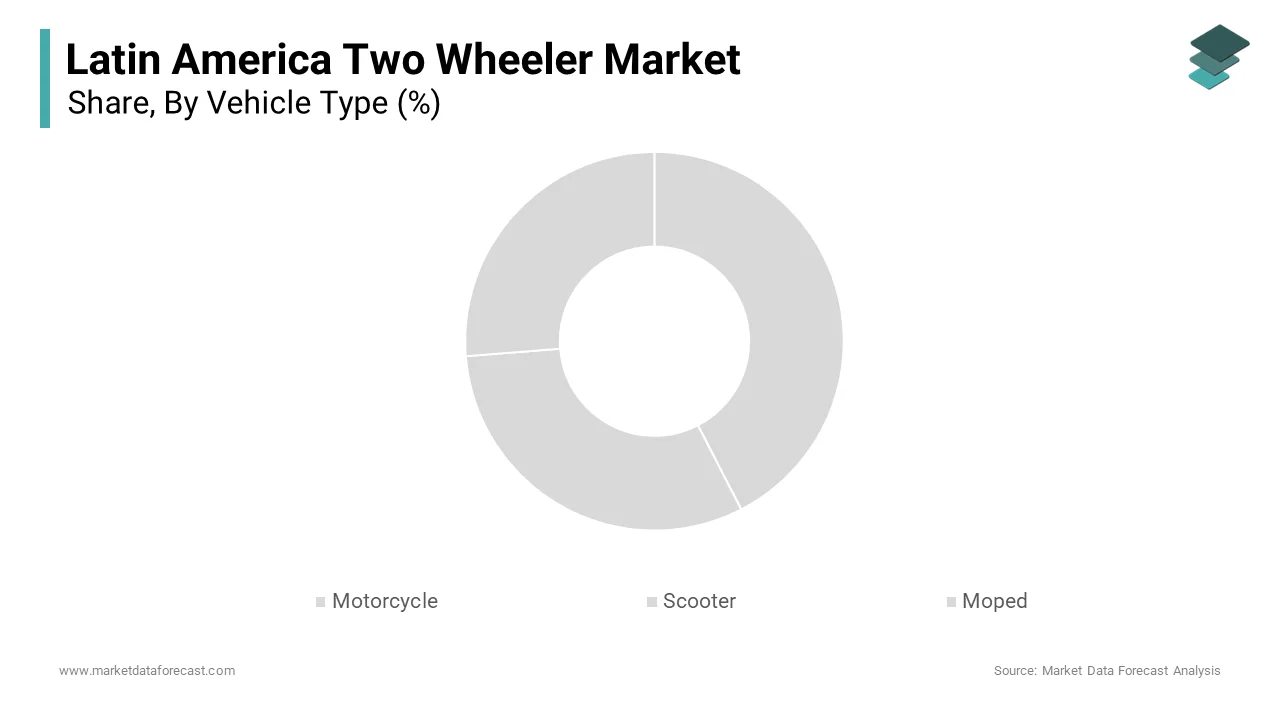
The scooter segment is anticipated to register a CAGR of 7.8% from 2025 to 20,33 with the increasing preference for scooters among urban commuters who seek comfort, ease of use, and fuel efficiency without compromising on style and convenience. Scooters are especially popular among younger demographics and female riders due to their automatic transmission and user-friendly design. In Mexico, scooter sales increased by 22% in 2023 compared to the previous year, according to the Mexican Automotive Industry Association (AMIA). Additionally, government incentives for cleaner transportation options have boosted the adoption of electric scooters.
By Fuel Insights
The gasoline-powered segment accounted in holding a prominent share of the Latin America market in 2024, with the limited availability of charging infrastructure for electric models. In countries like Argentina and Peru, public charging stations remain sparse, limiting the appeal of electric vehicles. Additionally, gasoline remains more accessible and cost-effective for consumers, particularly in rural areas where the electricity supply is inconsistent. In Brazil, where fuel prices are relatively stable compared to other Latin American countries, gasoline motorcycles continue to dominate both urban and rural markets. According to the Brazilian Petroleum Institute (IBP), nearly 95% of two-wheelers sold in 2023 were gasoline-powered.
The electric two-wheeler segment is likely to grow with a CAGR of 15.2% from 2025 to 2033. In Colombia, for example, electric two-wheeler sales surged by 60% in 2023, supported by tax exemptions under Decree 860 of 2020, as noted by the Colombian Association of Automotive Industries (ANDI). The government’s push for cleaner transport is also evident in Bogotá, where over 20,000 electric motorcycles are now in use for delivery and ride-hailing services.
By Engine Capacity Insights
The 126–250cc engine capacity segment accounted in holding 38.4% of the Latin American two-wheeler market share in 2024 due to its optimal balance of performance, fuel efficiency, and affordability, making it a popular choice for both personal and commercial users. The growing demand for mid-sized motorcycles in urban areas, where riders seek vehicles that offer better acceleration and highway capability than smaller engines, is accelerating the growth of the segment. Additionally, manufacturers have focused on expanding their 126–250cc product lines to cater to a broader consumer base.
The 250–500cc engine capacity segment is anticipated to grow with an expected CAGR of 9.5% from 2025 to 2033. In Argentina, for example, sales of 250–500cc motorcycles increased by 25% in 2023, as reported by the Argentine Automotive Chamber (ACARA), with buyers opting for models that offer enhanced touring capabilities and better riding experiences. Moreover, manufacturers are introducing affordable mid-sized sports and cruiser models to attract younger consumers. In Brazil, brands such as BMW Motorrad and Ducati have expanded their dealer networks, which is contributing to increased visibility and accessibility of 250–500cc bikes. The National Association of Vehicle Manufacturers (ANFAVEA) indicates that imports of higher-capacity motorcycles have risen by 12% in recent years, signaling strong market momentum.
COUNTRY ANALYSIS
Brazil Two-Wheeler Market Analysis
Brazil was the largest contributor with 35.4% of the Latin American two-wheeler market share in 2024. Brazil has a well-developed manufacturing ecosystem with domestic production exceeding 850,000 units in 2023, as reported by the National Association of Vehicle Manufacturers (ANFAVEA). The country benefits from a mature distribution network and a strong presence of global manufacturers such as Honda, Yamaha, and Harley-Davidson.
Argentina Two-Wheeler Market Analysis
Argentina was ranked second in the Latin American two-wheeler market with 15.3% of share in 2024, with the increasing use of two-wheelers in last-mile delivery services, particularly in Buenos Aires and Córdoba. The Argentine Logistics Association (ALA) reports that delivery motorcycle usage increased by 20% in 2023, driven by platforms like Rappi and Glovo. The Mexican two-wheeler market is expected to have significant growth opportunities in the coming years. The country’s market is characterized by a growing preference for scooters and electric models, particularly in urban centers like Mexico City and Guadalajara. The Mexican Automotive Industry Association (AMIA) notes that scooter sales increased by 22% in 2023, driven by ride-hailing and delivery platform adoption.
A major driver of growth is the government-backed financing schemes that have made two-wheeler ownership more accessible. The National Banking Association (ABM) reports that nearly 40% of motorcycle purchases in 2023 were financed through low-interest loan programs. Chile holds a modest but growing share of the Latin American two-wheeler market, with approximately 6% of total regional sales in 2023, as reported by the Latin American Automotive Association (ALFA). While traditionally not a major motorcycle market, Chile has seen a surge in two-wheeler adoption due to urban mobility initiatives and environmental policies.
COMPETITIVE LANDSCAPE
The Latin American two-wheeler market is highly competitive, characterized by the presence of both global and regional manufacturers striving to capture market share through product innovation, pricing strategies, and localized production. Established players such as Honda, Yamaha, and Suzuki maintain strong brand recognition and distribution networks, giving them a significant edge. However, emerging local brands are also gaining traction by offering cost-effective alternatives tailored to regional needs. The competitive environment is further shaped by evolving consumer preferences, particularly the growing interest in electric models and scooters for urban mobility. Companies are increasingly investing in research and development to introduce fuel-efficient, technologically advanced models that align with changing mobility trends. Additionally, strategic collaborations with financial institutions and ride-hailing platforms are being leveraged to enhance affordability and expand customer reach.
KEY MARKET PLAYERS
These are the market players that are dominating the Latin America two wheeler market.
- Bajaj Auto Limited (Bajaj Group)
- Dafra Motos (Itavema S/A)
- Honda de México S.A. de C.V. (The Honda Motor Company Ltd.)
- Kawasaki Motors Manufacturing Corp. U.S.A. (Kawasaki Heavy Industries, Ltd.)
- Lifan Industry (Group) Co. Ltd
- Motomel S.A.
- Shineray Do Brasil SA
- Suzuki Motor Corporation
- TVS Motor México (TVS Motor Company Limited)
- Wanxin Group International
- Yamaha Motor de México SA de CV (Yamaha Motor Co. Ltd.)
- Zanella Hnos & Cia SACIFI
- Zongshen Automobile Industry Manufacturing Co. Ltd. (Zongshen Industry Group Co. Ltd.).
Top Players In The Market
Honda Motor Co., Ltd.
Honda holds a dominant position in the Latin American two-wheeler market, recognized for its extensive product range, reliability, and technological innovation. The company has a strong distribution network across key markets such as Brazil, Mexico, and Colombia. Honda's consistent focus on adapting to local consumer preferences and offering cost-effective, fuel-efficient models has made it a preferred brand among both urban commuters and commercial users.
Yamaha Motor Co., Ltd.
Yamaha is a major player in Latin America, known for its high-performance motorcycles and scooters tailored to regional demands. The company has invested heavily in local production facilities, particularly in Brazil and Mexico, enabling faster market response and cost efficiency. Yamaha's commitment to design innovation and rider experience has strengthened its brand loyalty. Its operations in Latin America contribute significantly to its global two-wheeler sales and reinforce its reputation as a leader in the motorcycle and scooter industry.
Suzuki Motor Corporation
Suzuki has established a strong foothold in the Latin American two-wheeler market through its focus on affordability, durability, and fuel efficiency. The company's models are widely used for personal and commercial purposes, especially in urban and semi-urban areas. Suzuki’s strategy of localized manufacturing and strategic partnerships has enhanced its market reach and serviceability. In Latin America, Suzuki plays a crucial role in expanding the company’s global two-wheel err footprint, particularly in emerging markets with growing mobility needs.
Top Strategies Used By Key Market Participants
Localized Manufacturing and Assembly
Key players in the Latin American two-wheeler market have increasingly focused on setting up or expanding local production facilities to reduce costs, avoid import tariffs, and respond more efficiently to regional demand. This strategy enables faster delivery, customization of models to suit local preferences, and improved after-sales service networks.
Product Diversification and Customization
Manufacturers are expanding their product portfolios to cater to diverse consumer segments, including entry-level, mid-range, and premium riders. Customization of features such as engine capacity, design, and digital integration allows companies to target different usage patterns, from daily commuting to recreational riding, thereby strengthening brand appeal.
RECENT MARKET NEWS
- In February 2023, Honda Motor Co. expanded its manufacturing facility in Manaus, Brazil, to increase production capacity and meet rising demand for motorcycles and scooters in South America. This move reinforced Honda’s dominant position in the region by enhancing supply chain efficiency and reducing lead times.
- In June 2023, Yamaha Motor Co. launched a new line of electric scooters in Colombia, aligning with the country’s green mobility initiatives and strengthening its presence in the sustainable transport segment. This product expansion marked Yamaha’s commitment to supporting Latin America’s transition toward cleaner mobility solutions.
- In October 2023, Suzuki Motor Corporation partnered with a leading financial institution in Mexico to offer low-interest financing schemes for motorcycle buyers. This initiative aimed to improve affordability and attract first-time buyers, thereby expanding Suzuki’s customer base in one of Latin America’s fastest-growing two-wheeler markets.
- In January 2024, Yamaha Motor Co. entered into a strategic collaboration with a major ride-hailing platform in Brazil to supply a fleet of scooters for delivery and passenger services. This partnership enhanced Yamaha’s visibility in the urban mobility sector and strengthened its commercial vehicle segment.
- In May 2024, Honda Motor Co. introduced a digital after-sales service platform across several Latin American countries, offering online booking, spare parts delivery, and maintenance tracking. This initiative improved customer engagement and reinforced Honda’s reputation for reliable service and customer support in the region.
MARKET SEGMENTATION
This research report on the Latin American Latine market is segmented and sub-segmented into the following categories.
By vehicle Type
- Motorcycle
- Scooter
- Moped
By Fuel Type
- Gasoline
- Electric
By Engine Capacity
- Less Than 100cc
- 100-125cc
- 126-250cc
- 250-500cc
- More Than 500cc
By Technology
- Manual
- Automatic
By Country
- Brazil
- Mexico
- Colombia
- Argentina
- Peru
- Ecuador
- Chile
- Others
Frequently Asked Questions
What is the two-wheeler market in Latin America?
It includes motorcycles, scooters, and mopeds used for personal transport, delivery services, and commuting across urban and rural areas. The market is driven by affordability, fuel efficiency, and traffic congestion in major cities.
Which countries lead in two-wheeler demand?
Brazil and Mexico are the largest markets due to their big populations, growing middle class, and expanding road networks. Colombia, Argentina, and Chile also show steady growth in sales and usage.
Why are two-wheelers so popular in the region?
They cost less than cars, use less fuel, and can easily navigate through heavy traffic and narrow streets. For many, they are the most practical and accessible form of motorized transport.
How is the ride-hailing and delivery economy affecting the market?
The rise of food and parcel delivery platforms has increased demand for reliable, low-cost two-wheelers among gig workers. Many riders buy bikes specifically for app-based delivery jobs in cities.
Are electric two-wheelers gaining traction?
Yes, especially in urban centers where air pollution and fuel costs are concerns. Countries like Colombia and Chile are seeing early adoption, supported by government incentives and new charging setups.
What role do financing options play in sales?
Easy installment plans and credit programs from dealers and banks make two-wheelers accessible to lower-income buyers. Flexible payment models are a key factor behind rising ownership rates.
Who are the main manufacturers in the region?
Global brands like Honda, Yamaha, and Harley-Davidson have strong presence, but local assemblers and regional subsidiaries also dominate. In Brazil, national production plays a big role in supply and pricing.
How do road safety and infrastructure impact usage?
Poor road conditions and lack of dedicated lanes in many cities create risks for riders. However, increasing awareness and helmet laws are slowly improving safety standards across the region.
Are scooters becoming more popular than motorcycles?
Scooters are growing in appeal, especially among city commuters and women riders, due to their automatic transmission and ease of use. Their practicality in stop-and-go traffic gives them an edge in metropolitan areas.
What’s driving the future of this market?
Urbanization, youth population growth, digital mobility platforms, and interest in cleaner transport options are shaping the next phase. Expect more electric models, digital features, and shared mobility services to emerge.
Related Reports
Access the study in MULTIPLE FORMATS
Purchase options starting from
$ 1600
Didn’t find what you’re looking for?
TALK TO OUR ANALYST TEAM
Need something within your budget?
NO WORRIES! WE GOT YOU COVERED!
Call us on: +1 888 702 9696 (U.S Toll Free)
Write to us: sales@marketdataforecast.com