- Product Description Description
- Table of Contents TOC
- List of Table & Figure LOT
- Get Free Sample PDF Sample PDF
Market Size, 2025
$0.49 BnMarket Estimate, 2026
$0.52 BnMarket Forecast, 2034
$0.78 BnCAGR, 2026–2034
5.3%Latin America Water Testing and Analysis Market Size, Share, Trends & Forecast (2026–2034)
- Market Scope: Comprehensive regional evaluation of the Latin American water testing and analysis sector encompassing instrument types (pH meters, TOC analyzers, benchtop and portable instruments), cross-sector applications (industrial water testing, environmental monitoring, municipal supplies, agriculture), and country frameworks (Brazil, Mexico, Argentina, Chile).
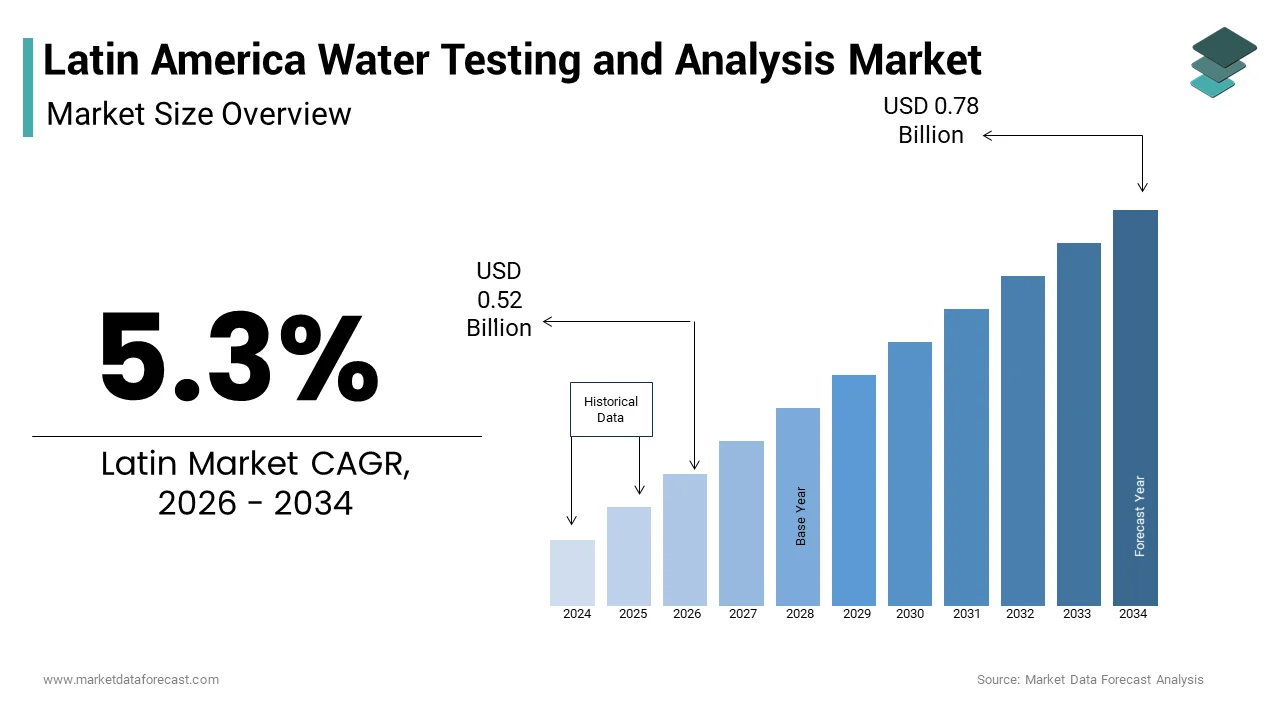
- Market Valuation: Valued at USD 0.49 billion in 2025, estimated at USD 0.52 billion in 2026, and projected to reach USD 0.78 billion by 2034, expanding at a steady CAGR of 5.3% (2026–2034).
- Primary Growth Enablers: Increasing stringency of government regulations on water quality standards, rapid industrialization and urban expansion driving wastewater monitoring needs, and widespread adoption of smart water management systems.
Key Latin America Water Testing Segment Metrics (2026–2034)
| Category | Leading Segment | Fastest-Growing / Key Segment Highlights |
|---|---|---|
| By Product Type | pH Meters (held 24% revenue share as fundamental parameters for drinking and industrial water standards) & Benchtop Instruments (held 38.5% share in centralized labs) | Total Organic Carbon (TOC) Analyzers (projected at an 8.1% CAGR) & Portable Water Testing Instruments (projected at a 9.3% CAGR for field operations) |
| By Application | Industrial Water Testing (held 35.6% market share driven by effluent discharge compliance in mining, energy, and manufacturing) | Environmental Water Testing (predicted to grow at the fastest CAGR of 9.5% due to river basin conservation initiatives) |
| By Country / Region | Brazil (dominant market capturing 32.4% regional share backed by robust environmental regulations and smart water investments) | Mexico, Argentina, and Chile (scaling rapidly via export-led manufacturing compliance, precision irrigation, and mining desalination checks) |
Major Market Players, Structure & Strategic Landscape
Market Structure: Consolidated at the top through global analytical leaders, complemented by agile regional distributors and service providers specializing in localized field kits and software-driven water monitoring solutions.
Key Companies: Thermo Fisher Scientific Inc., Hach Company (Danaher Corporation), Xylem, Agilent Technologies Inc., Emerson Electric Co., Honeywell International Inc., Mettler-Toledo International Inc., and Horiba Ltd.
Latin America Water Testing and Analysis Market Size
The Latin American water testing and analysis market size was valued at USD 0.49 billion in 2025 and is anticipated to reach USD 0.52 billion in 2026, to reach USD 0.78 billion by 2034, growing at a CAGR of 5.3% from 2026 to 2034.
The Latin American water testing and analysis market encompasses a wide range of services and technologies used to assess the physical, chemical, and biological properties of water in various applications, including municipal supply, industrial processes, agriculture, and environmental monitoring. The increasing concerns over water contamination, regulatory compliance, and sustainable resource management have significantly growth the demand across the region for accurate and reliable water quality testing.
Water testing involves parameters such as pH levels, turbidity, dissolved oxygen, heavy metals, microbial content, and presence of pollutants like pesticides and nitrates. These tests are crucial for ensuring safe drinking water, protecting aquatic ecosystems, and maintaining industrial process efficiency. According to the Pan American Health Organization (PAHO), nearly 30 million people in Latin America lack access to basic drinking water services, underscoring the need for robust water quality monitoring frameworks.
MARKET DRIVERS
Increasing Government Regulations on Water Quality Standards
The growing stringency of government regulations aimed at improving water quality and ensuring public health safety is one of the primary drivers of the Latin America water testing and analysis market is the growing stringency of government regulations aimed at improving water quality and ensuring public health safety. Governments across the region have been implementing stricter guidelines for drinking water, wastewater discharge, and industrial effluent treatment to align with global benchmarks set by organizations like the World Health Organization (WHO) and the U.S. Environmental Protection Agency (EPA).
For instance, Brazil’s National Council of Environmental Policy (CONAMA) has introduced updated norms requiring industries to conduct regular water quality assessments before releasing effluents into natural water bodies. Similarly, Mexico's Federal Commission of Electricity (CFE) mandates periodic testing of cooling water used in power plants to prevent contamination of local water sources.
In Argentina, the Ministry of Health has launched nationwide initiatives to monitor potable water supplies in urban and rural areas, leading to increased procurement of field-testing equipment and lab-based analyzers. As per the Inter-American Development Bank (IDB), over 20 new water quality laws were enacted across Latin American countries between 2020 and 2023, directly boosting demand for water testing services and technologies.
These regulatory developments are compelling municipalities, industrial operators, and environmental agencies to adopt comprehensive water analysis protocols, thereby driving sustained market expansion across the region.
Rising Industrialization and Urbanization Driving Demand for Process Water Monitoring
One more major driver of the Latin American water testing and analysis Market is the rapid pace of industrialization and urban development, which has led to increased consumption and contamination of water resources. Industries such as food and beverage, pharmaceuticals, textiles, mining, and energy require continuous water quality monitoring to ensure operational efficiency, regulatory compliance, and environmental sustainability. These industries must adhere to strict water usage and discharge limits, necessitating frequent testing for contaminants such as heavy metals, organic compounds, and suspended solids.
Moreover, urbanization has intensified pressure on municipal water infrastructure, prompting cities to invest in real-time water quality monitoring systems.
As per the International Water Association (IWA), over 70% of Latin American cities face challenges related to aging water infrastructure and pollution from untreated sewage. This growing awareness of water security issues is encouraging both public and private stakeholders to enhance their water testing capabilities, further propelling market growth.
MARKET RESTRAINT
Limited Infrastructure and Funding for Water Quality Monitoring
A key restraint affecting the Latin American water testing and analysis market is the limited availability of modern infrastructure and consistent funding for water quality monitoring programs. Many countries in the region struggle with outdated laboratory facilities, insufficient technical expertise, and inadequate coverage of testing centers, particularly in rural and remote areas.
Also, less than 50% of water quality testing stations in Central America operate at full capacity due to budgetary constraints nd lack of trained personnel, according to studies. In countries like Honduras and Bolivia, where access to clean water remains a pressing issue, investment in water testing infrastructure is often deprioritized due to competing economic challenges.
In addition, inconsistent government funding and reliance on external aid programs create uncertainty in long-term planning for water testing initiatives. Many municipal water utilities in the region depend on sporadic grants or donor support to maintain testing operations, limiting their ability to scale up services.
Furthermore, logistical difficulties in transporting samples to centralized laboratories delay results and reduce the effectiveness of contamination control measures. These systemic deficiencies hinder the widespread adoption of water testing and analysis solutions, despite rising awareness of their necessity.
High Cost of Advanced Water Testing Equipment and Services
A further significant barrier to market growth is the high cost associated with acquiring and operating advanced water testing equipment and services. While portable test kits and digital sensors offer convenience, they often come with premium price tags that are unaffordable for small-scale utilities, academic institutions, and independent laboratories. For cash-strapped public sector agencies, these costs represent a substantial financial burden, especially in economies facing inflationary pressures and currency fluctuations.
In addition, training requirements for operating sophisticated instrumentation add another layer of complexity. As per the Organization of American States (OAS), fewer than 30% of regional water testing personnel receive formal certification in analytical techniques, further limiting the effective use of available tools.
Private sector players also face challenges in justifying capital investments without guaranteed returns, particularly in regions where payment mechanisms for water testing services remain underdeveloped.
MARKET OPPORTUNITY
Expansion of Smart Water Management Systems
A major opportunity emerging in the Latin American water testing and analysis market is the increasing adoption of smart water management systems that integrate real-time monitoring, data analytics, and IoT-enabled sensors. Governments and utility providers are recognizing the benefits of digitizing water infrastructure to improve efficiency, reduce losses, and enhance service delivery.
According to McKinsey & Company, smart water metering and remote sensing technologies can reduce non-revenue water losses by up to 30%, offering significant cost savings for municipalities.
Moreover, partnerships between technology firms and water agencies are accelerating the rollout of these systems.
As per indications by the Inter-American Development Bank (IDB), over USD 2 billion in infrastructure financing has been allocated to digital water projects across Latin America since 2022. As connectivity improves and smart city initiatives gain traction, the integration of real-time water testing into broader water management frameworks presents a strong growth avenue for the market.
Growing Focus on Agricultural Water Quality Testing
Another promising opportunity lies in the expanding demand for water testing in the agricultural sector, driven by the need to ensure irrigation water quality and protect soil fertility. With agriculture accounting for nearly 70% of freshwater withdrawals in Latin America, according to the Food and Agriculture Organization (FAO), there is an urgent need to monitor water composition to avoid crop damage and long-term land degradation.
Excessive salinity, nutrient imbalance, and contamination from agrochemical runoff pose serious threats to productivity and environmental sustainability. In response, agritech companies and cooperatives are increasingly investing in on-site water analysis tools to optimize irrigation practices and comply with export standards for fresh produce.
Brazil and Argentina, two of the world’s largest soybean and corn exporters, have seen a surge in soil and water testing labs catering to large-scale farming operations. As per the Brazilian Agricultural Research Corporation (EMBRAPA), precision irrigation based on real-time water quality data has boosted yield efficiency by up to 25% in selected pilot projects.
Besides, microfinance institutions and agricultural banks are promoting subsidized testing kits for smallholder farmers, enabling them to access better crop insurance and credit options. As sustainable agriculture gains prominence, the agricultural segment is expected to contribute significantly to future market expansion.
MARKET CHALLENGES
Lack of Standardized Testing Protocols Across Countries
A major challenge confronting the Latin American water testing and analysis market is the absence of standardized testing methodologies and regulatory harmonization across countries. Each nation employs its own set of criteria for assessing water quality, making it difficult for multinational companies, research institutions, and cross-border water management initiatives to maintain consistency in data collection and interpretation.
Also, according to the Economic Commission for Latin America and the Caribbean (ECLAC), there are over 30 different national water quality standards currently in use across the region, varying widely in parameter thresholds, sampling frequency, and reporting formats. This fragmentation complicates efforts to compare data, benchmark performance, and implement region-wide pollution control strategies.
Besides, discrepancies in accreditation procedures for testing laboratories create confusion among end-users regarding the reliability of results. As per the Organization of American States (OAS), less than 40% of accredited labs in the region follow ISO/IEC 17025 standards, raising concerns about data integrity and traceability.
To solve this issue, regional bodies such as the Union of South American Nations (UNASUR) and the Central American Integration System (SICA) are working toward developing common water quality assessment frameworks. However, until a unified approach is adopted, inconsistency in testing protocols will remain a major impediment to market cohesion.
Political Instability and Regulatory Uncertainty
Political instability and shifting regulatory priorities pose a persistent challenge for the Latin American water testing and analysis market. Frequent changes in government leadership often result in abrupt policy reversals, delayed infrastructure projects, and inconsistent enforcement of environmental regulations—factors that directly impact investment decisions in the water sector.
For example, in Venezuela and Peru, recent administrations have undergone multiple reforms in water governance structures, leading to uncertainty among private sector participants and foreign investors. Moreover, according to the World Bank, regulatory unpredictability contributes to a 20–30% increase in risk premiums for water-related infrastructure projects in politically volatile regions.
Also, corruption scandals involving water infrastructure contracts have eroded public trust and discouraged private capital inflows. Transparency International ranks several Latin American countries low on anti-corruption indices, highlighting the need for stronger institutional frameworks to safeguard water quality initiatives.
These elements make long-term planning difficult for manufacturers and service providers who rely on stable regulatory environments to justify capital expenditures.
REPORT COVERAGE
| REPORT METRIC | DETAILS |
| Market Size Available | 2025 to 2034 |
| Base Year | 2025 |
| Forecast Period | 2026 to 2034 |
| CAGR | 5.3% |
| Segments Covered | By Product, Product Type, Application, And Region. |
|
Various Analyses Covered | Global, Regional and Country Level Analysis, Segment-Level Analysis, DROC, PESTLE Analysis, Porter’s Five Forces Analysis, Competitive Landscape, Analyst Overview of Investment Opportunities |
| Regions Covered | Brazil, Argentina, Mexico, South America. |
| Market Leaders Profiled | General Electric Company, Thermo Fisher Scientific Inc.Inc., Agilent Technologies Inc., Emerson Electric Co.IC Co, Honeywell International Inc., Tintometer GmbH, Danaher Corporation, Horiba, Ltd, Abb Ltd, Mettler-Toledo International Inc. |
SEGMENTAL ANALYSIS
By Product Insights
pH Meter
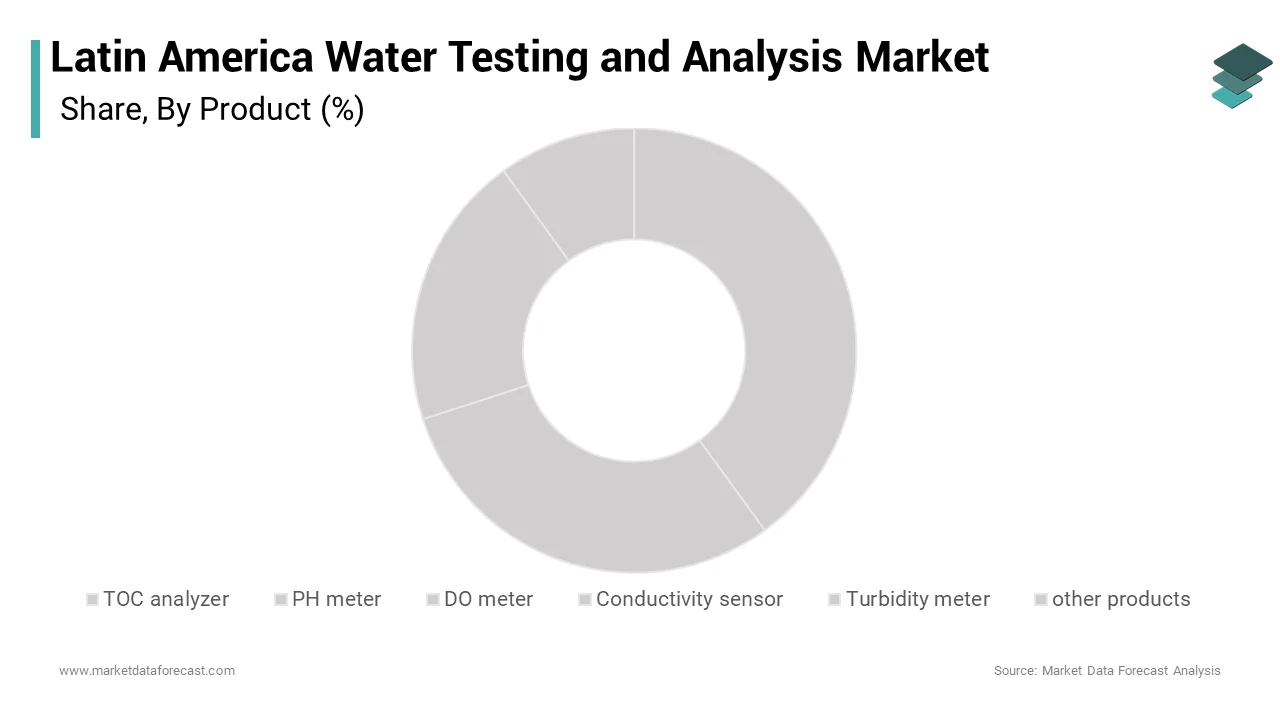
The pH meter segment spearheaded the Latin America water testing and analysis market, accounting for 24% of total revenue in 2025. This dominance is attributed to the fundamental role of pH measurement across various water testing applications, including drinking water supply, wastewater treatment, industrial processes, and environmental monitoring.
One of the main factors behind this is the widespread regulatory requirement for pH level monitoring in both municipal and industrial settings. According to the World Health Organization (WHO), maintaining optimal pH levels is crucial for ensuring safe drinking water and preventing pipe corrosion or scaling in distribution networks. In Brazil, the Ministry of Health mandates that public water supplies maintain a pH range between 6.0 and 9.5, necessitating continuous testing at treatment plants.
Besides, industries such as food and beverage, pharmaceuticals, and textiles rely heavily on pH control to maintain product quality and comply with safety standards. Furthermore, pH meters are cost-effective, easy to operate, and widely available in portable and benchtop formats, making them accessible even in remote locations. So, the governments as well as private entities are continuing to prioritize water quality, insurance, and the demand for pH meters remains robust across the region.
TOC Analyzer
The Total Organic Carbon (TOC) analyzer segment is projected to grow at the fastest CAGR of 8.1% in the forecast period. This rapid expansion is driven by increasing concerns regarding organic contamination in water sources due to industrial discharges, agricultural runoff, and pharmaceutical residues.
Moreover, TOC analysis is critical for assessing water purity, particularly in high-stakes applications such as pharmaceutical manufacturing, semiconductor processing, and advanced wastewater treatment. In Argentina, regulatory authorities have introduced stricter guidelines requiring TOC monitoring in effluent streams from chemical and biotech facilities, as per the National Institute of Industrial Technology (INTI).
In addition, the growing adoption of membrane-based water purification technologies such as reverse osmosis and ultrafiltration has increased the need for TOC analyzers to prevent membrane fouling and ensure process efficiency. According to the International Water Association (IWA), TOC levels above 5 mg/L can significantly reduce the lifespan of filtration membranes used in desalination plants.
In Brazil, where large-scale ethanol production generates significant volumes of organic-rich wastewater, companies are investing in TOC monitoring systems to meet environmental regulations and improve resource recovery. With rising awareness of organic pollution and its impact on human health and ecosystems, the TOC analyzer market is poised for sustained acceleration across Latin America.
By Product Insights
Benchtop Water Testing Instruments
Benchtop instruments commanded the American water testing and analysis market, capturing 38.5% of total revenue in 2024. These devices are extensively used in centralized laboratories, research institutions, and regulatory testing centers where accuracy, repeatability, and multi-parameter analysis are essential.
Among the key factors driving this dominance is the reliance of government-certified water testing labs on benchtop equipment for comprehensive sample analysis. Apart from these, academic and research organizations across the region use benchtop analyzers for studying water contaminants, climate change impacts, and emerging pollutants such as microplastics and endocrine disruptors.
Moreover, benchtop instruments offer superior calibration stability and data logging capabilities compared to portable alternatives, making them indispensable for compliance reporting. Despite higher initial costs, their long-term reliability ensures continued investment from regulatory bodies and large industrial users, reinforcing their leading position in the market.
Portable Water Testing Instruments
Portable water testing instruments are likely to witness the highest CAGR of 9.3% during the forecast period. This quick rise is primarily fueled by the increasing demand for on-site water quality monitoring in remote areas, disaster response scenarios, and field-based environmental studies.
The mobility and ease of use offered by portable testers make them ideal for rural water supply programs, where access to centralized laboratories is limited. Besides, the expansion of smart water management initiatives has boosted the adoption of portable sensors integrated with mobile apps and cloud platforms. In Chile, mining companies operating in arid zones are increasingly using handheld conductivity and dissolved oxygen meters to assess groundwater quality without transporting samples long distances.
Technological advancements such as battery-powered operation, wireless connectivity, and AI-assisted interpretation are further enhancing the appeal of portable instruments among utility providers, NGOs, and field researchers. Therefore, the growing emphasis on decentralized testing and rapid decision-making has positioned the portable segment for strong future growth.
By Application Insights
Industrial Water Testing
Industrial applications depicted the strongest segment in the American water testing and analysis market, holding 35.6% of the total market share in 2024. This influence is due to the increasing regulatory scrutiny on industrial effluent discharge and the necessity for process water quality control across sectors such as food and beverage, chemicals, mining, and energy. Also, water-intensive industries like sugar mills, pulp and paper, and textile dyeing require continuous monitoring of parameters such as pH, conductivity, and biochemical oxygen demand (BOD) to optimize operations and avoid environmental penalties.
Moreover, multinational corporations operating in Latin America are aligning with global sustainability goals and are mandating internal water stewardship policies that drive investment in real-time water analysis solutions. In addition, the International Council on Mining & Metals (ICMM) reports that major mining firms in Peru and Chile have installed automated water testing stations to track heavy metal concentrations and ensure responsible water reuse practices. Industrialization is accelerating across the region, and when coupled with rising environmental consciousness, the demand for industrial water testing services continues to expand. It is reinforcing its position as the market’s strongest application segment.
Environmental Water Testing
Environmental water testing is predicted to advance at the fastest CAGR of 9.5% in the future. This growth is driven by increasing concern over ecosystem degradation, biodiversity loss, and pollution from untreated sewage, agricultural runoff, and industrial waste.
Latin America is home to some of the world’s most biodiverse river basins, including the Amazon, Orinoco, and Paraná rivers, all of which face mounting threats from contaminants. Governments and environmental agencies are responding by expanding national water quality monitoring networks. In Ecuador, the Ministry of Environment has launched an initiative to install remote water testing stations along the Guayas River Basin to detect pesticide residues and nutrient imbalances affecting local fisheries.
Besides, international funding agencies such as the World Bank and the Global Environment Facility (GEF) are supporting water quality projects in countries like Bolivia and Honduras, promoting the deployment of mobile testing kits and sensor-based monitoring tools. With heightened focus on conservation and sustainable development, the environmental segment is experiencing accelerated traction across Latin America.
COUNTRY ANALYSIS
Brazil Water Testing and Analysis Market Analysis
Brazil dominated the Latin American water testing and analysis market, contributing 32.4% of total regional revenue in 2024. As the continent’s most populous and industrially developed nation, Brazil faces significant water quality challenges stemming from rapid urbanization, extensive agriculture, and environmental pressures on the Amazon and other major river basins.
A key driver behind Brazil’s dominant position is the strengthening of regulatory frameworks governing water resources. The National Water Agency (ANA) has implemented stringent guidelines for industrial effluent discharge, municipal water supply, and environmental monitoring. Moreover, the country is witnessing a surge in investments in smart water management systems. Cities like São Paulo and Rio de Janeiro have deployed IoT-enabled water sensors to detect contamination events and manage distribution networks more efficiently. The Inter-American Development Bank (IDB) estimates that Brazil allocated USD 1.2 billion toward digital water infrastructure in 2023 alone. With increasing pressure to address water scarcity and pollution, Brazil remains a central hub for water testing innovation and policy implementation in Latin America.
Mexico Water Testing and Analysis Market Analysis
Mexico is witnessing robust growth in the Latin American water testing and analysis market, driven by a combination of industrial demand, regulatory enforcement, and urban water supply concerns. One of the primary growth catalysts is the expansion of export-oriented manufacturing, particularly in the automotive, electronics, and food processing sectors, all of which require strict adherence to water usage and discharge regulations. Also, cross-border collaboration with the U.S. has led to improved wastewater treatment and monitoring infrastructure in border states like Baja California and Nuevo León. With ongoing efforts to modernize water infrastructure and enforce environmental regulations, Mexico remains a key player in the regional water testing landscape.
Argentina Water Testing and Analysis Market Analysis
Argentina has a considerable portion of the American water Testing and Analysis Market, with growing demand stemming from municipal water supply monitoring and agricultural water quality assessment. A major driver in the country is the expansion of precision irrigation practices in agro-export sectors such as soybean, corn, and wine production. The Argentine Chamber of Irrigation (CRAI) emphasizes that water composition significantly affects crop yield and soil health, encouraging farmers to adopt regular water analysis to optimize fertilizer use and prevent salinity buildup. With support from multilateral institutions like the Inter-American Development Bank (IDB), Argentina is expanding its capacity for water testing, positioning itself as a growing market within the region.
Chile Water Testing and Analysis Market Analysis
Chile is another significant player in the American water testing and Analysis Market, driven by its unique dependence on water quality monitoring in the mining sector and coastal desalination plants. The Atacama Desert, one of the driest regions in the world, relies heavily on desalinated seawater for both mining and urban consumption. Moreover, the Chilean Ministry of Public Works mandates continuous water quality checks at desalination plants to ensure a safe and sustainable supply. Moreover, Chilean universities and research institutes are actively engaged in studying glacial meltwater and groundwater depletion, further stimulating the market for specialized water testing instruments. The Pontifical Catholic University of Chile has launched several water quality research initiatives supported by the National Science Foundation. With increasing emphasis on resource conservation and environmental accountability, Chile remains a key contributor to the regional water testing market.
Rest of Latin America
The Rest of Latin America, encompassing countries such as Colombia, Peru, Ecuador, and Central American nations, collectively contributes a notable share of the regional Water Testing and Analysis Market. This diverse segment is characterized by varying levels of economic development, water stress conditions, and regulatory maturity.
Colombia has been particularly active in expanding its water quality monitoring network under the National Environmental Licensing Authority (ANLA), which requires industries to submit periodic water testing reports. In Central America, countries like Costa Rica and Panama are leveraging donor-funded programs to upgrade municipal water labs and deploy portable testing kits in rural communities. With increasing foreign investment in water infrastructure and growing awareness of contamination risks, the "Rest of Latin America" presents substantial potential for market participants seeking expansion opportunities beyond the core economies.
KEY MARKET PLAYERS
These are the market players that dominate the Latin American water testing and analysis market.
- General Electric Company
- Thermo Fisher Scientific, Inc
- Hach Company (A division of Danaher Corporation)
- Xylem
- AAgilendTechnologie, Inc.
- Emerson Electric.Co
- Honeywell InternaInternationalmeter Gmbh
- Danaher Corporation
- Horiba, Ltd
- Abb Ltd
- Mettler-Toledo International.
Top Players In The Market
- Thermo Fisher Scientific is a global leader in analytical instrumentation and water testing solutions, with a strong presence in Latin America. The company offers a comprehensive portfolio of laboratory and field-based water analysis equipment, including spectrophotometers, ion analyzers, and portable test kits. Thermo Fisher plays a critical role in supporting regulatory compliance and environmental monitoring across municipal, industrial, and research sectors.
- Hach is a major player known for its innovative water quality testing instruments and reagents tailored for both laboratory and on-site applications. In Latin America, Hach has been instrumental in providing affordable and reliable water testing solutions to public utilities, educational institutions, and environmental agencies. The company’s emphasis on customer training and technical support has strengthened its regional market position.
- Xylem is recognized for its advanced water testing and monitoring technologies, particularly in real-time sensor networks and digital water management systems. The company serves key industries such as energy, mining, and municipal water supply across Latin America. Xylem's commitment to sustainability and smart water infrastructure has made it a preferred partner for governments and private sector clients aiming to improve water resource management.
Top Strategies Used by Key Market Participants
Localized Product Development and Distribution Networks
Leading players are focusing on developing region-specific water testing products that address local contamination profiles and regulatory requirements. Establishing localized distribution and service centers enables faster delivery, improved after-sales support, and better alignment with regional customer needs.
Strategic Collaborations with Government and Research Institutions
To enhance credibility and expand market reach, companies are forming partnerships with universities, environmental agencies, and public health organizations. These collaborations help in co-developing testing protocols, participating in national water quality initiatives, and influencing policy development.
Integration of Digital Technologies and IoT-Enabled Monitoring Solutions
To meet the growing demand for real-time water quality data, manufacturers are embedding smart sensors, cloud connectivity, and predictive analytics into their products. This digital transformation supports remote monitoring, enhances decision-making, and improves operational efficiency for end-users in both urban and industrial settings.
COMPETITIVE LANDSCAPE
The competition in the Latin American Water Testing and Analysis Market is characterized by a mix of global industry leaders and emerging regional players striving to capture market share through differentiation, innovation, and strategic positioning. Established multinational firms like Thermo Fisher Scientific, Hach, and Xylem dominate due to their extensive product portfolios, technological expertise, and well-established distribution channels. These companies leverage their global experience to provide tailored water testing solutions suited to Latin American conditions.
At the same time, local and mid-sized firms are gaining traction by offering cost-effective alternatives, flexible service models, and proximity-based technical support. Their agility allows them to respond quickly to evolving regulatory landscapes and specific country-level challenges such as rural water access and industrial compliance.
Market participants are increasingly investing in digital integration, mobile testing solutions, and capacity-building programs to differentiate themselves in a competitive environment. As awareness of water quality issues grows and regulatory frameworks evolve, competition is shifting from product-centric strategies to holistic solutions that include software platforms, consulting services, and long-term partnerships with public institutions.
RECENT MARKET NEWS
- In February 2024, Thermo Fisher Scientific launched a new line of compact water quality analyzers designed specifically for small laboratories and field technicians in Latin America. The initiative aimed at improving accessibility and affordability for municipal water testing programs in underserved regions.
- In May 2024, Hach announced a partnership with a leading Brazilian university to establish a joint water quality research center focused on detecting emerging contaminants in river basins affected by agricultural runoff and industrial discharge.
- In August 2023, Xylem introduced an AI-powered water monitoring system in Chilean mining operations, enabling real-time tracking of heavy metal concentrations and salinity levels to ensure sustainable water reuse practices in arid zones.
- In November 2023, a European water instrumentation firm expanded its regional headquarters in Mexico City to enhance customer support and logistics capabilities, responding to rising demand from North American Free Trade Agreement-linked industrial clients.
- In January 2024, a South American distributor of water testing equipment launched a mobile training program in collaboration with government agencies to educate technicians and lab personnel on the use of modern water analysis tools, aiming to improve testing accuracy and consistency across the region.
MARKET SEGMENTATION
This research report on the Latin American testing and analysis market is segmented and sub-segmented into the following categories.
By Product
- TOC analyzer
- PH meter
- DO meter
- Conductivity sensor
- Turbidity meter
- other products
By Product Type
- Portable
- Handheld
- Benchtop
- others
By Application
- Laboratory
- Industrial
- Environmental
- Government
- other applications
By Country
- Brazil
- Argentina
- Mexico
- South America