- Product Description Description
- Table of Contents TOC
- List of Table & Figure LOT
- Get Free Sample PDF Sample PDF
Market Size, 2025
$2.22 BnMarket Estimate, 2026
$2.41 BnMarket Forecast, 2034
$4.63 BnCAGR, 2026–2034
8.5%Global Livestock Enzymes Market Size
The global livestock enzymes market size was valued at USD 2.22 billion in 2025 and is anticipated to reach a valuation of USD 2.41 billion in 2026 from USD 4.63 billion by 2034, growing at a CAGR of 8.5 %, from 2026 to 2034.
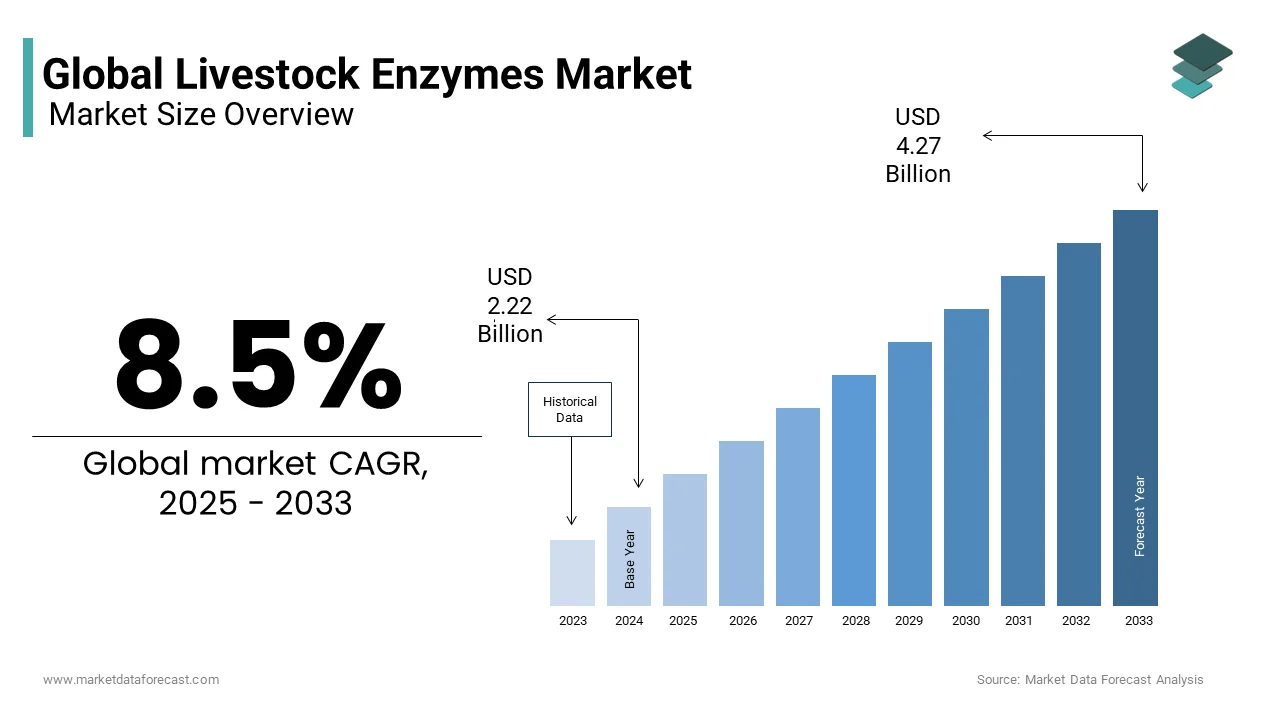
The market is showcasing evident potential in the mentioned forecasting period. The market continues to gain momentum with the rapid development in the livestock industry. Phytases, carbohydrates, and proteases are the major enzymes that are used in several animal nutrition sectors, which include poultry, pigs, and ruminants. These are the products that enhance the nutritional value of food and convert it into easily digestible food for livestock.
The rise in production, as well as consumption of animal-based products, the expensive nature of feed in livestock farming, the ban on the use of antibiotics as growth enhancers, rs and the positive influence on the environment are the factors that drive the growth of the feed enzymes market. The shifting of preferences away from the costly fish meal with feed enzymes and growth in awareness regarding feed quality are the factors that are leading to lucrative opportunities in this market.
REPORT COVERAGE
| REPORT METRIC | DETAILS |
| Market Size Available | 2025 to 2034 |
| Base Year | 2025 |
| Forecast Period | 2026 to 2034 |
| CAGR | 8.5 % |
| Segments Covered | By Type, Livestock, Source, F,orm and Region |
| Various Analyses Covered | Global, Regional & Country Level Analysis, Segment-Level Analysis, DROC, PESTLE Analysis, Porter’s Five Forces Analysis, Competitive Landscape, Analyst Overview of Investment Opportunities |
| Regions Covered | North America, Europe, APAC, Latin America, Middle East & Africa |
| Market Leaders Profiled | BIO-CAT (U. S.), BASF SE Germanyy) ,E. I. DuPont de Nemours and Company(U.S.), Associated British Foods plc (U.K.), Koninklijke DSM N.V. (Netherlands), Adisseo France SAS (France), Azelis Holdings SA (Belgium), Rossari Biotech Ltd (India), Alltech Inc. (U.S.), and Others. |
REGIONAL ANALYSIS
The livestock enzymes market was dominated by Asia Pacific, with around 43% market share globally, and was followed by North America.
KEY MARKET PLAYERS
These are some of the market players dominating the global livestock enzymes market.
- BIO-CAT (U.S.)
- BASF SE (Germany)
- E. I. du Pont de Nemours and Company (U.S.)
- Associated British Foods plc (U.K.)
- Koninklijke DSM N.V. (Netherlands)
- Adisseo France SAS (France)
- Azelis Holdings SA (Belgium)
- Rossari Biotech Ltd (India)
- Alltech Inc. (U.S.)
MARKET SEGMENTATION
This research report on the global livestock enzymes market is segmented and sub-segmented into the following categories.
By Type
- Phytase
- Protease
- and Carbohydrase
By Livestock
- Ruminants
- Swine
- Poultry
- Aquatic Animals
By Source
- Microorganism
- Plant
- Animal
By Form
- Liquid and Dry
By Region
- North America
- Europe
- Asia-Pacific
- Middle East and Africa
- Latin America