- Product Description Description
- Table of Contents TOC
- List of Table & Figure LOT
- Get Free Sample PDF Sample PDF
Market Size, 2025
$14.56 BnMarket Estimate, 2026
$16.23 BnMarket Forecast, 2034
$38.78 BnCAGR, 2026–2034
11.5%Global Mass Notification System Market Size
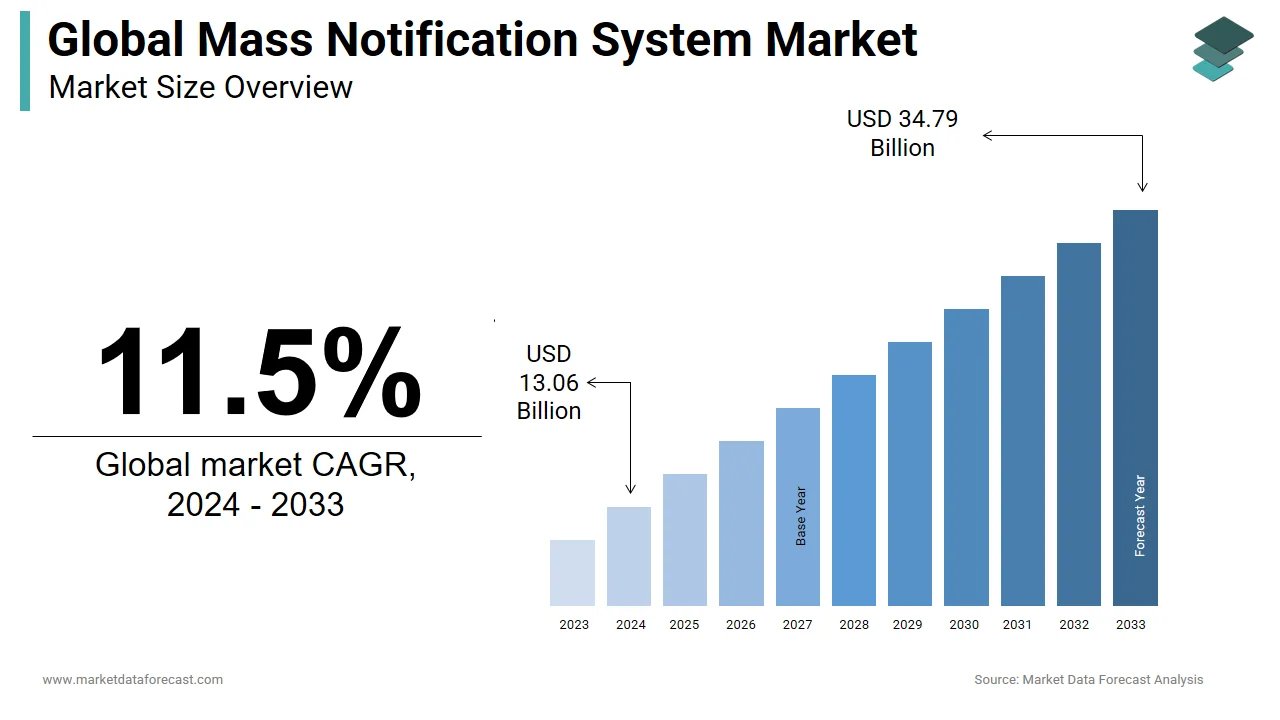
The global mass notification market was valued at USD 14.56 billion in 2025. This market is expected to grow at a CAGR of 11.5% from 2026 to 2034 and be worth USD 38.78 billion by 2034, up from USD 16.23 billion in 2026.
A Mass Notification System (MNS) is a unified communication platform designed to disseminate real-time alerts and critical information across multiple channels, including mobile devices, email, digital signage, public address systems, and desktop notifications. These systems are essential for ensuring situational awareness, safety compliance, and coordinated response during emergencies such as natural disasters, industrial accidents, cyberattacks, or security breaches. Also, MNS solutions are widely deployed in sectors like education, healthcare, government, manufacturing, transportation, and corporate enterprises to enhance operational resilience and regulatory adherence.
The increasing frequency of disruptive events globally has prompted organizations to adopt robust communication frameworks that can seamlessly integrate with existing infrastructure. According to the United Nations Office for Disaster Risk Reduction, global disaster occurrences increased by approximately 40% between 2010 and 2022, reinforcing the urgency for scalable alerting mechanisms.
Moreover, stringent mandates from agencies such as OSHA and FEMA have mandated the use of certified notification systems in high-risk environments. The Asia-Pacific region, in particular, is witnessing accelerated adoption due to rapid urbanization, industrial modernization, and rising investments in smart infrastructure.
MARKET DRIVERS
Increasing Regulatory Mandates Across Critical Sectors
A primary driver of the mass notification system market is the growing number of regulatory mandates requiring organizations to implement emergency communication systems. Governments and regulatory bodies worldwide have introduced stringent safety standards to ensure preparedness and response capabilities in the event of emergencies.
For instance, the U.S. Occupational Safety and Health Administration (OSHA) mandates that all workplaces must have an emergency action plan, which includes effective communication tools such as mass notification systems. Similarly, the Federal Emergency Management Agency (FEMA) emphasizes the importance of integrated alert systems for federal, state, and local institutions.
In Europe, the EU’s General Data Protection Regulation (GDPR) indirectly supports the deployment of MNS platforms by mandating timely breach notifications, thereby increasing reliance on automated alerting systems. This regulatory push ensures consistent demand for MNS solutions across sectors such as healthcare, education, defense, and manufacturing, where non-compliance could result in legal penalties or operational shutdowns.
Rising Frequency of Natural and Man-Made Disasters
A further significant driver of the mass notification system market is the escalating frequency and impact of both natural and man-made disasters globally. Climate change has intensified weather-related events such as hurricanes, floods, wildfires, and extreme heatwaves.
According to the World Meteorological Organization, the number of climate-related disasters has increased fivefold over the past 50 years, with annual economic losses exceeding USD 200 billion. These trends have heightened the need for real-time communication systems capable of delivering instant alerts to large populations.
In addition to natural calamities, the rise in cyberattacks and workplace violence has further underscored the importance of efficient emergency response protocols.
According to the FBI, a 64% increase in ransomware attacks targeting U.S. businesses between 2020 and 2022, many of which necessitated immediate internal communication to mitigate damage. Mass Notification Systems provide a centralized mechanism to relay actionable intelligence across geographically dispersed locations, enabling faster decision-making and reducing response time.
This growing imperative to safeguard personnel and assets is significantly propelling the adoption of mass notification technologies across industries.
MARKET RESTRAINTS
High Initial Implementation Costs for Small and Medium Enterprises
A key restraint impeding the widespread adoption of Mass Notification Systems (MNS) is the substantial initial investment required, particularly for small and medium-sized enterprises (SMEs). Deploying a comprehensive MNS involves purchasing software licenses, integrating with existing IT infrastructure, setting up multi-channel communication gateways, and training personnel each of which contributes to elevated upfront costs. Unlike large corporations that can absorb capital expenditures through dedicated risk management budgets, SMEs often operate under tighter financial constraints.
Moreover, ongoing maintenance, cloud subscription fees, and compliance audits add recurring expenses that many smaller firms find difficult to justify without immediate perceived risk. In regions such as Southeast Asia and Latin America, where SMEs constitute a major portion of the economy, this financial burden limits the penetration of advanced MNS solutions.
Until cost-effective, scalable solutions become more accessible, the affordability factor will continue to hinder market expansion among price-sensitive segments.
Complexity in Integration with Legacy Systems
A further significant restraint in the Mass Notification System Market is the technical challenge associated with integrating these systems into existing legacy infrastructure. Many organizations, especially those in the public sector, utilities, and older manufacturing facilities, rely on outdated communication platforms that were not originally designed for seamless interoperability. Integrating modern MNS platforms with legacy hardware, such as analog public address systems, proprietary control networks, or pre-cloud enterprise resource planning (ERP) systems, often requires extensive customization, middleware development, or even partial system overhauls.
In some cases, compatibility issues resulted in incomplete rollouts or reduced functionality, undermining the effectiveness of the entire system. Apart from these, the lack of standardized protocols across vendors further complicates integration efforts. Without streamlined integration pathways and broader industry standardization, the adoption of MNS in technologically entrenched environments will remain constrained.
MARKET OPPORTUNITIES
Expansion of Smart City Initiatives Driving Urban Emergency Communication
One of the most promising opportunities in the Mass Notification System Market is the rapid proliferation of smart city initiatives, which prioritize integrated emergency communication as a core component of urban infrastructure. Governments across the globe are investing heavily in smart city projects aimed at improving public safety, traffic management, environmental monitoring, and disaster response. According to the United Nations, an additional 2.5 billion people are expected to move to urban areas by 2050, intensifying the need for resilient communication networks capable of managing large-scale emergencies.
Smart cities leverage Internet of Things (IoT) sensors, AI-driven analytics, and cloud-based platforms to facilitate real-time information exchange. In this context, Mass Notification Systems serve as the backbone for disseminating alerts related to natural disasters, terrorist threats, public health crises, and infrastructure failures.
For instance, Singapore's "Safe City" initiative incorporates MNS technology to coordinate responses across police, fire departments, and transport agencies. Similarly, Barcelona has integrated emergency alert systems into its smart grid infrastructure to notify citizens about extreme weather conditions and utility disruptions. With urban centers increasingly prioritizing digital resilience, the demand for scalable, multi-modal MNS solutions is poised for sustained growth.
Adoption of Cloud-Based MNS Solutions in Remote Work Environments
The shift toward remote and hybrid work models has created a compelling opportunity for the Mass Notification System Market, particularly in cloud-based deployment formats. As companies extend their workforce beyond traditional office settings, the need for real-time, location-independent communication has surged. Cloud-based MNS platforms offer scalability, accessibility, and rapid deployment, making them ideal for organizations with distributed teams. According to a 2023 report by McKinsey, over 58% of companies globally now operate under a hybrid work model, necessitating robust digital communication tools to maintain continuity during emergencies.
Cloud-hosted MNS solutions allow organizations to send alerts via SMS, email, mobile apps, and web portals without being dependent on on-premises infrastructure. This flexibility is particularly valuable for multinational corporations and small businesses alike. Microsoft Teams and Slack, for example, have integrated emergency alert features that enable seamless mass communication within their platforms.
Furthermore, the rise in cybersecurity threats has also boosted demand for encrypted, cloud-native alerting systems. According to IBM, the average cost of a data breach reached USD 4.45 million in 2023, prompting organizations to invest in secure, cloud-enabled notification tools. This convergence of remote work dynamics and digital transformation is driving a new wave of innovation and adoption in the MNS space.
MARKET CHALLENGES
Cybersecurity Risks Associated with Digital Notification Platforms
A foremost challenge facing the Mass Notification System Market is the growing exposure to cybersecurity vulnerabilities inherent in digital communication platforms. As organizations increasingly rely on cloud-based and internet-connected MNS solutions, the potential for data breaches, unauthorized access, and malicious manipulation of alert systems has escalated.
These threats pose serious risks, ranging from false alarms that disrupt operations to compromised user databases that expose sensitive organizational and personal information.
Such incidents highlight the critical need for enhanced encryption, identity authentication, and continuous threat monitoring within MNS infrastructures. However, implementing robust cybersecurity measures often increases operational complexity and costs, discouraging adoption among smaller organizations. According to the Ponemon Institute, 43% of surveyed IT professionals identified security concerns as a major obstacle to expanding their organization's use of digital notification systems. As the sophistication of cyber threats continues to evolve, ensuring the integrity and reliability of MNS platforms remains a pressing challenge for vendors and end-users alike.
Interoperability Issues Across Multi-Vendor Ecosystems
A significant challenge in the Mass Notification System Market is the lack of universal interoperability across multi-vendor ecosystems, which hampers seamless integration and cross-platform communication. Organizations often deploy MNS solutions from different providers, each with proprietary protocols, data formats, and messaging standards. This fragmentation makes it difficult to establish a cohesive communication network, especially in scenarios requiring inter-agency coordination, such as public safety operations, disaster relief, and enterprise-wide crisis management.
The absence of common frameworks leads to redundant investments, extended deployment timelines, and diminished system performance. According to a Government Accountability Office review, interoperability gaps contributed to delayed evacuations and inconsistent public advisories.
In addition, vendor-specific limitations often result in lock-in scenarios, restricting organizations from switching providers or scaling their systems efficiently.
REPORT COVERAGE
| REPORT METRIC | DETAILS |
| Market Size Available | 2025 to 2034 |
| Base Year | 2025 |
| Forecast Period | 2026 to 2034 |
| Segments Covered | By Deployment, Application, Component, End-User, and Region. |
| Various Analyses Covered | Global, Regional and Country-Level Analysis, Segment-Level Analysis, Drivers, Restraints, Opportunities, Challenges; PESTLE Analysis; Porter’s Five Forces Analysis, Competitive Landscape, Analyst Overview of Investment Opportunities |
| Regions Covered | North America, Europe, Asia Pacific, Latin America, the Middle East, and Africa |
| Market Leaders Profiled | Everbridge, Alertus, OnSolve, Blackboard, Siemens, Honeywell, Eaton, Metis Secure Solution, and others. |
SEGMENTAL ANALYSIS
By Deployment Insights
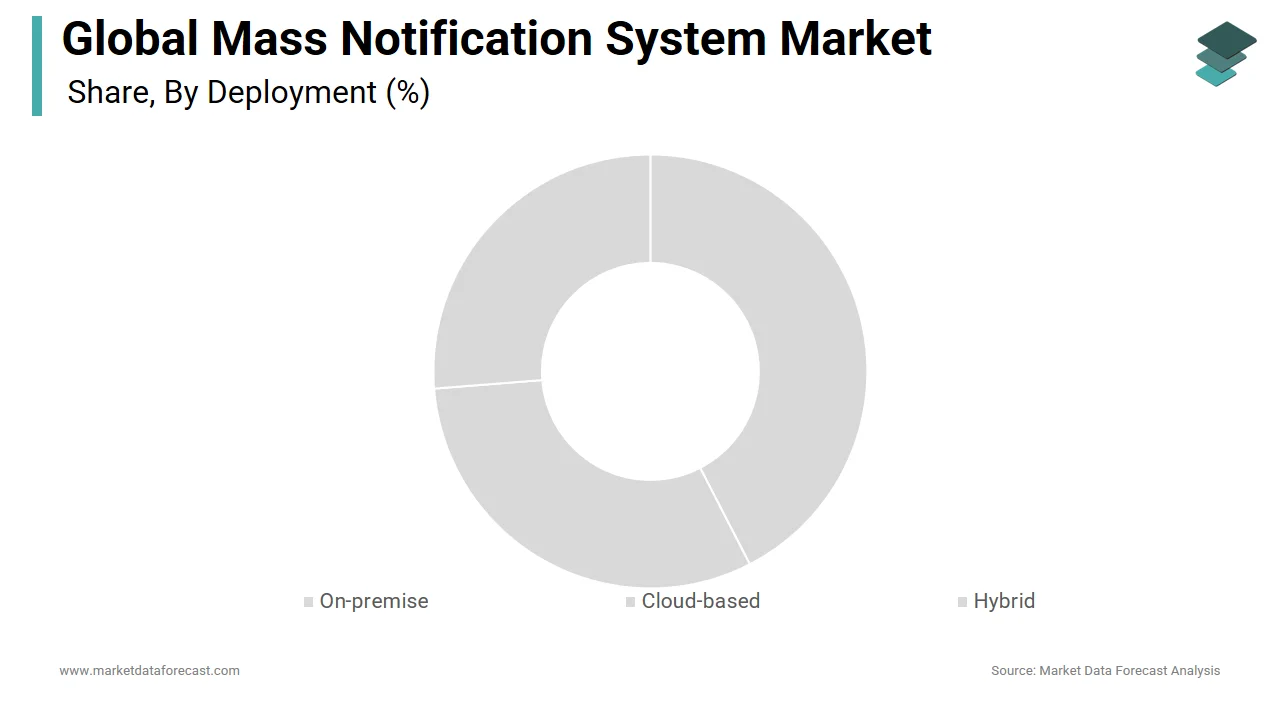
The on-premise deployment model holds the largest share of the Mass Notification System Market, accounting for 42.1% of total market revenue in 2024. This segment's dominance is primarily attributed to its widespread adoption by government agencies, defense organizations, and large enterprises that prioritize data sovereignty and system control over cloud-based alternatives.
A key driver behind this preference is regulatory compliance. In the United States, for example, federal mandates like the Federal Information Security Management Act (FISMA) require agencies to maintain strict control over data handling and storage, making on-premise systems more attractive.
Moreover, industries such as energy and utilities, where operational technology networks are often air-gapped for security reasons, also rely heavily on local deployment models. These factors collectively reinforce the continued dominance of the on-premise deployment segment despite rising interest in cloud-based alternatives.
Cloud-based deployment is emerging as the fastest-growing segment in the Mass Notification System Market, projected to expand at a CAGR of 12.4%. This rapid growth is driven by increasing digital transformation efforts across industries, particularly among small and medium-sized enterprises seeking cost-effective, scalable communication solutions. According to a 2023 analysis by McKinsey, over 68% of businesses globally are accelerating cloud migration strategies to enhance remote collaboration and crisis response capabilities.
One of the major contributing factors is the rise in hybrid and distributed work environments. With employees operating from multiple locations, organizations need real-time alerting mechanisms that can reach individuals via mobile apps, email, and SMS capabilities inherently supported by cloud-native architectures.
In addition, the integration of artificial intelligence and machine learning into cloud platforms allows for smarter alert routing, audience segmentation, and automated escalation workflows. Microsoft and Google have both expanded their enterprise communication suites to include embedded emergency notification features, further boosting adoption.
By Application Insights
Emergency Response Management represented the biggest application segment in the Mass Notification System Market, capturing 35.6% of total market value in 2024. This is because of the urgent need for real-time communication during natural disasters, industrial accidents, and security breaches. Organizations across sectors are prioritizing immediate situational awareness and coordinated action plans, fueling demand for advanced notification tools.
One key driver is the increasing frequency of climate-related emergencies. According to the World Meteorological Organization, a fivefold increase in weather-related disasters over the past 50 years, compelling governments and corporations to strengthen preparedness frameworks.
For instance, in Japan, where seismic activity is frequent, emergency response systems integrated with early earthquake alerts from the Japan Meteorological Agency have become standard practice. Similarly, in the U.S., the Department of Homeland Security has mandated federal agencies to implement MNS-compatible emergency protocols under the National Incident Management System (NIMS). As global risks escalate, the urgency to deploy robust, multi-channel alerting systems remains a central force behind this segment’s leadership position.
Reporting and analytics is emerging as the fastest-growing application within the Mass Notification System Market, expected to grow at a CAGR of 13.2% through 2033. This surge is fueled by the growing emphasis on post-event evaluation, compliance reporting, and performance optimization in emergency communication systems. Organizations are increasingly leveraging data-driven insights to refine alert dissemination strategies, assess response times, and ensure adherence to regulatory standards.
One of the primary drivers is the integration of AI-powered analytics into mass notification platforms. These advanced systems can generate detailed reports on message delivery rates, user engagement, and channel effectiveness, enabling organizations to fine-tune their emergency protocols.
Also, regulatory bodies such as OSHA and FEMA now require detailed audit trails for emergency communications, pushing companies to adopt MNS solutions with built-in analytics modules. As enterprises seek greater transparency and accountability in crisis communication, the reporting and analytics segment is poised for sustained high growth.
By End-User Insights
The government sector led the end-user segment in the Mass Notification System Market, representing 30.5% of total market share in 2024. This lead position is primarily driven by the extensive use of MNS technologies in public safety, national defense, emergency services, and municipal disaster management programs. Governments worldwide are investing heavily in integrated alerting systems to safeguard citizens and coordinate responses during crises.
A major contributing factor is the increasing threat landscape, including terrorism, cyberattacks, and natural disasters. Furthermore, defense agencies are integrating MNS into military bases and strategic installations for rapid threat communication. Given the persistent need for public safety infrastructure modernization, the government segment will remain a cornerstone of market expansion.
The healthcare sector is experiencing the fastest growth in Mass Notification System adoption, with a projected CAGR of 11.8%. This accelerated uptake is driven by the need for efficient internal communication, patient safety enhancements, and regulatory compliance in medical facilities. Hospitals, clinics, and research centers are increasingly deploying MNS platforms to manage emergency scenarios such as pandemics, code blue alerts, and cybersecurity incidents. According to a 2023 survey by Healthcare Information and Management Systems Society (HIMSS), over 68% of healthcare providers reported improved incident response times after implementing MNS solutions.
One key driver is the ongoing digitization of hospital operations and the integration of emergency communication into electronic health records (EHRs). The U.S. Centers for Medicare & Medicaid Services (CMS) has mandated healthcare facilities to maintain robust emergency communication protocols under the Conditions of Participation (CoP), prompting widespread MNS investments.
Also, the rise in ransomware attacks targeting healthcare institutions has intensified the demand for secure, real-time alerting systems. IBM reported that the healthcare industry faced the highest average data breach cost of USD 10.9 million in 2023, reinforcing the urgency for reliable notification mechanisms.
REGIONAL ANALYSIS
North America Mass Notification System Market Insights
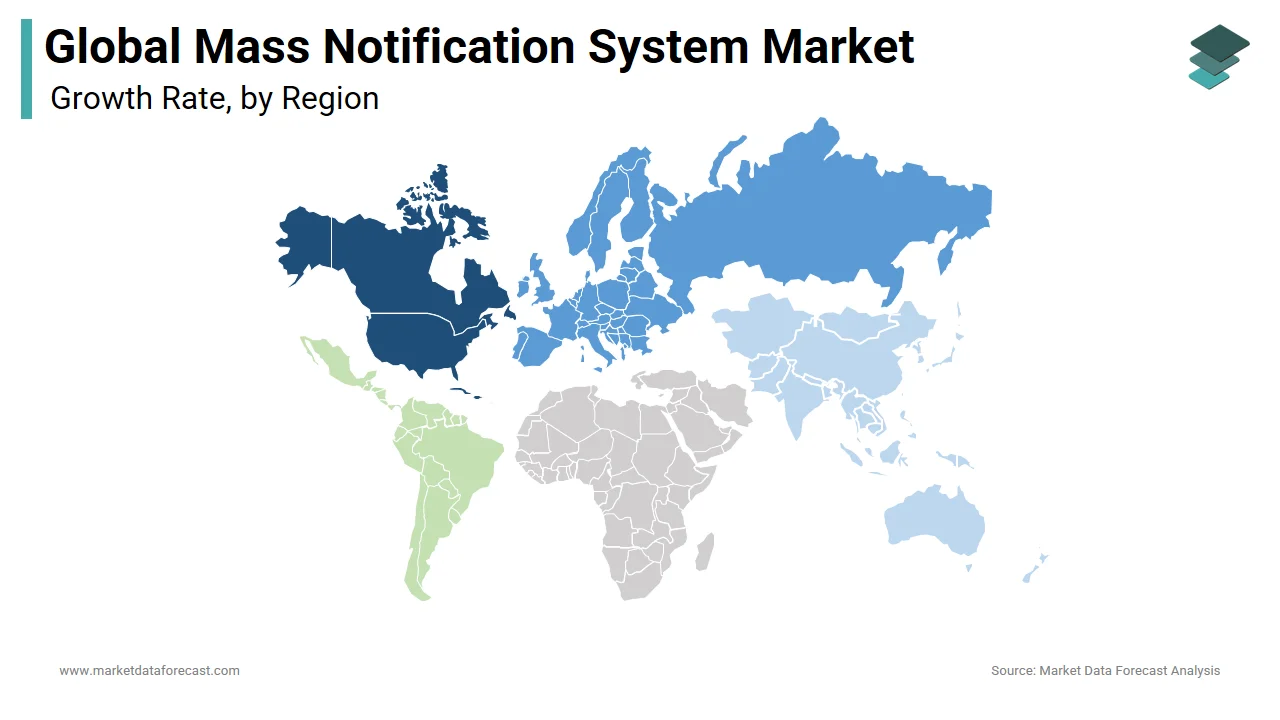
North America maintained the dominant position in the global Mass Notification System Market, holding 35.6% of total market share in 2024. The region's lead position is underpinned by stringent regulatory requirements, a well-established emergency response infrastructure, and high adoption rates across government, education, and healthcare sectors. The U.S., in particular, has been a key growth engine due to initiatives such as FEMA’s Integrated Public Alert and Warning System (IPAWS), which enables federal, state, and local authorities to send emergency alerts via multiple channels.
A further major factor is the prevalence of natural disasters and cyber threats. The National Oceanic and Atmospheric Administration (NOAA) recorded 18 separate billion-dollar weather and climate disasters in the U.S. in 2023 alone, necessitating real-time alerting capabilities. Simultaneously, according to the FBI, a 52% increase in ransomware attacks against U.S. hospitals, prompting healthcare providers to invest in secure MNS platforms. Canada is also witnessing strong growth, with provincial governments integrating MNS into public safety frameworks.
Europe Mass Notification System Market Insights
Europe is another key regional market for Mass Notification Systems. The region’s growth is largely driven by comprehensive regulatory frameworks and increasing investments in smart city initiatives. The European Union has mandated member states to develop cross-border emergency communication systems under the eCall initiative, which requires all new vehicles sold in the EU to automatically transmit crash data to emergency services.
Moreover, the General Data Protection Regulation (GDPR) has indirectly influenced MNS adoption by requiring organizations to promptly communicate data breaches to affected individuals and regulators. Germany and the UK lead in enterprise MNS adoption, with major banks, universities, and manufacturing firms deploying multi-channel notification systems to enhance business continuity planning.
Asia-Pacific Mass Notification System Market Insights
Asia-Pacific is emerging as the fastest-growing region in the Mass Notification System Market. This growth is primarily fueled by rapid urbanization, increasing disaster preparedness initiatives, and rising government investments in smart infrastructure. Countries such as Japan, South Korea, and India are at the forefront of adopting MNS technologies to enhance public safety and emergency coordination. According to the Asian Development Bank, over 60% of Asia’s population resides in areas vulnerable to natural disasters, necessitating robust alerting mechanisms.
Japan has been particularly proactive in deploying early warning systems, integrating MNS with the Japan Meteorological Agency’s seismic detection network. Meanwhile, India has launched the National Disaster Management Authority’s Early Warning Dissemination System (EWDS), which utilizes satellite-linked sirens and mobile alerts to warn coastal communities of cyclones and tsunamis.
Latin America Mass Notification System Market Insights
Latin America is witnessing steady growth in the Mass Notification System Market, with Brazil, Mexico, and Colombia leading the charge. It is driven by increasing investments in public safety and disaster risk reduction. According to the Economic Commission for Latin America and the Caribbean (ECLAC), the number of climate-related disasters in the region increased by 40% between 2010 and 2022, prompting governments to enhance emergency alert capabilities.
A key development is the implementation of national emergency alert systems. In Brazil, the government launched the Sistema de Alerta Rápido (SAR) to disseminate flood and landslide warnings to vulnerable populations. Similarly, Mexico’s Sistema Nacional de Protección Civil integrates MNS with early warning systems for hurricanes and earthquakes. Despite budget constraints in some countries, rising awareness of emergency preparedness is gradually strengthening the region’s market position.
Middle East and Africa Mass Notification System Market Insights
The Middle East and Africa represent an emerging but rapidly evolving segment of the Mass Notification System Market. Growth in this region is being driven by increasing urbanization, geopolitical tensions, and the expansion of smart city initiatives. Governments in the Gulf Cooperation Council (GCC) countries, particularly the UAE and Saudi Arabia, are investing heavily in digital infrastructure to enhance public safety and crisis response.
In Africa, the focus is on improving disaster resilience in regions prone to droughts, floods, and political instability. Kenya and South Africa have deployed mobile-based alert systems to notify citizens about extreme weather events and civil unrest.
Also, international aid agencies such as the Red Cross have supported the rollout of community-level alerting systems in vulnerable zones.
KEY MARKET PLAYERS
Everbridge, Alertus, OnSolve, Blackboard, Siemens, Honeywell, Eaton, Metis Secure Solution, and others.
RECENT MARKET DEVELOPMENTS
- In February 2024, Everbridge announced a strategic partnership with Google Cloud to integrate its Critical Event Management platform with Google Workspace. This collaboration aims to enhance real-time alerting within enterprise communication workflows, enabling faster incident response and improved situational awareness across organizations.
- In May 2024, Honeywell launched a new cloud-based version of its mass notification system designed specifically for mid-sized businesses. This move expands Honeywell’s accessibility beyond large-scale enterprises, allowing smaller organizations to adopt scalable emergency communication solutions without significant infrastructure investment.
- In July 2024, Singlewire Software introduced an updated version of its InformaCast platform featuring AI-driven message prioritization and automated escalation protocols. The enhancements are intended to improve message relevance and ensure timely delivery to targeted audiences during complex emergency scenarios.
- In September 2024, Motorola Solutions expanded its emergency communication portfolio by acquiring a niche MNS software firm specializing in campus-wide alerting systems. This acquisition strengthens Motorola’s position in the education and public safety sectors by integrating advanced notification capabilities into its existing command center solutions.
- In November 2024, OnSolve announced a major integration initiative with Microsoft Teams, enabling direct emergency alerts to be sent within collaborative workspace environments. This development supports hybrid and remote workforce safety by embedding mass notification directly into everyday digital communication tools used by enterprises.
MARKET SEGMENTATION
This research report on the global mass notification system market has been segmented and sub-segmented based on the deployment model, application, component, end-user, and region.
By Deployment
- On-premise
- Cloud-based
- Hybrid
By Application
- Emergency Response Management
- Business Continuity and Disaster Recovery
- Public Alert and Warning
- Reporting and Analytics
- Others
By Component
- Hardware
- Software
- Services
By End-User
- Healthcare
- Government
- Education
- Transportation
- Others
By Region
- North America
- Europe
- Asia-Pacific
- Latin America
- The Middle East and Africa