- Product Description Description
- Table of Contents TOC
- List of Table & Figure LOT
- Get Free Sample PDF Sample PDF
Market Size, 2025
$114 BnMarket Estimate, 2026
$120.21 BnMarket Forecast, 2034
$183.8 BnCAGR, 2026–2034
5.45%Global Incident and Emergency Management Market Report Summary
The global incident and emergency management market was valued at USD 114 billion in 2025 and is projected to grow from USD 120.21 billion in 2026 to USD 183.79 billion by 2034, registering a CAGR of 5.45% from 2026 to 2034. Market growth is driven by increasing frequency of natural disasters, rising cybersecurity threats, growing urbanization, and the need for coordinated emergency response systems. Governments, public safety agencies, and enterprises are increasingly investing in advanced incident management platforms, real-time monitoring systems, and emergency communication technologies to enhance preparedness and response capabilities. The integration of artificial intelligence, geospatial analytics, and cloud-based emergency management solutions is further supporting market expansion worldwide.
Key Market Trends
- Increasing adoption of real-time monitoring and situational awareness systems.
- Growing investments in disaster preparedness and emergency response infrastructure.
- Rising use of AI, predictive analytics, and geospatial technologies in emergency management.
- Expansion of cloud-based incident management and communication platforms.
- Strengthening focus on climate resilience, cybersecurity preparedness, and public safety initiatives.
Segmental Insights
- Based on type of system, the monitoring systems segment dominated the global incident and emergency management market by accounting for 34.5% share in 2025, driven by the growing need for real-time threat detection, situational awareness, and rapid response coordination.
- Based on communication technology, the first response tools segment held the largest share of the market with 45.4% in 2025, supported by increasing deployment of communication and coordination solutions that enable emergency responders to act quickly during critical incidents.
Regional Insights
The global incident and emergency management market is witnessing steady growth across major regions, supported by increasing disaster risks, technological advancements, and government investments in public safety infrastructure.
- North America dominated the global market in 2025 with 38.3% share, driven by advanced emergency response systems, strong public safety investments, and widespread adoption of innovative incident management technologies.
- Europe ranked second by accounting for 22.3% share in 2025, supported by strong cross-border collaboration frameworks, increasing focus on climate resilience, and investments in disaster preparedness programs.
- Asia-Pacific is projected to register significant growth during the forecast period, driven by rapid urbanization, increasing vulnerability to natural disasters, expanding smart city initiatives, and growing government expenditure on emergency management infrastructure.
Competitive Landscape
The global incident and emergency management market is characterized by the presence of technology providers, communication solution vendors, geospatial intelligence companies, and emergency response software developers focusing on improving preparedness, coordination, and operational efficiency. Market participants are investing in AI-powered analytics, cloud-based emergency management platforms, and integrated communication systems to strengthen market positioning. Strategic partnerships, product innovation, and expansion of public safety capabilities are shaping competitive dynamics across the industry.
Prominent companies operating in the global incident and emergency management market include IBM, NEC Corporation, Motorola Solutions Inc., Hexagon, Esri, NC4, Intermedix Corporation, Eccentex, The Response Group, Haystax Technology, Alert Technologies, Crisisworks, EmerGeo, Veoci, and MissionMode.
 Download Free Sample Report
Global Incident and Emergency Management Market Size
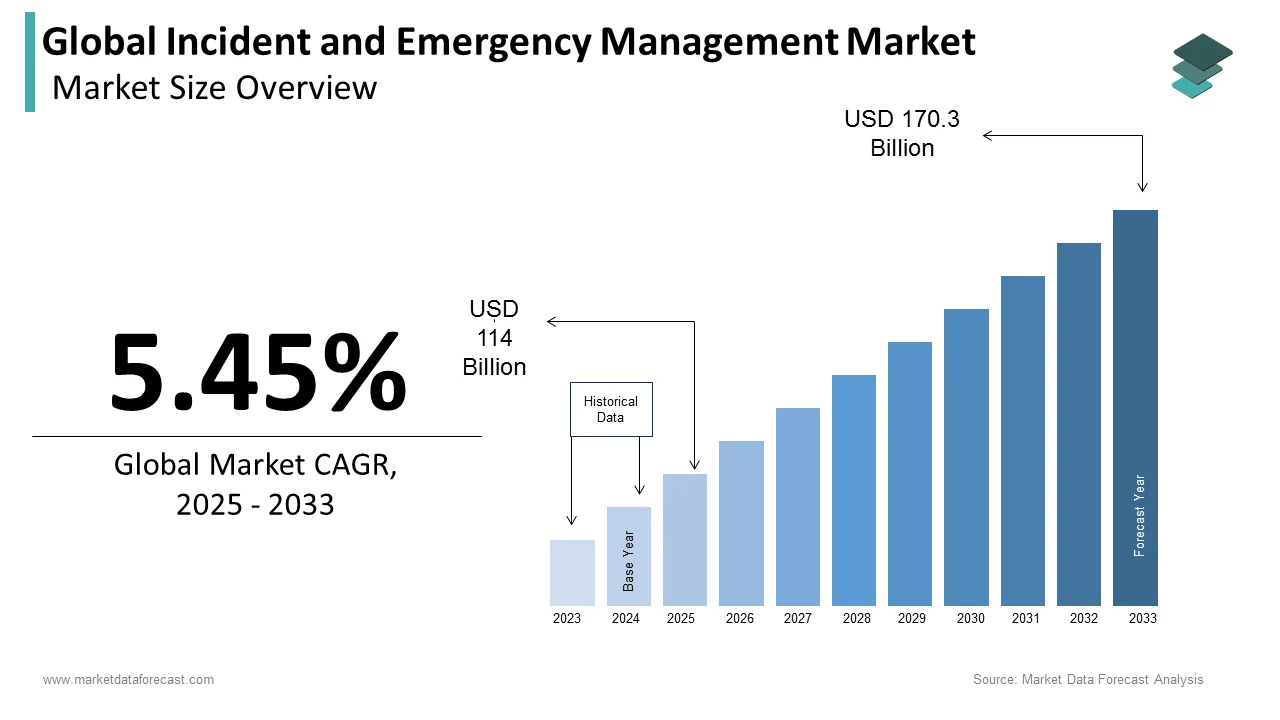
The global incident and emergency management market was worth US$ 114 billion in 2025 and is anticipated to reach a valuation of US$ 183.79 billion by 2034 from US$ 120.21 billion in 2026. It is predicted to register a CAGR of 5.45% during the forecast period 2026 to 2034.
The incident and emergency management market encompasses a comprehensive suite of technologies services and protocols designed to prepare for respond to and recover from critical events that threaten public safety and organizational continuity. This sector integrates command and control software communication systems geographic information systems and real time data analytics to facilitate coordinated responses among first responders government agencies and private entities. The scope extends beyond natural disasters to include cyberattacks industrial accidents and terrorist activities requiring robust interoperability and rapid decision making capabilities. In Europe the frequency of extreme weather events has intensified prompting urgent upgrades to existing infrastructure. According to the European Environment Agency climate related economic losses in Europe exceeded 145 billion euros between 1980 and 2020 with floods and storms accounting for the majority of these damages. This escalating risk profile drives the adoption of advanced predictive modeling and early warning systems. Furthermore the European Union Civil Protection Mechanism facilitates cross border cooperation ensuring that member states can share resources and expertise during large scale emergencies. The integration of artificial intelligence enables automated threat detection and resource allocation optimizing response times and minimizing human error. Regulatory frameworks such as the Critical Entities Resilience Directive mandate enhanced security measures for essential services further stimulating demand for sophisticated management solutions. As urbanization increases the complexity of emergency scenarios grows necessitating scalable and resilient technological frameworks that can handle high volume data streams and coordinate multi agency efforts effectively in real time.
MARKET DRIVERS
Escalating Frequency and Severity of Climate Induced Disasters
The increasing prevalence of extreme weather events for the adoption of advanced incident is promoting the growth of the incident and emergency management market. Climate change has altered weather patterns leading to more frequent and intense hurricanes floods wildfires and heatwaves that overwhelm traditional response mechanisms. According to the World Meteorological Organization, the number of weather related disasters has increased by a factor of five over the past 50 years causing significant loss of life and economic disruption. Governments and municipal authorities are compelled to invest in resilient infrastructure and smart monitoring systems to mitigate these risks. Real time data integration allows emergency managers to predict disaster trajectories and evacuate populations proactively rather than reactively. The financial burden of recovery operations far exceeds the cost of prevention driving budget allocations toward proactive management tools. Insurance companies also pressure municipalities to adopt rigorous emergency protocols to reduce claim payouts. The devastation caused by recent floods in Central Europe and wildfires in Southern Europe has highlighted gaps in current preparedness levels prompting legislative action and funding initiatives. These events demonstrate the critical need for interoperable communication platforms that function when traditional networks fail.
Stringent Government Regulations and Compliance Mandates
The regulatory frameworks imposed by national and international bodies for standardized systems is also escalating the growth of the incident and emergency management market. Governments recognize that uncoordinated responses lead to higher casualties and prolonged recovery periods necessitating strict adherence to established protocols. The specific preparedness standards for state and local governments receiving federal funding ensuring a baseline level of capability across jurisdictions. Similarly, operators of essential services to identify risks and implement robust incident response plans. Compliance with these regulations often necessitates the acquisition of specialized software for documentation reporting and audit trails. Organizations in sectors such as energy healthcare and transportation face severe penalties for non-compliance including fines and operational suspensions. This regulatory pressure creates a steady demand for solutions that automate compliance processes and provide verifiable evidence of preparedness. International standards such as ISO 22320 for emergency management provide guidelines that many organizations adopt to demonstrate due diligence. The legal liability associated with inadequate emergency response further motivates corporate entities to invest in comprehensive management platforms. As regulations evolve to address emerging threats like cyber physical attacks the requirements for management systems become more complex driving continuous upgrades and expansions.
MARKET RESTRAINTS
High Implementation Costs and Budgetary Constraints
The substantial upfront investment requirements with the widespread adoption of advanced incident and emergency management solutions for smaller municipalities and developing regions is one of the primary factors degrading the growth of the incident and emergency management market. Deploying comprehensive systems involves costs for hardware software licensing network infrastructure and extensive training programs for personnel. Many local governments face tight fiscal constraints limiting their ability to allocate funds for non-revenue generating infrastructure projects. The complexity of integrating new technologies with legacy systems often leads to unexpected expenses and project delays. Small rural communities may lack the technical expertise required to manage sophisticated platforms resulting in reliance on external consultants, which further escalates costs. Maintenance and upgrade fees add to the total cost of ownership making long term sustainability a concern for budget conscious administrators. In developing nations competing priorities such as healthcare and education often take precedence over emergency preparedness spending. The return on investment for emergency management is difficult to quantify since it prevents potential losses rather than generating direct revenue. This ambiguity makes it challenging for decision makers to justify large expenditures to stakeholders. Many organizations opt for basic or fragmented solutions that fail to provide holistic coverage.
Interoperability Issues Among Legacy Systems
The lack of seamless interoperability between diverse communication and data systems during emergency situations is also inhibiting the growth of the incident and emergency management market. First responder agencies often operate on different radio frequencies and software platforms that do not communicate effectively with each other. The incompatible public safety communications systems have historically impeded joint operations during major incidents leading to delays and confusion. Legacy infrastructure in many regions was deployed in silos without consideration for future integration needs. Upgrading these disparate systems to a unified standard requires significant technical effort and financial investment. Proprietary data formats used by different vendors further complicate data exchange preventing real time situational awareness across agencies. Efforts to establish common standards, such as Project 25 in North America have made progress but full implementation remains incomplete. The fragmentation of the vendor landscape exacerbates the problem as each provider promotes its own ecosystem. Agencies hesitate to switch providers due to high switching costs and fear of vendor lock in. This technological fragmentation undermines the core objective of incident management which is coordinated action.
MARKET OPPORTUNITIES
Integration of Artificial Intelligence and Predictive Analytics
The incorporation of artificial intelligence and machine learning for enhancing predictive capabilities and operational efficiency is to promote new opportunities for the growth of the incident and emergency management market. AI algorithms can analyze vast amounts of historical and real time data from social media sensors and satellite imagery to identify emerging threats before they escalate. These technologies enable dynamic modeling of disaster scenarios allowing managers to simulate various outcomes and choose the most effective mitigation strategies. Natural language processing tools can monitor social media channels for distress signals providing early warnings of incidents in densely populated areas. Automated dispatch systems powered by AI can prioritize calls based on severity and location ensuring that critical cases receive immediate attention. The ability to process data faster than human analysts allows for quicker decision making in high pressure environments. The integration of AI also supports post incident analysis by identifying patterns and weaknesses in response protocols.
Expansion of Internet of Things Enabled Smart City Infrastructure
The proliferation of Internet of Things devices within smart city initiatives offers significant opportunities for real time monitoring and automated emergency response is certainly to surge new opportunities for the growth of the incident and emergency management market. Sensors embedded in urban infrastructure can detect anomalies, such as gas leaks, structural failures, or unusual crowd movements triggering immediate alerts to emergency centers. According to Statista, the number of connected IoT devices globally is projected to reach 75 billion by 2025 with a significant portion deployed in urban environments. These devices provide granular data that enhances situational awareness allowing responders to assess risks accurately before arriving on scene. Smart traffic lights can be programmed to create green corridors for emergency vehicles reducing transit times during critical missions. Wearable devices for first responders monitor vital signs and location ensuring their safety and enabling efficient team coordination. The integration of IoT data with geographic information systems creates dynamic maps that update in real time reflecting changing conditions on the ground. Municipalities investing in smart infrastructure often bundle emergency management capabilities into broader digital transformation projects leveraging shared funding sources. This convergence of technologies creates a holistic ecosystem where prevention detection and response are seamlessly linked.
MARKET CHALLENGES
Cybersecurity Threats to Critical Emergency Infrastructure
The increasing digitization of emergency management systems exposes them to sophisticated cyberattacks that can disrupt operations during crises is to pose as a barrier for the growth of the incident and emergency management market. Hackers target command and control centers communication networks and data repositories to cause chaos or extract sensitive information. A successful breach can disable sirens scramble dispatch systems or alter emergency plans leading to catastrophic consequences. The reliance on cloud based services introduces additional vulnerabilities if proper encryption and access controls are not implemented. Supply chain attacks compromise software updates introducing malware into trusted systems. Emergency agencies often lack dedicated cybersecurity teams and budgets making them attractive targets for groups. The interconnectivity of systems means that a breach in one agency can spread to others compromising regional security. Ensuring the integrity and availability of data during an emergency is paramount yet challenging given the evolving nature of cyber threats.
Workforce Shortages and Training Gaps
A chronic shortage of skilled personnel capable of operating advanced incident and emergency management technologies is to impede the growth of the incident and emergency management market. The complexity of modern platforms requires specialized knowledge in data analysis system administration and crisis communication which many traditional first responders lack. Aging demographics in many developed nations exacerbate this issue as experienced professionals retire without adequate replacements. Training programs often lag behind technological advancements leaving staff ill-prepared to leverage new tools during high stress situations. High turnover rates in emergency services further disrupt continuity and institutional knowledge retention. The mental toll of emergency work contributes to burnout and attrition affecting operational readiness. Recruiting individuals with both technical aptitude and crisis management skills is difficult due to competition from the private sector. Without a competent workforce even the most sophisticated systems fail to deliver value. Organizations struggle to balance operational duties with ongoing training requirements leading to skill gaps.
REPORT COVERAGE
| REPORT METRIC | DETAILS |
| Market Size Available | 2025 to 2034 |
| Base Year | 2025 |
| Forecast Period | 2026 to 2034 |
| Segments Covered | By Type of System, Communication Technology, Sector, and Region. |
| Various Analyses Covered | Global, Regional and Country-Level Analysis, Segment-Level Analysis, Drivers, Restraints, Opportunities, Challenges; PESTLE Analysis; Porter’s Five Forces Analysis, Competitive Landscape, Analyst Overview of Investment Opportunities |
| Regions Covered | North America, Europe, Asia Pacific, Latin America, the Middle East, and Africa |
| Market Leaders Profiled | |
SEGMENTAL ANALYSIS
By Type of System Insights
The monitoring systems segment was the largest by holding 34.5% of the incident and emergency management market share in 2025. These systems integrate inputs from sensors cameras drones and social media to create a comprehensive operational picture for command centers. The proliferation of Internet of Things devices in smart cities has expanded the capabilities of monitoring systems to detect anomalies. Governments prioritize these systems to maintain public safety and minimize economic disruption during disasters. The ability to track assets and personnel in real time ensures accountability and enhances coordination among multiple agencies. Integration with geographic information systems allows for visual representation of threats enabling faster comprehension of complex scenarios. As urban populations grow, the density of potential hazards increases necessitating robust monitoring infrastructure. The shift toward predictive policing and disaster prevention further drives adoption as authorities seek to identify risks before they escalate. This proactive approach relies heavily on continuous data streams provided by advanced monitoring platforms.
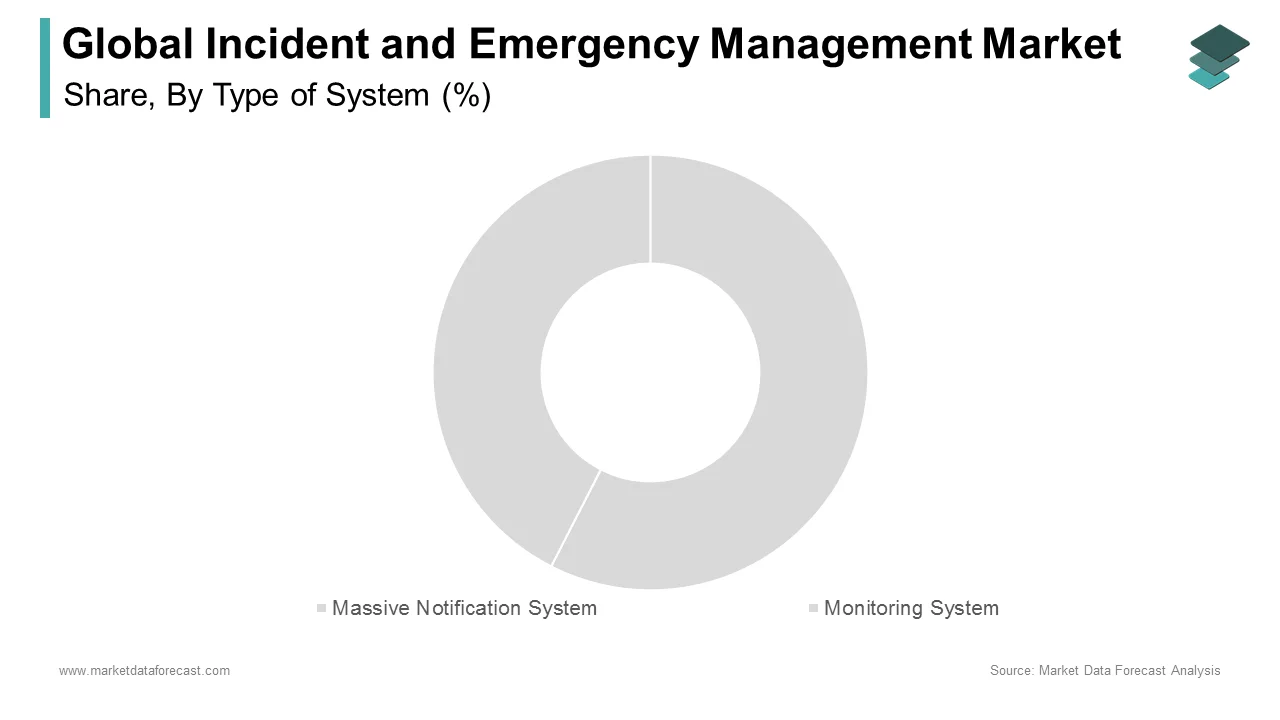
The mass notification systems segment is likely to exhibit a fastest CAGR of 14.2% from 2026 to 2034 with the ubiquity of mobile devices and the urgent need for rapid public communication. These systems enable authorities to send alerts via text messages emails social media and sirens simultaneously ensuring maximum reach during events. The rise of smartphone penetration globally allows for geo targeted alerts that warn only those in immediate danger reducing panic and network congestion. Recent high-profile incidents including active shooter situations and flash floods have highlighted the life saving potential of instant communication. Governments are mandating the implementation of Wireless Emergency Alerts and similar technologies to standardize public warning mechanisms. The integration of two way communication features allows citizens to report incidents and request help creating a crowdsourced intelligence network. Businesses also adopt these systems to protect employees and assets demonstrating versatility beyond public sector use. The low cost of deployment compared to physical infrastructure makes it an attractive investment for municipalities with limited budgets.
By Communication Technology Insights
The first response tools segment was the largest by holding 45.4% of the incident and emergency management market share in 2025, as they are essential for the immediate coordination of police fire and medical services during emergencies. These tools include ruggedized radios mobile data terminals and specialized software that function in harsh environments, where commercial networks may fail. The transition to broadband enabled public safety networks such as FirstNet in the United States has enhanced the capabilities of these tools allowing for video streaming and data sharing in real time. First responders require durable and secure devices that can withstand extreme temperatures water exposure and physical impact. The integration of body worn cameras and biometric sensors into these tools provides additional layers of safety and accountability. Training and familiarity with these specific tools drive consistent procurement cycles as agencies upgrade equipment to meet evolving standards. The inability to communicate effectively during past disasters has led to significant federal funding for modernizing first response communication infrastructure.
The satellite phones segment is expected to grow at a fastest CAGR of 11.5% during the forecast period due to their ability to operate independently of terrestrial infrastructure. During major disasters such as earthquakes hurricanes or wildfires cellular towers often suffer damage or power outages rendering standard communication methods useless. The miniaturization of satellite technology has made handheld devices more affordable and user friendly encouraging wider adoption among emergency management agencies and NGOs. Recent geopolitical conflicts and climate induced disasters have underscored the vulnerability of ground-based networks prompting governments to invest in redundant satellite capabilities. Low earth orbit satellite constellations are reducing latency and improving data speeds making satellite phones viable for video conferencing and large file transfers. Emergency kits increasingly include satellite communicators as standard equipment for disaster preparedness. The global nature of satellite coverage allows for international coordination during cross border crises.
REGIONAL ANALYSIS
North America Incident and Emergency Management Market Analysis
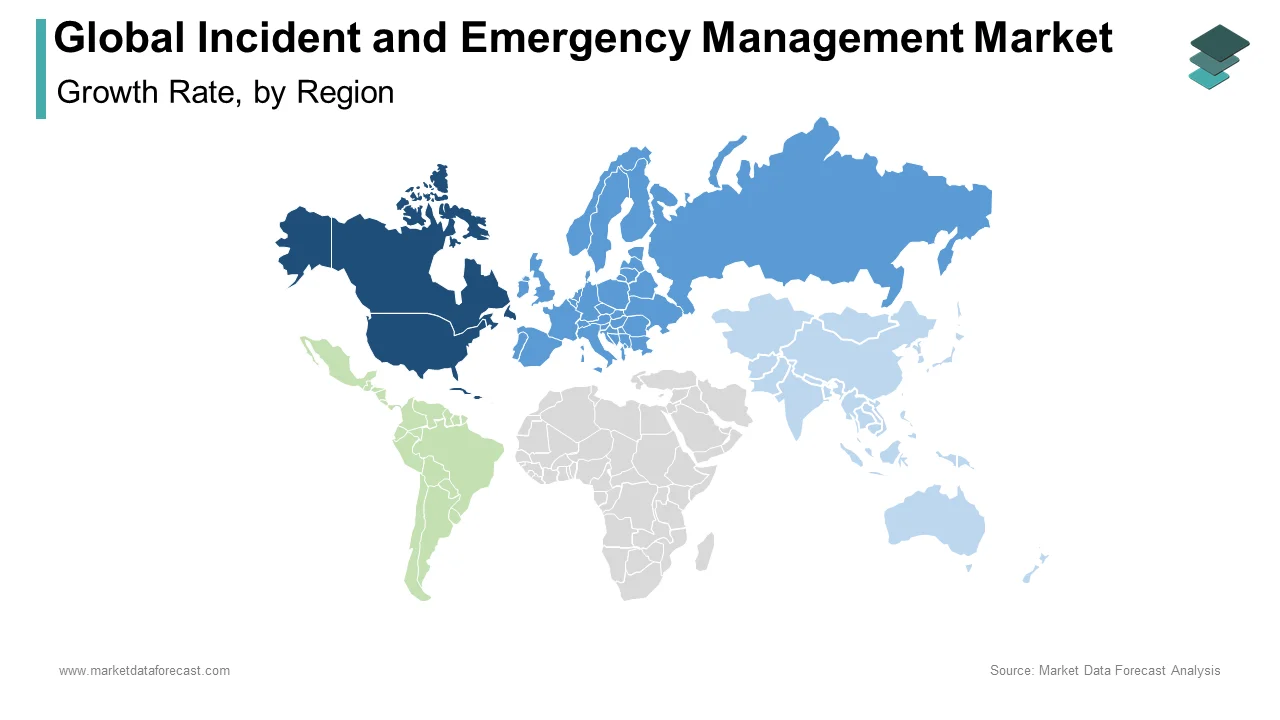
North America was the top performer of the global incident and emergency management market by holding 38.3% of share in 2025. The substantial government investment in public safety infrastructure and stringent regulatory requirements for emergency preparedness is escalating the growth of the segment. The United States Federal Emergency Management Agency allocates billions of dollars annually to state and local jurisdictions for upgrading communication systems and purchasing advanced management software. The establishment of nationwide broadband networks like FirstNet has set a global benchmark for interoperable public safety communications. Canada follows suit with robust civil protection strategies that emphasize cross provincial cooperation and technological integration. High awareness of cybersecurity threats prompts continuous upgrades to protect critical emergency data from malicious attacks. The presence of major technology vendors in Silicon Valley fosters innovation in artificial intelligence and data analytics for emergency response. Frequent natural disasters such as hurricanes wildfires and tornadoes provide a practical impetus for adopting resilient management solutions. Private sector participation is strong with corporations investing heavily in business continuity planning. The mature market structure supports high adoption rates of cloud based and mobile solutions.
Europe Incident and Emergency Management Market Analysis
Europe incident and emergency management market was ranked second by holding 22.3% of share in 2025 with the strong collaborative frameworks and increasing focus on climate resilience. The European Union Civil Protection Mechanism facilitates resource sharing and joint training exercises among member states enhancing regional preparedness capabilities. Germany, France, and the United Kingdom lead in deploying smart city technologies that integrate emergency management with urban infrastructure. The General Data Protection Regulation influences how personal data is handled during crises driving demand for secure and compliant software solutions. Rising frequency of floods and heatwaves across the continent has prompted governments to upgrade early warning systems and monitoring networks. Interoperability remains a key focus with initiatives like the European Public Safety Broadband Network aiming to connect first responders across borders. Public awareness campaigns educate citizens on emergency protocols increasing demand for mass notification systems. The aging population in Europe necessitates specialized emergency responses for health-related incidents driving innovation in telemedicine integration. Strict environmental regulations encourage the use of energy efficient and sustainable emergency equipment.
Asia Pacific Incident and Emergency Management Market Analysis
The Asia Pacific incident and emergency management market growth is driven by rapid urbanization and high exposure to natural disasters. Countries, such as Japan, China, India, and Australia, are investing heavily in disaster risk reduction strategies to protect growing urban populations. Japan leads in technological innovation utilizing earthquake early warning systems and automated shutdown protocols for critical infrastructure. China is expanding its smart city initiatives integrating surveillance and emergency response platforms to manage large scale public events and natural hazards. India is modernizing its disaster management authority with digital tools for real time monitoring and resource allocation. Australia focuses on bushfire detection and management using satellite imagery and AI driven predictive models. Increasing disposable incomes allow governments to allocate larger budgets for public safety infrastructure. International aid and partnerships facilitate technology transfer and capacity building in developing nations. The sheer scale of population density in megacities creates complex emergency scenarios requiring sophisticated coordination tools.
Latin America Incident and Emergency Management Market Analysis
Latin America incident and emergency management market growth is anticipated to grow steadily with the governments recognize the need for improved disaster preparedness and response capabilities. According to the Economic Commission for Latin America and the Caribbean, economic losses from disasters have averaged 2% of regional GDP annually prompting greater investment in mitigation strategies. Chile has developed robust tsunami warning networks following historical tragedies enhancing coastal community safety. Limited budgets remain a challenge but international funding and public private partnerships are helping to bridge the gap. The adoption of mobile based notification systems is rising due to high smartphone usage rates among the population. Training programs for first responders are being standardized to improve operational efficiency.
Middle East and Africa Incident and Emergency Management Market Analysis
The Middle East and Africa incident and emergency management market growth is likely to grow with the growing incident and emergency management capabilities to address both security threats and natural hazards. Gulf Cooperation Council countries are investing heavily in smart city projects that include integrated emergency response systems for large scale events and infrastructure protection. Saudi Arabia and the United Arab Emirates are deploying advanced surveillance and command centers to ensure safety during major religious gatherings and international exhibitions. South Africa is modernizing its emergency medical services and fire response units with digital dispatch systems to improve efficiency in urban centers. Nigeria and Kenya are leveraging mobile technology to disseminate health and security alerts to remote populations. Political instability in certain areas necessitates robust security management solutions for government facilities and critical infrastructure. International organizations support capacity building initiatives providing technical assistance and equipment to vulnerable regions. The lack of uniform standards across the continent presents challenges but also opportunities for harmonized solutions.
COMPETITIVE LANDSCAPE
The competitive landscape of the incident and emergency management market is characterized by a mix of established technology giants and specialized niche providers vying for government and enterprise contracts. Large corporations leverage their extensive resources to offer integrated end to end solutions that combine hardware software and services. They compete on reliability scalability and interoperability, which are for mission critical operations. Smaller firms differentiate themselves through innovative features such as advanced analytics drone integration or specialized industry applications. Regulatory compliance and cybersecurity certifications serve as key differentiators influencing procurement decisions. Price competition is less intense than value based competition, where proven performance and support quality matter most. Collaboration with telecom operators and cloud providers creates ecosystems that lock in customers through seamless integration. Innovation cycles are rapid driven by emerging threats like cyberattacks and climate change requiring constant product updates.
KEY MARKET PARTICIPANTS
A few of the promising companies operating in the global incident and emergency management market are
-
- IBM
- NEC Corporation
- Motorola Solutions Inc
- Hexagon
- Esri
- NC4
- Intermedix Corporation
- Eccentex
- The Response Group
- Haystax Technology
- Alert Technologies
- Crisisworks
- EmerGeo
- Veoci
- MissionMode
TOP PLAYERS IN THE MARKET
- Motorola Solutions Inc is a global leader in mission critical communications providing essential hardware and software for public safety agencies. The company offers integrated ecosystems that combine land mobile radio broadband video security and command center software to enhance situational awareness. Motorola recently expanded its portfolio through strategic acquisitions of video security and analytics firms to create unified platforms for emergency responders. Its Avigilon brand enhances visual intelligence capabilities allowing real time threat detection during incidents. The corporation actively collaborates with government bodies to deploy next generation broadband networks ensuring interoperability across jurisdictions.
- Hexagon AB contributes significantly to the incident and emergency management market through its advanced geospatial and sensor technologies. The company provides comprehensive software solutions that enable real time data visualization and resource coordination for emergency operations centers. Hexagon recently enhanced its public safety offerings by integrating artificial intelligence into its command and control platforms improving decision making speed and accuracy. Its Luciad technology supports complex 3D mapping which is crucial for urban disaster response and planning. The firm partners with telecommunications providers to ensure seamless data flow between field units and central dispatchers.
- IBM Corporation plays a pivotal role in the market by offering cognitive computing and cloud based solutions for emergency management. The company utilizes artificial intelligence and predictive analytics to help authorities anticipate risks and coordinate responses more effectively. IBM recently expanded its environmental intelligence suite providing hyper local weather forecasting and flood modeling capabilities to municipal governments. Its Maximo Asset Management software helps maintain critical infrastructure resilience ensuring operational continuity during disasters. The corporation collaborates with international agencies to develop open standards for data sharing enhancing interoperability among diverse response teams.
TOP STRATEGIES USED BY KEY MARKET PARTICIPANTS
Key players in the incident and emergency management market primarily focus on strategic acquisitions to expand their technological capabilities and integrate complementary services. Companies invest heavily in research and development to incorporate artificial intelligence machine learning and Internet of Things technologies into their platforms. Partnerships with telecommunications providers ensure robust connectivity and interoperability for critical communications during disasters. Vendors emphasize cloud based deployments to offer scalability and remote accessibility for distributed emergency teams. Compliance with international security standards builds trust among government clients handling sensitive data. Training and simulation services are bundled with software solutions to enhance user proficiency and operational readiness. Geographic expansion into emerging markets allows firms to tap into growing demand for modernized public safety infrastructure. Continuous innovation in user interface design improves usability under high stress conditions.
MARKET SEGMENTATION
This market research report on the global incident and emergency management market has been segmented and sub-segmented based on the type of system, communication technology, sector, and region.
By Type of System
- Massive Notification System
- Monitoring System
- Others
By Communication Technology
- First Response Tools
- Satellite Phones
- Others
By Sector
- BFSI
- Energy and Public Services
- Others
By Region
- North America
- Europe
- Asia Pacific
- Latin America
- The Middle East and Africa