- Product Description Description
- Table of Contents TOC
- List of Table & Figure LOT
- Get Free Sample PDF Sample PDF
Market Size, 2025
$686.91 MnMarket Estimate, 2026
$767.83 MnMarket Forecast, 2034
$1871.45 MnCAGR, 2026–2034
11.78%Middle East and Africa Safety Syringes Market Size, Growth, Trends & Forecast (2026–2034)
The safety syringes market in the Middle East and Africa was valued at USD 686.91 million in 2025, is estimated at USD 767.83 million in 2026, and is projected to reach USD 1,871.45 million by 2034, registering a compound annual growth rate (CAGR) of 11.78% during the forecast period from 2026 to 2034. Driven by occupational health mandates, large-scale immunization campaigns, and regional healthcare modernization frameworks, the market continues to expand rapidly across clinical and home-care segments.
Key Executive Metrics (At-a-Glance)
- 2025 Base Valuation: USD 686.91 Million
- 2026 Current Valuation: USD 767.83 Million
- 2034 Forecast Valuation: USD 1,871.45 Million
- Compound Annual Growth Rate (CAGR): 11.78% (2026–2034)
- Dominant Technology Segment: Non-Retractable Safety Syringes (accounted for 64.2% market share in 2025, favored for lower unit costs and simpler deployment)
- Fastest-Growing Technology Segment: Retractable Safety Syringes (predicted to witness the highest CAGR of 18.7% driven by GCC regulations and premium private hospital demand)
- Dominant Therapy Segment: Insulin Therapy (maintained the lead with 42.7% share in 2025 due to regional diabetes prevalence)
- Fastest-Growing Therapy Segment: GLP-1 Receptor Agonist Therapy (estimated to register the fastest CAGR of 34.2% due to obesity epidemic recognition and prefilled pen formats)
- Dominant End-User Segment: Hospitals (held the majority share in 2025 due to concentrated procedural volume and compliance frameworks)
- Fastest-Growing End-User Segment: Home Care (anticipated to witness the fastest CAGR of 22.8% fueled by chronic disease decentralization and telehealth adoption)
- Dominant Country / Region: Saudi Arabia (accounted for a leading 24.7% market share in 2025 backed by Vision 2030 transformations)
Core Market Drivers
- Occupational Health Mandates: Government-enforced safety rules and facility licensing requirements in Gulf and African nations driving institutional procurement.
- Expanded Immunization Programs: Large-scale vaccination initiatives supported by Gavi and WHO creating predictable, high-volume demand for auto-disable injection platforms.
- Chronic Disease Epidemics: Rising prevalence of diabetes and obesity scaling up regular injection frequencies across domestic and clinical settings.
Primary Market Restraints & Challenges
- Budgetary Constraints & Supply Fragmentation: Fiscal limitations in low-income countries and weak logistics infrastructure causing distribution barriers and stockouts.
- Training & Waste Management Deficits: Healthcare worker training gaps on safety mechanisms and inadequate sharps waste treatment capacity posing environmental and secondary hazard risks.
Middle East and Africa Safety Syringes Market Segmentation Breakdown
| Segment Category | Leading Sub-Segment (2025 Base) | Fastest-Growing Sub-Segment (2026–2034) |
|---|---|---|
| By Technology | Non-Retractable Safety Syringes (held 64.2% share due to cost efficiency and passive safety design) | Retractable Safety Syringes (projected at an 18.7% CAGR driven by GCC regulatory mandates) |
| By Therapy | Insulin Therapy (captured 42.7% share backed by high regional diabetes prevalence) | GLP-1 Receptor Agonist Therapy (estimated at a 34.2% CAGR driven by obesity management expansion) |
| By End User | Hospitals (held majority share due to high procedural volume and centralized procurement) | Home Care (anticipated at a 22.8% CAGR driven by chronic care decentralization) |
| By Region / Country | Saudi Arabia (led with 24.7% share) & United Arab Emirates (occupied 16.3% share) | GCC Healthcare Transformation Hubs & South African Public Health Frameworks |
Major Industry Players Profiled
Key enterprises shaping the Middle East and Africa safety syringes market include Covidien plc, Retractable Technologies, Inc., Becton, Dickinson and Company (BD), Terumo Corporation, Unilife Corporation, Revolutions Medical Corporation, Smiths Medical, Sol-Millennium Medical Group, UltiMed, Inc., and Axel Bio Corporation.
Middle East and Africa Safety Syringes Market Size
The safety syringes market in the Middle East and Africa was valued at USD 686.91 million in 2025 and is anticipated to reach USD 767.83 million in 2026 from USD 1871.45 million by 2034, growing at a CAGR of 11.78% during the forecast period from 2026 to 2034.
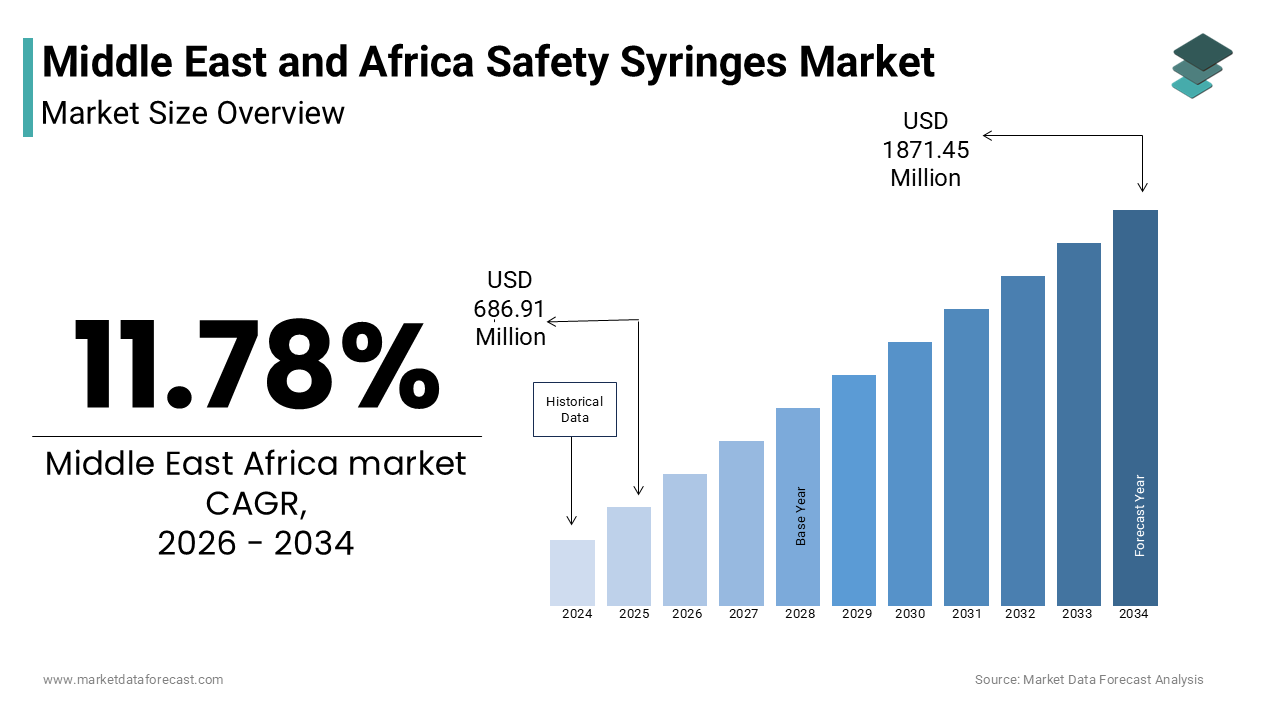
A safety syringe is a specialised medical syringe with a built-in mechanism designed to prevent accidental needlestick injuries and stop the device from being reused. These devices include retractable needles, shielded syringes, auto-disable syringes, and prefilled safety systems designed to protect healthcare workers and patients from bloodborne pathogen transmission while ensuring single-use compliance in resource-variable environments. According to the World Health Organisation, the estimated regional pooled prevalence of needlestick injuries among healthcare workers spans multiple global areas, prompting an active transition toward safety-engineered injection devices. Also, as per the World Health Organisation, standard immunisation campaigns and clinical delivery frameworks across developing nations frequently encounter multiple percutaneous injuries per worker each year, driving regional healthcare markets to scale up procurement of auto-disable medical infrastructure. According to the World Health Organisation, international procurement channels and regional ministries are widely executing mandatory auto-disable syringe replacement policies to mitigate occupational pathogens. This market operates at the intersection of occupational health mandates, infectious disease control priorities, and healthcare system modernisation efforts, where adoption depends not only on clinical efficacy but also on supply chain resilience, cold chain compatibility, and alignment with national immunisation technical advisory group recommendations unique to each jurisdiction’s epidemiological profile and fiscal capacity.
MARKET DRIVERS
Occupational Health Mandates Accelerate Institutional Procurement
Government-enforced safety rules in Gulf and select African nations compel healthcare facilities to adopt engineered safety devices, which contributes to the growth of the Middle East and Africa safety syringes market. These devices serve as mandatory protective equipment rather than optional upgrades. According to the South African National Department of Health, centralised procurement models and healthcare safety frameworks are actively updating institutional standards to optimise protective medical consumable delivery matrices. As per the UAE Ministry of Health and Prevention, nationwide clinical safety programs are successfully driving down workplace pathogen exposures and sharps contamination rates across government-licensed healthcare centres. Kuwait and Qatar have similarly amended healthcare facility licensing requirements to include safety device audits during annual inspections. These regulatory interventions transform safety syringes from discretionary purchases into compliance necessities, creating baseline demand insulated from budgetary fluctuations affecting elective medical equipment. Enforcement mechanisms including surprise inspections and penalty structures ensure sustained adherence even when cost pressures mount, embedding safety syringes as permanent infrastructure components rather than temporary program-dependent supplies vulnerable to funding cycles.
Expanded Immunisation Programs Drive Volume-Based Demand
Large-scale vaccination initiatives supported by multilateral organisations and national governments generate predictable, high-volume demand for auto-disable and safety syringes across the Middle East and Africa market. According to Gavi, the Vaccine Alliance, coordinated international distribution mechanisms are continually scaling the delivery of auto-disable injection platforms to stabilise regional disease immunisation campaigns. As per the World Health Organisation, supplementary immunisation frameworks and international therapeutic logistics channels are increasing medical consumable demand across regional healthcare jurisdictions. Multilateral procurement creates volume certainty, enabling manufacturers to invest in regional production capacity and supply chain infrastructure that would be unjustifiable based on commercial market signals alone. Donor-funded programs often specify WHO-prequalified safety syringes, establishing quality benchmarks that subsequently influence national tender specifications even for domestically funded purchases, creating spillover effects extending beyond donor-supported activities into broader health system procurement practices.
MARKET RESTRAINTS
Budgetary Constraints Limit Premium Device Adoption
Severe fiscal limitations across low-income and lower-middle-income countries impede the expansion of the Middle East and Africa safety syringes market. This restricts the ability to absorb higher unit costs of safety syringes despite recognised clinical benefits, forcing trade-offs between safety features and coverage breadth. According to the World Bank, structural updates across regional medical budgets are continually optimising funding to deliver essential disposable healthcare products uniformly to rural medical clinics. As per Médecins Sans Frontières, global manufacturing adjustments and pooled public agency purchasing structures are reducing baseline cost disparities between regular disposable needles and specialised auto-disable syringes. Sierra Leone and Liberia similarly face allocation dilemmas where safety syringe premiums compete directly with vaccine procurement, workforce salaries, and facility maintenance. Without sustained donor subsidy or domestic revenue mobilisation, these countries remain trapped in suboptimal equilibrium where partial safety syringe adoption creates inconsistent protection levels and complicates training standardisation across facilities using mixed device types.
Supply Chain Fragmentation Disrupts Consistent Availability
Weak logistics infrastructure, customs delays, and distribution barriers create chronic stockouts and supply unpredictability in the Middle East and Africa safety syringes market. This undermines confidence in safety syringe programs and encourages a reversion to conventional alternatives. As per the United Nations Children’s Fund, international logistics frameworks are scaling supply chain delivery networks to mitigate transit challenges when distributing high-priority medical instruments to remote destinations. According to the World Health Organisation, modernised last-mile distribution networks are expanding tracking technologies to decrease medical consumable stockout events inside regional clinical warehouses. Temperature excursions during transit compromise sterility of pre-sterilised safety syringes. These systemic vulnerabilities mean theoretical availability does not translate to reliable point-of-care access, forcing healthcare workers to improvise with available conventional syringes during stockouts, eroding safety culture and creating parallel systems that persist even after supply restoration.
MARKET OPPORTUNITIES
Regional Manufacturing Localisation Reduces Import Dependency
Establishing domestic or regional safety syringe production capacity unlocks potential for the Middle East and Africa safety syringes market. This development addresses supply chain vulnerabilities, reduces foreign exchange expenditure, and creates responsive supply aligned with local epidemiological calendars and emergency needs. According to the Africa CDC, local production of medical infrastructure is scaling up significantly as regional pooled procurement mechanisms unify demand across African nations to strengthen health security. As per the World Health Organisation, local manufacturing capacities are expanding across the region, with facilities achieving international prequalification to supply auto-disabled syringes directly to localised immunisation campaigns. Local production enables just-in-time manufacturing responsive to campaign timing, and outbreak surges impossible with 12-week international lead times. Currency hedging benefits stabilise procurement costs against exchange rate volatility affecting imported supplies. Technology transfer partnerships with global manufacturers accelerate capability building while maintaining quality standards, creating sustainable industrial ecosystems beyond assembly operations.
Digital Integration Enables Smart Inventory and Usage Tracking
Embedding digital technology into safety syringe packaging and distribution systems creates opportunities for the Middle East and Africa safety syringes market. This provides real-time inventory visibility, usage analytics, and anti-diversion controls to fix old supply chain problems. As per the World Health Organisation, integrated tracking frameworks and supply chain monitoring tools are expanding to automate medical inventory assessments across decentralised clinics. Also, pilot digital health systems and upgraded forecast models are helping regional primary care centres decrease medical stock wastage. Anti-counterfeit serialisation prevents diversion of donor-procured safety syringes to informal markets. Data generated enables evidence-based demand forecasting, identifying geographic and seasonal utilisation patterns informing production planning and procurement scheduling. This digital transformation converts safety syringes from passive commodities into intelligent supply chain nodes generating operational intelligence previously unavailable in paper-based systems.
MARKET CHALLENGES
Healthcare Worker Training Gaps Undermine Safety Mechanism Effectiveness
Poor training on how to activate and dispose of safety syringes cancels out their built-in safety benefits, which challenges the growth of the Middle East and Africa safety syringes market. This gap creates a false sense of security, meaning actual injury rates stay the same or even rise due to incorrect handling. According to the World Health Organisation, regional medical delivery networks implement comprehensive health worker guidance to improve the actual deployment precision of engineered syringe safety features. As per research, rural clinical networks scale localised training protocols to manage professional staff transitions and preserve unified device deployment proficiency. Language barriers and low literacy levels complicate written instruction comprehension, requiring demonstration-based pedagogies that are resource-intensive to scale. Safety syringe investments fail to achieve protective outcomes without sustained competency assurance systems. These systems must be embedded in routine supervision rather than episodic training events, regardless of device quality or availability.
Waste Management Infrastructure Deficits Create Secondary Hazards
Inadequate sharps waste treatment and disposal capacity transforms these syringes from protective tools into environmental and public health hazards when discarded improperly, which constrains the expansion of the Middle East and Africa safety syringes market. This undermines community trust and creates liability concerns for implementing agencies. According to the United Nations Environment Programme, regional waste management initiatives expand thermal treatment standards and modernise infrastructure to secure the safe ecological elimination of used clinical supplies. Even when safety syringes feature needle shielding or retraction, plastic barrel components remain environmentally persistent, accumulating in landfills and waterways without degradation. Recycling infrastructure for medical plastics is virtually nonexistent across the region, preventing material recovery. Incinerator breakdowns and fuel shortages create intermittent treatment capacity, causing backlog accumulation and unsafe storage practices. Injection safety interventions displace rather than eliminate risk without parallel investment in waste management infrastructure matching safety syringe distribution scale. This transfers harm from healthcare workers to communities and the environment while failing to achieve comprehensive protection objectives embedded in safe injection frameworks.
REPORT COVERAGE
| REPORT METRIC | DETAILS |
| Market Size Available | 2025 to 2034 |
| Base Year | 2025 |
| Forecast Period | 2026 to 2034 |
| CAGR | 11.78% |
| Segments Covered | By Technology, Therapy, End Users and Region. |
| Various Analyses Covered | Global, Regional & Country Level Analysis, Segment-Level Analysis, DROC, PESTLE Analysis, Porter’s Five Forces Analysis, Competitive Landscape, Analyst Overview of Investment Opportunities |
| Regions Covered | KSA, UAE, Israel, the rest of GCC countries, South Africa, Ethiopia, Kenya, Egypt, Sudan, and Rest of MEA. |
| Market Leaders Profiled | Covidien plc, Retractable Technologies, Inc., Becton, Dickinson and Company (BD), Terumo Corporation, Unilife Corporation, Revolutions Medical Corporation, Smiths Medical, Sol-Millennium Medical Group, UltiMed, Inc., and Axel Bio Corporation. |
SEGMENTAL ANALYSIS
By Technology Insights
The non-retractable safety syringes segment dominated the Middle East and Africa Safety Syringes Market and accounted for a 64.2% share in 2025. This dominance of the segment was driven by lower unit costs, simpler manufacturing processes, and compatibility with existing waste management infrastructure across resource-constrained healthcare systems. Moreover, this dominance reflects pragmatic adoption patterns where passive safety mechanisms requiring no user activation are preferred over complex retractable designs in high-throughput immunisation settings and facilities with limited training capacity. Non-retractable safety syringes achieve price points lower than retractable equivalents, making them financially viable for large-scale public health programs operating under severe budget constraints throughout the region. According to Gavi, the Vaccine Alliance, global health distribution and mass procurement networks favour cost-effective single-use syringe designs to extend immunisation volume limits within tightly managed development budgets. As per the United Nations Children’s Fund, international supply networks scale the bulk delivery of non-retractable safety syringe structures to stabilise vaccine logistics and expand clinic coverage parameters across developing territories. Lower price sensitivity enables buffer stock accumulation, reducing stockout risks during supply disruptions. This economic accessibility ensures non-retractable devices remain the default choice for publicly funded programs regardless of technological sophistication available in premium segments. Non-retractable safety syringes with integrated shields or needle covers require minimal behavioural change from conventional syringe use, eliminating activation steps that frequently fail in high-pressure clinical environments with high staff turnover. As per Gavi, the Vaccine Alliance, training programs and medical product evaluations across regional clinics actively optimise passive device deployment styles to ensure accurate syringe mechanism activation. According to Gavi, the Vaccine Alliance, standardised protective injection architectures lower occupational needlestick rates within active healthcare delivery centres and field immunisation corridors. Simplified design reduces language and literacy barriers in training materials, enabling rapid competency achievement among auxiliary health workers with limited formal education. Compatibility with standard sharps containers avoids the need for specialised disposal infrastructure required by some retractable systems. These operational advantages make non-retractable safety syringes functionally superior in real-world conditions despite the theoretical benefits of retraction technology.
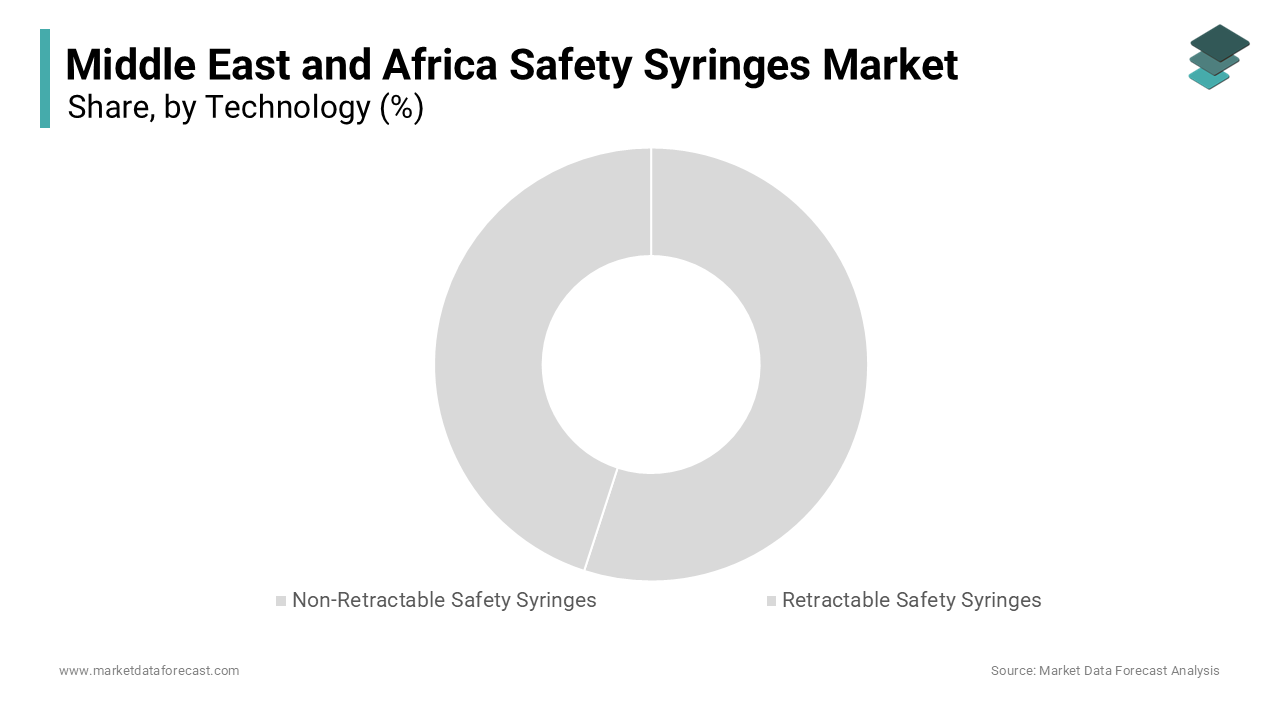
The retractable safety syringes segment is predicted to witness the highest CAGR of 18.7% during the forecast period owing to regulatory mandates in Gulf Cooperation Council states, occupational health litigation awareness, and premium private hospital demand for maximum protection technologies exceeding minimum compliance standards. Stringent occupational health regulations across Saudi Arabia, the United Arab Emirates, Qatar and Kuwait explicitly require retractable or equivalent highest-level safety-engineered devices in licensed healthcare facilities, creating a captive market insulated from price sensitivity affecting public sector procurement. According to the Saudi Food and Drug Authority, updated medical equipment classifications impose high-precision device shielding benchmarks to regulate active injection supply tracks across national clinical institutions. As per the Saudi Food and Drug Authority, regulatory compliance inspections across modern regional healthcare systems enforce the deployment of advanced medical device safety guidelines to isolate infection variables. The regulatory interventions create premium segment demand independent of broader regional affordability constraints. Multinational hospital operators including Cleveland Clinic Abu Dhabi and King Faisal Specialist Hospital apply global safety protocols exceeding local minimums, reinforcing retractable preference. Regulatory convergence across Gulf states enables manufacturers to serve multiple markets with a single product platform, achieving economies of scale supporting continued growth acceleration. Rapid growth of private hospital networks and medical tourism destinations across Gulf states and select African nations creates demand for Western standard safety equipment as a competitive differentiator and liability mitigation strategy. As per the Saudi Food and Drug Authority, commercial clinical healthcare networks are scaling their infrastructure and expanding facility procurement channels to fulfil international patient care standards. According to the Saudi Food and Drug Authority, major destination hospitals enhance their invasive clinical practice standards by procuring highly advanced protective medical consumables to engage broader patient networks. Premium positioning enables manufacturers to maintain margins despite higher production costs. Patient awareness campaigns amplify demand as informed consumers request specific safety features, creating bottom-up pressure complementing top-down regulatory mandates.
By Therapy Insights
The insulin therapy segment maintained the lead in the Middle East and Africa Safety Syringes Market and captured a 42.7% share in 2025. This leading position of the segment was attributed to the diabetes epidemic, scale chronic treatment frequency and established safety syringe integration into diabetes care protocols across both public and private healthcare systems.
Middle East and Africa region exhibits the world’s highest diabetes prevalence rates, generating massive cumulative injection volume requiring safety-engineered devices for millions of daily administrations. According to the World Health Organisation, global infection prevention guidelines mandate the use of safety-engineered syringes across health systems to eliminate needlestick injuries and protect clinical workforces. As per the World Health Organisation, patient dependency on specialised injectable therapies produces a highly consistent and repetitive consumption cycle of medical sharps consumables within domestic therapeutic settings. Ageing populations and urbanisation accelerate incidence, ensuring sustained growth independent of acute health emergencies. This epidemiological foundation establishes insulin as a structural demand anchor for the safety syringe market.
Widespread adoption of patient self-injection for diabetes management extends safety syringe utilisation beyond clinical settings into household environments where needle safety and disposal concerns are amplified. According to the World Health Organisation, structured medical training frameworks emphasise safety-engineered device options to reduce accidental punctures and lower overall user anxiety across home-based care networks. As per the Saudi Health Council, integrated primary care centres are expanding localised delivery loops to supply public healthcare assets directly to registered metabolic disease cohorts. Home care safety syringes often feature simplified activation mechanisms and integrated disposal caps addressing unique domestic environment challenges absent in clinical settings. Caregiver burden reduction drives acceptance among elderly patients and family members managing dependent relatives. Educational programs emphasising safe disposal reinforce habitual safety syringe use, preventing reversion to conventional devices when supplies fluctuate. This embeddedness in daily living routines creates demand stability exceeding episodic clinical applications.
The GLP-1 receptor agonist therapy segment is estimated to register the fastest CAGR of 34.2% from 2026 to 2034 due to obesity epidemic recognition, cardiovascular benefit evidence expansion, and premium injectable formulation characteristics necessitating specialised safety delivery systems distinct from traditional insulin syringes.
Reclassification of obesity as a chronic disease requiring pharmacological intervention rather than lifestyle modification alone dramatically expands the addressable patient pool for GLP-1 therapies beyond traditional diabetes indications. As per the World Obesity Federation, adult weight issues and related metabolic trends are climbing rapidly across regional populations, forcing local health economies to scale therapeutic planning. According to the World Health Organisation, harmonised pharmaceutical licensing structures are expanding specific drug indications to cover continuous obesity management across distinct clinical sectors. Private insurance coverage expansion for obesity treatment removes historical financial barriers, enabling middle-class access previously restricted to self-pay elites. Social media normalisation of GLP 1 use reduces stigma, accelerating help-seeking behaviour. This indication expansion transforms GLP-1 from niche diabetes adjunct into mass market chronic therapy, creating safety syringe demand growth uncorrelated with diabetes trends.
Unlike insulin, available in vial and cartridge formats compatible with reusable pens, GLP-1 therapies are predominantly supplied as single-use prefilled pens with integrated safety mechanisms, creating inseparable linkage between drug and device procurement. According to the World Health Organisation, global medical supply patterns for advanced obesity treatments are increasingly shifting toward factory-integrated safety pen systems over basic open vials. As per the World Health Organisation, current regulatory compliance mandates enforce international protective shielding certifications on auto-injectors before regional healthcare approvals. Cold chain requirements for biologics reinforce single-use prefilled format preference, minimising contamination risks during multi-dose extraction. Patent protection prevents generic competition, maintaining proprietary device bundling through the forecast period. This structural coupling ensures GLP-1 volume growth translates directly to safety syringe growth without substitution risk from alternative delivery methods.
By End Users Insights
In 2025, the hospitals segment held the majority share in the Middle East and Africa Safety Syringes Market because of concentrated procedural volume, regulatory compliance mandates, and centralised procurement systems enabling bulk purchasing and standardised safety protocol implementation across diverse clinical departments.
Acute care hospitals perform the majority of invasive procedures, vaccinations, blood draws, and medication administrations, creating a natural aggregation point for safety syringe utilisation unmatched by decentralised care settings. According to the World Health Organisation, intensive institutional delivery models concentrate advanced syringe safety-engineered device distribution inside centralised regional hospital wards rather than rural outreach locations. As per the Saudi Ministry of Health, public medical facilities are restructuring baseline clinical consumable supply allocations to support scaled localised therapy delivery. Emergency departments, intensive care units, and surgical suites operate continuously, generating 24-hour safety syringe consumption patterns absent in outpatient clinics with limited operating hours. Teaching hospitals serve as protocol development sites, establishing safety standards subsequently adopted by smaller facilities, creating a demonstration effect amplifying institutional influence beyond direct consumption. Centralised infection prevention committees enforce uniform device selection, preventing fragmentation common in decentralised procurement. This procedural density makes hospitals indispensable volume anchors for safety syringe suppliers regardless of growth rates in alternative channels.
Hospital licensing, accreditation, and occupational health regulations create mandatory compliance frameworks absent in informal or home care settings, ensuring near-universal safety syringe adoption in institutional environments. According to Joint Commission International, global hospital accreditation protocols emphasise rigorous sharp instrument injury prevention frameworks to evaluate occupational worker safety systems. As per the South African Office of Health Standards Compliance, nationwide healthcare monitoring programs are updating their clinical survey metrics to track uniform medical equipment safety baseline rules. Gulf state hospital licensing requires annual safety device audits with results published publicly, creating reputational accountability absent in other settings. Malpractice insurance premiums tied to safety compliance create direct financial motivation for private hospitals exceeding regulatory minimums. These overlapping compliance mechanisms create institutional demand floors insulated from budgetary pressures affecting voluntary adoption in less regulated environments.
The home care segment is anticipated to witness the fastest CAGR of 22.8% over the forecast period. This rapid expansion of the segment is fuelled by chronic disease management decentralisation, ageing population preferences, telehealth-enabled remote monitoring and caregiver safety awareness extending safety syringe utilisation beyond traditional clinical boundaries.
Healthcare system reforms prioritising ambulatory care and patient empowerment deliberately transfer injection responsibilities from hospitals to homes for diabetes, autoimmune diseases and hormone therapies, expanding safety syringe consumption in residential environments. As per the World Health Organisation, long-term chronic treatment trends are moving continuous injectable therapeutics into home settings, expanding domestic single-use device demand portfolios. According to the South African National Department of Health, public chronic medical dispensing initiatives distribute single-use safety needles directly to home-care cohorts to optimise localised pharmaceutical treatment timelines. Telemedicine platforms enable remote prescription renewal and delivery logistics, removing geographic barriers to home care access. Patient preference for autonomy and dignity reinforces policy-driven shifts, creating sustainable demand independent of clinical necessity alone. This structural care model transformation embeds safety syringes in domestic routines, creating a growth trajectory decoupled from hospital capacity constraints.
Growing recognition of needlestick risks to family caregivers and domestic workers creates voluntary safety syringe demand in home settings absent regulatory compulsion but motivated by liability concern and familial protection ethics. According to the International Labour Organisation, updated occupational guidelines emphasise protective labour standards to insulate professional residential care groups from preventable biological punctures. As per the Dubai Health Authority, standardised residential home nursing guidelines enforce strict medical sharps waste handling compliance to maintain worker safety criteria. Social media caregiver communities share safety experiences normalising protective equipment use beyond professional contexts. Elderly patients themselves increasingly request safety syringes to protect visiting grandchildren, reducing intergenerational transmission anxiety. Insurance products covering domestic worker injuries create financial incentives for preventive equipment provision. This emerging social consciousness expands the addressable market beyond medically necessary injections to include discretionary safety investments reflecting evolving cultural attitudes toward domestic labour protection and familial responsibility.
COUNTRY ANALYSIS
Saudi Arabia Safety Syringes Market Analysis
Saudi Arabia was the top performer in the Middle East and Africa Safety Syringes Market and accounted for a 24.7% share in 2025. This growth of the country’s market was driven by its position as the region’s largest healthcare spender, most advanced regulatory framework and ambitious Vision 2030 healthcare transformation agenda driving comprehensive safety syringe adoption across public and private sectors. According to the Saudi Central Bank, health expenditure structures are actively shifting as specialised medical procurement programs adapt to newly integrated public and private hospital licensing frameworks. As per the Saudi Food and Drug Authority, medical facility inspections are continuously scaling up across the regional supply chain to strictly enforce high-performance single-use safety needle regulations. Vision 2030 privatisation program transferring 100 hospitals to private operators creates commercial incentives for safety standardisation as a competitive differentiator and accreditation prerequisite. According to the Saudi Industrial Development Fund, domestic production portfolios are consistently scaling up to satisfy expanding percentages of localised healthcare and specialised therapeutic manufacturing infrastructure mandates. As per the Saudi Ministry of Hajj and Umrah, international pilgrim arrivals are steadily increasing, which structurally elevates mass gathering preventative vaccination rollouts and healthcare supply delivery volumes during peak travel seasons. However, workforce Saudization pressures create training gaps as inexperienced national staff replace expatriate professionals, temporarily affecting safety protocol adherence despite device availability.
United Arab Emirates Safety Syringes Market Analysis
The United Arab Emirates was the next prominent region in the Middle East and Africa safety syringes market and occupied a 16.3% share in 2025. This position of the UAE's market was supported by the highest per capita safety syringe expenditure, the most stringent occupational health enforcement, and medical tourism-driven quality standards exceeding regional norms. According to the UAE Ministry of Health and Prevention, national clinical infrastructure is actively expanding with prioritised funding models emphasising standardised safety device clinical licensing guidelines. As per the Dubai Health Authority, international healthcare tourists are travelling to the emirate in record numbers, stimulating consistent demand across advanced specialised clinics and high-standard medical fields. According to Joint Commission International, hospital accreditation frameworks are expanding across the region to mandate rigorous safety-engineered device standards and continuous quality improvement baselines. Abu Dhabi Department of Health occupational injury reporting system tracks needlestick incidents with facility-level benchmarking, creating transparency pressure driving continuous improvement beyond minimum compliance. As per the UAE Ministry of Health and Prevention, medical procurement distributors are advancing fast-response logistics models to deliver healthcare assets uniformly across the nation's hospital networks. However, small absolute population limits volume growth potential, making UAE strategically important for premium positioning and innovation testing rather than scale contribution. According to the UAE Ministry of Health and Prevention, persistent professional training programs are actively scaling to address workforce updates and solidify safety-engineered device compliance across advanced clinical settings.
Egypt Safety Syringes Market Analysis
Egypt is expected to showcase a promising CAGR in the regional market during the forecast period, owing to a massive population base, a universal health insurance rollout, and domestic manufacturing capacity creating a unique combination of volume potential and supply security. According to the World Health Organisation, national insurance frameworks and clinical procurement platforms are modernising treatment guidelines to manage localised healthcare expansions across primary public and private centres. As per Economics by Design, regional health programs face a 15.5% diabetes prevalence rate, shifting public medical supply chains toward extensive consumable device rollouts. According to the World Health Organisation, domestic pharmaceutical and medical equipment manufacturing infrastructure is scaling capacity to satisfy expanding state immunisation distribution targets. As per sources, localised clinical budgets are favouring highly cost-effective auto-disable syringe layouts to maintain essential safety coverage amid macroeconomic adjustments.
South Africa Safety Syringes Market Analysis
South Africa is another key player in the Middle East and Africa safety syringes market. It functions as sub-Saharan Africa’s most developed safety syringe ecosystem, with established domestic manufacturing, private hospital networks, and progressive occupational health legislation creating a template for regional replication. According to the South African Department of Employment and Labour, public health systems utilise centralised medical tender panels to optimise macro-scale supply procurement and distribute essential medical supplies uniformly. As per the South African Department of Employment and Labour, multi-facility private clinical corporations observe standard accreditation protocols by universally integrating protective safety device models across active medical units. According to the South African Department of Employment and Labour, localised pharmaceutical distributor groups are increasing output capabilities to secure delivery channels across neighbouring export networks. Also, as per the South African Department of Employment and Labour, legislative workplace safety codes enforce employer liability rules regarding sharp tool wounds to mandate safe injection designs. However, load-shedding electricity crises disrupt manufacturing operations, causing intermittent supply shortages and forcing inventory buffering strategies, increasing working capital requirements. Public sector payment delays strain supplier cash flows, discouraging small entrants despite market opportunities.
Israel Safety Syringes Market Analysis
Israel maintains a significant position in the regional market due to an advanced medtech ecosystem, universal healthcare coverage, and early adoption of next-generation safety devices, serving as a regional innovation benchmark despite geopolitical isolation from neighbouring markets. According to the Israel Ministry of Health, nationwide health programs utilise high-performance safety-engineered device streams to reduce occupational needle contact hazards. As per the Israel Ministry of Health, national health organisations including Clalit, Maccabi, Meuhedet, and Leumit pool clinical procurement frameworks to negotiate competitive safe-needle delivery supply arrays. According to the Israel Ministry of Health, local pharmaceutical innovators and healthcare technology groups validate proprietary needle protection tools through regional research frameworks before international clinical commercialisation. Universal health coverage eliminates financial barriers to safety device access, ensuring equitable utilisation across socioeconomic strata unlike tiered systems elsewhere. As per the Israel Ministry of Health, specialised population dynamics shift the regional medical community's role toward advanced technological validation rather than sheer procurement volume. Geopolitical tensions occasionally disrupt supply chains, requiring strategic stockpiling and dual sourcing strategies absent in politically stable markets. Defence sector medical preparedness creates a parallel demand stream for tactical safety syringes with unique specifications.
COMPETITIVE LANDSCAPE
Competition in the Middle East and Africa Safety Syringes Market remains bifurcated between multinational corporations dominating premium segments and regional manufacturers capturing volume driven public sector contracts through cost advantages and localization compliance. Multinationals leverage technological superiority regulatory expertise and global quality systems but face pricing pressure from domestic producers benefiting from government preferential procurement policies and lower operating costs. Regional champions in Saudi Arabia Egypt South Africa and Kenya increasingly match international quality standards while offering superior supply responsiveness and currency stability creating competitive threats in traditionally import dependent markets. Donor funded procurement creates parallel competitive arena where WHO prequalification rather than price determines eligibility enabling specialized suppliers to access volumes unavailable commercially. Regulatory heterogeneity prevents unified regional competition protecting national champions while limiting consumer choice versus harmonized markets. Innovation competition focuses on training integration waste management compatibility and digital tracking rather than core safety mechanisms which have largely converged toward industry standards. Supply chain reliability emerges as critical differentiator with local producers gaining advantage during global logistics disruptions despite technological gaps. This complex landscape rewards players balancing cost competitiveness with regulatory compliance supply resilience and human capital development investments tailored to specific national contexts rather than standardized regional approaches.
KEY MARKET PLAYERS
Companies that dominate the MEA safety syringes market include
- Covidien plc
- Retractable Technologies, Inc.
- Becton, Dickinson and Company (BD)
- Terumo Corporation
- Unilife Corporation
- Revolutions Medical Corporation
- Smiths Medical
- Sol-Millennium Medical Group
- UltiMed, Inc.
- Axel Bio Corporation
Top Players in the Middle East and Africa Safety Syringes Market
Becton Dickinson and Company
Becton Dickinson and Company maintains extensive involvement in the Middle East and Africa Safety Syringes Market through comprehensive safety engineered injection portfolios serving public immunization programs and private hospital networks across diverse regulatory environments. The company recently expanded its Dubai regional distribution center enabling forty eight hour delivery to Gulf Cooperation Council countries and reducing supply chain lead times for emergency outbreak responses. Becton Dickinson also partnered with Saudi Arabian authorities to establish local assembly operations supporting Vision 2030 localization mandates while maintaining WHO prequalification standards. These strategic investments demonstrate commitment to balancing global quality benchmarks with regional supply security requirements ensuring reliable access to advanced safety technologies amid geopolitical volatility and infrastructure constraints affecting cross border medical device logistics throughout the region.
Terumo Corporation
Terumo Corporation contributes significantly to the Middle East and Africa Safety Syringes Market through specialized auto disable and retractable syringe platforms optimized for high volume immunization campaigns and chronic disease management programs. The company recently launched next generation prefilled safety syringes compatible with GLP 1 receptor agonist therapies addressing rapidly expanding obesity treatment demand across Gulf states and South Africa. Terumo also established training partnerships with nursing councils in Kenya and Ethiopia improving healthcare worker competency in safety device activation reducing needlestick injuries despite high staff turnover. These initiatives reflect focus on integrating product innovation with human capital development recognizing that technological sophistication alone cannot achieve safety outcomes without sustained behavioral reinforcement and institutional capacity building in resource variable healthcare settings across the region.
Jamjoom Pharma Industries
Jamjoom Pharma Industries plays vital role in the Middle East and Africa Safety Syringes Market as leading regional manufacturer supplying domestically produced safety syringes to Saudi Arabian public health programs and neighboring Gulf markets. Jamjoom Pharma also achieved certification for retractable safety syringes meeting Saudi Food and Drug Authority Category A standards enabling eligibility for premium hospital tenders previously dominated by multinational suppliers. These capacity and quality upgrades demonstrate successful localization strategy aligning domestic manufacturing capabilities with evolving regulatory expectations while providing supply resilience against international shipping disruptions and geopolitical risks affecting imported medical device availability throughout the Arabian Peninsula.
Top Strategies Used by Key Market Participants
Key players in the Middle East and Africa Safety Syringes Market prioritize regional manufacturing localization establishing domestic production facilities to reduce import dependency comply with localization mandates and mitigate currency volatility risks. Companies invest heavily in healthcare worker training programs addressing competency gaps that undermine safety mechanism effectiveness despite device availability. Strategic partnerships with multilateral organizations including Gavi UNICEF and WHO enable participation in large scale immunization procurement while building relationships transitioning to commercial markets as donor support evolves. Regulatory alignment strategies ensure products meet varying national standards from basic WHO prequalification to advanced ISO 23908 Category A requirements across heterogeneous jurisdictions. Digital supply chain integration through barcode tracking and electronic logistics management systems improves inventory visibility reduces stockouts and enables data driven demand forecasting. Product portfolio diversification balances low cost auto disable syringes for mass immunization with premium retractable devices for private hospitals and chronic therapy applications. Public private partnership models share investment risks while securing long term offtake agreements. These multifaceted approaches reflect recognition that regional success requires adapting global capabilities to local operational realities rather than uniform market strategies.
MARKET SEGMENTATION
This research report on the Middle East and Africa Safety Syringes Market has been segmented and sub-segmented into the following categories
By Technology
- Non-Retractable Safety Syringes
- Retractable Safety Syringes
By Therapy
- Insulin
- GLP-1
- Tuberculosis
- Growth Hormones
By End Users
- Hospitals
- Home Care
By Country
- KSA
- UAE
- Israel
- Rest of GCC countries
- South Africa
- Ethiopia
- Kenya
- Egypt
- Sudan
- Rest of MEA