- Product Description Description
- Table of Contents TOC
- List of Table & Figure LOT
- Get Free Sample PDF Sample PDF
Market Size, 2025
$76.67 BnMarket Estimate, 2026
$8.36 BnMarket Forecast, 2034
$16.6 BnCAGR, 2026–2034
8.96%Global Safety Syringes Market Size
The global safety syringes market size was valued at USD 7.67 billion in 2025 and is anticipated to reach USD 8.36 billion in 2026 and USD 16.61 billion by 2034, growing at a CAGR of 8.96% during the forecast period from 2026 to 2034.
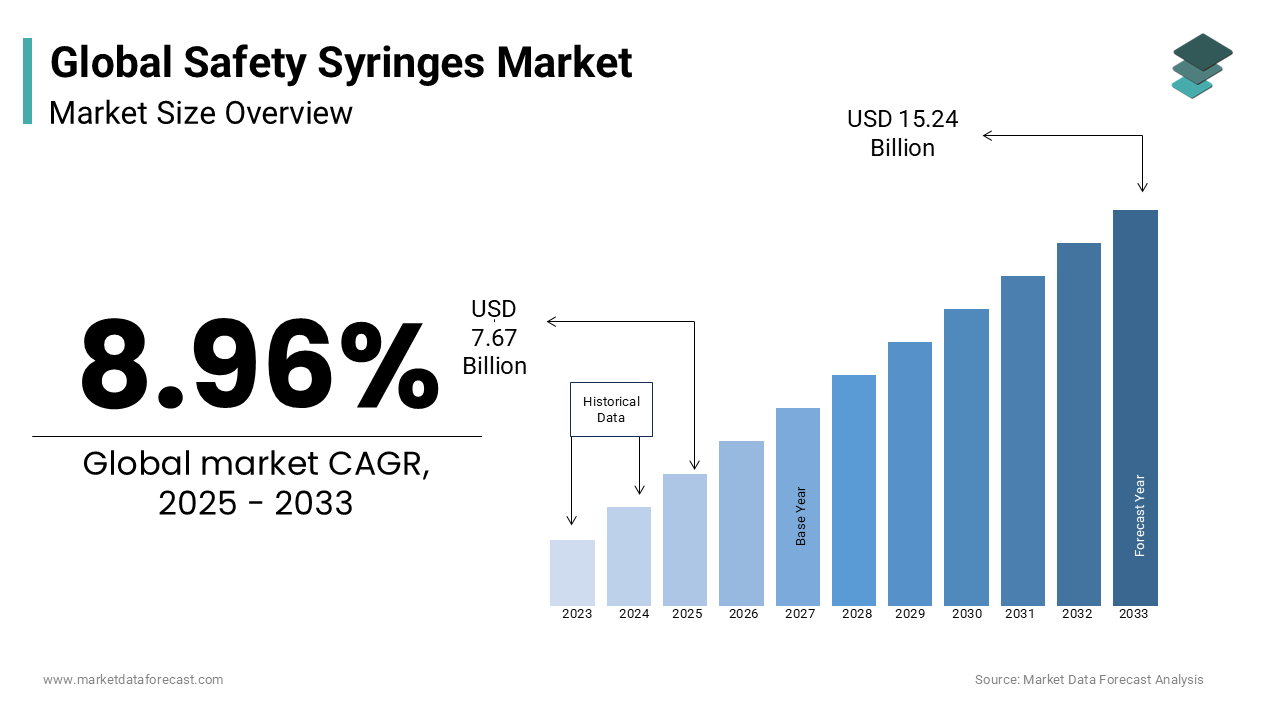
The Safety Syringes are medical devices engineered to mitigate needlestick injuries and enhance infection control during parenteral administration. As per the World Health Organization (WHO), an estimated 16 billion injections are administered annually worldwide, with unsafe practices contributing to over 21 million hepatitis B virus infections, 2 million hepatitis C cases, and 260,000 HIV infections in healthcare settings before widespread safety device adoption.
MARKET DRIVERS
The rising prevalence of bloodborne pathogens and occupational hazards in healthcare settings is driving the growth of the Safety Syringes Market. Healthcare workers face persistent exposure to infectious agents through percutaneous injuries, with the Centers for Disease Control and Prevention (CDC) estimating that needlestick incidents expose professionals to more than 20 bloodborne pathogens, including HIV, hepatitis B, and hepatitis C. The financial burden of a single needlestick injury can exceed $3,000 when accounting for testing, prophylactic treatment, and psychological counseling, according to a study published in Infection Control & Hospital Epidemiology. Consequently, healthcare institutions are increasingly prioritizing preventive engineering controls. The integration of safety syringes not only aligns with OSHA’s Bloodborne Pathogens Standard but also reduces institutional liability is driving systemic procurement across acute care and outpatient facilities.
Mandatory Regulatory Frameworks and Global Injection Safety Initiatives are propelling the growth of the Safety Syringes Market. The European Union’s Directive 2010/32/EU on the prevention of sharps injuries mandates the use of safety-engineered devices in all member states, leading to near-universal adoption across hospitals in countries like Germany and France. Similarly, the U.S. Needlestick Safety and Prevention Act, enacted in 2000 and reinforced by OSHA guidelines, requires healthcare employers to maintain a sharps injury log and implement safer medical devices. As per data from the American Hospital Association, over 95% of U.S. acute care hospitals have transitioned to safety syringes since the regulation’s enforcement. Additionally, the WHO’s Global Injection Safety Initiative advocates for the exclusive use of auto-disable and safety syringes in immunization programs, particularly in low-resource regions.
MARKET RESTRAINTS
High Acquisition and Implementation Costs
The reluctance to adopt high cost procedures especially in Low- and Middle-Income Countries (LMICs) is hindering the growth of the Safety Syringes Market. According to PATH, a global health innovation nonprofit, safety syringes can cost up to two to three times more than standard disposable syringes ranging from $0.08 to $0.25 per unit compared to $0.03 to $0.05. For national immunization programs in resource-constrained settings, this differential poses a substantial fiscal challenge. In sub-Saharan Africa, where millions of vaccinations are administered annually, budgetary limitations often lead to selective or delayed adoption. Moreover, the need for staff retraining and waste management adjustments further escalates implementation expenses, deterring widespread deployment in underfunded healthcare systems.
Supply Chain Fragmentation and Counterfeit Product Infiltration Undermine Market Integrity
The persistent challenges related to inconsistent distribution networks and the proliferation of substandard devices in developing regions is hampering the growth of the Safety Syringes Market. As per the WHO Medical Devices Unit, an estimated 10% to 15% of medical devices in circulation across parts of Southeast Asia and Africa are counterfeit or non-compliant with international safety standards. These illicit products often lack functional safety mechanisms, exposing healthcare workers to preventable risks. Additionally, logistical inefficiencies such as temperature-sensitive storage requirements and cold-chain dependencies for vaccine-linked syringe distribution exacerbate delivery delays. A 2023 audit by the Global Fund revealed that 22% of syringe shipments to remote clinics in East Africa experienced disruptions due to inadequate transport infrastructure.
MARKET OPPORTUNITIES
Expansion of Immunization Programs and Preventive Healthcare Initiatives Creates Scalable Demand
The global momentum toward universal vaccination coverage is expected to bolster the growth of the Safety Syringes Market. Gavi is the Vaccine Alliance, has supported the administration of over 10 billion vaccines since 2000, with a strict requirement for auto-disable safety syringes in all funded immunization campaigns. As per Gavi’s 2023 program update, over 500 million safety syringes were distributed annually to low-income countries between 2020 and 2022. The WHO’s Immunization Agenda 2030 aims to reach 500 million additional people with vaccines in underserved regions, necessitating a parallel surge in safe injection supplies. Furthermore, national programs such as India’s Universal Immunization Programme, which administers over 600 million doses yearly, have mandated safety syringes since 2015.
Technological Advancements in Smart and Connected Injection Devices Open New Frontiers
Innovations integrating digital tracking, dose verification, and user feedback mechanisms are amplifying the growth of the Safety Syringes Market. Companies are developing smart syringes equipped with RFID tags or Bluetooth-enabled components that record administration data, reducing errors and enhancing pharmacovigilance. According to a 2023 analysis by the Journal of Medical Devices and Sensors, pilot deployments of connected safety syringes in German clinics reduced dosing inaccuracies by 37% and improved documentation compliance by 52%. Additionally, advancements in materials science have led to the development of syringes with antimicrobial coatings and improved ergonomic designs, increasing user adherence. The U.S. Food and Drug Administration’s (FDA) clearance of next-generation auto-retractable syringes with fail-safe triggers further validates the shift toward intelligent delivery systems.
MARKET CHALLENGES
Healthcare Worker Resistance Due to Usability Concerns and Training Deficiencies
The frontline staff often express reluctance in adopting safety syringes due to perceived complexity, altered injection dynamics, or fear of accidental activation which inhibits the growth of the Safety Syringes Market. As per a 2022 multicenter study published in BMC Health Services Research, 41% of nurses in urban Indian hospitals reported discomfort with the activation mechanism of safety syringes, citing increased hand pressure requirements and delayed shielding. Inadequate training compounds these issues, as per the International Council of Nurses, only 58% of nursing staff in Southeast Asia received formal instruction on safety device usage.
Environmental Impact and Medical Waste Management pressure
The widespread use of single-use safety syringes with environmental implications that are increasingly scrutinized is also hampering the growth of the Safety Syringes Market. As per the WHO, approximately 16 billion injections annually generate over 1.5 million tons of used syringes and sharps waste. In India alone, healthcare facilities produce nearly 560 tons of biomedical waste daily, of which syringes constitute a major fraction, according to the Central Pollution Control Board. The European Union’s Medical Device Regulation (MDR) now emphasizes eco-design principles, urging manufacturers to explore biodegradable materials or reusable safety systems. However, reusable models face sterilization and cross-contamination risks, limiting adoption.
REPORT COVERAGE
| REPORT METRIC | DETAILS |
| Market Size Available | 2025 to 2034 |
| Base Year | 2024 |
| Forecast Period | 2026 to 2034 |
| Segments Covered | By Technology, Therapy, End-User, and Region |
| Various Analyses Covered | Global, Regional & Country Level Analysis, Segment-Level Analysis; DROC, PESTLE Analysis, Porter's Five Forces Analysis, Competitive Landscape, Analyst Overview of Investment Opportunities |
| Regions Covered | North America, Europe, APAC, Latin America, Middle East & Africa |
| Market Leader Profiled | Covidien plc, Retractable Technologies Inc., Becton, Dickinson & Company, Terumo Corporation, Unilife Corporation, and Revolutions Medical, Smiths Medical, Sol-Millennium, Ultimed Inc., and Axel Bio Corporation. |
SEGMENTAL ANALYSIS
By Technology Insights
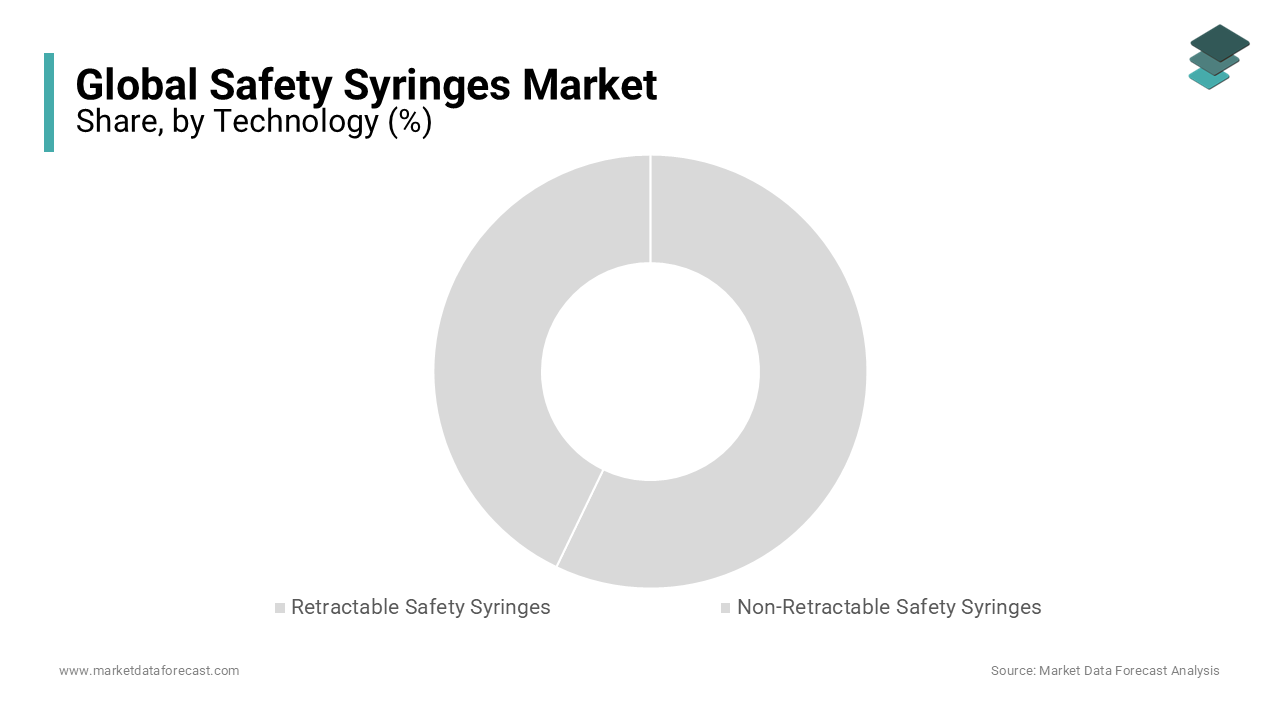
The non-retractable safety syringes segment dominated the Safety Syringes Market by capturing 58.3% of the share in 2025 with their widespread integration into mass immunization and insulin delivery programs, where operational simplicity and cost-efficiency are paramount. This cost advantage for large-scale public health initiatives, particularly in low- and middle-income countries reliant on donor-funded vaccine campaigns. The high compatibility of non-retractable syringes with existing clinical workflows is additionally to further enhance the growth of the Safety Syringes Market.
The retractable safety syringes segment is projected to grow with an expected CAGR of 9.6% during the forecast period. A 2023 study published in Occupational & Environmental Medicine found that retractable syringes reduced needlestick incidents by 68% in U.S. emergency departments compared to non-retractable models, reinforcing their appeal in high-risk clinical settings. The design, which pulls the needle into the barrel upon activation, ensures complete containment by aligning with stringent regulatory expectations in North America and Western Europe.
By Therapy Insights
The insulin therapy segment was the largest by occupying 47.5% of the safety syringes market share in 2025 with the escalating global prevalence of diabetes, which affects an estimated 537 million adults worldwide, a figure projected to rise to 643 million by 2030 according to the International Diabetes Federation. The majority of type 1 and advanced type 2 diabetes patients require daily insulin injections, generating sustained demand for safe, repeat-use delivery systems.
The glucagon-like peptide-1 (GLP-1) receptor agonist therapy segment is expected to grow with an emerging CAGR of 14.3% throughout the forecast period with the unprecedented rise in prescriptions for GLP-1 analogs such as semaglutide and tirzepatide, driven by their dual efficacy in glycemic control and weight management. According to the CDC’s 2023 National Prescription Audit, prescriptions for GLP-1 agonists in the U.S. increased by 56% year-over-year, with over 18 million dispensed units recorded annually. These therapies are predominantly self-administered via subcutaneous injection, necessitating user-friendly, safety-integrated delivery devices.
By End-User Insights
The hospitals segment was the largest by occupying a significant share of the global safety syringe market in 2025 with the high volume of parenteral procedures performed in acute care settings, where injections are integral to diagnostics, anesthesia, and emergency interventions. As per U.S. Department of Health and Human Services, over 1.2 billion injections are administered annually in hospitals across the country alone, with safety syringes now standard in 98% of facilities due to OSHA compliance requirements. The institutionalized nature of hospital procurement, coupled with mandatory sharps injury logs and safety device evaluations that ensures consistent and large-scale adoption.
The home care segment is projected to grow at a CAGR of 11.8% from 2026 to 2034 owing to the growing shift toward decentralized care models and patient self-administration of chronic therapies. The global home injection market, encompassing insulin, biologics, and hormone therapies, is expanding rapidly, with over 40 million patients in high-income countries now managing injectable treatments at home, as reported by the European Home Care Association. Safety syringes mitigate risks in unsupervised environments, where family members or caregivers may lack formal medical training.
REGIONAL ANALYSIS
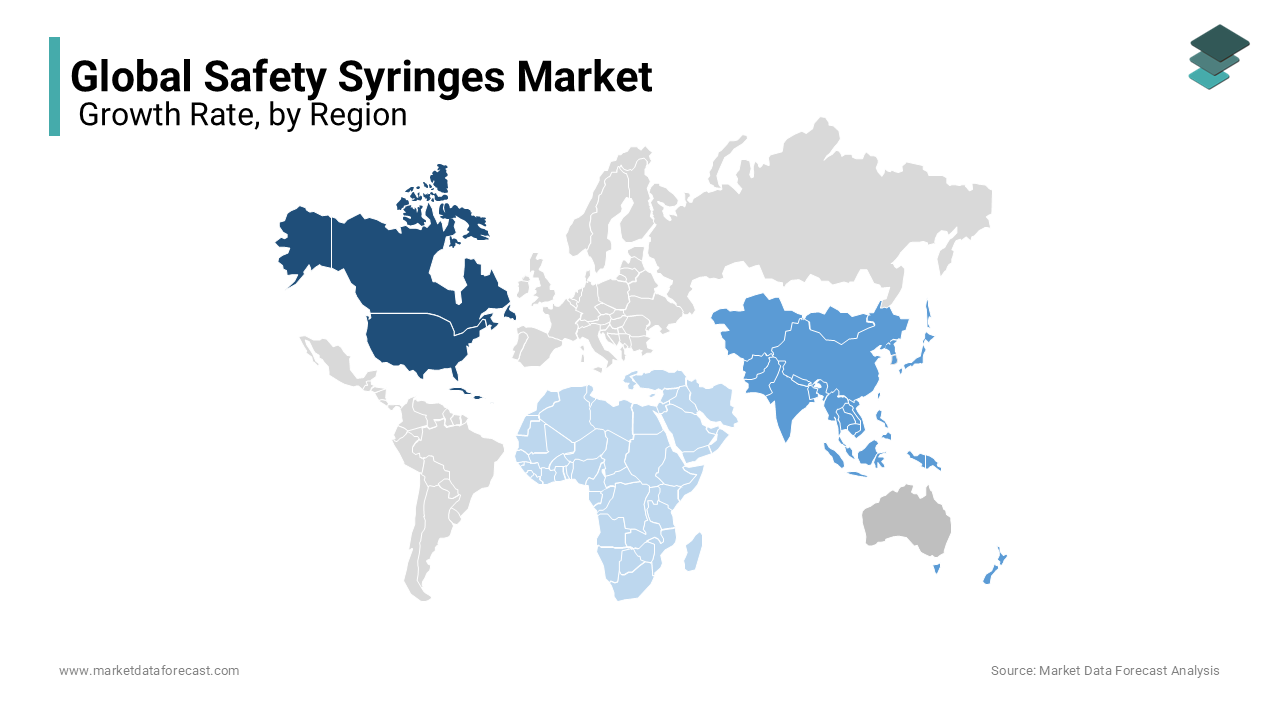
North America was the top performer in the Safety Syringes Market with 38.3% of share in 2025 owing to the robust regulatory frameworks and early adoption of safety-engineered devices. According to the American Hospital Association, over 97% of U.S. hospitals have transitioned to safety syringes, with annual procurement exceeding 2.5 billion units. Additionally, the presence of leading manufacturers such as Becton Dickinson, Medtronic, and Retractable Technologies fosters innovation and supply chain resilience.
Europe Safety Syringes Market was positioned second with a prominent share in 2024. The region’s strong performance is attributed to the EU Directive 2010/32/EU, which legally obligates employers to implement safety-engineered sharps devices. As per the European Agency for Safety and Health at Work, needlestick injuries among healthcare workers declined by 32% between 2012 and 2022 in countries with full compliance. National health systems in Scandinavia and the Benelux region have achieved near-total penetration of safety syringes in both hospitals and primary care.
The Asia-Pacific (APAC) is deemed to have significant growth opportunities with a significant CAGR during the forecast period. India and China are the primary growth engines, fueled by government-led immunization drives and rising healthcare infrastructure investment. India’s National Health Mission has mandated safety syringes in all public health programs since 2015, distributing over 1.2 billion units annually, according to the Ministry of Health and Family Welfare. China’s 14th Five-Year Plan includes modernization of medical device standards, with safety syringes prioritized in hospital upgrades.
COMPETITIVE LANDSCAPE
The competition in the Safety Syringes Market is intense, characterized by technological innovation, regulatory responsiveness, and strategic positioning across diverse healthcare ecosystems. Established medical device manufacturers dominate due to their R&D capabilities, global distribution networks, and strong regulatory compliance records. The market features a blend of product-centric and solution-oriented competition, with companies increasingly integrating digital features such as injection tracking and user feedback mechanisms. Differentiation is achieved through ergonomic design, cost efficiency, and compatibility with high-volume therapeutic areas like diabetes and immunization. Regional dynamics play a crucial role, as local regulations and public health priorities shape procurement patterns. Emerging players are challenging incumbents by offering affordable alternatives, while leading firms respond with localized production and training initiatives to maintain competitive advantage in both developed and emerging markets.
KEY MARKET PLAYERS
Companies playing a noteworthy role in the global safety syringes market include
- Covidien plc
- Retractable Technologies Inc.
- Becton, Dickinson & Company
- Terumo Corporation
- Unilife Corporation
- Revolutions Medical
- Smiths Medical
- Sol-Millennium
- Ultimed Inc.
- Axel Bio Corporation
Top Players in the Safety Syringes Market
Becton, Dickinson and Company (BD) has long been a pivotal force in advancing injection safety across the Asia Pacific region. The company’s extensive portfolio includes the BD Ultrafine™ and BD SafetyGlide™ syringes, which are widely adopted in hospitals and home care settings. BD has strengthened its regional footprint through strategic collaborations with national health programs, particularly in India and Indonesia, where it supports immunization campaigns with safety-engineered devices. In 2023, BD launched a localized manufacturing initiative in Malaysia to enhance supply chain resilience and reduce delivery lead times. The company also partnered with the Indian Council of Medical Research to conduct training workshops for healthcare workers on safe injection practices, reinforcing its commitment to public health infrastructure development across high-burden, resource-variable markets.
Terumo Corporation holds a significant position in the Asia Pacific safety syringes market by leveraging its Japanese heritage and deep regional integration. The company’s Surflash® safety syringe, featuring a passive retractable needle mechanism, is extensively used in Japan, South Korea, and Thailand, where regulatory standards align closely with ISO 24947. Terumo has invested in expanding its production capacity in Nagoya to meet rising demand from public health programs. In 2022, it introduced a next-generation auto-disable syringe for diabetes care in collaboration with the Thai Ministry of Public Health, tailored for reuse prevention in outpatient clinics.
Nipro Corporation is a key contributor to the safety syringes ecosystem in the Asia Pacific. The company manufactures a broad range of safety-engineered syringes, including retractable and shielded models compliant with WHO and JIS standards. Nipro has established joint ventures in India to co-develop cost-effective safety syringes for mass immunization, supporting government initiatives like Mission Indradhanush. In 2023, it inaugurated a new automated facility in Pune dedicated to safety syringe production, aiming to double output by 2025. The company also launched an educational campaign in collaboration with nursing associations across ASEAN countries to promote proper disposal and activation techniques.
Top Strategies Used by Key Market Participants
Key players in the Safety Syringes Market employ a range of strategic initiatives to consolidate their presence and drive innovation. Major companies focus on product differentiation through advanced engineering, integrating features like automatic retraction, tamper evidence, and dose confirmation. Strategic partnerships with governments and NGOs are common in low- and middle-income countries, to support large-scale immunization programs. Mergers and acquisitions are leveraged to expand technological capabilities, as seen with companies acquiring startups specializing in smart injection systems. Geographic expansion, especially into high-growth regions like the Asia Pacific and Africa, is pursued through localized manufacturing and distribution alliances. Additionally, firms invest heavily in clinician and patient training programs to ensure proper device usage and compliance, enhancing brand trust and long-term adoption.
RECENT MARKET HAPPENINGS
- In January 2022, Becton, Dickinson and Company launched the BD SafetyGlide™ Pro Pen Needle in Japan, a safety-engineered insulin delivery device designed to reduce needlestick injuries among diabetic patients and caregivers by enhancing its presence in the home care segment across the Asia Pacific.
- In August 2022, Terumo Corporation partnered with the Thai Ministry of Public Health to supply 50 million auto-disable safety syringes for national vaccination programs with its public sector engagement and distribution reach in Southeast Asia.
- In March 2023, Nipro Corporation inaugurated a fully automated safety syringe manufacturing facility in Pune, India that aimed at doubling production capacity and supporting India’s universal immunization program with locally produced, WHO-prequalified devices.
- In November 2023, BD announced a collaboration with the Indian Council of Medical Research to conduct nationwide training for healthcare workers on safe injection practices.
- In May 2024, Terumo introduced the next-generation Surflash® Plus retractable syringe in South Korea, featuring enhanced activation reliability and ergonomic design, which is targeting hospital procurement contracts and expanding its technological edge in acute care settings.
MARKET SEGMENTATION
This research report on the global safety syringes market has been segmented and sub-segmented based on technology, therapy, end-user, and Region.
By Technology
- Retractable Safety Syringes
- Automatic Retractable Safety Syringes
- Manual Retractable Safety Syringes
- Non-Retractable Safety Syringes
- Sheathing Tube Syringes
- Sliding Needle Cover Syringes
- Hinged Needle Cover Syringes
By Therapy
- Insulin
- Glucagon-like peptide-1 (GLP-1)
- Tuberculosis
- Growth Hormones
By End-User
- Home care
- Hospitals
By Region
- North America
- Europe
- Asia Pacific
- Latin America
- Middle East and Africa