- Product Description Description
- Table of Contents TOC
- List of Table & Figure LOT
- Get Free Sample PDF Sample PDF
Market Size, 2025
$157.90 MnMarket Estimate, 2026
$167.28 MnMarket Forecast, 2034
$265.41 MnCAGR, 2026–2034
5.94%Executive Summary: Middle East and Africa (MEA) Bearing Market
- Market Scope: Comprehensive analysis of the MEA bearing market covering rolling element types, gear configurations, application verticals, distribution channels, and country-level breakdowns.
- Market Valuation: Valued at USD 157.90 million in 2025, estimated at USD 167.28 million in 2026, and projected to reach USD 265.41 million by 2034, expanding at a steady CAGR of 5.94% from 2026 to 2034.
- Primary Growth Drivers: Proliferation of industrial and manufacturing activities following post-pandemic economic stabilization, massive energy reserve extractions, and large-scale infrastructure investments (railways, airports, and urban development).
Key Market Segment Metrics (2026–2034)
| Category | Leading Segment (Base Position) | Fastest-Growing / High-Growth Segment |
|---|---|---|
| By Rolling Element | Ball Bearings (holds the largest market share due to high adaptability, versatility, and heavy utilization in construction gear, EVs, and industrial machines) | Specialized Ball Bearings (high-precision variants tailored for CNC machines, automation, and robotics) |
| By Gear Type | Ungeared Bearings (dominant category integrated increasingly with smart sensors and IoT predictive maintenance features) | Internal/External Gear Bearings (vital for heavy-duty construction machinery like cranes, excavators, and wind turbines) |
| By Distribution Channel | Aftermarket (holds maximum market share driven by continuous maintenance cycles for the massive installed base of machinery) | OEM & Online Channels (growing through digital procurement and direct industrial equipment assembly partnerships) |
| By Country / Region | GCC / UAE & Saudi Arabia (dominates the regional market share backed by rapid automation, modern production techs, and non-oil GDP expansions) | North Africa (Egypt and Morocco demonstrating strong localized industrial and agricultural market growth) |
Major Market Players & Industry Landscape
Market Structure: Highly competitive landscape balancing international tier-1 multinational bearing conglomerates with regional suppliers navigating raw material price volatilities and import dependencies.
Key Companies: Emerson Bearing Company, IMO Group, Italcuscinetti S.p.A., Liebherr, Schaeffler Technologies AG & Co. KG, SKF, The Timken Company, and ThyssenKrupp Rothe Erde Germany GmbH.
Middle East And Africa Bearing Market Size
The Middle East and Africa bearing market size was valued at USD 157.90 million in 2025 and is anticipated to reach USD 167.28 million in 2026 to reach USD 265.41 million by 2034, growing at a CAGR of 5.94% during the forecast period from 2026 to 2034.
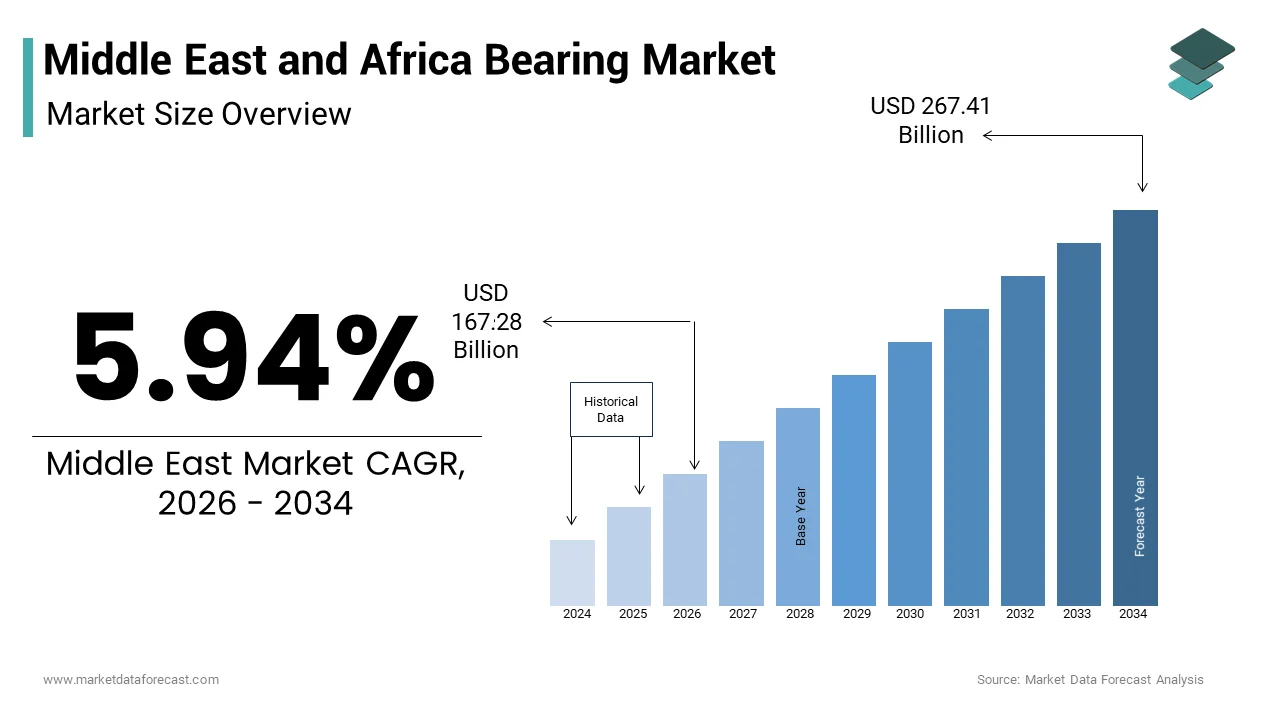
The demand for ball bearings in the construction, transportation, and manufacturing industries is driving the growth of the MEA bearing market. The need for BB increased with the expansion of factory and commercial activities after the second COVID-19 wave. The region has the largest energy reserves, which significantly boost the market value. A wide range of machinery and equipment with BB is required in extraction, processing, handling, and transportation.
The bearings market in the Middle East and Africa is dominated by the UAE and Saudi Arabia. This is due to the rapid application of automation and modern production technologies. Also, companies are investing in high-quality BB, which is required for CNC machines, robotics, and automatic systems. There is a big demand for such types of ball bearings. Its focus on enhancing industrialization and modernization is propelling the market share of specialized BBs further. Climatic conditions are another driving factor for the MEA-bearing market growth. There is a constant demand for bearings and lubricants because of high temperatures and sandstorms. Additionally, South Africa has a larger and more mature bearing market. It is primarily propelled by its strong manufacturing and mining sectors. In North Africa, Morocco and Egypt have substantial market growth.
The development of infrastructure is expected to drive the expansion of the MEA-bearing market share. Railways, airports, and energy projects are providing opportunities for companies in the market. Thus, the demand for durable and high-quality bearings has increased. Also, as the recession in Sudan and other factors fade, the economy is expected to rebound in 2024, with growth reaching 3.4 percent. Other factors also include temporary limitations in oil production.
High raw material and production costs are some of the barriers hindering the MEA-bearing market growth. The Ukraine-Russia war has increased the component prices of ball bearings. Moreover, key players and suppliers worldwide have already raised the prices by an average of 8 percent between March and April. To be specific, the cost surged from USD 1480 per ton to USD 21500. It was the highest level of increment. Furthermore, due to the war, electricity and natural gas costs also increased. The crude oil prices went to an eight-year. Additionally, China’s decreasing production of medium and small bearings may result in a market shortage due to the decision to either actively or passively cease production.
Limited technological advances are limiting the MEA-bearing market growth. Many manufacturers still rely on outdated production technologies. It causes inefficiency, higher energy consumption, and low-quality bearings compared to modern methods. Also, the lack of R&D investments is restricting the market expansion in the region. This limited the development of local manufacturing capability for indigenous high-performance and specialized bearings. Therefore, the market share decreases compared to other regions.
Impact of COVID-19 on the Market
The MEA-bearing market was notably affected by COVID-19. The supply of raw materials, machinery, factory equipment, and finished bearings was slowed or halted due to closed country borders. As a result, the bearing producers and distributors for the manufacturing, oil and gas, and aerospace and defense sectors suffered a decrease in income. But as regulations loosened, production started and saw a consistent rate of adoption in the first quarter of 2021.
REPORT COVERAGE
| REPORT METRIC | DETAILS |
| Market Size Available | 2025 to 2034 |
| Base Year | 2025 |
| Forecast Period | 2026 to 2034 |
| CAGR | 5.94% |
| Segments Covered | By Rolling Element, Gear Type, Application, and Region. |
| Various Analyses Covered | Global, Regional, Country-Level Analysis, Segment-Level Analysis, DROC, PESTLE Analysis, Porter’s Five Forces Analysis, Competitive Landscape, Analyst Overview of Investment Opportunities |
| Regions Covered | KSA, UAE, Israel, rest of GCC countries, South Africa, Ethiopia, Kenya, Egypt, Sudan, rest of MEA |
| Market Leaders Profiled | Emerson Bearing Company, IMO Group, Italcuscinetti S.p.A. a,, Socio Unico L, Iebherr, Schaeffler Technologies AG & Co. KG, SKF, THE TIMKEN COMPANY, and ThyssenKrupp Rothe Erde Germany GmbH |
SEGMENT ANALYSIS
By Rolling Element Insights
The ball segment holds the largest market share in the MEA region because of its adaptability and versatility in multiple applications across industries. The shift towards urbanization and infrastructure development will further increase the regional market size. The demand is expected from the latest construction equipment, EVs, and industrial machinery.
By Gear Insights
The ungeared segment is the dominant category of the MEA-bearing market. The integration of sensors and smart features will elevate its market share. With this, it can offer performance data, wear, and lubrication. Thus, enabling predictive maintenance and reducing downtime for industrial users. At the same time, internal gear bearings are popular in heavy-duty machinery like cranes, excavators, and wind turbines.
By Application Insights
The automotive segment is a mature market with high competition. This is due to the superiority of international brands in the region. However, aftermarkets have an opportunity for local manufacturers to increase their market value. Also, the company is emphasizing lightweight bearings for fuel efficiency.
By Distribution Channel Insights
The aftermarket segment holds the maximum market share of the MEA-bearing market. There is a significant demand for replacement bearings due to the current installed base of machinery and equipment across different sectors. On the other hand, counterfeit bearings are a major problem affecting both performance and safety.
COUNTRY ANALYSIS
- UAE-bearing market value is expected to elevate rapidly in the forecast period. The mounted bearings are propelling the country’s market growth rate. It is anticipated that the ball-bearing segment will hold almost half of the MEA bearing market by the end of the projection period.
- South Africa is estimated to grow at a CAGR of 1.8 percent in the future. One of the main factors driving the market growth is the rise in demand for bearings from the automotive and industrial sectors. It is getting less competitive. In 2022, the HHI index was 1224 compared to 1112 in 2017.
- GCC is predicted to register a higher market growth rate in the forecast period. The substantial increase in non-oil GDP is driven by expanding services in Bahrain, Oman, Saudi Arabia, and the UAE, nd also solid manufacturing activity in Oman, Saudi ArabiArabia, the UAE Qatar. This has counterbalanced the slowdown in oil GDP.
- Israel might experience slow economic growth due to the ongoing war with Hamas. The complex political situation in the region can create challenges for exporting Israeli bearings to certain countries within the MEA.
COMPETITIVE LANDSCAPE
KEY MARKET PLAYERS
A few of the market players in the Middle East and Africa bearing market include
- Emerson Bearing Company
- IMO Group
- Italcuscinetti S.p.A.
- Socio Unico L
- IEBHERR
- Schaeffler Technologies AG & Co. KG
- SKF
- THE TIMKEN COMPANY
- ThyssenKrupp Rothe Erde Germany GmbH.
RECENT MARKET NEWS
- In October 2023, NBC Bearings partnered with FOGTEC to offer fire detection and suppression systems to Indian railways.
MARKET SEGMENTATION
This research report on the Middle East & Africa bearing market is segmented and sub-segmented into the following categories.
By Rolling Element:
- Ball
- Self-Aligning Ball Bearing
- Deep Groove Ball Bearing
- Angular Contact Ball Bearing
- Thrust Ball Bearing
- Others
- Roller
- Split
- Tapered
- Others
- Plain
- Journal Plain Bearings
- Linear Bearing
- Thrust
By Gear Type
- Internal Gear
- Ungeared
- External Gear
By Application
- Wind and Solar Energy
- Aerospace and Defense
- Medical
- Industrial Machinery
- Automotive
- Oil and Gas
- Mining
- Others (Agriculture, Railway, etc.)
By Distribution Channel
- OEM
- Aftermarket
- Online
By Country
- KSA
- UAE
- IsraelThe
- rest of the GCC countries
- South Africa
- Ethiopia
- Kenya
- Egypt
- Sudan
- rest of MEA