- Product Description Description
- Table of Contents TOC
- List of Table & Figure LOT
- Get Free Sample PDF Sample PDF
Market Size, 2025
$15.44 BnMarket Estimate, 2026
$16.78 BnMarket Forecast, 2034
$32.71 BnCAGR, 2026–2034
8.70%Middle East and Africa Bottled Water Market Size
The Middle East and Africa bottled water market size was valued at USD 15.44 billion in 2025 and is projected to reach USD 32.71 billion by 2034 from USD 16.78 billion in 2026, growing at a CAGR of 8.70%.
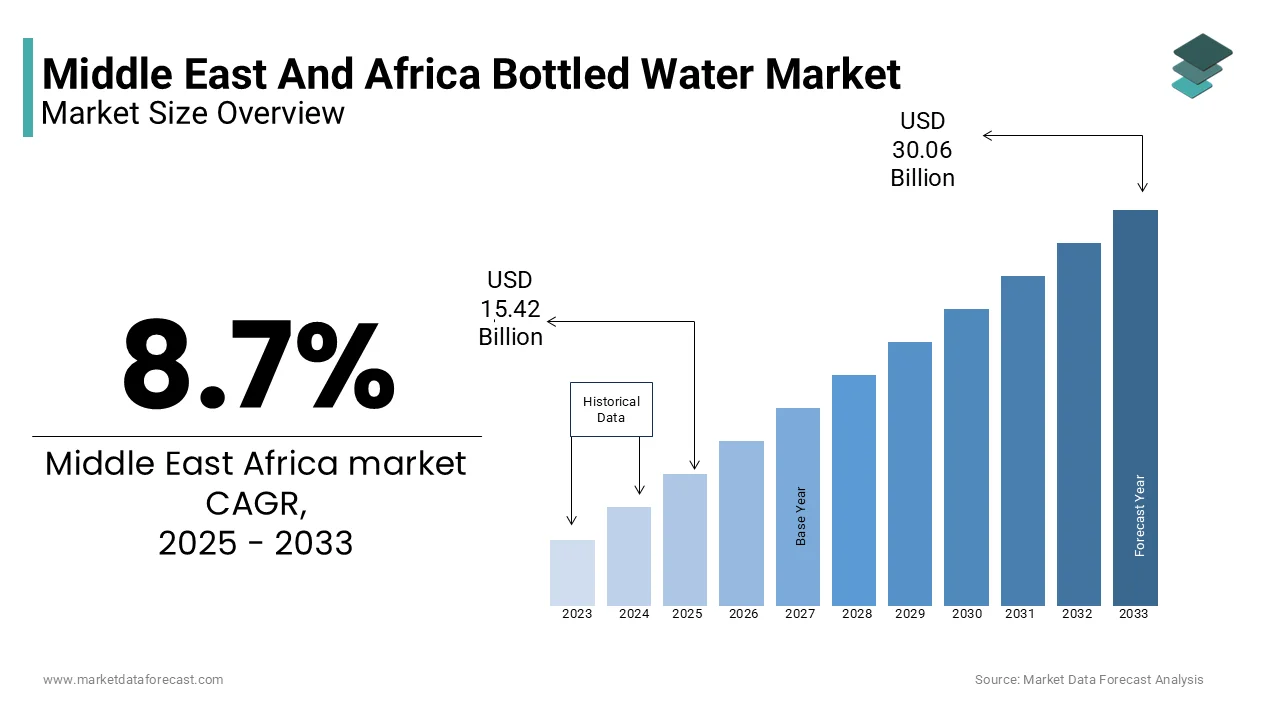
Bottled Water Market covers packaged drinking water in both still and flavored forms, serving as a critical alternative to unreliable municipal supplies and unsafe natural sources. This market has evolved beyond mere hydration, reflecting broader shifts in urbanization, public health awareness, and consumer behavior. In addition, a large share of potable water in GCC countries be desalinated, a costly and energy-intensive process that reinforces dependence on bottled alternatives. These conditions anchor bottled water not as a luxury, but as a structural necessity across much of the region.
MARKET DRIVERS
The persistent inadequacy of public water infrastructure, particularly in rapidly expanding urban centers, is a primary driver of the Middle East and Africa Bottled Water Market. Also, households increasingly turn to bottled water as a reliable alternative. In Egypt, where the Nile faces increasing pollution from agricultural runoff and industrial discharge, only a limited share of rural water sources meet national safety standards. These systemic deficiencies make packaged water a default choice for millions.
The surge in urbanization and lifestyle changes, particularly among the growing middle class, which favors convenience and perceived hygiene, is another significant driver. According to the United Nations Department of Economic and Social Affairs, Africa’s urban population is projected to reach 1.3 billion by 2050. This demographic shift fuels demand for on-the-go consumption formats. The alignment of bottled water with modern, mobile lifestyles has cemented its role in daily consumption patterns.
MARKET RESTRAINTS
The escalating environmental impact of plastic waste, which is triggering regulatory scrutiny and public backlash, is one major restraint in the Middle East and Africa Bottled Water Market. These measures increase compliance costs and constrain production scalability, challenging market expansion.
The rising competition from affordable point-of-use water purification technologies, which offer a cost-effective alternative to daily bottled water purchases, is another critical restraint. Companies like Doulton and LifeStraw have expanded distribution through pharmacies and NGOs, increasing accessibility. These technologies, particularly in middle-income urban areas, are eroding the economic rationale for long-term bottled water dependency.
MARKET OPPORTUNITIES
The development of sustainable packaging and circular economy models, which can align with evolving regulatory and consumer expectations, is a significant opportunity. Companies have launched rPET (recycled PET) bottle lines in the UAE and Saudi Arabia, reducing virgin plastic use. The African Union’s Agenda 2063 includes a commitment to zero plastic leakage by 2030, incentivizing investment in refillable containers and water ATMs. Innovations such as biodegradable sachets made from plant-based polymers, piloted in Ghana by Pure Water Ltd, signal a shift toward eco-conscious product design.
The expansion into underserved rural and peri-urban markets through decentralized bottling and micro-distribution networks is another transformative opportunity. Also, approximately 57% of Sub-Saharan Africa’s population lives in rural areas, where access to branded bottled water remains limited. In Ethiopia, only a share of rural households use packaged water regularly, indicating substantial untapped demand. These models reduce logistics costs and enhance affordability, unlocking new market frontiers.
MARKET CHALLENGES
The proliferation of unregulated and counterfeit products, which undermine consumer trust and brand integrity, is a major challenge in the Middle East and Africa Bottled Water Market. These substandard products, often sold at lower prices, distort competition and pose public health risks, necessitating stricter enforcement and traceability mechanisms.
The increasing strain on natural water sources due to over-extraction for commercial bottling, leading to ecological degradation and community conflict, is another pressing challenge. Companies now face growing pressure to adopt water stewardship practices and disclose source sustainability metrics to maintain social license to operate.
REPORT COVERAGE
| REPORT METRIC | DETAILS |
| Market Size Available | 2025 to 2034 |
| Base Year | 2025 |
| Forecast Period | 2026 to 2034 |
| CAGR | 8.70% |
| Segments Covered | By Product Type, Packaging, Distribution channel, and Region |
| Various Analyses Covered | Global, Regional, & Country Level Analysis; Segment-Level Analysis; DROC; PESTLE Analysis; Porter’s Five Forces Analysis; Competitive Landscape; Analyst Overview of Investment Opportunities |
| Regions Covered | KSA, UAE, Israel, rest of GCC countries, South Africa, Ethiopia, Kenya, Egypt, Sudan and Rest of MEA |
| Market Leaders Profiled | Nestlé Waters, Hangzhou Wahaha Group Co., Ltd., The Coca-Cola Company, Danone, PepsiCo Inc., Natural Waters of Viti Ltd, Icelandic Glacial Inc., Mountain Valley Spring Company, Dasani, and others. |
SEGMENTAL ANALYSIS
By Product Type Insights
The Still Water segment dominated the Middle East and Africa Bottled Water Market by capturing a substantial share of total product sales in 2024. This dominance is due to consumer preference for safe, neutral-tasting hydration, particularly in regions where tap water is unreliable or contaminated. Large number of people in Sub-Saharan Africa lack access to safely managed drinking water. In Nigeria, where sachet water is widely consumed, the vast majority of packaged water sold is non-carbonated. A further key driver is institutional and commercial demand in healthcare, education, and corporate sectors. These institutional use cases, combined with cultural familiarity and health perceptions, solidify still water as the foundational category in the regional market.
The Functional Water segment is the fastest-growing product type and is projected to expand at a CAGR of 14.3% from 2025 to 2034. This surge is driven by rising health consciousness and demand for value-added hydration among urban, middle-income consumers. Functional water, enriched with electrolytes, vitamins, oxygen, or alkaline properties, is increasingly marketed as a wellness product in gyms, spas, and premium retail outlets. An additional pivotal factor is aggressive branding and positioning by private labels and international entrants. Clinical endorsements further legitimize these products. With increasing disposable income and digital health awareness, functional water is transitioning from niche to mainstream.
By Packaging Insights
The PET Bottles segment was the dominant packaging in the market by accounting for a substantial share of total bottled water packaging in 2024. This dominance is primarily due to PET’s lightweight, durability, and cost-effectiveness, making it ideal for mass distribution in regions with underdeveloped logistics infrastructure. The material’s adaptability to high-speed filling lines and resistance to breakage further enhances its appeal to producers. A different critical factor is the established recycling ecosystem in certain markets, which supports circularity and reduces regulatory pressure. As per the South Africa’s PETCO initiative, 64% of PET bottles were collected and recycled in 2023, the highest rate on the continent, encouraging brand owners to maintain PET usage. Besides, advancements in rPET (recycled PET) technology have enabled brands to launch bottles with recycled content. While environmental concerns persist, the scalability and evolving sustainability of PET ensure its continued market leadership.
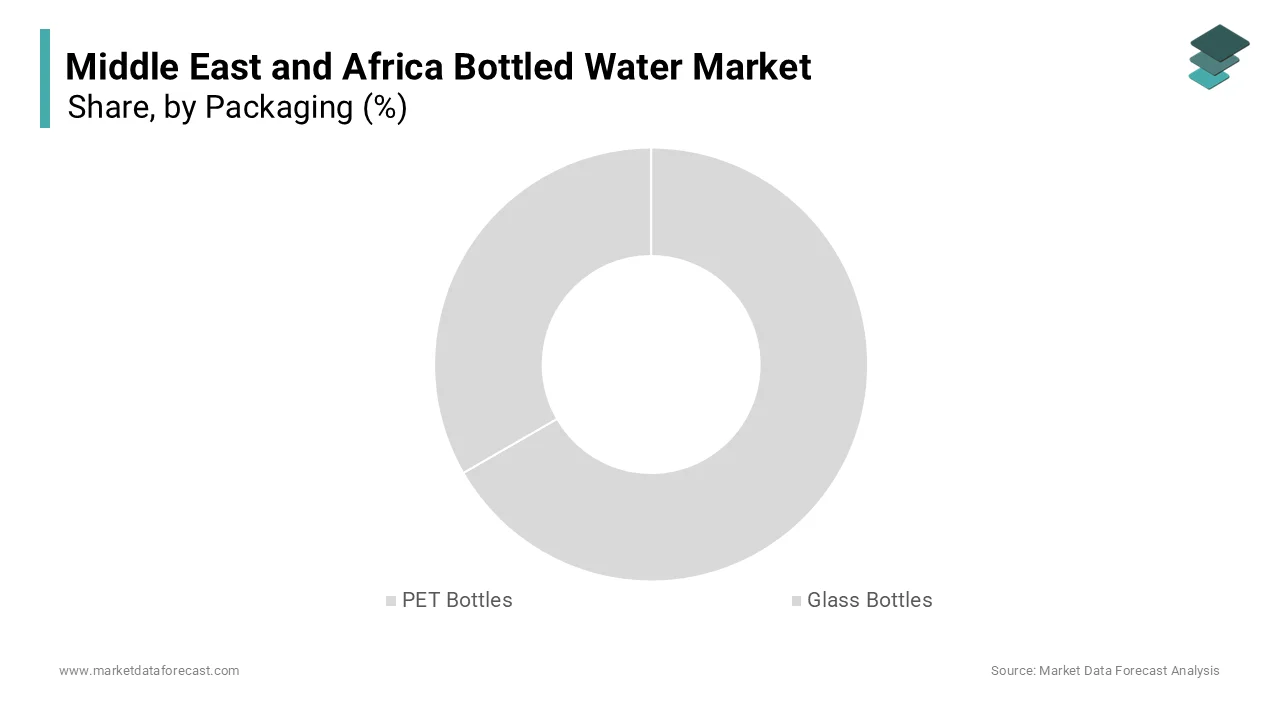
The Glass Bottles segment is experiencing the fastest growth and is projected to grow at a CAGR of 9.8% from 2026 to 2034. This acceleration is driven by premiumization trends and consumer demand for eco-friendly, non-leaching packaging in high-end hospitality and residential sectors. In the UAE, five-star hotels and luxury villas increasingly serve glass-bottled water to align with sustainability branding. An additional contributing factor is government-led initiatives to reduce single-use plastics. While logistics and cost remain barriers, glass is gaining traction as a symbol of quality and environmental responsibility.
By Distribution Channel Insights
The Supermarkets segment commands the distribution channel by accounting for 46.3% of total bottled water sales in 2025. This lead position is due to the expansion of organized retail chains and their role as primary procurement hubs for urban households. A further major driver is the integration of supermarkets into corporate and government supply chains. With air-conditioned storage, brand diversity, and loyalty programs, supermarkets offer a trusted, scalable channel for both mass and premium water brands.
The Convenience/Drug Stores segment is the fastest-growing distribution channel and is projected to expand at a CAGR of 13.7% from 2026 to 2034. This growth is fueled by urban mobility, on-the-go consumption, and the proliferation of small-format retail in high-traffic zones. A different key factor is the strategic placement of chilled displays in transit hubs, malls, and business districts. With extended operating hours, proximity, and impulse-buy dynamics, convenience stores are becoming critical nodes in the bottled water supply chain, especially for single-serve formats.
REGIONAL ANALYSIS
Saudi Arabia led the regional bottled water market by capturing a 29.1% of total MEA sales in 2025. The Kingdom’s dominance is anchored in its complete reliance on desalinated water. This dependence, coupled with high urbanization and disposable income, drives massive bottled water consumption. The Ministry of Environment, Water and Agriculture confirmed that per capita bottled water consumption exceeds 120 liters annually, among the highest in the region.
The United Arab Emirates holds a significant share of the market which is driven by extreme climate conditions, a large expatriate population, and advanced retail infrastructure. The UAE’s reliance on desalination reinforces demand for packaged alternatives. The country’s robust logistics network enables rapid distribution.
South Africa is serving as the primary bottled water hub for Sub-Saharan Africa. The country’s formal regulatory framework, led by the South African Bureau of Standards (SABS), ensures high product safety. Urbanization and distrust in municipal supply drive demand. With a mature retail sector and growing health awareness, South Africa remains a testing ground for new product innovations.
Egypt is characterized by high volume and price sensitivity. The country consumes billions of liters of bottled water annually. Contamination of the Nile due to agricultural runoff and industrial discharge has eroded trust in tap water. The proliferation of local brands like Baraka and Nestlé Pure Life has intensified competition.
Kenya is distinguished by its dynamic informal sector and innovation in low-cost packaging. However, regulatory enforcement remains weak.
COMPETITIVE LANDSCAPE
The competitive landscape of the Middle East and Africa Bottled Water Market is highly fragmented, characterized by a mix of multinational corporations, regional conglomerates, and thousands of local bottlers. Global players leverage brand equity, technological innovation, and sustainability initiatives to dominate premium and urban segments, while domestic producers thrive on price competitiveness and proximity to informal markets. Competition is intensifying around packaging sustainability, with companies racing to adopt recycled materials and reduce plastic footprints. Regulatory pressures, consumer activism, and water scarcity are reshaping brand strategies. In high-growth areas like East Africa, unbranded and sachet water suppliers maintain strong footholds, challenging formal brands. The absence of uniform quality enforcement allows substandard products to persist, creating both risks and opportunities for consolidation. Innovation in distribution, source stewardship, and affordability will determine long-term market leadership.
KEY MARKET PLAYERS
Companies playing a notable role in the Middle East and Africa bottled water market include
-
Nestlé Waters
-
Hangzhou Wahaha Group Co., Ltd.
-
The Coca-Cola Company
-
Danone
-
PepsiCo Inc.
-
Natural Waters of Viti Ltd
-
Icelandic Glacial Inc.
-
Mountain Valley Spring Company
-
Dasani
TOP PLAYERS IN THE MARKET
- Nestlé Waters maintains a strong presence across the Middle East and Africa through its localized brands such as Nestlé Pure Life, Soudanina in Sudan, and Sheba in Yemen. The company has invested heavily in sustainable bottling operations, including water stewardship initiatives in water-stressed regions like Saudi Arabia and South Africa. It also introduced a solar-powered bottling plant in Ismailia, Egypt, reducing carbon emissions by 40%. The company actively engages in public-private partnerships, collaborating with municipal authorities in Nairobi and Khartoum to improve access to safe drinking water through affordable packaging. Its focus on operational sustainability, brand trust, and community engagement reinforces its leadership in diverse regional markets.
- Danone (via its subsidiary Aquafina and local brand partnerships) plays a pivotal role in shaping premium and mass-market bottled water consumption in the Gulf and North Africa. Through its joint ventures with local distributors, Danone supplies packaged water to hypermarkets, hospitality chains, and government agencies across the UAE, Qatar, and Morocco. The company also launched a digital traceability platform in Saudi Arabia, enabling consumers to scan QR codes and view water source and production data. Danone’s collaboration with the Dubai Future Foundation on circular economy pilots for water packaging has positioned it as an innovator in sustainable hydration solutions, strengthening its reputation beyond volume-driven sales.
- Almarai Company, a leading food and beverage producer in the Middle East, dominates the bottled water segment in Saudi Arabia and the GCC through its Almarai Water brand. The company operates one of the largest integrated dairy and beverage networks in the region, leveraging its cold chain and distribution infrastructure to ensure nationwide availability. It introduced 100% rPET bottles for its 1.5-liter format, becoming the first major regional brand to do so at scale. Almarai also partnered with the Ministry of Environment, Water and Agriculture on public awareness campaigns promoting responsible water consumption. Its vertically integrated model and alignment with national sustainability objectives solidify its influence in the evolving bottled water landscape.
TOP STRATEGIES USED BY THE KEY MARKET PLAYERS
Key players in the Middle East and Africa Bottled Water Market are adopting strategies centered on sustainable packaging innovation, source transparency, premium product differentiation, expansion into underserved regions, and strategic partnerships with governments and retailers. Companies are investing in rPET, glass, and alternative materials to comply with tightening environmental regulations. Digital traceability, QR-based origin tracking, and blockchain verification are being used to build consumer trust. Firms are also enhancing distribution through micro-retail networks and e-commerce platforms. Localization of branding and affordability-focused formats, such as small sachets and refill stations, enables penetration in low-income and rural areas. Collaborations with municipal bodies and health agencies further strengthen legitimacy and access.
RECENT HAPPENINGS IN THE MARKET
- In March 2023, Nestlé Waters launched a solar-powered bottling facility in Ismailia, Egypt, reducing energy consumption by 50% and integrating advanced water recovery systems to minimize aquifer extraction in the Nile Delta region.
- In August 2023, Danone introduced aluminum-packaged Evian in high-end retailers across Dubai and Riyadh, targeting environmentally aware consumers and reinforcing its commitment to plastic-free alternatives in the GCC luxury segment.
- In January 2024, Almarai expanded its rPET usage to 100% in 1.5-liter bottles across Saudi Arabia, becoming the first major regional brand to achieve full recyclable content in a best-selling format, as verified by the Saudi Standards, Metrology and Quality Organization.
- In May 2024, Bisleri International partnered with Kenya’s Nairobi Water to distribute affordable 1-liter bottled water through kiosks in informal settlements, improving access while building brand loyalty in underserved urban communities.
- In July 2024, Coca-Cola Beverages Africa rebranded its AdeZ water line in South Africa with QR-coded traceability, allowing consumers to verify source sustainability and production ethics, enhancing transparency and trust in the functional water category.
MARKET SEGMENTATION
This research report on the Middle East and Africa bottled water market has been segmented and sub-segmented based on the following categories.
By Product Type
- Still water
- carbonated water
- flavored water
- functional water
By Packaging
- PET Bottles
- Glass Bottles
By Distribution Channels
- Supermarkets
- Convenience/Drug Stores
- Grocery Stores
By Country
- KSA
- UAE
- Israel
- rest of GCC countries
- South Africa
- Ethiopia
- Kenya
- Egypt
- Sudan
- rest of MEA