- Product Description Description
- Table of Contents TOC
- List of Table & Figure LOT
- Get Free Sample PDF Sample PDF
Market Size, 2025
$45.11 MnMarket Estimate, 2026
$48.65 MnMarket Forecast, 2034
$89.05 MnCAGR, 2026–2034
7.85%Executive Summary: Middle East and Africa Caviar Market
- Market Scope: Comprehensive analysis of the Middle East and Africa caviar market covering sturgeon product types, application segments, distribution dynamics, regional country insights, growth drivers, restraints, and competitive landscapes.
- Market Valuation: Valued at USD 45.11 million (2025), estimated at USD 48.65 million (2026), and projected to reach USD 89.05 million by 2034, registering a robust CAGR of 7.85% during the forecast period (2026–2034).
- Primary Growth Drivers: Surging luxury hospitality and fine-dining sectors across GCC urban hubs, rising disposable incomes among ultra-high-net-worth individuals, consumer health awareness regarding omega-3 fatty acids and antioxidants, and advancements in local aquaculture and farm-raised sturgeon technologies.
Key Market Segment Metrics (2026–2034)
| Category | Leading Segment (2025 Position) | Fastest-Growing Segment |
|---|---|---|
| By Product Type | Acipenser Gueldenstaedtii (Osetra) & Hybrid Caviar (dominant variants prized for exceptional flavor and smooth texture) | Acipenser Baerii (Siberian Sturgeon) & Hybrid Caviar (driven by efficient farm-raising and sustainable aquaculture expansion) |
| By Application | Restaurants & Food Service (captures the largest market share fueled by luxury hotels, resorts, and fine dining) | Households (expanding rapidly as affluent consumers recreate luxury gourmet experiences at home) |
| By Region / Country | UAE & KSA (anchor regional consumption due to luxury tourism, elite demographics, and high-end culinary hubs) | South Africa, Israel, & Egypt (growing steadily via upscale metropolitan food trends and local aquaculture initiatives) |
Major Market Players & Market Structure
Market Structure: Moderately consolidated luxury food and aquaculture landscape featuring specialized sturgeon farmers, global caviar distributors, and international luxury brand houses competing on grading standards, freshness, sustainable farming, and cold-chain integrity.
Key Companies: Kaluga Queen, California Caviar Company, Sterling Caviar, Agroittica Lombarda, Coastal Bay Seafoods, Avori Caviar, American Pearl Caviar, Russian Caviar House, and others.
 Download Free Sample Report
Middle East and Africa Caviar Market Size
The Middle East and Africa caviar market size was valued at USD 45.11 million in 2025 and is projected to reach USD 89.05 million by 2034 from USD 48.65 million in 2026, growing at a CAGR of 7.85%.
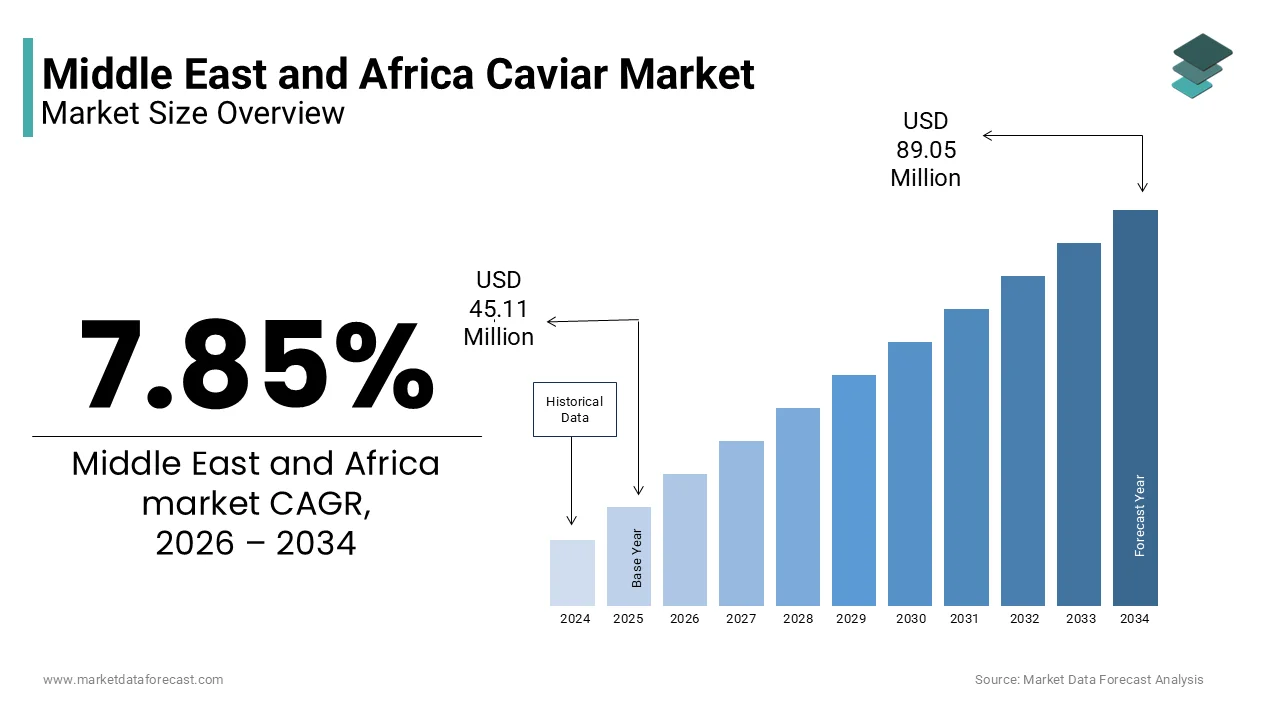
The Middle East and Africa caviar market represents a specialized luxury food sector defined by the production, import, and consumption of sturgeon roe within this geographically diverse region. According to the United Arab Emirates Ministry of Climate Change and Environment, an Abu Dhabi sturgeon farm has a maximum capacity of 35 tonnes of caviar and 700 tonnes of sturgeon meat per year, demonstrating the presence of commercial-scale caviar aquaculture in the UAE. This market is distinct due to its reliance on both emerging local farming operations in the Gulf and established imports to serve expatriate communities and high-end hospitality sectors. As per the Convention on International Trade in Endangered Species of Wild Fauna and Flora, all Acipenseriformes species have been listed under the CITES Appendices since 1998, and international trade in caviar and other sturgeon products is subject to traceability and documentation requirements. These statistics demonstrate how government-led agricultural diversification strategies directly underpin supply availability and commercial viability within the Middle East and Africa caviar market. The sector operates at the intersection of luxury gastronomy and advanced aquaculture technology, making it highly sensitive to both tourism flows and technical farming capabilities rather than traditional wild-capture fisheries.
MARKET DRIVERS
Expansion of Luxury Hospitality and Tourism Infrastructure
The rapid development of ultra-luxury hotels and fine-dining establishments is propelling the Middle East and Africa caviar market growth by creating consistent institutional demand for premium garnishes and menu items. According to the Dubai Department of Economy and Tourism, Dubai welcomed 17.15 million international overnight visitors in 2023, representing a 19.4% increase from 2022, driving substantial procurement volumes for high-end ingredients. This influx of affluent tourists necessitates authentic luxury experiences where caviar serves as a status symbol and culinary differentiator. The statistical correlation between tourist arrivals and premium food imports demonstrates that hospitality growth directly translates to caviar sales volume. Furthermore, the World Travel and Tourism Council reported that travel and tourism contributed substantially to Saudi Arabia's economy in 2023 as part of the country's Vision 2030 tourism expansion. New resort openings across the Red Sea and NEOM projects are specifically designed to attract high-net-worth individuals who expect Michelin-star-level dining standards. Consequently, the Middle East and Africa caviar market benefits from a structural demand driver where infrastructure expansion creates captive markets for luxury seafood products independent of broader economic cycles affecting retail consumers.
Government Investment in Sustainable Aquaculture Diversification
Strategic national agendas prioritizing food security and non-oil revenue streams is further contributing to the Middle East and Africa caviar market expansion by subsidizing infrastructure and research for sturgeon farming. According to the United Arab Emirates Ministry of Climate Change and Environment, a commercial sturgeon farm in Abu Dhabi has a maximum production capacity of 35 tonnes of caviar and 700 tonnes of sturgeon meat annually, demonstrating the scale that advanced aquaculture can achieve in the Gulf. This financial commitment de-risks capital-intensive caviar farming projects, enabling local producers to establish facilities that meet international quality standards. The statistical impact is evident in the development of controlled sturgeon farming systems that allow caviar to be produced without dependence on wild sturgeon populations. Similarly, the South African Department of Forestry, Fisheries and the Environment recognizes aquaculture as an agricultural activity and requires authorization for the commercial import and export of aquaculture products. These policy interventions lower barriers to entry and accelerate the development of regulated aquaculture operations. Thus, the Middle East and Africa caviar market is propelled by top-down economic planning that transforms caviar from an imported luxury into a domestically produced strategic asset to ensure long-term supply resilience and export potential.
MARKET RESTRAINTS
High Production Costs and Long Maturation Cycles
The extended biological timeline required for sturgeon to produce viable roe is impeding the Middle East and Africa caviar market by tying up capital for years before generating any revenue. According to the Food and Agriculture Organization of the United Nations, female Acipenser baerii generally reach puberty at about 7 years under favorable farm conditions, while females in natural conditions can mature at approximately 12 to 20 years depending on origin. This prolonged gestation period necessitates massive upfront investment in recirculating aquaculture systems, feed, and labor without interim cash flow. The statistical burden is significant because sturgeon farming requires several years of rearing before females become suitable for caviar production. Additionally, long biological production cycles make short-term supply adjustments difficult when market demand changes. These economic realities restrict new entrants and limit scalability for existing operators. Consequently, the Middle East and Africa caviar market faces inherent supply constraints where production cannot rapidly expand to meet demand spikes, creating volatility and limiting mainstream adoption beyond niche luxury segments.
Regulatory Complexity and Trade Compliance Barriers
Stringent international trade regulations and inconsistent domestic enforcement hinder the Middle East and Africa caviar market by creating administrative bottlenecks and compliance costs for exporters and importers. According to the Convention on International Trade in Endangered Species of Wild Fauna and Flora, all Acipenseriformes species have been listed under the CITES Appendices since 1998, with two species listed in Appendix I and the remaining species generally listed in Appendix II. In 2023, the CITES Secretariat continued to maintain traceability and documentation requirements for international sturgeon and caviar trade rather than suspending all trade permits for African range states. The statistical impact of regulatory friction is profound because CITES requires internationally traded caviar to comply with identification and documentation requirements covering the source and processing information. Furthermore, varying halal certification standards across Gulf Cooperation Council countries create additional fragmentation for processed caviar products. These bureaucratic hurdles disproportionately affect smaller producers lacking dedicated compliance teams. Thus, the Middle East and Africa caviar market is constrained by a complex web of conservation and customs protocols that slow commercial velocity and discourage foreign buyers seeking reliable just-in-time delivery schedules.
MARKET OPPORTUNITIES
Development of Regional Halal-Certified Premium Brands
Creating culturally aligned luxury brands offers a substantial opportunity for the Middle East and Africa caviar market by tapping into the underserved Muslim consumer base in Gulf nations and Southeast Asian export markets. According to the State of the Global Islamic Economy Report, Muslim consumer spending on halal food and beverages reached approximately USD 1.4 trillion in 2023, demonstrating the scale of the addressable halal food economy. Currently, most global caviar brands lack explicit halal verification, creating a trust gap for observant consumers despite sturgeon being generally permissible. Establishing recognized halal certification protocols for caviar processing would unlock this latent demand and differentiate regional products from European competitors. Additionally, branding caviar as a heritage product linked to Persian or Arabian culinary traditions enhances cultural resonance. This strategic positioning allows producers to command premium pricing while building loyalty among demographics previously excluded from the category. Consequently, the Middle East and Africa caviar market can leverage religious and cultural alignment to create defensible market niches insulated from generic commodity competition.
Integration of Agritourism and Experiential Retail
Combining caviar production with tourism and direct-to-consumer experiences presents a lucrative opportunity for the Middle East and Africa caviar market to diversify revenue streams and build brand equity. According to the United Nations World Tourism Organization, the Middle East was the first region globally to recover to pre-pandemic international tourist arrival levels in 2023 and received approximately 22% more international arrivals than in 2019, strengthening the environment for experiential luxury tourism. Caviar farms are uniquely positioned to capitalize on this trend by offering guided tours, tasting sessions, and educational workshops that justify premium retail pricing. The statistical viability is demonstrated by the established use of farm and food tourism experiences in South Africa, where agricultural tourism forms part of the country's broader tourism offering. Furthermore, the Ras Al Khaimah Tourism Development Authority actively promotes sustainable tourism experiences that can support connections between agriculture and hospitality. This experiential approach transforms caviar from a mere ingredient into a memorable lifestyle product, fostering emotional connections with consumers. Thus, the Middle East and Africa caviar market can mitigate business-to-business volatility by cultivating direct relationships with end users who value transparency and origin stories.
MARKET CHALLENGES
Technical Expertise Gap in Sturgeon Husbandry
A critical shortage of specialized aquaculture professionals proficient in sturgeon biology is a significant challenge to the Middle East and Africa caviar market by limiting operational efficiency and stock survival rates. According to the Food and Agriculture Organization of the United Nations, sturgeon aquaculture requires specialized broodstock management, including sex identification, maturation monitoring, temperature management, and controlled egg harvesting. This expertise deficit forces farms to rely on expensive expatriate consultants or trial-and-error methods that increase mortality and delay maturation. The statistical consequence is severe because female sturgeon does not mature simultaneously, and the proportion of mature females producing eggs in a given year can vary substantially. In the Gulf region, similar gaps exist despite heavy investment because university curricula have not kept pace with industry specialization needs. Training programs take years to yield competent staff, creating a lag between infrastructure deployment and operational excellence. Consequently, the Middle East and Africa caviar market struggles to achieve consistent quality and yield benchmarks necessary for competing with established European and Asian producers who benefit from decades of accumulated institutional knowledge.
Climate Change Induced Water Stress and Temperature Volatility
Escalating environmental pressures threaten the biological stability and economic viability of the Middle East and Africa caviar market by disrupting the precise aquatic conditions sturgeon require. According to the Intergovernmental Panel on Climate Change, the Middle East and North Africa is among the regions expected to experience substantial warming and increasing water stress under continued climate change. Sturgeon reproduction is highly sensitive to environmental conditions, and successful aquaculture therefore requires careful management of temperature, oxygen, and water quality. The statistical reality of this vulnerability is reinforced by the increasing need for energy-intensive water management in hot and water-stressed environments. Similarly, the United Nations Economic Commission for Africa identifies climate change and water scarcity as significant risks to agricultural and aquatic production systems in Africa. Adapting to these shifts requires costly technological upgrades and relocation strategies that strain already thin margins. Thus, the Middle East and Africa caviar market faces an existential threat where environmental degradation directly undermines the biological foundation upon which the entire industry depends.
REPORT COVERAGE
| REPORT METRIC | DETAILS |
| Market Size Available | 2025 to 2034 |
| Base Year | 2025 |
| Forecast Period | 2026 to 2034 |
| CAGR | 7.85% |
| Segments Covered | By Product Type, Application, and Region |
| Various Analyses Covered | Global, Regional, & Country Level Analysis; Segment-Level Analysis; DROC; PESTLE Analysis; Porter’s Five Forces Analysis; Competitive Landscape; Analyst Overview of Investment Opportunities |
| Regions Covered | KSA, UAE, Israel, rest of GCC countries, South Africa, Ethiopia, Kenya, Egypt, Sudan and Rest of MEA |
| Market Leaders Profiled | Kaluga Queen, Emirates Aqua Tech, California Caviar Company, Sterling Caviar, Agroittica Lombarda, Zeugma Caviar, Coastal Bay Seafoods, Avori Caviar, American Pearl Caviar, Al Ain Farms, and Russian Caviar House |
SEGMENTAL ANALYSIS
By Product Type Insights
The acipenser baerii caviar segment accounted for the dominating share of the Middle East and Africa caviar market in 2025. The leading position of acipenser baerii caviar segment in this regional market is majorly driven by its adaptability to controlled aquaculture environments and favorable cost-to-quality ratio. The dominance of Acipenser baerii is further driven by its physiological resilience, which makes it ideal for the intensive recirculating aquaculture systems prevalent in arid Middle Eastern climates. According to the Food and Agriculture Organization of the United Nations, Acipenser baerii can be farmed successfully under controlled conditions, and females can reach puberty at about 7 years in generally temperate farming environments. This biological advantage reduces the production period compared with natural maturation and supports controlled caviar production. The statistical reliability of this species allows producers to guarantee consistent supply contracts with luxury hotels that require uninterrupted availability. Additionally, the smaller body size of baerii enables higher stocking densities without compromising water quality. As per the Food and Agriculture Organization of the United Nations, Acipenser baerii is widely used in aquaculture and has been subjected to hybridization and intensive farming programs across Europe and Asia. This efficiency lowers operational costs and enhances profitability. Consequently, the Middle East and Africa caviar market relies on Acipenser baerii as an important species for domestic production, ensuring economic viability and supply security in regions where natural water resources are scarce and expensive to manage.
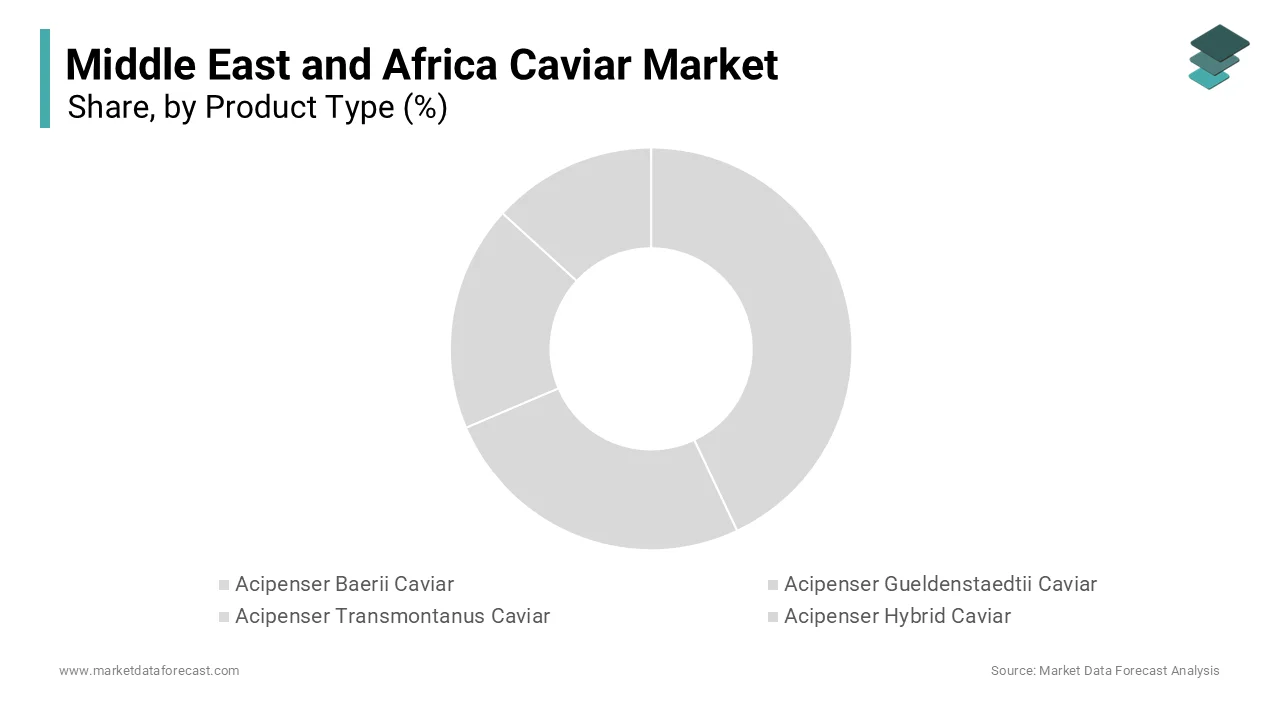
However, the acipenser hybrid caviar segment is the fastest-growing segment in the Middle East and Africa caviar market and is predicted to grow at a CAGR of 8.4% over the forecast period owing to the genetic optimization and superior production traits and selective breeding programs that combine desirable traits from different sturgeon species to reduce time to harvest. According to the Food and Agriculture Organization of the United Nations, the bester hybrid is produced from Huso huso and Acipenser ruthenus and has demonstrated early sexual maturity, with females capable of reaching maturity from approximately 6 to 7 years under suitable farming conditions. This reduced lifecycle allows farmers in South Africa and Egypt to respond more quickly to market demand fluctuations. The statistical reduction in capital lock-up periods makes hybrid caviar projects more attractive to private equity investors seeking shorter exit horizons. Additionally, hybrids often exhibit heterosis or hybrid vigor, resulting in improved disease resistance and feed conversion ratios. As per the Food and Agriculture Organization of the United Nations, hybridization can be used to combine desirable characteristics and improve adaptability in aquaculture species. These biological advantages lower production costs and increase overall yield. Consequently, the Middle East and Africa caviar market sees hybrid caviar as the future of sustainable profitability, enabling producers to scale operations rapidly while maintaining high quality standards.
By Application Insights
The restaurants segment had the largest share of the Middle East and Africa caviar market in 2025. The growth of the restaurants segment in this regional market can be attributed to the region’s robust luxury hospitality sector, the cultural importance of lavish dining experiences and the high concentration of five-star hotels and Michelin-recognized establishments that use caviar as a staple ingredient for garnishing and signature dishes. According to the Dubai Department of Economy and Tourism, Dubai welcomed 17.15 million international overnight visitors in 2023, representing a 19.4% year-on-year increase and supporting demand across the emirate's hospitality sector. These establishments procure caviar in bulk to ensure consistency across multiple outlets and banquets. The statistical volume of institutional procurement supports the importance of foodservice channels in the luxury food sector. Additionally, the tradition of hosting elaborate business dinners and social gatherings in the Gulf region necessitates the presence of luxury ingredients to demonstrate hospitality and status. As per the United Nations World Tourism Organization, the Middle East recorded international tourism recovery above pre-pandemic levels in 2023, supporting continued expansion of hospitality and luxury dining activity. This structural demand ensures that restaurants remain an important channel for caviar distribution. Consequently, the Middle East and Africa caviar market is anchored by the hospitality industry, which provides stable and predictable revenue streams through long-term supply contracts.
On the other end, the households segment is estimated to showcase the fastest CAGR of 10.3% over the forecast period owing to the growing disposable incomes and direct-to-consumer retail channels and increasing wealth among urban populations in Gulf countries and South Africa who are incorporating luxury foods into their daily lifestyles. According to the World Bank, Qatar and the United Arab Emirates recorded high levels of GDP per capita in 2023, supporting substantial purchasing power for premium consumer goods. This financial capacity allows families to purchase caviar for home entertainment and personal indulgence rather than relying solely on restaurant experiences. The statistical rise in high-net-worth individuals correlates with increased sales of small-format caviar tins in upscale supermarkets. Additionally, the growing expatriate population in cities like Dubai and Johannesburg brings diverse culinary habits that include regular caviar consumption. As per the World Bank, the United Arab Emirates and Qatar remain among the higher-income economies globally based on gross national income per capita, supporting demand for premium consumer products. This shift indicates a normalization of caviar as a household staple for the affluent. Consequently, the Middle East and Africa caviar market is expanding into the residential sector driven by economic prosperity and changing consumption patterns.
REGIONAL ANALYSIS
The Middle East and Africa region is likely to experience continued development in the global caviar market over the next few years because of state-led aquaculture investments and luxury hospitality growth. The UAE and South Africa are key hubs for production and consumption. According to the United Arab Emirates Ministry of Climate Change and Environment, a commercial sturgeon farm in Abu Dhabi has a maximum annual capacity of 35 tonnes of caviar and 700 tonnes of sturgeon meat, demonstrating established production capability in the region. This self-sufficiency strategy reduces import reliance. The statistical boom in tourism and fine dining creates robust institutional demand. As per the South African Department of Forestry, Fisheries and the Environment, aquaculture products are subject to formal import and export authorization requirements, demonstrating an established regulatory framework for commercial aquaculture trade. High-net-worth individuals drive retail sales. Consequently, the Middle East and Africa is transitioning from a pure importer to a significant producer and consumer in the global caviar landscape.
COMPETITIVE LANDSCAPE
The competition in the Middle East And Africa Caviar Market is characterized by a small number of specialized local producers competing against established international imports from Europe and Asia. Local players leverage their proximity to key luxury hospitality hubs in the Gulf and South Africa to offer fresher products and faster delivery times. However they face intense pressure from global brands that benefit from decades of heritage and recognition. Competitive intensity is moderate but rising as new entrants invest in aquaculture technology supported by government incentives for food security. Differentiation is achieved through sustainability claims halal certification and unique flavor profiles derived from local water conditions. Price competition is less significant than quality and provenance as the target demographic prioritizes exclusivity and status. Regulatory compliance with CITES remains a critical barrier that shapes the competitive landscape by limiting the number of qualified operators. This environment favors companies with strong technical capabilities and robust supply chain management skills.
Key Market Players
Some of the key players in the Middle East and Africa caviar market are
- Kaluga Queen
- Emirates Aqua Tech
- California Caviar Company
- Sterling Caviar
- Agroittica Lombarda
- Zeugma Caviar
- Coastal Bay Seafoods
- Avori Caviar
- American Pearl Caviar
- Al Ain Farms
- Russian Caviar House
Top Players in the Market
- Emirates Aqua Tech stands as a pioneering force in the Middle East And Africa Caviar Market by operating one of the largest land based sturgeon farms in the United Arab Emirates. The company utilizes advanced recirculating aquaculture systems to produce high quality Acipenser Baerii caviar that meets international sustainability standards. Recently the firm expanded its processing facility to include state of the art pasteurization equipment which extends shelf life and ensures consistent texture for export markets. This technological upgrade allows the company to supply premium hotels and retailers across the Gulf region with greater reliability. Their commitment to zero water discharge practices aligns with regional environmental goals enhancing brand reputation among eco conscious buyers. By focusing on local production they reduce dependency on imports and support national food security initiatives. These strategic moves solidify their position as a key domestic supplier driving the growth of the regional luxury seafood sector.
- Zeugma Caviar contributes significantly to the Middle East And Africa Caviar Market through its specialized focus on sustainable sturgeon farming in South Africa leveraging the country’s favorable climate and water resources. The company produces premium caviar from hybrid sturgeon species which mature faster than traditional varieties allowing for more efficient production cycles. Recently Zeugma launched a direct to consumer e commerce platform targeting affluent households in major African cities and international buyers seeking ethically sourced products. This digital expansion bypasses traditional intermediaries and increases profit margins while building brand loyalty. They also partnered with local culinary institutes to promote caviar usage in modern African cuisine creating new demand channels. Their adherence to strict CITES regulations ensures legal compliance and facilitates smooth exports to Europe and Asia. These actions enhance their visibility and accessibility in both local and global luxury food markets.
- Al Ain Farms plays a vital role in the Middle East And Africa Caviar Market by integrating caviar production into its diverse agricultural portfolio in the United Arab Emirates. The company leverages its extensive experience in desert agriculture to operate efficient sturgeon farms that contribute to the nation’s food diversification strategy. Recently Al Ain Farms introduced a line of halal certified caviar products specifically designed to appeal to local and regional Muslim consumers who prioritize religious compliance in luxury goods. This certification opens up new market segments previously hesitant to purchase caviar due to uncertainty about permissibility. They also collaborate with high end restaurants in Abu Dhabi and Dubai to create exclusive menu items featuring their caviar. These initiatives strengthen their brand identity as a culturally aligned and innovative producer in the regional luxury food landscape.
Top Strategies Used by Key Market Participants
Key players in the Middle East and Africa Caviar Market primarily employ vertical integration strategies to control every stage of production from breeding to processing and distribution. This approach ensures quality consistency and reduces reliance on external suppliers which is critical in regions with limited specialized infrastructure. Companies also focus heavily on sustainability certifications and halal compliance to differentiate their products in a market driven by ethical and religious considerations. Investing in advanced recirculating aquaculture technology allows producers to mitigate climate risks and optimize water usage in arid environments. Furthermore participants are expanding direct to consumer channels through e commerce platforms to capture higher margins and build brand loyalty among affluent households. Strategic partnerships with luxury hospitality groups ensure steady institutional demand while joint ventures with international experts help bridge technical expertise gaps. These combined tactics enable firms to navigate regulatory complexities and establish strong footholds in this niche but high value sector.
MARKET SEGMENTATION
This research report on the Middle East and Africa caviar market is segmented and subs egmented into following categories
By Product Type
- Acipenser Baerii Caviar
- Acipenser Gueldenstaedtii Caviar
- Acipenser Transmontanus Caviar
- Acipenser Hybrid Caviar
By Application
- Restaurants
- Households
By Region
- KSA
- UAE
- Israel
- rest of GCC countries
- South Africa
- Ethiopia
- Kenya
- Egypt
- Sudan
- rest of MEA