- Product Description Description
- Table of Contents TOC
- List of Table & Figure LOT
- Get Free Sample PDF Sample PDF
Market Size, 2025
$1.87 BnMarket Estimate, 2026
$2.24 BnMarket Forecast, 2034
$9.54 BnCAGR, 2026–2034
19.85%Executive Summary: Middle East and Africa Cloud-Based Contact Center Market
- Market Scope: Comprehensive Middle East and Africa cloud-based contact center industry analysis covering solution categories, organization sizes, vertical adoption sectors, regional leadership frameworks, and strategic competitive developments.
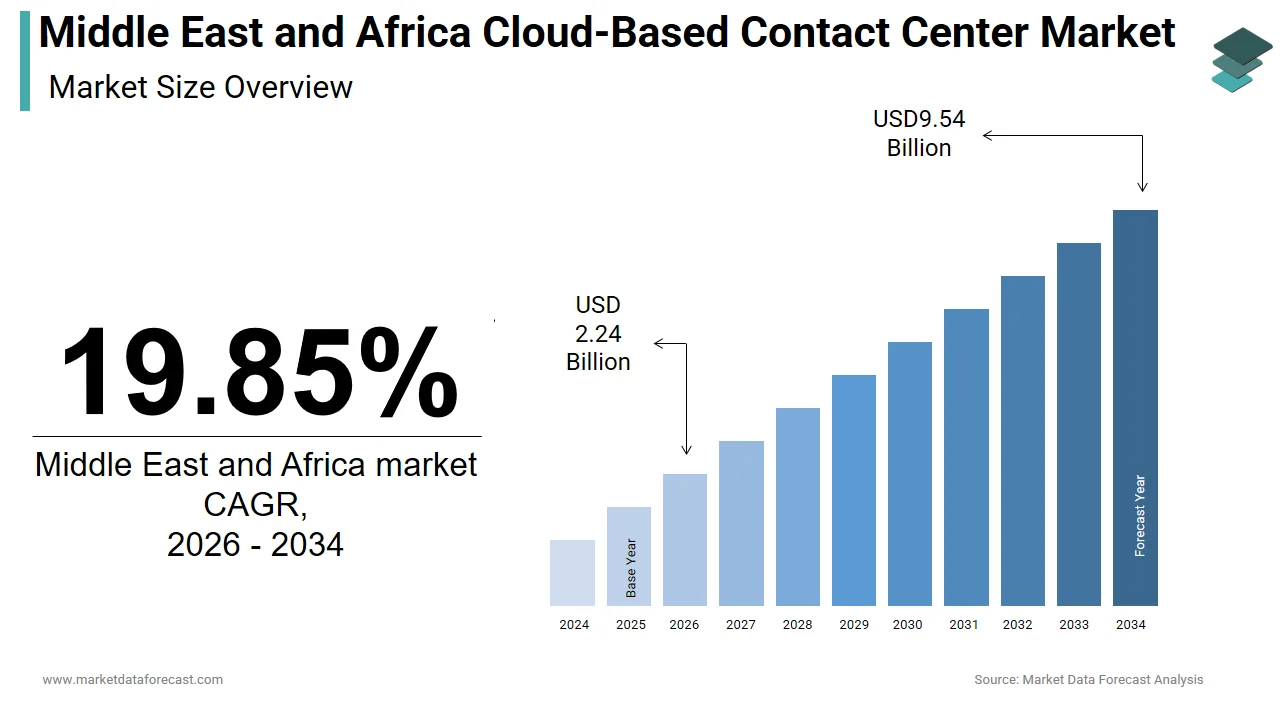
- Market Valuation: Valued at USD 1.87 billion (2025), estimated at USD 2.24 billion (2026), and projected to reach USD 9.54 billion by 2034, registering a robust CAGR of 19.85% (2026–2034).
- Primary Growth Drivers: E-commerce industry contributions to contact center development, cost-effectiveness of cloud solutions leveraging inexpensive skilled labor, service provider application suite expansions, and retail sector customer experience investments. Restraints include government pressure against offshore job elimination and data security concerns.
Key Market Segment Metrics (2026–2034)
| Category | Leading Segment (2025 Position) | Fastest-Growing / High-Growth Segment |
|---|---|---|
| By Solution Type | CTI solutions (projected to hold the largest market share among solutions) | Full application suites and omnichannel cloud tools |
| By Organization Size | Large enterprises (represent the largest segment due to demand for improved customer experience systems) | Scalable cloud architecture deployment across growing enterprises |
| By End-User Sector | Telecommunications, BFSI, retail, healthcare, and government sectors | E-commerce and retail-driven customer interaction platforms |
| By Region / Country | Middle East & Africa regional hubs | United Arab Emirates (expected to see a high-growth CAGR of 25.4% during the forecast period) |
Major Market Players & Market Structure
Market Structure: Fragmented and competitive regional ecosystem where key participants leverage extensive resources, AI capabilities, and technological expertise to maintain competitive positioning.
Key Companies: 8x8 Inc. (US), Five9 (US), Cisco Systems (US), Genesys (US), Oracle (US), NewVoiceMedia (UK), Connect First (US), Aspect Software (US), and 3CLogic (US).
Middle East and Africa Cloud-Based Contact Center Market Size
The size of the Middle East and Africa cloud-based contact center market was worth USD 1.87 billion in 2025. The MEA market is expected to be worth USD 9.54 billion by 2034 from USD 2.24 billion in 2026, growing at a CAGR of 19.85% from 2026 to 2034.
A cloud-based contact center is a digital customer service platform hosted on remote internet servers instead of physical office hardware. This ecosystem integrates artificial intelligence, workforce management, and omnichannel routing to serve diverse populations spanning from Morocco to Oman. As per the International Telecommunication Union, approximately 69.5% of individuals in the Arab States region use the internet, which expands the digital infrastructure necessary for widespread digital platform adoption. According to the World Bank, mobile cellular subscriptions in Sub-Saharan Africa reached approximately 83 per 100 people, accelerating regional telecommunications infrastructure expansion despite a distinct lag in fixed-line connectivity. Unlike traditional legacy systems, these cloud solutions enable businesses to scale agent capacity dynamically while supporting remote work models that are increasingly prevalent across the Gulf Cooperation Council nations. According to sources, the number of unique mobile subscribers in the Middle East and North Africa region reached 415 million, driving persistent commercial wireless connectivity growth. This market definition excludes generic software as a service and focuses specifically on real-time customer engagement technologies tailored for regional linguistic diversity, regulatory compliance, and varying bandwidth conditions across the continent.
MARKET DRIVERS
Accelerated Digital Transformation Initiatives Across Gulf Nations
Government-led digital transformation agendas are one of the reasons behind the growth of the Middle East and Africa cloud-based contact center market. Saudi Arabia Vision 2030 accelerates national connectivity through its national data center program valued at 18 billion dollars, incentivizing corporate migration to cloud-optimized infrastructure. As per the Communications, Space and Technology Commission of Saudi Arabia, the Kingdom achieved an overall internet penetration rate of 99%, driving extensive regional enterprise and government digital platform deployment. According to the Official Platform of the United Arab Emirates, the country achieved a score of 96.4 out of 100 in the ICT Development Index, expanding the structural reach of digital-first institutional public support channels. These national strategies mandate that public sector entities achieve full digitisation of citizen services by 2027, forcing agencies to implement scalable cloud contact solutions capable of handling Arabic and English interactions simultaneously. As per the Dubai Digital Authority, the digitization rate for government services reached 99.5%, yielding substantial public sector operational efficiency. Enterprises recognize that cloud-based architectures reduce capital expenditure by eliminating physical switchboards while providing the agility required to meet evolving regulatory digital service standards across multiple jurisdictions within the peninsula.
Expanding Mobile Penetration and Smartphone Adoption Rates
Widespread mobile connectivity fundamentally reshapes customer engagement expectations and drives the expansion of the Middle East and Africa cloud-based contact centre market. As per studies, 4G connectivity is projected to account for almost one in four mobile connections in Sub-Saharan Africa, establishing high-speed networks as the primary vehicle for regional telecom growth. The Alliance for Affordable Internet states that 1 gigabyte of prepaid mobile data costs an average of 7.12% of the average monthly salary across Africa, outlining a significant affordability hurdle for mass-market consumers. Also, the Communications Authority of Kenya reports that processed mobile money transactions reached a valuation of 41.68 trillion shillings, requiring robust digital support architectures for processing networks. Unlike Western markets where desktop usage remains significant, African consumers predominantly interact with brands through WhatsApp and USSD interfaces, requiring contact centers to deploy cloud platforms with native mobile channel integration. Organisations must adopt cloud architectures because traditional circuit-switched networks cannot handle the multimedia-rich interactions that mobile-first consumers now expect as standard service delivery.
MARKET RESTRAINTS
Inconsistent Fibre Optic Infrastructure Reliability
Unreliable backbone connectivity restricts the growth of the Middle East and Africa cloud-based contact center market. This severely constrains cloud contact centre performance across substantial portions of the African continent and hampers consistent service delivery. As per the International Telecommunication Union, fixed broadband subscriptions in Sub-Saharan Africa remain exceptionally low at less than 1 subscription per 100 people, forcing near-total enterprise reliance on mobile networks for commercial connectivity. The World Bank reports that three-quarters of firms in Sub-Saharan Africa experience regular power outages, losing an average of 8.3 per cent of their annual sales due to operational disruptions. As per the Alliance for Affordable Internet, landlocked African nations experience highly inflated transit and wholesale fiber access fees due to geographic isolation, driving up operating costs for local business communications. Even when fibre exists, last-mile connectivity often degrades significantly. According to the International Telecommunication Union, alternative last-mile connectivity technologies are expanding in secondary markets to resolve persistent latency and packet loss barriers for universal meaningful connectivity. Organizations attempting cloud migration frequently encounter abandoned implementations because underlying telecommunications infrastructure cannot sustain the continuous data flows necessary for real-time agent desktops and call recording systems without expensive redundant backup connections.
Data Sovereignty and Regulatory Compliance Complexities
Fragmented data protection regulations across jurisdictions in the region create significant legal barriers to unified deployments of these centers, which impede the expansion of the Middle East and Africa cloud-based contact center market. As per the United Nations Conference on Trade and Development, 33 African countries (61%) have successfully enacted comprehensive data protection and privacy legislation, establishing baseline rules for regional cloud ecosystems. As per the Saudi Data and AI Authority, the Personal Data Protection Law establishes rigorous regulatory safeguards and standard contractual clauses for transferring personal data outside the Kingdom's borders. The European Union General Data Protection Regulation continues influencing North African markets. According to the European Commission, cross-border data transfer flows between European corporations and North African business process offshoring markets rely heavily on localised data protection compliance models. As per the European Centre for International Political Economy, extraterritorial digital regulations force international businesses to establish complex data architectures to reconcile open, closed, or restrictive data transfer models across multiple jurisdictions. These regulatory divergences prevent economies of scale and force organizations to adopt hybrid models that undermine core cloud benefits of centralized management and resource pooling.
MARKET OPPORTUNITIES
Integration of Generative Artificial Intelligence for Multilingual Support
Generative artificial intelligence offers transformative opportunities for addressing linguistic diversity across the Middle East and Africa cloud-based contact center market. As per UNESCO, more than 1,000 languages are spoken across designated regional sites, representing a vast repository of localized cultural practices and linguistic heritage. Recent advances in large language models now enable real-time translation. According to ResearchGate, regional natural language processing models achieve up to 85% precision metrics when evaluating localized Arabic social media text, supporting expanding enterprise analytics capabilities. According to the Council for Scientific and Industrial Research, public adoption dynamics shape how lower-income demographics and workforce sectors navigate structural fourth industrial revolution technologies. Vendors offering pretrained models for Amharic, Swahili, and Hausa gain a competitive advantage in underserved markets where human bilingual talent remains scarce and expensive to retain at scale.
Rising Demand for Remote Work Enablement Infrastructure
Post-pandemic workforce preferences open new pathways for the Middle East and Africa cloud-based contact centre market. These centres perfectly support distributed agent models across the region. As per the International Labour Organization, enterprise models are adapting to technological transitions and shifting workplace structural formats across global regions. Cloud platforms eliminate geographic constraints, allowing employers to tap talent pools in lower-cost locations such as Jordan and Tunisia while serving premium markets in Dubai and Riyadh. According to the Egyptian Ministry of Communications and Information Technology, public-private partnerships focus directly on inclusive digital employment strategies to integrate workers with disabilities into localised tech roles. According to the Ministry of Human Resources and Social Development, labor-market modernization initiatives target public administration efficiency to optimize localized service delivery models. Cloud-based quality monitoring and screen recording ensure compliance regardless of agent location, addressing managerial concerns about remote productivity.
MARKET CHALLENGES
Cybersecurity Threat Landscape and Trust Deficits
Escalating cyberattacks targeting customer data erode confidence in cloud contact center solutions throughout the region, which holds back the growth of the Middle East and Africa market. As per Check Point Research, Africa experienced the highest global volume of digital threats, averaging 2,960 weekly cyberattacks per organization, which underscores severe system exposure. Cloud contact centres aggregate sensitive personally identifiable information, making them attractive targets for ransomware operators who understand that service disruption causes immediate revenue loss. According to the Saudi National Cybersecurity Authority, national cybersecurity regulations mandate strict controls to accelerate enterprise threat resilience and update legacy compliance cycles. Customer trust remains fragile. According to studies, digital personalization trends drive consumer interactions while shifting regional service requirements and data safety behavior. Many enterprises hesitate to migrate critical voice infrastructure to cloud environments, fearing loss of direct security control compared to on-premises deployments. Regional cloud providers struggle to obtain international certifications like ISO 27001 due to auditor shortages and documentation gaps, creating perception gaps even when actual security posture meets standards. Risk-averse industries handling sensitive citizen or financial data will remain slow to adopt these technologies. Adoption will only increase once stakeholders develop clear, demonstrable security assurance frameworks for regional threats.
Shortage of Specialised Technical Talent Pool
Critical skills deficits in cloud architecture and contact center engineering impede implementation velocity across the region, which limits the expansion of the Middle East and Africa cloud-based contact center market. As per the World Economic Forum, rapid generative artificial intelligence advances are reshaping labor market demand, accelerating high-skill instability and technical recruitment challenges. According to the Gulf Research Center, evolving regional geopolitical strategies and economic transformations alter how member states structure professional workforce localization goals. Existing workforce retraining programs fail to address the specialised intersection of telecommunications, networking, cloud platforms and customer experience design, creating persistent capability gaps. Salaries for qualified cloud contact centre architects command premiums above general IT roles, leading to intense competition and high turnover rates. Vendor partner ecosystems remain underdeveloped, with fewer accredited implementation partners serving entire Sub-Saharan Africa excluding South Africa. Educational institutions lack curriculum alignment. Talent scarcity will continue to bottleneck market expansion despite strong underlying demand signals. Growth will remain limited until coordinated industry-academia collaboration establishes standardised certification pathways and practical lab environments.
REPORT COVERAGE
| REPORT METRIC | DETAILS |
| Market Size Available | 2025 to 2034 |
| Base Year | 2025 |
| Forecast Period | 2026 to 2034 |
| Segments Covered | By Solution, Service, Application, Deployment Mode, Organization Size, Vertical, and Region. |
| Various Analyses Covered | Global, Regional, and Country-Level Analysis, Segment-Level Analysis, Drivers, Restraints, Opportunities, Challenges; PESTLE Analysis; Porter’s Five Forces Analysis, Competitive Landscape, Analyst Overview of Investment Opportunities |
| Countries Covered |
|
| Market Leaders Profiled | 8x8 Inc., Five9, Cisco Systems, Avaya, Genesys, Oracle, NewVoiceMedia, NICE, Connect First, Aspect Software, 3CLogic, and Others. |
SEGMENTAL ANALYSIS
By Solution Insights
The automatic call distribution segment was the largest in 2025 and occupied a commanding share of the Middle East and Africa cloud-based contact centre market. It serves as the non-negotiable operational backbone for regulated industries across the Gulf Cooperation Council. Financial institutions in Saudi Arabia and the United Arab Emirates must adhere to strict service level agreements mandated by central banks, which require precise call routing and queue management capabilities that only mature ACD platforms can guarantee. According to the Central Bank of the United Arab Emirates, financial consumer regulations impose mandatory consumer protection standards and operational risk requirements on all licensed operations to ensure market compliance. As per the Saudi Central Bank, online purchase conversion initiatives and embedded financial options reduced retail digital transaction cart abandonment rates by an average of 22%. According to the Dubai Financial Services Authority, regulatory frameworks enforce comprehensive capital requirements, risk-based operational supervision, and anti-money laundering controls on licensed institutions. Unlike optional analytics or security modules, ACD functionality represents table stakes for market entry, meaning every cloud contact centre implementation includes this component regardless of organisational maturity.
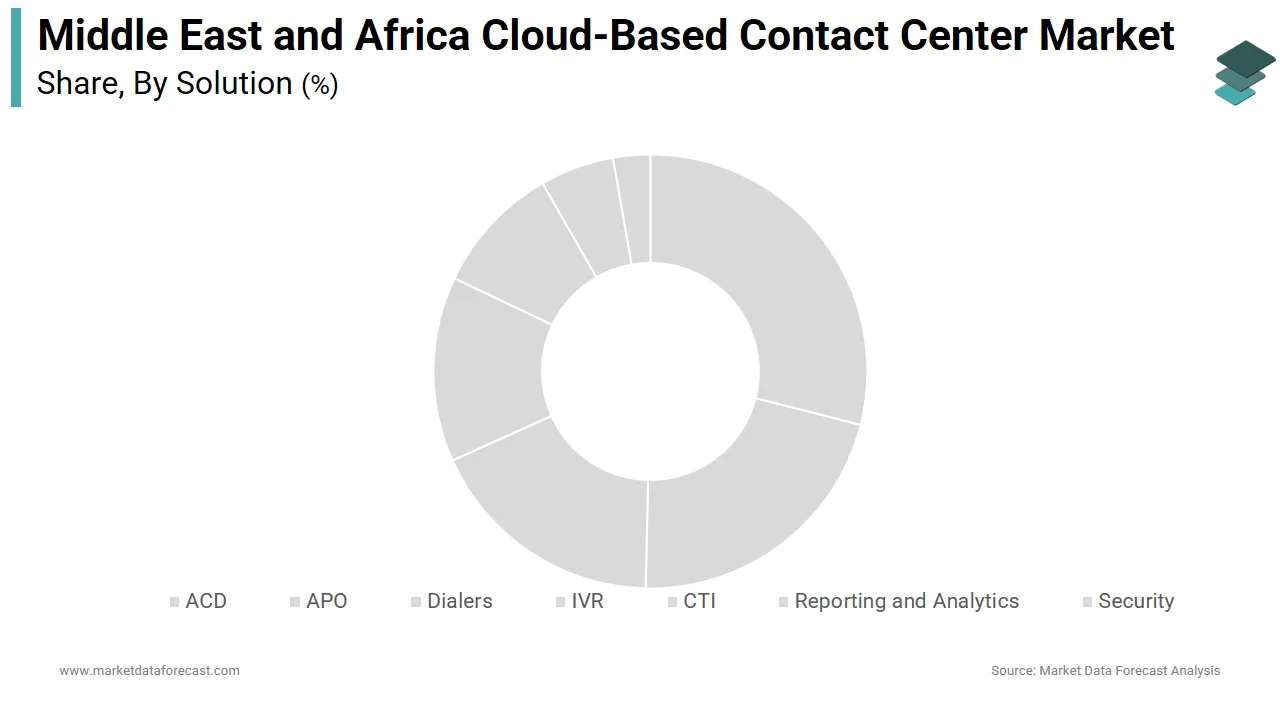
The transition from traditional private branch exchange systems to cloud architectures inherently prioritizes Automatic Call Distribution replacement as the first migration phase driving sustained segment dominance. Organizations typically retain existing IVR and reporting tools temporarily while immediately replacing hardware-based call routing with cloud ACD to achieve quick wins in operational flexibility. According to sources, approximately 72% of regional banking consumers now utilize mobile application interfaces as their primary transactional hub, accelerating corporate channel optimization. As per the World Bank, enterprise adoption of artificial intelligence architectures is restructuring information-access networks to expand service capacity across developing economies. The immediate performance improvement creates strong business case validation, encouraging broader solution stack expansion subsequently. Vendor pricing models further reinforce this pattern by bundling ACD as core platform capability while treating other solutions as add-ons, ensuring universal inclusion across all contract sizes and vertical segments throughout the region.
The Reporting and Analytics segment is likely to experience the fastest CAGR of 24.1% between 2026 and 2034 due to intensifying competitive pressure for customer experience differentiation. According to research, the expansion of cloud-powered analytics, artificial intelligence platforms, and risk-management networks is accelerating modern core infrastructure transitions. The exponential increase in omnichannel interaction data volumes makes manual analysis impossible, forcing organisations to adopt automated intelligence platforms capable of processing millions of conversation records daily. As per the African Development Bank, public technology programs focus on developing specialized digital competencies to bridge the gap between student education and immediate marketplace employment demand. Regional regulators increasingly mandate evidence-based service quality reporting. Cloud native analytics eliminate traditional data warehouse complexity, enabling mid-market companies to access enterprise-grade insights previously available only to large corporations.
The convergence of generative artificial intelligence with traditional reporting frameworks creates unprecedented value propositions, accelerating analytics segment growth beyond historical trends. According to studies, modern feedback analysis deployment focuses on unified sentiment processing across dozens of communication channels to unify customer information profiles. Natural language processing enables automatic categorisation of unstructured voice and text interactions, transforming qualitative feedback into quantifiable metrics at scale without manual tagging labour. As per IEEE Xplore, fine-tuned Arabic natural language processing models achieve an 83% precision metric and an 85% F1 score when automatically classifying sentiment on social media platforms. Cloud platforms continuously update AI models without requiring customer intervention, ensuring access to the latest capabilities unlike static on-premises systems.
By Service Insights
The professional services segment dominated the Middle East and Africa cloud-based contact center market and accounted for a substantial share in 2025. This dominance of the segment was driven by inherent technical complexity associated with migrating heterogeneous legacy environments to unified cloud platforms across diverse regulatory jurisdictions. Unlike standardised software deployments, contact centre transformations require extensive workflow redesign, integration with core banking or ERP systems, and compliance validation that cannot be accomplished through self-service mechanisms. As per sources, 82 percent of surveyed financial sector institutions prioritize core operational automation frameworks during structural cost optimization implementation phases. According to the Saudi Ministry of Communications and Information Technology, national digital transformation mandates focus on deploying automated collaboration architectures and supervisor frameworks to effectively bridge specialized enterprise cloud software skills gaps. As per the World Bank, enterprise deployment of artificial intelligence tools is restructuring core communication and information access networks across developing economies. Vendor ecosystems remain fragmented, with limited local expertise forcing reliance on global system integrators whose professional services engagements typically represent a notable portion of total contract value.
The necessity for extensive localization and cultural adaptation creates sustained professional services revenue streams that managed services alone cannot address effectively. Standard global cloud platforms require significant modification to support right-to-left Arabic interfaces, dialect-specific voice recognition, and Sharia-compliant financial workflows unique to Middle Eastern markets. As per UNESCO, regional technical development focuses on integrating indigenous language systems into global knowledge networks to bridge persistent cultural and digital access gaps. According to the Islamic Development Bank, regional technical funding initiatives focus on developing highly specialized technological competencies to expand regional marketplace employment opportunities. According to the Dubai Chamber of Commerce, corporate service frameworks are aligning with a 99.5% government service digitization rate to remove administrative friction across public sector transactions. Managed service providers typically lack deep domain expertise in regional nuances, creating a natural division of labour where professional services handle strategic customisation while managed services maintain operational stability.
The Managed Services segment is expected to exhibit a noteworthy CAGR of 21.3% during the forecast period owing to an enterprise focus on converting fixed labor costs to variable operational expenses amid economic uncertainty. According to sources, evolving retail personalisation trends are rapidly shifting consumer purchasing preferences and restructuring corporate engagement channels. The South African Reserve Bank enforces strict consumer grievance and regular data-handling compliance metrics across all licensed banking operations to manage structural risk. As per the International Labour Organization, youth unemployment across North Africa stood at approximately 22.8%, creating a major workforce mismatch where joblessness typically increases alongside formal educational attainment. Cloud vendors increasingly bundle managed services with platform subscriptions, creating frictionless procurement pathways that accelerate adoption velocity.
Strategic corporate refocusing toward differentiating capabilities rather than infrastructure management drives unprecedented managed services adoption across the Middle East and Africa. According to the Boston Consulting Group, rapid generative artificial intelligence advances are reshaping general workforce skills stability, causing acute organizational recruitment bottlenecks for more than 60% of modern businesses. Telecommunications operators increasingly outsource customer service to specialised managed providers while redirecting engineering talent toward network expansion and 5G deployment, creating structural demand shifts. As per the Gulf Research Center, shifting national strategic planning metrics and regional transformations alter how major sovereign member states enforce professional labor localization mandates. The African Development Bank targets strategic funding allocations toward human capital growth and structural educational programming to build sustained regional economic baseline capability. Cloud platform complexity continues increasing, making in-house expertise maintenance economically unviable for organizations lacking scale. This fundamental restructuring of organizational boundaries ensures managed services growth trajectory remains decoupled from broader economic cycles.
By Vertical Insights
In 2025, the Banking, Financial Services and Insurance segment held the majority share in the Middle East and Africa cloud-based contact center market, because stringent regulatory requirements make cloud contact center adoption compulsory. Central banks throughout the Gulf Cooperation Council mandate minimum digital service availability standards that legacy on-premises systems cannot reliably meet without prohibitive capital investment. According to the Central Bank of Bahrain, targeted regulatory updates promote high innovation capabilities by standardizing digital custody onboarding and consumer transaction rails. As per the Prudential Authority, operational risk principles mandate continuous data backup protocols and active system images to stabilize core financial architecture. According to the Islamic Financial Services Board, baseline prudential and conduct standards are structured to support the orderly growth of wealth creation and consumer assets under dual regulatory models. Regulatory penalties for service failures reach millions of dollars, making BFSI organisations least price sensitive and most committed to premium cloud contact centre deployments, ensuring segment revenue stability regardless of broader economic conditions.
Government-led financial inclusion programs across Africa create massive new customer bases requiring cloud-enabled support infrastructure, driving sustained BFSI segment growth. As per the World Bank, account ownership in Sub-Saharan Africa reached a penetration level of 55.60%, expanding consumer involvement within the formal digital banking economy. According to the African Development Bank, technical skills modernisation initiatives focus on developing advanced digital proficiencies to match evolving consumer service demand. Unlike mature Western markets where BFSI contact centre demand correlates with population growth, African markets experience multiplicative effects as previously unbanked populations enter the formal financial system.
The government and public segment is predicted to witness the highest CAGR of 26.3% from 2026 to 2034. This rapid growth is driven by comprehensive national digitization mandates across the Gulf Cooperation Council and North African nations. As per the Government Electronic and Mobile Services Maturity Index, Saudi Arabia achieved the top ranking across the Middle East and North Africa for its advanced digital government platforms. According to the World Bank, generative artificial intelligence deployments alter corporate and public interface structures by fundamentally reshaping user access to data platforms. The African Union Commission Digital Transformation Strategy accelerates cross-border investments across broadband data networks to expand regional data center availability and universal connectivity. Unlike private sector deployments subject to economic cycles, government cloud contact centre investments follow multi-year appropriation cycles, providing predictable growth visibility. Political leadership personally champions digital transformation initiatives, ensuring budget protection even during fiscal consolidation periods, making the government segment the most resilient growth driver.
Rising citizen expectations shaped by commercial digital experiences create a political imperative for government contact centre modernisation, driving fastest segment growth. According to studies, digital personalization trends drive modern consumer expectations and alter how public and private entities structure their service platforms. Social media amplification of service failures creates reputational risks that elected officials cannot ignore, making cloud contact centre investment politically rational beyond pure operational considerations. As per the World Economic Forum, macro-level public employment updates indicate that acute technical skills mismatches constrain over 60% of modern institutional operations. Younger demographics constituting the majority population in many MEA countries have zero tolerance for analogue government interactions, forcing rapid catch-up modernisation. This convergence of political, social and economic drivers ensures government segment growth velocity exceeds historically slower public sector technology adoption patterns observed in previous decades.
COUNTRY LEVEL ANALYSIS
Saudi Arabia Cloud-Based Contact Center Market Analysis
Saudi Arabia led the Middle East and Africa cloud-based contact centre market, capturing a 32.5% share in 2025. This leading position was attributed to unprecedented digital transformation spending in the public sector. Saudi Arabia Vision 2030 accelerates national connectivity through its national data center program valued at 18 billion dollars, incentivizing corporate migration to cloud-optimized infrastructure. As per the Communications, Space and Technology Commission of Saudi Arabia, the Kingdom achieved an overall internet penetration rate of 99%, driving extensive regional enterprise and government digital platform deployment. As per the Saudi Central Bank, operational risk principles mandate continuous data backup protocols and active system images to stabilize core financial architecture. Local content requirements under the National Industrial Development and Logistics Program incentivise vendors establishing data centers in the Kingdom and hiring Saudi nationals creating sustainable ecosystem advantages.
United Arab Emirates Cloud-Based Contact Center Market Analysis
The United Arab Emirates was the next prominent region in the Middle East and Africa cloud-based contact center market and accounted for a 23.9% share in 2025. This growth of the UAE’s market was driven by the highest per capita cloud contact center spending and the most mature vendor ecosystem in the region. The nation's strategic positioning as a global business hub creates disproportionate demand for multilingual, sophisticated customer engagement platforms serving international corporations establishing regional headquarters. According to the Dubai Digital Authority, the digitization rate for government services reached 99.5%, yielding substantial public sector operational efficiency. According to the Official Platform of the United Arab Emirates, the country achieved a score of 96.4 out of 100 in the ICT Development Index, expanding the structural reach of digital-first institutional public support channels. According to the Dubai Future Foundation, the Dubai Centre for Artificial Intelligence deploys targeted accelerator programs to integrate generative models across municipal service networks. Unlike the volume-driven Saudi market, UAE leadership stems from a sophistication premium with organisations willing to pay above regional averages for advanced capabilities, creating disproportionate revenue contribution relative to population size.
Israel Cloud-Based Contact Center Market Analysis
Israel occupies a significant share of the regional market due to the highest innovation intensity and the strongest domestic technology vendor presence despite a smaller absolute market size. The nation's mature startup ecosystem produces indigenous cloud contact centre solutions tailored for Hebrew, Arabic, and Russian-speaking populations, reducing dependence on global vendors. As per the Israel Innovation Authority, the entity's core annual budget typically operates at 1.8 billion shekels to systematically finance technological incubation and early-stage startup assistance across the high-tech sector. According to the Israel Innovation Authority, the country maintains an active ecosystem of more than 7,000 tech companies and startups, representing one of the world's most dense concentrations of per capita venture investment. According to ResearchGate, regional natural language processing models achieve up to an 85% F1 score when automatically classifying localized text sentiment, bolstering business analytics systems. Military veterans transitioning to the civilian workforce bring advanced technical skills, creating a talent advantage unavailable elsewhere in the region. The Ministry of Economy export promotion programs help Israeli vendors expand regionally, generating feedback loops improving domestic product offerings. Unlike Gulf markets driven by government spending, Israeli growth stems from private sector innovation and export orientation, creating different sustainability dynamics less vulnerable to oil price fluctuations or political cycles affecting neighboring countries.
South Africa Cloud-Based Contact Center Market Analysis
South Africa is also a key player in the regional market owing to the most developed telecommunications infrastructure and the deepest enterprise cloud adoption outside the Gulf region. The Financial Sector Conduct Authority monitors institutional compliance with the Treating Customers Fairly framework, which forces financial firms to implement auditable performance structures and recordkeeping evidence. According to the World Economic Forum, macro-level talent mismatch indices show that acute structural skills gaps constrain more than 60% of modern corporate and service transformations. According to the World Bank, high-scale sovereign digital modernisation programs valued at 18 billion dollars are expanding regional communication infrastructure networks. Unlike other African markets, South Africa possesses a mature system integrator ecosystem with local expertise reducing implementation risk. However, load-shedding electricity crises impose operational constraints requiring expensive backup power investments, adding to total cost of ownership. The Competition Commission investigations into telecommunications pricing create regulatory uncertainty affecting long-term planning, yet market fundamentals remain strongest in continental Africa, making South Africa an essential beachhead for vendors pursuing pan-African expansion strategies.
COMPETITIVE LANDSCAPE
Competition in the Middle East and Africa cloud-based contact center market exhibits intense fragmentation between global technology giants and emerging regional specialists, each pursuing distinct value propositions. Established vendors leverage comprehensive product portfolios and brand recognition yet struggle with the agility required for rapid localization demands across diverse jurisdictions. Regional players compete through superior cultural understanding, flexible pricing, and responsive support models tailored to local business practices despite narrower technological capabilities. Telecommunications operators increasingly enter the market, bundling cloud contact solutions with connectivity services, creating vertical integration threats to pure-play software vendors. Competition intensifies around artificial intelligence capabilities, with vendors racing to develop accurate Arabic and African language models as key differentiators. Price sensitivity varies dramatically between premium Gulf markets and cost-constrained African territories, forcing competitors to maintain multiple go-to-market strategies simultaneously. Talent acquisition represents a critical competitive battleground as specialized skills scarcity enables knowledgeable professionals to command significant premiums. Regulatory compliance expertise creates sustainable advantages since certification processes favor incumbents with established relationships and documented track records. Ultimately, success depends on balancing global scale efficiencies with hyperlocal responsiveness, creating high barriers for undifferentiated entrants lacking regional commitment or resources for sustained investment.
KEY MARKET PLAYERS
The leading companies operating in the Middle East and Africa cloud-based contact center market include:
- 8x8 Inc.
- Five9
- Cisco Systems
- Avaya
- Genesys
- Oracle
- NewVoiceMedia
- NICE
- Connect First
- Aspect Software
- 3CLogic
TOP PLAYERS IN THE MARKET
- Avaya maintains significant involvement in the Middle East and Africa cloud-based contact center market through extensive partnerships with regional telecommunications providers and system integrators. The company recently launched enhanced Arabic language support within its Experience Platform to better serve Gulf Cooperation Council clients requiring native dialect recognition. Avaya established a new technical training center in Riyadh during 2024 to develop local talent capable of deploying complex cloud architectures. This initiative strengthens their regional presence by reducing implementation timelines and improving customer satisfaction scores across Saudi Arabia and United Arab Emirates public sector engagements while addressing critical data sovereignty requirements through localized hosting options.
- Genesys contributes substantially to the Middle East and Africa cloud-based contact center market by providing AI-powered customer experience platforms tailored for multilingual environments. The company opened a dedicated innovation hub in Dubai during early 2025, focusing on generative artificial intelligence applications for Arabic and African languages. Genesys partnered with major South African financial institutions to deploy cloud native solutions supporting financial inclusion initiatives across underserved communities. These strategic actions demonstrate commitment to regional customization rather than generic global offerings while strengthening market position through localized research and development investments that address unique linguistic diversity and regulatory compliance challenges specific to Middle Eastern and African jurisdictions.
- NICE plays a vital role in the Middle East and Africa cloud-based contact center market through workforce engagement management and analytics solutions optimized for regional operational patterns. The company expanded its Cairo development center in late 2024, adding fifty engineers specializing in Arabic speech analytics and sentiment analysis capabilities. NICE collaborated with Egyptian government entities to implement cloud-based quality monitoring systems supporting national digital transformation objectives. This expansion strengthens regional delivery capacity while ensuring solutions meet local data residency requirements. Recent product enhancements include Sharia-compliant interaction recording features addressing specific needs of Islamic financial institutions operating across Gulf Cooperation Council nations and North African markets.
TOP STRATEGIES USED BY KEY MARKET PARTICIPANTS
Key players in the Middle East and Africa cloud-based contact center market prioritize localization strategies including Arabic language optimization and regional data center establishment to address sovereignty concerns. Companies form strategic alliances with local telecommunications operators and system integrators to navigate complex regulatory environments and access established distribution channels. Vendors invest heavily in regional talent development through training centers and university partnerships to overcome specialized skills shortages while building long-term ecosystem loyalty. Product portfolios undergo continuous adaptation, incorporating generative artificial intelligence trained on indigenous languages and culturally appropriate interaction models. Pricing structures shift toward flexible consumption-based models accommodating currency volatility and budget constraints prevalent across diverse African markets. Organizations pursue targeted acquisitions of niche regional specialists to accelerate market penetration and acquire localized intellectual property. Customer success teams embed within client organizations, providing hands-on change management support essential for successful cloud migrations in low-maturity environments. These multifaceted approaches reflect an understanding that winning requires deep contextual adaptation beyond simple translation of global offerings.
MARKET SEGMENTATION
This research report on the Middle East and Africa Cloud-Based Contact Center market has been segmented and sub-segmented based on the following categories.
By Solution
-
ACD
-
APO
-
Dialers
-
IVR
-
CTI
-
Reporting and Analytics
-
Security
By Service
-
Professional
-
Managed
By Application
-
Call routing and queuing
-
Data integration and recording
-
Chat quality and monitoring
-
Real-time decision-making
-
Workforce Optimization (WFO)
By Deployment Mode
-
Public cloud
-
Private cloud
-
Hybrid cloud
By Organization Size
-
Small and Medium-sized Enterprises
-
Large Enterprises
By Vertical
-
Banking, Financial Services, and Insurance
-
Consumer goods and retail
-
Government and public sector
-
Healthcare and life sciences
-
Manufacturing
-
Media and entertainment
-
Telecommunication and Information Technology Enabled Services
-
Others
By Region
-
Saudi Arabia
-
Egypt
-
UAE
-
Tunisia
-
Qatar
-
Morocco