- Product Description Description
- Table of Contents TOC
- List of Table & Figure LOT
- Get Free Sample PDF Sample PDF
Market Size, 2025
$0.42 BnMarket Estimate, 2026
$0.43 BnMarket Forecast, 2034
$0.53 BnCAGR, 2026–2034
2.75%Middle East and Africa Condensed Milk Market Size
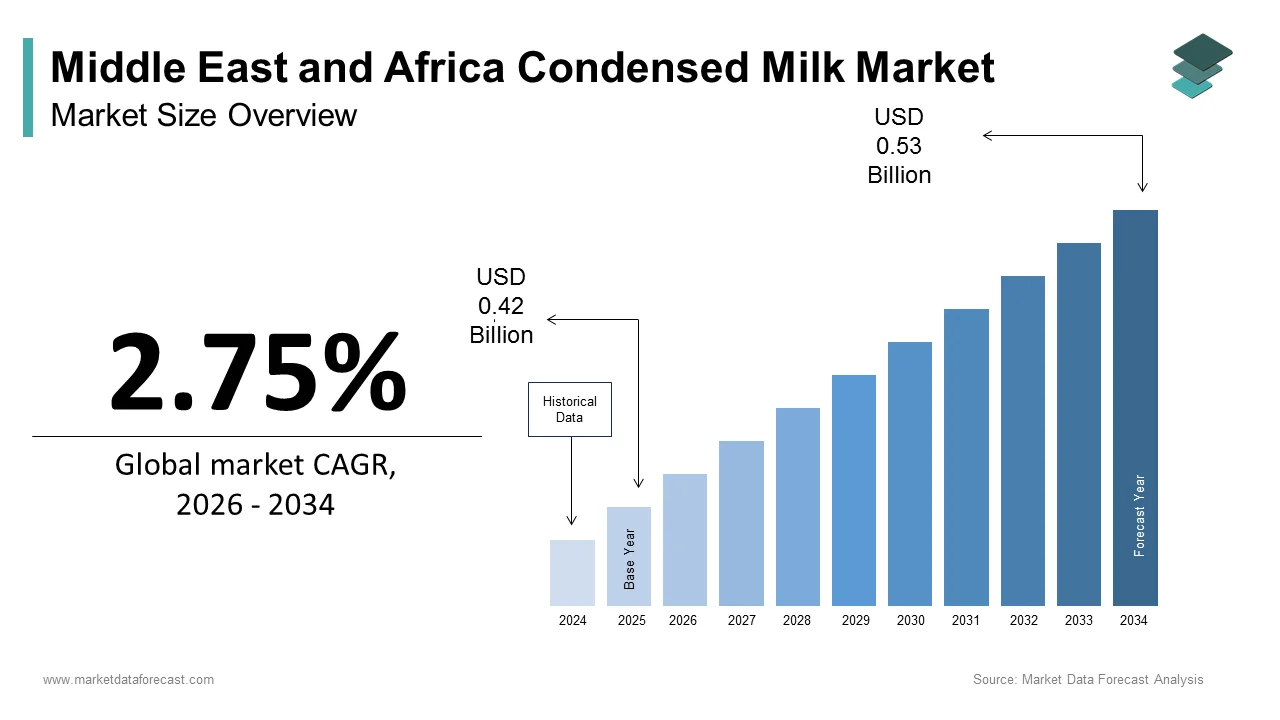
The size of the Middle East and Africa Condensed Milk Market was calculated to be USD 0.42 billion in 2025 and is anticipated to be worth USD 0.53 billion by 2034 from USD 0.43 billion in 2026, growing at a CAGR of 2.75% during the forecast period.
Condensed milk is generally milk from which water has been removed. It is generally found in the form of sweetened condensed milk, with sugar added. Sweetened condensed milk is a thick, sweet product which is canned. It can last for years without refrigeration if not opened. Condensed milk is used in various dessert dishes. An associated product is evaporated milk, which is prepared from a more complex process and is not sweetened. Evaporated milk is known in some parts of the world are known as unsweetened condensed milk.
The significant driver is Consumer preference, wide application and new recipes in bakery and confectionaries. Also change in lifestyles and rise in awareness of consumers regarding healthy eating habits, in developed and developing nations is boosting the industry. Also new improvements in the field of dairy and dairy products including biotechnological improvements are further expected to boost this industry. In addition, Growing market for health drinks and beverages is expected to limit the condensed milk market.
This research report on the Middle East and Africa Condensed Milk Market is segmented and sub-segmented into the following categories.
Middle East and Africa Condensed Milk Market By Type
- Sweetened
- Unsweetened
- Skimmed
- Part Skimmed
- Flavored
Sweetened condensed milk products has a major share in condensed milk market in 2017 because of its use in bakery and confectionary.
Middle East and Africa Condensed Milk Market By Application
- Foods
- Beverages
- Bakery
- Confectionary
- Personal & Beauty Care
Food and bakery is estimated to be the largest segment in Condensed Milk market in 2017.
Middle East and Africa Condensed Milk Market By Sales Channel
- Online Retailing
- Supermarkets/Hypermarkets
- Departmental Stores
- Retail Shops
Online Retailing is expected to have highest growth rate.
Middle East and Africa Condensed Milk Market By Region
- KSA
- UAE
- Israel
- rest of GCC countries
- South Africa
- Ethiopia
- Kenya
- Egypt
- Sudan
- Rest of MEA
Middle East and Africa has an untapped market and key players are slowly expanding to this region which is the main reason for the growth of market in this region.
KEY MARKET PLAYERS
Major Key Players in the MEA Condensed Milk Market are Nestlé S.A, The J.M. Smucker Company, GCMMF PVT LTD, Magnolia, Inc, Goya Foods, Inc, Olvebra Industrial, UAB, F&N Foods Pte Ltd, Meijer, Inc, Sun Hing Foods, Inc, and Meadow Gold Dairies