- Product Description Description
- Table of Contents TOC
- List of Table & Figure LOT
- Get Free Sample PDF Sample PDF
Market Size, 2025
$34.30 BnMarket Estimate, 2026
$36.70 BnMarket Forecast, 2034
$63.06 BnCAGR, 2026–2034
7%Middle East and Africa Flavours and Fragrances Market Size
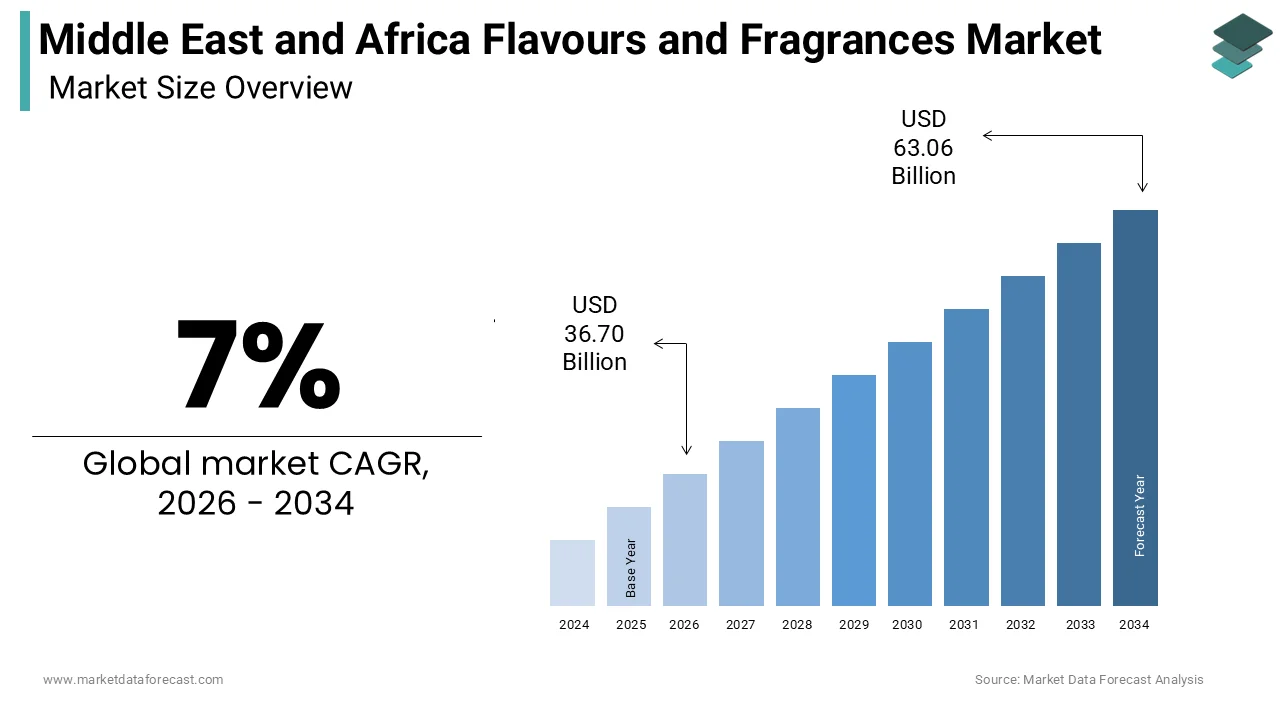
As per our analysis report, Middle East and Africa Flavours and Fragrances Market size was calculated to be USD 34.30 billion in 2025 and is anticipated to be worth USD 63.06 billion by 2034 from USD 36.70 billion In 2026, growing at a CAGR of 7% during the forecast period.
Flavour refers to the characteristic taste of a product like those of food and beverage items. Flavours are added to products to enhance or alter their tastes. Fragrance, on the other hand, implies compounds used to add a pleasant perfume or odour to products ranging from food products to cosmetics products, and even products like detergents.
MARKET DRIVERS AND RESTRAINTS
Heavy consumption of cosmetic products in the Middle East and African region is a driving factor for the fragrance industry whereas growth in the food and beverage industry sparked growth in the flavours industry. The market is driven by the growth in the consumption of personal care products across the area. Companies are trying to exploit this market by introducing a variety of products that are advertised to be non-synthetic and skin-friendly.
Flavours and Fragrances market industry is affected by volatile prices and alternatives. The Middle East and African region is one of the largest markets for Flavours and Fragrances but the Asian Pacific region is growing the fastest, and more growth can be expected in this locale.
Impact of COVID-19 on the Middle East and Africa Flavours and Fragrances Market
The COVID-19 global pandemic has affected severely the major and minor economies of the world. The flavours and fragrance industry witnessed a slump in demand during this period. As a result of that, production has dipped, and the industry witnessed a recession. Many production activities were put on hold during this period, as fragrances were not considered to be essential items and naturally were not given much importance during this time.
This research report on the Middle East and Africa Flavours and Fragrances market has been segmented and sub-segmented based on the following categories.
Middle East and Africa Flavours and Fragrances Market By Ingredients
- Synthetic
- Natural
Middle East and Africa Flavours and Fragrances Market By End-User
- Savory and Snacks
- Beverage
- Bakery
- Dairy Products
- Confectionery
- Consumer Products
- Fine Fragrances
Natural segment by ingredients in the Middle East and African flavours and fragrances market is segmented into various categories including essential oils and natural extracts. In addition to the aforementioned categories, they are further segmented into personal care, household care, and fine fragrances. The essential oils market segment is expected to lead the market during the forecasted period in terms of overall value. Increased adoption of natural fragrances over synthetic counterparts has triggered the growth of this industry.
By Application, Fine fragrance is the largest application industry. The growing penetration rate of fragrances as a luxury product in developing countries is driving the regional market in this application. It can be extensively applied as perfumes, colognes, and deodorants. This is a cardinal factor driving the fine fragrance industry.
Middle East and Africa Flavours and Fragrances Market By Country
- KSA
- UAE
- Israel and the rest of the GCC countries
- South Africa
- Ethiopia
- Kenya
- Egypt
- Sudan and the Rest of MEA
The Middle East and Africa is one of the largest markets for the Flavours and Fragrances industry thanks to the huge investments in the food and beverages sector. The importance to safe packaging has increased and plastics are becoming the second choice to Flavours and Fragrances. The population of the Middle East is at high risk of obesity, which is one of the leading avoidable causes of death in the region. Many are opting for healthy options, such as vegetarianism and veganism to avoid obesity, while others have converted to them out of a sense of responsibility toward living organisms. The developments in the local market have been exploiting the emerging food and beverage industries. Plant-derived vegan flavours in the food ingredients market have emerged as a growing opportunity for businesses dedicating operations for vegan products. Moreover, the rising vegan population in the countries remain the primary factor boosting the flavours industry.
Saudi Arabian food market is showing positive new trends towards the food and beverage industry. More people are adopting the fast-paced lifestyle that has changed their eating habits. The demand for dietary and frozen food has increased over time in the region which is driving the flavours market.
KEY MARKET PLAYERS
Firmenich SA, Givaudan SA, Balirom Ltd., Frutarom Industries Ltd., KATO FLAVORS & FRAGRANCES S.A.E, Nicola-J Flavours and Fragrances are some of the notable companies in the Middle East and Africa Flavours and Fragrances market.
RECENT HAPPENINGS IN THE MARKET
- In April 2018, Mane SA opened a new manufacturing site in Colombia to help the company bolster its position to serve customers in the Andean region better and capture growth opportunities in fragrance markets.
- In October 2017, Givaudan opened a new fragrance creative centre in Mexico City, Mexico. This was done to boost the company’s position in the North American region and to cater to local demands.
- International Flavours & Fragrances focused on mergers and acquisitions strategy and acquired Frutarom, which is one of the largest manufacturers in the segment. They also opened an ingredients plant in China to strengthen their existing presence in the region.