- Product Description Description
- Table of Contents TOC
- List of Table & Figure LOT
- Get Free Sample PDF Sample PDF
Market Size, 2025
$2.19 BnMarket Estimate, 2026
$2.33 BnMarket Forecast, 2034
$3.78 BnCAGR, 2026–2034
6.22%Middle East and Africa Glucose, Dextrose and Maltodextrin Market Size
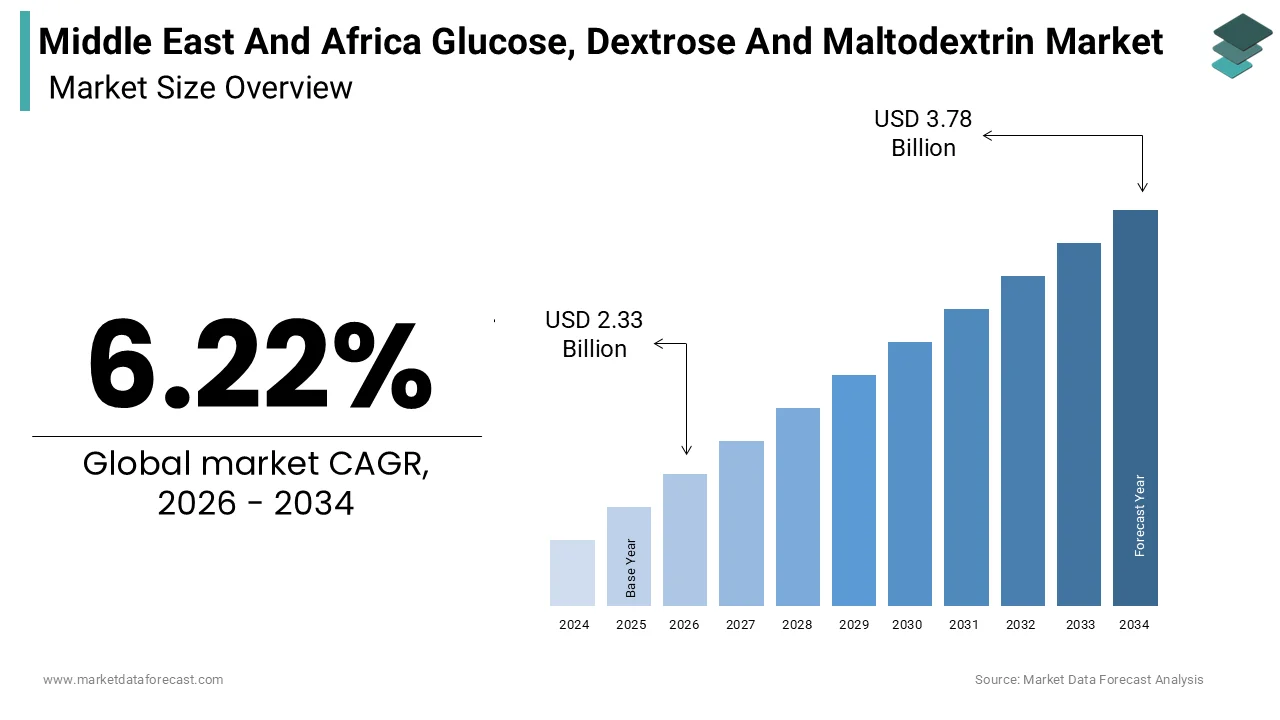
The Middle East and Africa Glucose, Dextrose and Maltodextrin Market size was calculated to be USD 2.19 billion in 2025 and is anticipated to be worth USD 3.78 billion by 2034 from USD 2.33 billion In 2026, growing at a CAGR of 6.22% during the forecast period.
Glucose, dextrose and maltodextrin are common ingredients in packaged and prepared foods. Glucose is table sugar; dextrose is another name for the common sugar, glucose with slight chemical variations. Maltodextrin is made from starch and retains many of starch’s chemical properties. All three are carbohydrates that affect your cells in similar ways and are used for the same things by the body.
Maltodextrin, very much like dextrose, comes from starch. It is essentially a polysaccharide, meaning it is made of many monosaccharide units, all of which are glucose units. Maltodextrin does not have a specific chemical formula; molecules of this substance can be made from two to upto 20 glucose units. Not as sweet as glucose, maltodextrin is sweeter than starch because the smaller molecules of maltodextrin can bind to the sweetness receptor much more effectively, though larger maltodextrin molecules cannot. It is used in food and beverages industry to impart both a starchy texture and slightly sweet flavour. Nutrition wise, like other sugars, maltodextrin contains four calories per gram.
Market Drivers
The major driver of the Middle East and Africa Glucose, Dextrose and Maltodextrin market is the rising demand for convenience food or packaged food and beverage products, which also includes the higher demand for carbonated and non-carbonated beverages. Other drivers include the intense research and developmental activities done by major companies in the market, higher disposable incomes and changing lifestyles.
Market Restraints
As for the restraints of the market, the production costs, investment needed for research and development and health concerns among consumers are the major ones.
Segmental Analysis
Middle East and Africa Glucose, Dextrose and Maltodextrin Market By Product
- Glucose
- Dextrose
- Maltodextrin
Middle East and Africa Glucose, Dextrose and Maltodextrin Market By Application
- Food and Beverages
- Pharmaceuticals,
- Personal Care/Cosmetics
- Paper and Pulp Industry
- Others
Middle East and Africa Glucose, Dextrose and Maltodextrin Market By Form
- Syrup
- Solids
Middle East and Africa Glucose, Dextrose and Maltodextrin Market By Region
- KSA
- UAE
- Israel
- Rest of GCC countries
- South Africa
- Ethiopia
- Kenya
- Egypt
- Sudan
- Rest of MEA
The region is the smallest market globally contributing the least to the total market revenue while also having a less than average growth rate. This is mainly due to the underdeveloped nature of many African countries. The major markets in the region are Morocco, South Africa, UAE, Saudi Arabia, Dubai, Qatar and Egypt.
Key Players in the Market
Major Key Players in the MEA Glucose, Dextrose And Maltodextrin Market are Archer Daniels Midland Company, Ingredion Incorporated, Agrana Investment Corp, Tate & Lyle PLC, Cargill Incorporated, Penford Corporation, Roquette Frères, Emsland-StÓ“rke Gmbh, Grain Processing Corporation, and Avebe U.A