- Product Description Description
- Table of Contents TOC
- List of Table & Figure LOT
- Get Free Sample PDF Sample PDF
Market Size, 2025
$0.50 BnMarket Estimate, 2026
$0.51 BnMarket Forecast, 2034
$0.59 BnCAGR, 2026–2034
1.8%Executive Summary: Middle East and Africa Hernia Mesh Devices Market
- Market Scope: Regional analysis of the Middle East and Africa (MEA) hernia mesh devices market encompassing product classifications, hernia types, country-level insights, and clinical treatment patterns.
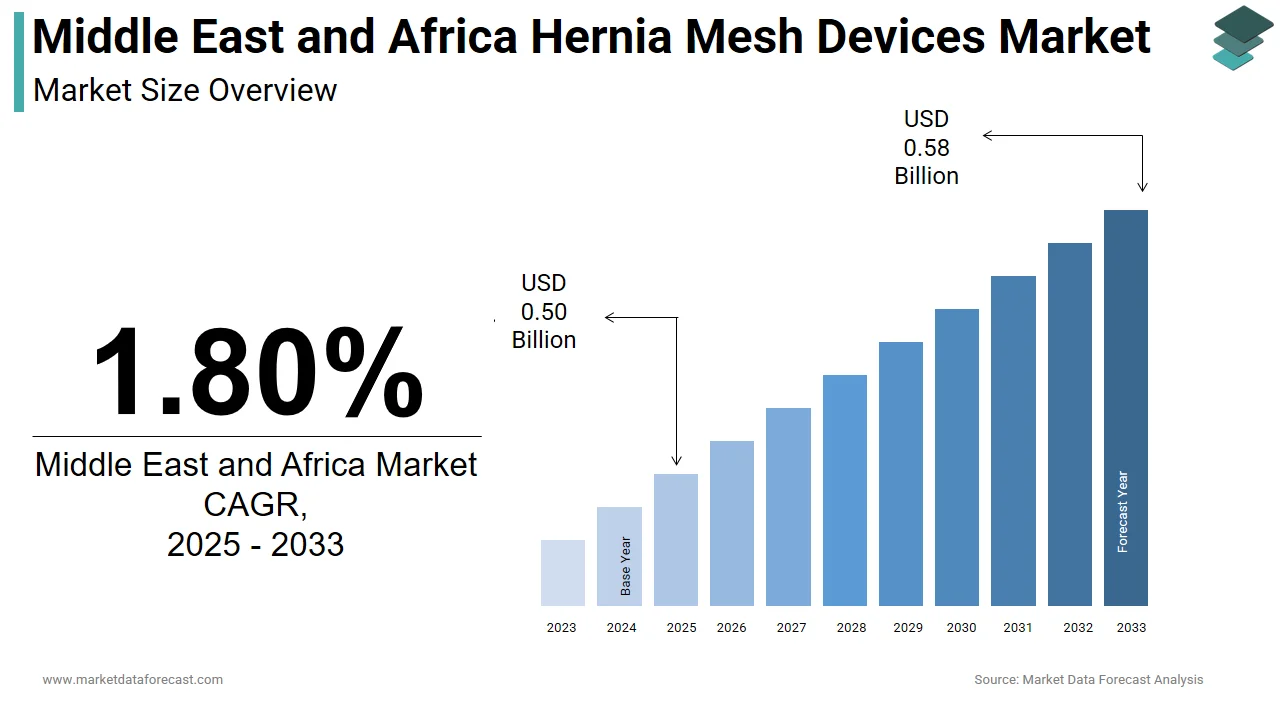
- Market Valuation: Valued at USD 0.50 billion in 2025, estimated at USD 0.51 billion in 2026, and projected to reach USD 0.59 billion by 2034, registering a steady CAGR of 1.80% from 2026 to 2034.
- Primary Growth Drivers: High prevalence of chronic disorders and abdominal wall hernias, rising aging demographics, increased consumer health and wellness spending, and technological advancements favoring minimally invasive surgeries.
Key Market Segment Metrics (2026–2034)
| Category | Leading Segment / Position | Key Segment Details |
|---|---|---|
| By Hernia Type | Inguinal Hernia | Accounts for the highest risk and occurrence rate among populations (particularly men), alongside Umbilical, Hiatal, Femoral, and Incisional types. |
| By Product Type | Synthetic Mesh (Flat & 3D) & Biologic Mesh | Widespread utilization of synthetic options for durability and cost-effectiveness, alongside advanced biologic alternatives for enhanced biocompatibility. |
| By Country / Region | South Africa (Regional Leader) | Led by advanced healthcare amenities and higher wellness spending; followed by steady growth in the UAE, Saudi Arabia (KSA), and Israel. |
Major Market Players & Market Structure
Market Structure: Dominated by global medical technology leaders focusing on product versatility, safety profiles, and expanding surgical options across emerging healthcare infrastructure in the MEA region.
Key Companies: Medtronic, Ethicon, Inc. (Johnson & Johnson), C.R. Bard, Inc., Atrium, W.L. Gore & Associates, Lifecell Corporation, and B. Braun Melsungen AG.
Middle East and Africa Hernia Mesh Devices Market Size
The size of the Middle East and Africa hernia mesh devices market was worth USD 0.50 billion in 2025. The regional market is anticipated to grow at a CAGR of 1.80% from 2026 to 2034, reaching USD 0.59 billion by 2034, up from USD 0.51 billion in 2026.
MARKET DRIVERS
Rising Chronic Diseases and Hernia Cases Driving Demand
Increasing the incidence of chronic diseases among the countries of the Middle East and African regions is expected to favor the market to grow. 27% to 43% of men and 3% to 6% of women are at higher risk with inguinal hernia, as per the International Journal of Abdominal Wall and Hernia Surgery. Key players focus on manufacturing new devices in the medical field to satisfy the patient's needs and flourish the market during this region's forecast period. Around 20 million prosthetic meshes are implanted every year, and 18.5 million people are affected by inguinal, femoral, and abdominal hernias, of which 59,800 lost their lives, and significant cases are hernia inguinal in 2015, according to the CDC.
MARKET RESTRAINTS
Stringent Regulations and High Surgery Costs
Strict rules and regulations made for the acceptance of the products and accessibility of substitute techniques for hernia repair damage are obstructing the market growth in the region during the analysis period. Also, difficulties arise due to the mesh's failure, and post-treatment, which gives an outcome of chronic pains, may restrain the hernia mesh devices market growth in the region. The high cost of the surgeries may also restrict the market.
REPORT COVERAGE
| REPORT METRIC | DETAILS |
| Market Size Available | 2025 to 2034 |
| Base Year | 2025 |
| Forecast Period | 2026 to 2034 |
| Segments Covered | By Hernia Type, Product Type, and Region. |
| Various Analyses Covered | Global, Regional and Country-Level Analysis, Segment-Level Analysis, Drivers, Restraints, Opportunities, Challenges; PESTLE Analysis; Porter’s Five Forces Analysis, Competitive Landscape, Analyst Overview of Investment Opportunities |
| Countries Covered | Brazil, Mexico, Argentina, Chile, Rest of Latin America |
| Market Leaders Profiled | Medtronic (U.S.), Ethicon, Inc. (U.S.), C.R. Bard, Inc. (U.S.), Atrium (Sweden), W.L. Gore & Associates (Germany), Lifecell Corporation (U.S.), and B. Braun Melsungen AG (Germany). |
REGIONAL ANALYSIS
Geographically, the high occurrence of cases involving hernia damage leads to increasing demand for hernia mesh devices, which is expected to drive the market growth. Raising awareness, coupled with the growing preference for hernia mesh by consumers and surgeons, is expected to promote market growth in the region.
South Africa is predicted to lead the Middle East and Africa market during the forecast period with a considerable share in the region. The availability of developed healthcare amenities and the rise in expenses by single towards health and wellness and surging discretionary costs fuel the market growth in the area. Quick approval of stress-free repairing processes, advancements in technology like robotic surgeries, and the frequent rise of obesity cases due to an unhealthy diet boost the hernia mesh devices market growth further in Middle East and Africa. Moreover, increasing senior citizens population with prominent hernia cases is accelerating the market growth.
UAE and Saudi Arabia are predicted to have constant growth with the launch of new products, the quick recovery process, and meshes' availability in different sizes and shapes are propelling the development further.
KEY MARKET PLAYERS
Noteworthy companies leading the Middle East and Africa Hernia Mesh Devices Market are Medtronic (U.S.), Ethicon, Inc. (U.S.), C.R. Bard, Inc. (U.S.), Atrium (Sweden), W.L. Gore & Associates (Germany), Lifecell Corporation (U.S.), and B. Braun Melsungen AG (Germany).
MARKET SEGMENTATION
This research report has been segmented and sub-segmented into the following categories:
By Hernia Type:
- Inguinal
- Umbilical
- Hiatal
- Femoral
- Incisional
By Product Type:
- Synthetic Mesh
- Flat Mesh
- 3D Mesh
- Biologic Mesh
By Country:
- KSA
- UAE
- Israel
- rest of GCC countries
- South Africa
- Ethiopia
- Kenya
- Egypt
- Sudan
- rest of Middle East and Africa