- Product Description Description
- Table of Contents TOC
- List of Table & Figure LOT
- Get Free Sample PDF Sample PDF
Market Size, 2025
$4.90 BnMarket Estimate, 2026
$5.20 BnMarket Forecast, 2034
$8.37 BnCAGR, 2026–2034
6.13%Middle East and Africa Industrial Boilers Market Research Report: Size, Share, Trends & Forecasts (2026–2034)
- Market Scope: Comprehensive Middle East and Africa (MEA) industrial boilers market analysis covering system types (Fire Tube and Water Tube), key industrial applications, product capacities (BHP ranges), fuel types (Gas, Coal, and Oil), and country-level breakdowns across the GCC, South Africa, North Africa, and the wider region.
- Market Valuation: Valued at USD 4.90 billion in 2025, estimated at USD 5.20 billion in 2026, and projected to reach USD 8.37 billion by 2034, registering a solid CAGR of 6.13% during the forecast period from 2026 to 2034.
- Primary Growth Drivers: Stricter environmental compliance forcing industries to curb emissions, optimization of combustion efficiency via enhanced oxygen distribution, and rising energy-efficient heating adoption across expanding industrial sectors.
Key Middle East and Africa Industrial Boilers Market Segment Metrics (2026–2034)
| Category | Leading Segment / Options Covered | Focus / Growth Driver |
|---|---|---|
| By Type | Fire Tube and Water Tube industrial boilers | Water tube systems suited for high-capacity power/refining needs; fire tube options favored for cost-effective, smaller-scale utility. |
| By Application | Refineries, Primary Metal, Chemical, and Food processing | Heavy process manufacturing and oil & gas sectors requiring constant, heavy-duty steam generation. |
| By Product (Capacity) | 10BHP-150BHP, 151BHP-300BHP, and 301BHP-600BHP | Scalable specifications to fit diverse industrial plant output footprints. |
| By Fuel Type | Gas, Coal, and Oil | Natural gas dominance supported by regional resource availability, alongside alternative biomass bedding upgrades. |
| By Country / Region | KSA, UAE, Israel, Rest of GCC, South Africa, Ethiopia, Kenya, Egypt, Sudan, and Rest of MEA | GCC economic zones and South Africa lead regional demand driven by infrastructure buildouts and energy investments. |
Major Industrial Boilers Industry Players & Competitive Landscape
Market Structure: Highly competitive international environment featuring leading global power equipment suppliers and engineering firms specializing in high-efficiency, lower-emission thermal systems.
Key Companies: Babcock & Wilcox Enterprises, Inc. (U.S.), Dongfang Electric Corporation Ltd. (China), Siemens AG (Germany), General Electric (U.S.), AC Boilers S.p.a. (Europe), Bharat Heavy Electricals Limited (India), Harbin Electric Group (China), IHI Corporation (Japan), Mitsubishi Hitachi Power Systems, Ltd. (Japan), and Thermax Limited (India).
 Download Free Sample Report
Middle East and Africa Industrial Boilers Market Size
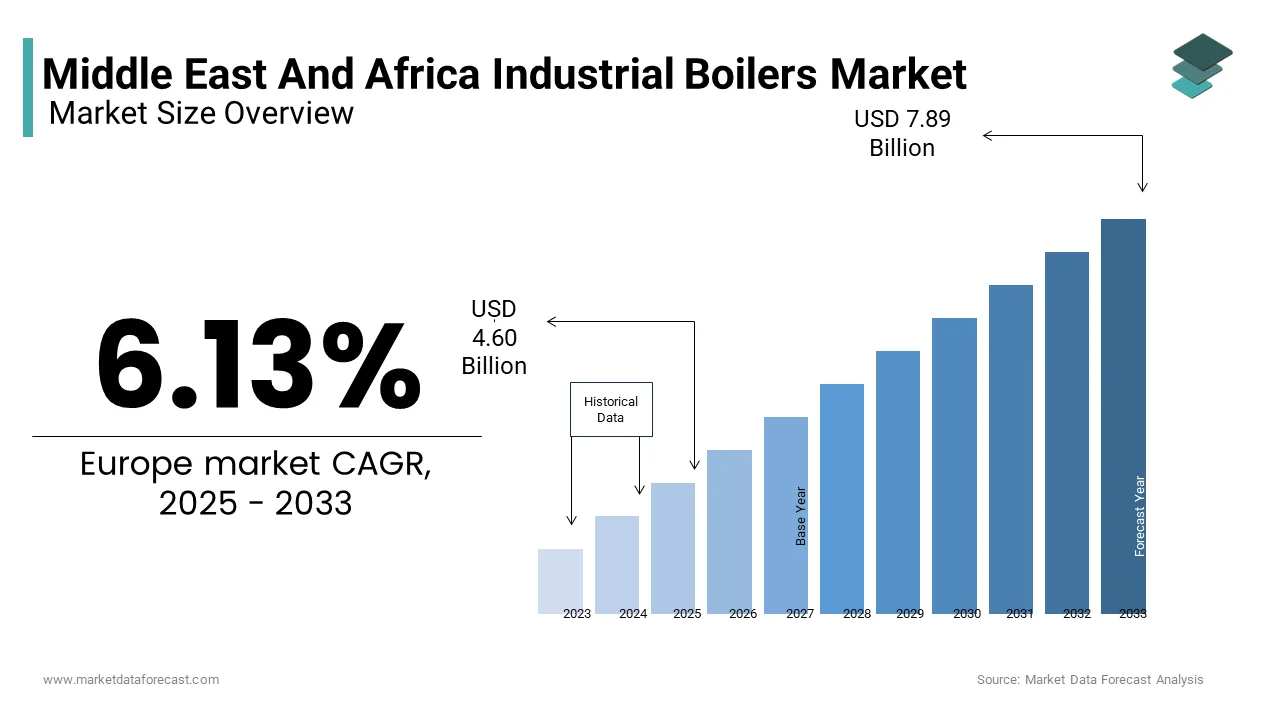
The Middle East and Africa industrial boilers market size was valued at USD 4.90 billion in 2025 and is anticipated to reach USD 5.20 billion in 2026, from USD 8.37 billion by 2034, growing at a CAGR of 6.13% during the forecast period from 2026 to 2034.
Current Intro Definition of the Middle East and Africa Industrial Boilers Market
The industrial boilers are high-capacity thermal generation systems engineered specifically for extreme ambient temperatures, saline water conditions, and diverse fuel infrastructures ranging from associated gas in Gulf hydrocarbon basins to biomass and coal in Sub Saharan manufacturing zones. Unlike standardized global products, equipment deployed across this region requires specialized metallurgy, enhanced cooling systems, and corrosion resistant coatings to withstand operational environments where summer temperatures routinely exceed 50 degrees Celsius and feedwater salinity can surpass 45000 parts per million. Furthermore, data from the Gulf Petrochemicals and Chemicals Association indicates that GCC industrial boiler installations are integrated with desalination or district cooling infrastructure by creating unique system interdependencies absent in other global markets.
MARKET DRIVERS
Petrochemical and Refining Capacity Expansion Across Gulf States
The national economic diversification programs are driving unprecedented expansion in downstream petrochemical and refining capacity, directly generating demand for large scale industrial boilers as integral components of new integrated industrial complexes. The petrochemical and refining capcity expansion across gulf states is levelling up the growth of the Middle East and Africa industrial boilers market. According to the study, active petrochemical projects across Saudi Arabia, UAE, Qatar, and Oman represent combined capital expenditure exceeding 185 billion dollars, with each major facility requiring multiple high pressure steam boilers ranging from 100 to 400 tons per hour for process heating, distillation, and hydrogen production. The Abu Dhabi National Oil Company commissioned three new ethane cracker trains at Ruwais Industrial Complex in 2024, each requiring auxiliary boiler systems totaling 180 megawatts thermal capacity for startup and emergency operations. These state led mega projects operate on multi decade investment horizons insulated from short term commodity price volatility by ensuring sustained boiler demand aligned with national industrial transformation timelines rather than cyclical signals. The concentration of such projects within geographic clusters further amplifies demand through shared utility infrastructure requirements and standardized specification frameworks adopted across multiple developments.
Local Manufacturing Growth Under AfCFTA Framework
The operationalization of the African Continental Free Trade Area is catalyzing distributed industrial development is accelerating the growth of the Middle East and Africa industrial boilers market. According to the Report, intra African trade in manufactured goods increased by 18% in 2024, with food processing, textiles, and building materials sectors showing highest growth rates and corresponding thermal energy requirements. As per the Ethiopia’s Industrial Parks Development Corporation, tenant occupancy in Hawassa and Bole Lemi parks reached 92% in 2024, with boiler installations growing proportionally as garment and leather processing units scaled production. This geographically dispersed demand pattern differs fundamentally from Gulf mega project concentration, favoring modular standardized boiler designs adaptable to varying fuel qualities and maintenance capabilities across diverse national contexts.
MARKET RESTRAINTS
Feedwater Quality and Salinity Induced Corrosion Challenges
The pervasive feedwater quality issues impose severe engineering constraints on industrial boiler design and operation, significantly increasing capital costs and reducing asset lifespans compared to temperate region equivalents that is declining the growth of the Middle East and Africa industrial boilers market. According to the research, industrial facilities relying on seawater derived feedwater experience tube failure rates 3.2 times higher than global averages despite advanced pretreatment. The industrial boilers in KwaZulu Natal and Eastern Cape provinces operate with feedwater total dissolved solids due to municipal supply inconsistencies, forcing operators to implement continuous blowdown regimes that waste few generated steam and increase fuel consumption proportionally. Egypt’s Holding Company for Water and Wastewater reported that industrial customers in Alexandria and Port Said face seasonal salinity spikes during Nile low flow periods, requiring redundant demineralization trains and premium alloy specifications that add to boiler system capital costs. These water chemistry challenges create persistent operational friction that suppresses thermal efficiency, elevates maintenance expenditures, and discourages adoption of high efficiency condensing technologies sensitive to contaminant ingress, thereby constraining market development toward more robust but less efficient conventional designs.
Skilled Technical Workforce Deficits Across Region
The chronic shortage of qualified boiler technicians, welders, water treatment specialists, and combustion engineers creates systemic implementation hurdles that degrade equipment performance, extend commissioning timelines, and increase safety risks independent of technology sophistication or capital availability. The skilled technical workforce deficits is also declining the growth of the Middle East and Africa industrial boilers market. According to the study, only 14 training institutions across 16 member states offer accredited industrial boiler operation courses, graduating fewer than 400 qualified technicians annually against estimated replacement demand exceeding 2800 positions. Even in Gulf states with extensive expatriate labor forces, Saudization and Emiratization policies have created transitional skill gaps as knowledge transfer from retiring foreign experts to national workforces remains incomplete.
MARKET OPPORTUNITIES
Waste Heat Recovery Integration in Energy Intensive Industries
The integration of waste heat recovery systems with existing industrial boiler infrastructure to capture economic and environmental value is likely to pose new opportunities for the growth of the Middle East and Africa industrial boilers market. According to the Study, Saudi Arabian cement, steel, and petrochemical facilities discard an estimated 48 terawatt hours of recoverable waste heat annually, equivalent to 14% of national industrial primary energy consumption and representing addressable resource for supplementary steam generation or power production. The industrial energy efficiency projects in North and West Africa, with waste heat boiler integration comprising highest funded category due to demonstrated bankability and rapid return profiles. This circular thermal economy approach transforms boilers from standalone fuel consumers into nodes within integrated energy systems, creating differentiated value propositions beyond simple heat generation.
Hybrid Solar Thermal and Fossil Fuel Boiler Systems
The deployment of hybrid solar thermal and conventional boiler systems to reduce fossil fuel consumption and operating costs, while preserving dispatchable thermal supply essential for continuous industrial processes that cannot tolerate intermittency. The hybrid solar thermal and fossil fuel boiler systems is also to elevate the growth of the Middle East and Africa industrial boilers market.. Morocco’s Noor Ouarzazate complex integrated 15 megawatts thermal of parabolic trough solar field with existing phosphate processing boilers in 2024, achieving 22% annual fuel displacement while maintaining 99.4% process reliability through automated fossil backup switching during cloud transients and nighttime operation. Namibia’s Green Hydrogen Strategy explicitly incorporates solar thermal preheating for ammonia synthesis boilers by reducing electrolyzer electricity demand and improving overall green hydrogen production economics. This hybridization strategy addresses fundamental tension between decarbonization aspirations and reliability requirements in regions.
MARKET CHALLENGES
Extreme Ambient Temperature Derating Effects
The persistent extreme ambient temperatures fundamentally alter industrial boiler thermodynamics, causing significant output derating and efficiency degradation is a major challenge for the growth of the Middle East and Africa industrial boilers market. According to the study, Middle East and North Africa industrial zones experience more than 120 days annually with ambient temperatures exceeding 40 degrees Celsius, conditions under which conventional forced draft fans deliver 12 to 18% less mass airflow due to reduced air density, directly limiting combustion capacity and steam output unless equipment is physically oversized or equipped with inlet air cooling systems. Saudi Electricity Company’s 2024 Generation Performance Report documented that industrial boilers in Eastern Province experienced average capacity loss during summer months compared to winter baseline, requiring installation of evaporative inlet coolers consuming 8 to 12 cubic meters of treated water per hour per unit to restore nameplate ratings by adding parasitic load that offsets partial efficiency gains. These thermodynamic penalties create hidden cost multipliers that distort procurement decisions toward nominally cheaper but undersized equipment, resulting in chronic underperformance and accelerated degradation as units operate continuously at maximum derated capacity.
Currency Volatility and Foreign Exchange Access Constraints
The severe currency depreciation and foreign exchange rationing create unpredictable cost structures and supply chain disruptions that delay boiler projects is also to impede the growth of the Middle East and Africa industrial boilers market. The planned industrial boiler rehabilitation projects were suspended in 2024 due to inability to secure letters of credit, leaving aging assets in deteriorating condition and increasing safety risks, as per the study. Even in relatively stable countries like Kenya, Central Bank’s 2025 Foreign Exchange Reserves Monitor showed import cover declined to 3.8 months by prompting prioritization guidelines that deprioritized industrial equipment behind fuel and pharmaceuticals by creating allocation uncertainty that complicates multi-year project planning. This monetary instability transforms boiler procurement from technical optimization exercise into financial risk management challenge, suppressing demand and distorting technology selection toward locally available or barter accessible options regardless of long-term suitability.
REPORT COVERAGE
| REPORT METRIC | DETAILS |
| Market Size Available | 2025 to 2034 |
| Base Year | 2025 |
| Forecast Period | 2026 to 2034 |
| CAGR | 16.73% |
| Segments Covered | By Type, Application, Product, Fuel, and Region. |
| Various Analyses Covered | Global, Regional & Country Level Analysis, Segment-Level Analysis, DROC, PESTLE Analysis, Porter’s Five Forces Analysis, Competitive Landscape, Analyst Overview of Investment Opportunities |
| Regions Covered | North America, Europe, APAC, Latin America, Middle East & Africa |
| Market Leaders Profiled | Babcock & Wilcox Enterprises, Inc. (U.S.), Dongfang Electric Corporation Ltd. (China), Siemens AG (Germany), General Electric (U.S.), AC Boilers S.p.a. (Europe), Bharat Heavy Electricals Limited (India), Harbin Electric Group (China), IHI Corporation (Japan), Mitsubishi Hitachi Power Systems, Ltd. (Japan), Thermax Limited (India) and Others. |
SEGMENTAL ANALYSIS
By Type Insights
The Water tube boilers held the largest share of the Middle East and Africa industrial boilers market in 2025 with the superior suitability for high pressure steam generation, large capacity requirements, and integration with combined cycle power plants that dominate regional industrial infrastructure. This region’s industrial structure where petrochemical complexes, refineries, and desalination facilities require steam parameters exceeding 100 bar and temperatures above 500 degrees Celsius that fire tube designs cannot safely or efficiently achieve. This technological imperative for high parameter steam ensures water tube segment maintains structural leadership despite higher capital costs and maintenance complexity compared to simpler fire tube alternatives.
The fire tube boilers segment is expected to witness a fastest CAGR of 7.8% throughout the forecast period with the proliferation of small and medium manufacturing facilities across Africa and distributed commercial industrial applications in Gulf states, where moderate steam parameters suffice and capital sensitivity dominates procurement decisions. As per the Survey, 76% of district cooling plants and laundry facilities installed packaged fire tube boilers for auxiliary steam needs, leveraging factory assembled skids requiring minimal site work and enabling rapid operational startup. This emergence of affordability, simplicity, and adequate performance for moderate duty applications accelerates adoption in price sensitive segments constituting majority of establishment counts despite smaller individual unit capacities.
By Product Insights
The 301 BHP to 600 BHP product segment was accounted in holding 44.3% of the Middle East and Africa industrial boilers market share in 2025 due to its optimal alignment with mid-sized industrial facilities that constitute backbone of regional manufacturing outside mega project enclaves. This capacity range serves as standard specification for food processing plants, textile mills, pharmaceutical manufacturing units, and medium scale chemical facilities where process steam demand typically ranges between 10 and 20 tons per hour at moderate pressures. According to the Egypt’s Federation of Egyptian Industries, 58% of industrial boiler permits issued in 2024 fell within 301 to 600 BHP classification, demonstrating continued relevance for greenfield and brownfield projects alike. This widespread adoption across diverse sectors creates economies of scale in manufacturing, spare parts availability, and technician training that reinforce market leadership through lower total cost of ownership and reduced operational risk compared to specialized larger or smaller units.
The 10 BHP to 150 BHP product segment is expected to witness a fastest CAGR of 9.2% from 2026 to 2034 with the explosive growth in micro and small enterprises, decentralized rural processing, and auxiliary thermal applications in larger facilities where modularity and low entry cost enable incremental capacity addition aligned with cash flow constrained expansion strategies. According to the report, rural agro processing enterprises in East and West Africa grew in 2024, utilizing boilers below 150 BHP for shea butter extraction, cassava processing, and rice parboiling operations serving local and regional markets. This democratization of thermal access through appropriately scaled equipment unlocks previously underserved segments, where conventional industrial boilers were economically or physically inaccessible.
By Fuel Insights
The gas fired boilers segment was the largest by accounting for 58.4% of the Middle East and Africa industrial boilers market share in 2025 due to abundant domestic natural gas reserves in Gulf states, extensive pipeline infrastructure in North Africa, and policy preferences for cleaner burning fuels over coal and oil alternatives. This dominance reflects both resource endowment advantages and strategic energy policies that prioritize domestic gas utilization for industrial value addition over raw export, creating structurally favorable economics for gas fired thermal generation across much of the region. The new industrial boiler permits issued in 2024 specified natural gas as primary fuel, reflecting mandatory connection requirements for facilities within designated industrial cities and prohibition of liquid fuels except where gas infrastructure is unavailable.
The coal fired boilers segment is anticipated to witness a fastest CAGR of 6.4% from 2026 to 2034 with the energy security imperatives in import dependent economies, industrial competitiveness concerns amid high gas prices, and delayed renewable infrastructure deployment creating transitional demand for dispatchable baseload thermal generation. Unlike global decarbonization narratives, several MEA countries face acute balance of payments pressures and unreliable gas supplies that make domestically available or regionally sourced coal strategically attractive despite environmental drawbacks. This pragmatic energy trilemma balancing creates counter cyclical coal demand in specific national contexts where immediate affordability and reliability trump long term climate commitments, accelerating segment growth despite global headwinds.
COUNTRY LEVEL ANALYSIS
Kingdom of Saudi Arabia Industrial Boilers Market Analysis
Kingdom of Saudi Arabia was the outperformer in the Middle East and Africa industrial boilers market by accounting for 28.8% of share in 2025 with the Vision 2030 industrial diversification agenda and massive downstream petrochemical expansion creating sustained high capacity thermal equipment requirements. The Kingdom’s industrial transformation strategy has generated unprecedented boiler demand through giga projects and specialized industrial cities where integrated utility infrastructure serves anchor tenants and secondary manufacturers alike. Saudi Aramco’s Jafurah unconventional gas development commissioned dedicated boiler complexes supplying 2.4 gigawatts thermal to gas processing facilities in 2024, illustrating direct linkage between upstream resource monetization and thermal equipment procurement.
United Arab Emirates Industrial Boilers Market Analysis
United Arab Emirates industrial boilers market was ranked second by holding 18.2% of share in 2025 with the most diversified industrial base in GCC spanning petrochemicals, aluminum, food processing, and logistics services creating varied boiler demand profiles across capacity and fuel segments. The country’s strategic positioning as regional trade hub and advanced manufacturing center generates both large scale utility boiler demand and distributed commercial thermal requirements absent in more specialized economies. However, UAE Ministry of Industry and Advanced Technology’s 2025 Competitiveness Assessment reveals that industrial electricity tariffs remain above GCC averages, suppressing electrification adoption and maintaining gas boiler dominance despite net zero ambitions.
Israel Industrial Boilers Market Analysis
Israel industrial boilers market growth is expected to grow prominently with the advanced technology adoption, strong renewable integration, and unique security driven industrial resilience requirements distinguishing it from neighboring countries. According to report, 34 industrial facilities received grants for boiler electrification and hydrogen readiness upgrades in 2024, representing highest per capita clean thermal investment in MEA region. As per the Ministry of National Infrastructure Energy and Water Resources’ 2025 Energy Security Assessment, many industrial thermal capacity remains gas fired due to strategic reserve requirements mandating dual fuel capability, limiting pure electrification despite favorable economics.
Rest of GCC Countries Industrial Boilers Market Analysis
Rest of GCC countries industrial boilers market growth is driven by the heterogeneous industrial strategies ranging from Qatar’s gas to liquids specialization to Oman’s logistics and minerals focus creating differentiated boiler demand patterns within sub regional grouping. These smaller economies pursue distinct niches within GCC division of labor rather than competing directly with Saudi and UAE mega projects, resulting in specialized thermal requirements aligned with comparative advantages. The petrochemical boiler replacements averaged 18 month delays in 2024 due to contractor shortages and customs clearance hurdles, suppressing realized demand below planned levels.
South Africa Industrial Boilers Market Analysis
South Africa industrial boilers market growth is to driven by the most developed industrial base on continent, extensive coal infrastructure legacy, and acute energy security challenges creating complex boiler demand dynamics balancing decarbonization aspirations with reliability imperatives. The country’s dual economy structure generates simultaneous demand for advanced clean thermal technologies in formal sector and basic coal fired systems in mining and heavy industry, creating bifurcated market unlike any other MEA nation.
COMPETITIVE LANDSCAPE
Competition in the Middle East and Africa industrial boilers market features stratified structure with multinational technology leaders competing against regional specialists and low-cost Asian manufacturers across divergent application segments and geographic sub markets. Global players leverage advanced engineering R&D scale and brand recognition to serve Gulf mega projects and multinational industrial customers requiring certified high parameter systems and integrated digital services. Regional specialists excel in local regulatory navigation contextual adaptation and responsive service delivery for SME and distributed applications where global vendors’ standardized offerings and premium pricing create accessibility barriers. Competition intensity varies dramatically between GCC high specification markets where technical qualification dominates vendor selection and Sub Saharan Africa where affordability and availability determine purchasing decisions regardless of performance differentials. Talent scarcity amplifies competitive advantages for companies with established training infrastructure as skilled labor becomes binding constraint on installation quality and aftermarket service delivery across all competitor categories.
KEY MARKET PLAYERS
Some of the market players dominate the Middle East and Africa Industrial boilers market.
- Babcock & Wilcox Enterprises, Inc. (U.S.)
- Dongfang Electric Corporation Ltd. (China)
- Siemens AG (Germany)
- Thermax Limited
- Cochran Ltd
- Alfa Laval AB
- General Electric (U.S.)
- AC Boilers S.p.a. (Europe)
- Bharat Heavy Electricals Limited (India)
- Harbin Electric Group (China)
- IHI Corporation (Japan)
- Mitsubishi Hitachi Power Systems, Ltd. (Japan)
- Thermax Limited (India).
Top Players In The Market
- Thermax Limited maintains extensive involvement in the Middle East and Africa industrial boilers market through specialized thermal systems engineered for extreme ambient temperatures and saline feedwater conditions prevalent across Gulf and North African industrial zones. The company recently commissioned a dedicated engineering center in Dubai in 2024 focused on corrosion resistant boiler designs for desalination integrated applications, addressing region specific failure modes identified in coastal installations. Thermax strengthened its position by establishing local assembly facilities in Saudi Arabia and Kenya, reducing lead times and import dependencies while meeting national content requirements for government linked industrial projects. Strategic partnerships with regional EPC contractors enable bundled thermal solution offerings aligned with mega project procurement structures. Their waste heat recovery boiler portfolio has been deployed across 28 cement and steel plants in Egypt and South Africa, demonstrating circular economy integration capabilities valued by operators pursuing efficiency mandates. Continuous adaptation of global platforms to MEA environmental extremes ensures product reliability under conditions where standardized international designs fail prematurely, building reputation for contextual engineering excellence that differentiates from competitors offering generic catalogs without regional customization.
- Alfa Laval AB contributes significantly to the Middle East and Africa industrial boilers market through advanced heat exchanger technologies and integrated thermal systems that complement conventional boiler offerings, particularly in waste heat recovery and flue gas condensation applications critical for efficiency improvement in energy intensive industries. Alfa Laval strengthened its position by partnering with Saudi Aramco’s In Kingdom Total Value Add program to localize heat transfer equipment manufacturing, gaining preferential vendor status for downstream thermal projects. Strategic focus on hybrid solar thermal and fossil fuel integration positions company as enabler of transitional decarbonization pathways relevant to high irradiation MEA environments where pure renewable solutions remain technically premature. Their service network spans 14 MEA countries providing localized maintenance and retrofit capabilities overcoming geographic dispersion challenges limiting pure equipment vendors. Continuous R&D investment in compact heat transfer technologies reduces footprint enabling retrofits in space constrained existing facilities where greenfield replacement is economically unfeasible by creating differentiated value proposition for brownfield optimization projects.
- Cochran Ltd plays vital role in the Middle East and Africa industrial boilers market through specialized packaged boiler systems designed for distributed industrial applications, rural agro processing, and auxiliary thermal needs across Sub Saharan Africa and smaller Gulf states where modularity and rapid deployment outweigh maximum capacity requirements. The company recently launched containerized steam generator series specifically configured for off grid African operations at its UK manufacturing base in 2024, integrating water treatment fuel handling and control systems into ISO standard frames enabling plug and play deployment in remote locations lacking permanent infrastructure. Cochran strengthened its position by establishing authorized service partnerships in Nigeria Ethiopia and Tanzania, addressing chronic technician shortages through trained local teams supported by remote diagnostic capabilities. Strategic alignment with development finance institution procurement standards enables participation in donor funded industrialization programs where compliance with environmental and social safeguards is mandatory for eligibility. Their fire tube boiler portfolio dominates small and medium enterprise segment across East and West Africa due to proven reliability under variable fuel quality and limited maintenance expertise conditions common in emerging markets. Focus on appropriate technology rather than specification maximization resonates with capital constrained operators prioritizing operational continuity over theoretical efficiency, building loyalty through pragmatic product design aligned with actual user capabilities.
Top Strategies Used By Key Market Participants
Key players in the Middle East and Africa industrial boilers market prioritize regional engineering adaptation over global product standardization to address extreme ambient temperatures saline feedwater and variable fuel qualities that cause premature failure in generic designs. Companies establish local assembly and fabrication facilities to meet national content requirements reduce import lead times and mitigate currency volatility exposure through domestic cost structures aligned with local revenue currencies. Strategic partnerships with regional EPC contractors and state owned enterprises secure preferred vendor status for mega projects and long term service agreements that provide revenue visibility amid volatile private sector demand. Investment in local technician training and certification programs addresses chronic skills shortages while building customer loyalty and creating switching costs through proprietary maintenance competencies. Modular and containerized product development targets distributed SME and rural industrial segments underserved by large scale utility oriented vendors, capturing growth in democratized thermal access markets.
MARKET SEGMENTATION
This research report on the Middle East and Africa industrial boilers market is segmented and sub-segmented into the following categories.
By Type
- Fire Tube
- Water Tube
By Application
- Refineries
- Primary Metal
- Chemical
- Food
By Product
- 301BHP-600BHP
- 151BHP-300BHP
- 10BHP-150BHP
By Fuel Type
- Gas
- Coal
- Oil
By Country
- KSA
- UAE
- Israel
- Rest Of GCC Countries
- South Africa
- Ethiopia
- Kenya
- Egypt
- Sudan
- Rest Of MEA