- Product Description Description
- Table of Contents TOC
- List of Table & Figure LOT
- Get Free Sample PDF Sample PDF
Market Size, 2025
$0.46 BnMarket Estimate, 2026
$0.53 BnMarket Forecast, 2034
$1.70 BnCAGR, 2026–2034
15.62%Middle East and Africa Irrigation Equipment Market Size, Growth Drivers, and Forecast (2025–2034)
- Market Scope: Comprehensive regional industry analysis of the Middle East and Africa (MEA) irrigation equipment market covering product categories, crop types, end-user settings, country-level frameworks, and automated water management technologies.
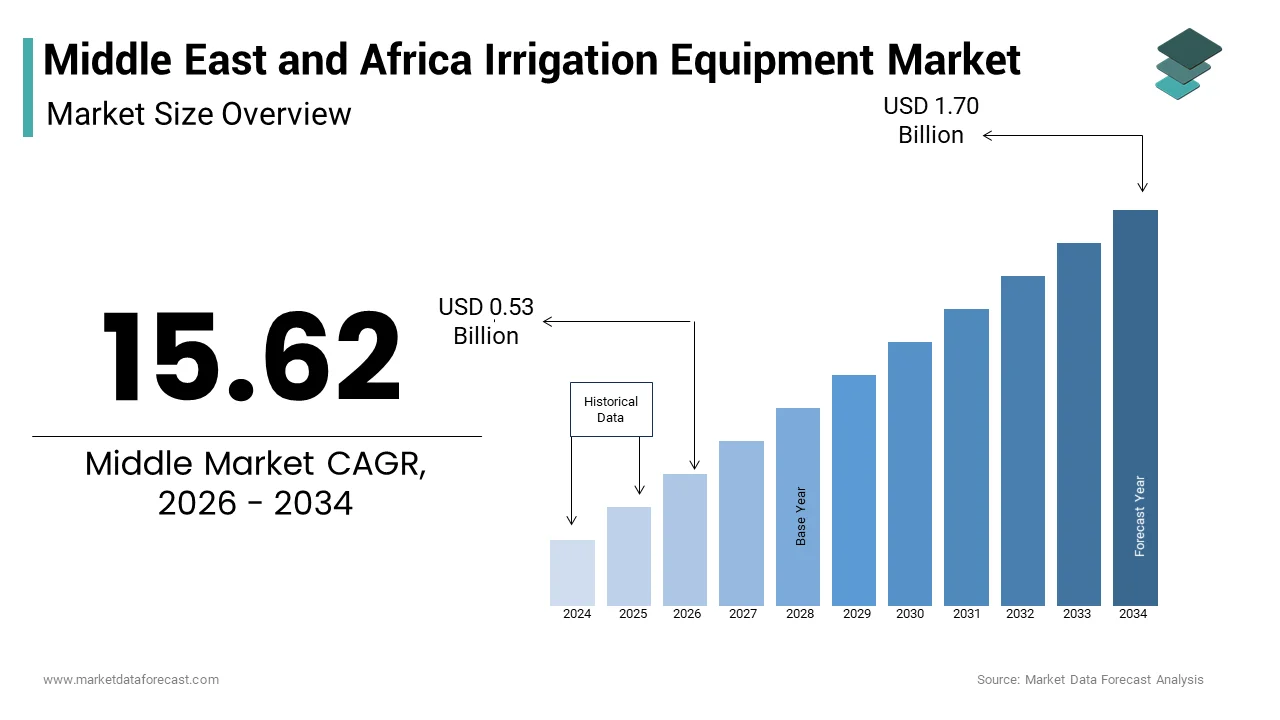
- Market Valuation: Valued at USD 0.46 billion in 2025, estimated at USD 0.53 billion in 2026, and projected to reach USD 1.70 billion by 2034, registering a robust CAGR of 15.62% from 2026 to 2034.
- Primary Growth Drivers: Increasing scarcity of water and energy resources, rising food demand, growing sophistication of equipment, and favorable government subsidy initiatives aimed at expanding resource-efficient farming and landscaping.
Middle East and Africa Irrigation Equipment Market Segment Metrics (2026–2034)
| Category | Leading Segment (2025 Position) | Fastest-Growing Segment |
|---|---|---|
| By Product | Emitters, Sprinklers, & Center Pivots (essential tools for controlled, automated water delivery) | Flow Meters, Valves, & Smart Injectors (driven by automated precision efficiency) |
| By Crop Type | Fruits and Vegetables (holds the largest share due to intensive greenhouse and horticulture practices) | Cereals and Grains & Oilseeds (adapting to climate-resilient agricultural mandates) |
| By End-User | Agriculture (primary consumer of regional irrigation systems and water networks) | Landscape & Mining (expanding via urban green spaces and specialized industrial applications) |
| By Country | KSA, UAE, Israel, and South Africa (leading regional tech adoption hubs) | Egypt, Sudan, Ethiopia, Kenya, and Rest of GCC (scaling untapped agricultural perimeters) |
Middle East and Africa Irrigation Equipment Market Players & Industry Structure
Market Structure: Evolving regional landscape featuring top-tier global irrigation leaders expanding into untapped territories to address severe arid climate challenges, irregular rainfall patterns, and long-term food security objectives.
Key Companies: Netafim, Rivulis Irrigation, Jain Irrigation Systems, Rain Bird, Eurotrip, The Toro Company, Hunter Industries, Nelson Irrigation, Valmont Industries, and T-L Irrigation Co.
 Download Free Sample Report
Middle East And Africa Irrigation Equipment Market Size
The Middle East irrigation equipment market size was valued at USD 0.46 billion in 2025 and is anticipated to USD 0.53 billion in 2026 to reach USD 1.70 billion by 2034, growing at a CAGR of 15.62% from 2026 to 2034.
The provision of water to crops or plants in controlled amounts at regular intervals is called irrigation. It is especially used in times of inadequate rainfall. Due to the irregular climate changes and unseasonal rainfalls, farmers have become increasingly dependent on irrigation to provide water to crops.
Irrigation equipment is very useful in this situation. Different types of irrigation systems, suc, such as sprinkler and drip irrigation, are increasingly adopted in farming and landscaping. Each type of irrigation system requires different types of equipment and has different purposes. Automated irrigation systems are available in recent days, greatly reducing the manual effort and also decreasing the consumption of resources.
The increasing scarcity of water and energy resources has increased the demand for controlled irrigation systems, which provide effective distribution of resources, in turn increasing the demand for irrigation equipment. The growing sophistication of irrigation equipment, government initiatives in the form of subsidies to increase the reach of the equipment, and the rise in food demand are driving the market growth. However, the lack of awareness among farmers in developed countries and the high initial investments required to install the equipment are hindering market growth.
REPORT COVERAGE
| REPORT METRIC | DETAILS |
| Market Size Available | 2025 to 2034 |
| Base Year | 2025 |
| Forecast Period | 2026 to 2034 |
| CAGR | 15.62% |
| Segments Covered | By Product, Crop, End-User, and Region. |
| Various Analyses Covered | Global, Regional & Country Level Analysis, Segment-Level Analysis, DROC, PESTLE Analysis, Porter’s Five Forces Analysis, Competitive Landscape, Analyst Overview on Investment Opportunities |
| Regions Covered | KSA, UAE, Israel, rest of GCC countries, South Africa, Ethiopia, Kenya, Egypt, Sudan, rest of MEA |
| Market Leaders Profiled | Netafim, Rivulis Irrigation, Jain Irrigation Systems, Rain Bird, Eurotrip, The Toro Company, Hunter Industries, Nelson Irrigation, Valmont Industries, and T-L Irrigation Co. |
SEGMENT ANALYSIS
By Crop Insights
The fruits and vegetable crops segment holds the largest market share. It is because of the increasing greenhouse and horticulture practices for food and vegetables, and also these crops consume more water than other types of crops.
COUNTRY ANALYSIS
Based on region, the Middle East Irrigation Equipment market is segmented into the Middle East and Africa. The Middle East and Africa are expected to have a low growth rate and low market share during the forecast period.
KEY MARKET PLAYERS
Some of the major players in the Irrigation Equipment market are
- Netafim
- Rivulis Irrigation
- Jain Irrigation Systems
- Rain Bird
- Eurotrip
- The Toro Company
- Hunter Industries
- Nelson Irrigation
- Valmont Industries
- T-L Irrigation Co.
MARKET SEGMENTATION
This research report on the Middle East and Africa Middle East Irrigation Equipment market is segmented and sub-segmented into the following categories.
By Product
- Flow Meters
- Valves
- Injectors
- Filters
- Pressure Pumps
- Emitters
- Center Pivots
- Sprinklers
- Others
By Crop Type
- Fruits and Vegetables
- Cereals and Grains
- Oilseeds
- Others
By End-Users
- Agriculture
- Landscape
- Mining
- Others
By Country
- KSA
- UAE
- Israel
- The rest of the GCC countries
- South Africa
- Ethiopia
- Kenya
- Egypt
- Sudan
- Rest of MEA