- Product Description Description
- Table of Contents TOC
- List of Table & Figure LOT
- Get Free Sample PDF Sample PDF
Market Size, 2025
$82.76 BnMarket Estimate, 2026
$85.41 BnMarket Forecast, 2034
$109.88 BnCAGR, 2026–2034
3.2%Executive Summary: Middle East and Africa (MEA) Machine Tools Market Analysis
- Market Scope: Comprehensive Middle East and African industrial evaluation covering product types, end-user verticals, country-level adoption metrics, technological trends (Industry 4.0, robotics, AI integration), and infrastructure growth.
- Market Valuation: Valued at USD 82.76 billion in 2025, estimated at USD 85.41 billion in 2026, and projected to reach USD 109.88 billion by 2034, registering a CAGR of 3.2% during the forecast period from 2026 to 2034.
- Primary Growth Drivers: Proliferation of advanced manufacturing technologies (multi-axis and robotic arms), rising application of 3D printing across medical and defense sectors, adoption of smart technologies (man-machine interaction and unattended work), and industrial investments aligned with Industry 4.0.
Key Market Segment Metrics (2026–2034)
| Category | Leading Segment (2024/2025 Position) | Fastest-Growing / Prominent Trend Segment |
|---|---|---|
| By Product Type | Cutting Machines (held prominent share for producing stress-resistant structural tools and high-impact components) | AI- and Robotics-Enhanced Cutting Solutions (experiencing accelerated integration to drive precision and efficiency) |
| By End-User | Automotive Industry (dominant sector driven by production line restructuring for electric and hybrid vehicles) | Aerospace and Defense (expanding rapidly via rising technological requirements and localized 3D printing adoption) |
| By Region / Country | GCC Countries (primary regional consumers backed by heavy investments in automotive, oil & gas, and rail sectors) | South Africa and North Africa (contributing positively through manufacturing base updates and infrastructural development) |
Major Market Players & Industry Structure
Market Structure: Dynamic and transitioning landscape involving prominent global machine tool builders establishing footprints across developing industrial corridors, integrating smart factory platforms, and upgrading local research capabilities.
Key Companies: Doosan Machine Tools, Komatsu, Yamazaki Mazak (Yamazaki Mahjong), Trumpf, JTEKT, Amada (Duke of Amada), Hyundai WIA (Hyundai Wire), MAG IAS GmbH, Makino, Schuler AG, and Okuma.
Middle East and Africa (MEA) Machine Tools Market Size
The Middle East and Africa machine tools market size was valued at USD 82.76 billion in 2025 and is anticipated to reach a valuation of USD 85.41 billion in 2026 and USD 109.88 billion by 2034, growing at a CAGR of 3.2% from 2026 to 2034.
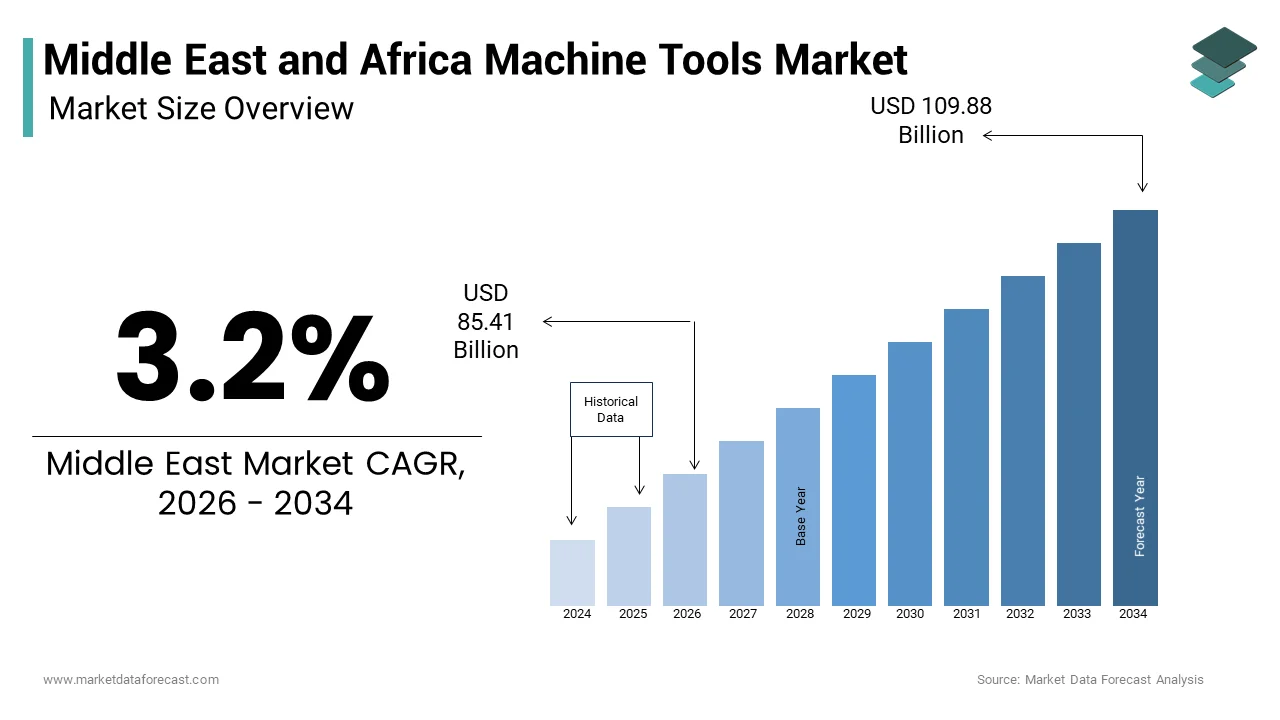
A machine tool is a power-driven machine used to shape, cut, drill, or grind rigid materials, primarily metal, into precise parts. This market serves as the foundational bedrock for industrialisation efforts spanning from the manufacturing hubs of South Africa to the emerging economic zones in Saudi Arabia and Egypt. According to the United Nations Economic Commission for Africa, the continent's manufacturing value added as a proportion of gross domestic product reached 11.97% in 2023, accelerating structural industrial expansion. As per the World Bank, gross fixed capital formation in the Middle East and North Africa region reached 27.81% of GDP in recent years, boosting infrastructural and physical plant assets. Furthermore, according to the International Energy Agency, global renewable energy capacity additions reached 670 gigawatts in 2024, expanding the production pipeline for advanced technical infrastructure components. This market is currently transitioning from being purely import dependent to developing localized maintenance and assembly ecosystems driven by national visions aiming to diversify economies beyond hydrocarbon reliance and establish resilient regional supply chains capable of supporting heavy industry, automotive manufacturing, and aerospace development initiatives.
MARKET DRIVERS
Accelerated Industrial Diversification Programs Driving Equipment Procurement
National strategic frameworks aimed at reducing oil dependency are fundamentally reshaping procurement patterns for precision manufacturing equipment across the Gulf Cooperation Council states, which fuels the growth of the Middle East and Africa machine tools market. As per the Saudi Ministry of Investment, the Kingdom recorded net foreign direct investment inflows of 26 billion dollars during 2023, expanding capital commitments into industrial infrastructure projects. According to the Ministry of Industry and Mineral Resources, the National Industrial Strategy targets a total of 36,000 factories operating in the Kingdom by 2035, scaling domestic heavy equipment production. As per the UAE Ministry of Industry and Advanced Technology, the Operation 300bn initiative raised the industrial sector's contribution to GDP to a projected 197 billion dirhams, reinforcing industrial machinery absorption. The state-led initiatives provide fiscal incentives and subsidised financing specifically for acquiring modern manufacturing technology which lowers the barrier to entry for small and medium enterprises. Consequently, original equipment manufacturers are witnessing a structural shift where government backed industrial cities act as primary anchors for machine tool sales rather than traditional private sector organic growth alone, creating a predictable demand pipeline tied directly to sovereign wealth fund deployment schedules and localization mandates.
Infrastructure Expansion Stimulating Heavy Machinery Fabrication Demand
Large scale construction and transportation projects are growing, which accelerates the expansion of the Middle East and Africa machine tools market. These projects are generating unprecedented requirements for heavy duty machine tools used in fabricating structural components and rail systems. According to the African Development Bank, infrastructure financing needs on the continent range between 130 billion and 170 billion dollars annually, accelerating mechanical engineering and fabrication requirements. The ongoing development of the Lagos Calabar Coastal Highway in Nigeria involves earthmoving and structural steel fabrication that necessitates on site or nearby machining capabilities for maintenance and customization of heavy equipment. The Egyptian Ministry of Transport indicates that the national railway network upgrade plan allocated 225 billion Egyptian pounds for multi-sector systemic overhauls, driving heavy engineering asset deployment. Additionally, the Standard Gauge Railway projects in East Africa have created regional workshops requiring lathes and vertical boring mills to service locomotives locally rather than exporting them abroad for repairs. This infrastructure boom transforms machine tools from discretionary purchases into essential operational assets where project timelines dictate procurement urgency. Governments are increasingly mandating local content participation in these mega projects, forcing international contractors to establish fabrication yards equipped with indigenous machining capacity, thus embedding machine tool demand within long term national development blueprints rather than cyclical commercial construction activity.
MARKET RESTRAINTS
Chronic Foreign Exchange Volatility Hindering Capital Equipment Imports
Currency instability severely restricts the ability of manufacturers to acquire necessary tools despite strong underlying industrial demand, which constrains the Middle East and Africa machine tools market. According to the International Monetary Fund, the Nigerian Naira depreciated by approximately 55% against the US dollar in 2023, driving up cross-border capital equipment procurement costs. As per the National Bank of Ethiopia, structural foreign exchange administration rules historically restricted commercial liquidity before structural market liberalization frameworks transitioned to commercial-bank-led approvals. The liquidity constraint forces businesses to defer fleet upgrades or resort to purchasing obsolete second-hand equipment that lacks modern efficiency and precision standards. According to the World Bank, currency depreciation and intense domestic price increases diverged across individual economies within Sub-Saharan Africa, shifting the baseline acquisition economics for industrial capital assets. Manufacturers must navigate complex hedging strategies or seek alternative financing arrangements that add significant transaction costs to already high price tags. Consequently, market penetration rates for premium machine tool brands remain artificially suppressed, not because of a lack of need but because macroeconomic monetary policies create an insurmountable financial barrier preventing the translation of industrial intent into actual equipment acquisition transactions.
Deficient Technical Workforce Limiting Advanced Technology Adoption
A critical shortage of skilled operators and maintenance technicians prevents many industries in the region from fully utilizing advanced machine tool capabilities even when equipment is procured, which restricts the expansion of the Middle East and Africa machine tools market. According to the United Nations Educational, Scientific and Cultural Organization, the gross tertiary enrollment ratio across Sub-Saharan Africa reaches approximately 9.4%, limiting the baseline scale of advanced workforce talent. As per the South African Department of Higher Education and Training, the national vocational landscape faces an absolute shortfall of 46,000 qualified artisans, constraining domestic precision industrial throughput. Without adequate human capital, companies experience higher rejection rates and longer setup times that negate the productivity benefits of investing in 5 axis machining centers or automated cells. The International Labour Organization indicates that youth unemployment in the Arab States reached approximately 28%, expanding structural labor market entry frictions across regional private sectors. The skills deficit acts as a functional restraint where the theoretical capacity of the machine tools market cannot be realized operationally, leading firms to under specify equipment purchases or delay automation investments until workforce development programs can produce sufficient numbers of competent technicians to support advanced manufacturing technologies.
MARKET OPPORTUNITIES
Localisation Mandates Creating Regional Assembly Ecosystems
Government-enforced local content requirements are driving change across the industry, which is expected to propel the Middle East and Africa machine tools market. These regulations are catalyzing the establishment of regional machine tool assembly and service centers rather than mere distribution networks. According to the Saudi Local Content and Government Procurement Authority, local content in government procurement reached 47.4% in 2024, incentivizing machine tool localization through public tender rewards. The South African Automotive Master Plan mandates that the automotive supply chain increase local content in assembled vehicles to 60% by 2035, accelerating domestic component manufacturing. As per the Egyptian General Authority for Investment and Free Zones, private free zone investment projects must source at least 30% of their supplies locally, driving industrial joint ventures. The trend transforms the market from a pure import destination into a hybrid production hub where technology transfer becomes a prerequisite for market access. Companies that establish local presence gain competitive advantages through reduced lead times, lower logistics costs, and eligibility for government subsidies while simultaneously building indigenous technical capabilities that create sustainable long-term demand for spare parts, consumables and retrofit services beyond initial equipment sales cycles.
Renewable Energy Manufacturing Unlocking Specialised Tooling Demand
The rapid expansion of solar and wind energy infrastructure across the region is generating niche demand for specialized machine tools tailored to green technology component production, which is anticipated to drive the growth of the regional market. According to the International Renewable Energy Agency, Africa expanded its total renewable power capacity by 4.6% to reach 62 gigawatts, creating structural demand for systemic technical components. Morocco’s Noor Ouarzazate Solar Complex generated an aggregate capacity of 582 megawatts across four operational phases, establishing a localised hub for clean power infrastructure. The South African Renewable Energy Master Plan indicates that the wind power sector targets local content of between 56% and 61% by 2030, boosting wind tower industrial fabrication. Unlike conventional automotive or aerospace applications, renewable energy manufacturing requires adaptable tooling solutions that can accommodate varying specifications across different technology providers. This creates opportunities for machine tool suppliers offering modular platforms and application-specific engineering support rather than generic catalogue products. Early movers establishing expertise in green manufacturing processes position themselves as preferred partners for both utility developers and government agencies seeking to build complete domestic renewable energy value chains that extend beyond simple installation to full lifecycle production capability.
MARKET CHALLENGES
Supply Chain Fragmentation Disrupting Consistent Equipment Availability
Geopolitical disruptions and logistical barriers across the Red Sea and Mediterranean corridors create unpredictable delivery schedules that slow down the growth of the Middle East and Africa machine tools market. This undermines reliable machine tool supply chains in the region. According to the United Nations Conference on Trade and Development, Red Sea shipping disruptions and rerouting through the Cape of Good Hope added roughly 10 to 14 days to standard maritime transit timelines, raising fuel expenditures across active trade routes. As per the World Bank, vessel anchorage times across South African ports declined by approximately 75% between mid-2024 and mid-2025, accelerating cargo processing velocities. According to the World Customs Organization, regional trade optimization is driven by the progressive implementation of electronic lodgement and automated processing architectures under international trade facilitation frameworks. Machine tool distributors face working capital strain as inventory sits idle in ports or bonded warehouses while customers postpone installation commitments awaiting confirmed arrival dates. This fragmentation discourages lean inventory practices and forces buyers to maintain excessive safety stocks or accept longer lead times as normal operating conditions, ultimately constraining market velocity and increasing total cost of ownership through hidden logistics expenses that are rarely reflected in quoted equipment prices but significantly impact end-user economics.
Regulatory Heterogeneity Complicating Cross-Border Market Access
Divergent technical standards, certification requirements, and import regulations across jurisdictions in the region inhibit the expansion of the Middle East and Africa machine tools market. This prevents manufacturers from adopting unified regional market strategies. According to the African Organisation for Standardisation, the continental trade ecosystem has harmonised 2,440 quality standards across 15 priority industrial sectors, reducing technical compliance costs. As per the Gulf Standardization Organization, low voltage technical frameworks integrate safety and electromagnetic compatibility standards that recognize international test reports to establish a presumption of conformity. According to the United Nations Conference on Trade and Development, non-tariff measures impose high ad-valorem equivalent costs that disproportionately increase import expenses for developing economies. Distributors operating across multiple jurisdictions face administrative burdens maintaining separate documentation inventories and service protocols that fragment after sales support networks and reduce economies of scale. This regulatory complexity disproportionately affects smaller machine tool builders lacking dedicated compliance teams, thereby concentrating market share among multinational corporations with resources to navigate bureaucratic variations while limiting competitive diversity and innovation diffusion across the broader regional marketplace despite underlying demand homogeneity.
REPORT COVERAGE
| REPORT METRIC | DETAILS |
| Market Size Available | 2025 to 2034 |
| Base Year | 2025 |
| Forecast Period | 2026 to 2034 |
| CAGR | 3.2% |
| Segments Covered | By Product Type, By End-User, and Country |
| Various Analyses Covered | Regional & Country Level Analysis, Segment-Level Analysis, DROC, PESTLE Analysis, Porter’s Five Forces Analysis, Competitive Landscape, Analyst Overview on Investment Opportunities |
| Countries Covered | KSA, UAE, Israel, the rest of GCC countries, South Africa, Ethiopia, Kenya, Egypt, Sudan, and the rest of MEA |
| Market Leaders Profiled | Doosan Machine Tools, Komatsu, Yamazaki Mahjong, Trump, JTEKT, Duke of Amada, Hyundai Wire, MAG IAS GmbH, Makino, Schuler AG, and Okuma |
SEGMENTAL ANALYSIS
By Product Insights
Cutting Machines
In 2025, the cutting machines segment held the majority share in the Middle East and Africa machine tools market because of its universal applicability across diverse industrial verticals ranging from heavy construction to consumer goods manufacturing. The main factor behind this position is the massive infrastructure development pipeline that requires extensive metal plate and structural steel processing capabilities. According to the African Development Bank, the continent requires between 130 billion and 170 billion dollars annually for infrastructure, driving widespread commercial project procurement. The sheer volume of raw material processing needed for these mega projects makes cutting equipment the first capital expenditure for any new fabrication facility entering the regional supply chain. Furthermore, as per the Global Infrastructure Hub, global infrastructure investment requires coordinated public and private capital deployment across major transit, energy, and heavy telecommunication asset networks. This segment benefits from technological maturity where fiber laser cutters have achieved price points accessible to small and medium enterprises while offering throughput speeds five times faster than legacy CO2 systems, thereby accelerating replacement cycles. Manufacturers prioritise cutting machines because they offer the highest utilization rates and fastest return on investment compared to specialized forming or grinding equipment, making them the foundational asset class in regional industrialization strategies.
Fueling this segment's ongoing lead is the rapid expansion of renewable energy component manufacturing, which relies heavily on precision cutting technologies. As per the International Renewable Energy Agency, the Middle East expanded its renewable energy additions by 28.9% by adding over 12 gigawatts of new capacity. Solar panel frame production demands high speed aluminum extrusion cutting with tolerances under 0.1 millimeters which only modern CNC cutting centers can achieve consistently at scale. According to BloombergNEF, global transition metrics require rapid supply chain localization to satisfy corporate procurement goals and clean energy equipment supply demands. Wind energy tower fabrication similarly depends on large format plasma and oxy fuel cutting systems capable of processing steel plates up to 100 millimeters thick for tubular tower sections. Unlike general purpose machining, cutting equipment serves as the bottleneck process in green energy supply chains, meaning capacity expansions directly translate to cutting machine orders. Government local content mandates in countries like South Africa and Morocco further amplify this trend by requiring domestic production of balance of system components rather than importing finished assemblies, thus embedding cutting technology demand within national energy security strategies.
Electrical Discharge Machines
The electrical discharge machines segment is predicted to witness the highest CAGR of 9.8% from 2026 to 2034 due to aerospace and medical device manufacturing expansion. A key growth factor is the establishment of regional aerospace maintenance, repair, and overhaul facilities that require EDM technology for machining hardened alloys used in turbine blades and engine components. According to the International Air Transport Association, Middle East airlines recorded a 16.2% year-on-year demand expansion, amplifying regional civil aviation operations. Wire EDM and sinker EDM machines are irreplaceable for producing intricate cooling channels and airfoil profiles in nickel-based superalloys that conventional cutting tools cannot machine without inducing thermal damage. As per the UAE General Civil Aviation Authority, civil aviation modernization frameworks require comprehensive compliance with international safety and security oversight frameworks to handle high traffic volumes. Regional airlines increasingly mandate local sourcing for non critical components, creating immediate demand for EDM capacity among tier two suppliers seeking certification. This specialized demand grows faster than general machining because it addresses previously outsourced work now being reshored due to geopolitical supply chain vulnerabilities and strategic autonomy objectives embedded in national aviation policies.
The swift expansion of this segment gains further momentum from the emergence of precision medical device and mould-making industries across the Gulf Cooperation Council states. As per the Dubai Health Authority, the emirate welcomed 691,478 international health tourists who spent more than 1.03 billion dirhams on localized medical care. Medical grade titanium and stainless steel components often feature complex geometries and internal cavities that wire EDM machines produce with surface finishes below 0.2 micrometers Ra, eliminating secondary polishing operations. According to the Saudi Food and Drug Authority, medical device manufacturing oversight enforces rigorous quality management systems to guarantee compliance with domestic safety rules. Mold makers serving packaging and consumer electronics sectors similarly drive EDM demand as miniaturization trends require finer electrode wires and tighter tolerances for injection molds producing millions of parts annually. Unlike commodity machining where competition focuses on price, EDM users compete on technical capability, creating willingness to invest in premium 5-axis wire EDM systems with automatic threading and submerged cutting features. This technology intensive segment grows rapidly because it enables entry into high margin niches where barriers to entry protect early adopters from commoditization pressures affecting conventional machine tool categories.
By End User Insights
Automotive
The automotive end-user segment was the largest in 2025 and occupied a commanding share of the Middle East and Africa machine tools market. This prominence of the segment was supported by established vehicle assembly ecosystems and aggressive localization policies across multiple nations. The dominant driver is the integrated automotive manufacturing cluster in South Africa, which serves as the continental production hub exporting vehicles to Europe and Asia. According to the National Association of Automobile Manufacturers of South Africa, the automotive sector contributed 5.2% to the national gross domestic product in 2024, expanding long-term manufacturing output pipelines. Major original equipment manufacturers including Toyota, Volkswagen and Ford operate dedicated machining plants with thousands of CNC turning and milling centres that undergo regular technology refresh cycles to maintain global quality standards. The Department of Trade, Industry and Competition reveals that the automotive sector attracted over 12 billion rand in new investment specifically directed toward new energy vehicle models. Component suppliers must meet stringent OEM audit requirements mandating modern equipment with statistical process control capabilities forcing elimination of legacy machinery. This segment leads because automotive manufacturing represents the most capital-intensive and technologically demanding industrial activity in the region, creating concentrated demand volumes that dwarf fragmented purchases from smaller fabrication shops or jobbing workshops operating in other sectors.
The foremost factor securing this segment's leading position is the wave of new electric vehicle assembly investments transforming traditional powertrain machining demand toward battery and motor component production. As per the Public Investment Fund, Saudi Arabia's electric vehicle sector investments are projected to exceed 10 billion dollars across integrated localized production developments. These components demand different machine tool configurations than internal combustion engines favoring horizontal machining centres with pallet changers and multi-spindle drilling units optimised for lightweight materials. According to the UAE Ministry of Industry and Advanced Technology, modern industrial programs prioritize advanced technological integration and local asset optimization to scale non-oil manufacturing output. Existing suppliers face retooling imperatives as OEMs transition model lineups, forcing simultaneous decommissioning of obsolete equipment and acquisition of EV-specific machinery. Unlike mature markets where EV adoption cannibalizes ICE machining demand, the MEA region experiences net additive growth because EV manufacturing represents greenfield capacity rather than conversion of existing assets. Government sovereign wealth funds de-risk these transitions through co-investment structures, ensuring machine tool suppliers benefit from both legacy fleet maintenance and new platform launches, creating dual demand streams that reinforce automotive segment dominance.
Aerospace and Defence
The aerospace and defence segment is estimated to register the fastest CAGR of 11.2% during the forecast period owing to strategic sovereignty initiatives and offset program obligations. The primary growth catalyst is the systematic buildout of indigenous defence manufacturing capabilities mandated by national security strategies across Gulf states. According to the General Authority for Military Industries, Saudi Arabia recorded a localised military procurement spending rate of 24.89% as it targets a 50% localisation threshold by 2030. Defence contractors receive preferential financing and guaranteed offtake agreements, reducing investment risk for expensive machine tools that would otherwise be uneconomical for commercial applications. As per the Tawazun Economic Council, national defense technology transfer initiatives focus on enhancing local defense industries and establishing sovereign electronics and naval processing capabilities. This segment grows fastest because procurement decisions are decoupled from economic cycles and driven by geopolitical imperatives, creating predictable long-term demand visibility unmatched by commercial sectors. Machine tool suppliers benefit from premium pricing and extended service contracts as defence customers prioritise supply security over cost optimisation, accepting longer payback periods for strategically critical capabilities.
Growth in this segment is propelled by the expansion of commercial aviation maintenance, repair, and overhaul networks supporting regional carrier fleet expansions. As per the Boeing Commercial Market Outlook, the Middle East region will require approximately 3,400 new jet aircraft deliveries over a 20-year timeline to address rising civil traffic demand. Engine overhaul facilities require specialized grinding, honing and EDM machines certified to original equipment manufacturer specifications, creating high barrier entry points that limit competition and sustain premium equipment valuations. According to the International Civil Aviation Organization, regional transport infrastructure growth requires integrated public-private financing frameworks to satisfy localized long-term capacity requirements. Unlike automotive, where suppliers serve multiple OEMs, aerospace MRO customers typically dedicate entire machining cells to single engine or airframe programs, ensuring stable utilisation rates justifying capital intensity. Growth accelerates because each new aircraft type introduction triggers supplementary tooling requirements for unique components while aging fleets generate increasing repair volumes compounding demand. Governments view MRO self-sufficiency as essential for aviation resilience, providing grants covering a notable portion of eligible machine tool costs, effectively subsidizing market expansion beyond organic commercial fundamentals.
COUNTRY LEVEL ANALYSIS
Saudi Arabia Machine Tools Market Analysis
Saudi Arabia led the Middle East and Africa machine tools market, capturing a 28.6% share in 2025. This leading position was attributed to the country's Vision 2030 industrial transformation initiatives. The Kingdom’s market status reflects deliberate state-led capital deployment through the National Industrial Development and Logistics Program. According to the Ministry of Industry and Mineral Resources, the National Industrial Development and Logistics Program has recorded cumulative non-oil export investments of 206 billion Saudi riyals, accelerating heavy equipment capacity additions. The unprecedented public spending crowds in private investment creating multiplicative effects on machine tool procurement across automotive renewables and defence sectors simultaneously. Moreover, the Saudi Export Development Authority shows that non-oil exports reached a historic record of 515 billion Saudi riyals in 2024, expanding the production pipeline for advanced technical infrastructure components. Local content regulations mandate that government entities source domestically manufactured goods whenever feasible, creating captive demand for locally machined components and incentivising suppliers to establish in Kingdom machining operations rather than importing finished products. The market operates under unique conditions where sovereign wealth fund co investments de risk capital expenditures for strategic industries, enabling adoption of premium European and Japanese machine tools despite higher upfront costs. Suppliers benefit from long-term framework agreements tied to giga-project timelines, providing demand visibility extending beyond typical business cycles and allowing inventory planning aligned with national development milestones rather than quarterly earnings guidance.
United Arab Emirates Machine Tools Market Analysis
The United Arab Emirates was positioned second in the Middle East and Africa machine tools market and held a 22.5% share in 2025. This growth of the UAE's market was propelled by advanced manufacturing specialization and regional headquarters concentration. The nation’s market status reflects successful positioning as a high-value-added production hub rather than a mass manufacturing centre, focusing on aerospace, medical devices and precision engineering, where machine tool intensity per unit output exceeds regional averages. According to the UAE Ministry of Industry and Advanced Technology, the industrial sector's contribution to the gross domestic product reached 190 billion dirhams in 2024, reinforcing industrial machinery absorption. As per the Emirates Development Bank, the deployment of Operation 300bn utilizes a dedicated 30 billion dirham financial envelope to fund priority manufacturing and advanced engineering projects. The Dubai Department of Economy and Tourism reveals that the emirate attracted 52 billion dirhams in greenfield foreign direct investment capital during 2024, expanding capital commitments into industrial projects. Free zones like Jebel Ali and Khalifa Industrial Area offer duty-free import regimes for capital equipment combined with streamlined customs processing, reducing total landed costs compared to mainland operations. The market distinguishes itself through ecosystem maturity where machine tool distributors maintain comprehensive application engineering teams, spare parts inventories and training academies enabling rapid deployment and minimising downtime risks that deter investment in less developed jurisdictions.
South Africa Machine Tools Market Analysis
South Africa maintains a significant position in the Middle East and Africa machine tools market because of the continent’s most diversified industrial base and deepest automotive supply chain. The country’s market status reflects decades of accumulated manufacturing expertise creating persistent replacement demand alongside greenfield investments in emerging sectors. According to Statistics South Africa, gross fixed capital formation across the broader macroeconomy recorded structural fluctuations influenced heavily by shifting private and public sector asset investments. The automotive sector alone operates over 200 component manufacturers requiring regular machine tool upgrades to maintain export competitiveness under European Union trade agreements mandating progressive local value addition. According to the Steel and Engineering Industries Federation of Southern Africa, metal and engineering industrial tracking highlights ongoing operational cost constraints linked directly to municipal power tariffs and systemic logistics performance gaps. Government incentives through the Manufacturing Competitiveness Enhancement Programme provide cash grants covering a notable portion of qualifying asset costs, specifically targeting productivity improvement and energy efficiency retrofits. Unlike Gulf markets driven by sovereign wealth, South African demand emerges from competitive pressure and operational necessity, creating more price-sensitive but sustainable procurement patterns. Suppliers adapt by offering refurbished equipment options, flexible payment terms, and local assembly arrangements, reducing foreign exchange exposure while maintaining access to global technology platforms essential for export market compliance.
Egypt Machine Tools Market Analysis
Egypt is also a key player in the Middle East and Africa machine tools market. It leverages its geographic positioning and a large domestic population to attract labor-intensive manufacturing investments requiring substantial machining capacity. The nation’s market status reflects active pursuit of import substitution industrialisation through tariff protections and investment incentives targeting textiles, appliances and automotive components. According to the General Authority for Investment and Free Zones, national industrial zone parameters prioritize structural manufacturing scaling and cross-border commercial trade facilitation to raise non-oil exports. As per the Suez Canal Economic Zone, investments are subject to a headline 22.5% corporate income tax rate but qualify for a 50% corporate tax reduction over their first seven operational years. According to the Central Bank of Egypt, nationwide monetary policy transmission enforces targeted credit allocation guidelines to satisfy real economy structural investment goals. Local content requirements in public procurement mandate minimum domestic value thresholds, creating guaranteed demand for locally machined components in infrastructure and utilities sectors. Currency devaluation paradoxically stimulates machine tool demand as import substitution becomes economically viable for previously imported goods, triggering domestic production investments. Suppliers navigate foreign exchange restrictions through barter arrangements, local currency pricing, and phased delivery schedules accommodating liquidity constraints while maintaining market presence during transitional monetary policy periods.
Israel Machine Tools Market Analysis
Israel is expected to grow further in the Middle East and Africa machine tools market from 2026 to 2034, owing to technology-intensive precision manufacturing serving global semiconductor, medical, and defence supply chains. The country’s market status reflects innovation-driven demand where machine tool requirements correlate with R&D expenditure rather than GDP growth, creating counter cyclical resilience during economic downturns. According to the Israel Innovation Authority, national research and development frameworks utilise structured public grant allocations and technology incubators to accelerate civilian high-tech entrepreneurship. As per the Israel Ministry of Defence, national defense exports reached an all-time record of nearly 14.8 billion dollars in 2024, expanding the international procurement backlog. According to the Manufacturers Association of Israel, high-technology industrial operations emphasize skilled labor integration and structural plant efficiency to preserve cross-border corporate competitiveness. Government grants cover up to 50 per cent of approved R&D capital expenditures, including machine tools used exclusively for experimental development, reducing effective acquisition costs for startups and scale-ups. The market operates with minimal price sensitivity, prioritising technical specifications, delivery speed and after-sales support over cost considerations. Suppliers succeed by maintaining application engineering teams fluent in Hebrew and familiar with local standards, enabling collaborative development relationships rather than transactional vendor-customer dynamics typical elsewhere in the region.
COMPETITIVE LANDSCAPE
Competition in the Middle East and Africa machine tools market features intense rivalry between established European Japanese multinational corporations and increasingly capable Chinese Turkish and Indian manufacturers targeting different customer segments. Premium brands compete on technological superiority application engineering depth and comprehensive after sales support justifying higher price points for mission critical applications in aerospace and automotive sectors. Value oriented competitors gain traction through aggressive pricing simplified specifications and faster delivery appealing to small fabricators and first time buyers constrained by capital availability. Regional distributors wield significant influence as gatekeepers controlling access to end users across fragmented markets with diverse regulatory requirements. Competition intensifies around localization capabilities with governments favoring suppliers demonstrating tangible commitments to domestic value creation through assembly operations or technology transfer agreements. Digital service offerings emerge as new competitive battlegrounds as remote diagnostics and predictive maintenance become expected standards rather than premium add ons. Market fragmentation prevents winner take all dynamics enabling multiple players to coexist serving distinct geographic and vertical niches though consolidation pressures mount as scale advantages in service networks and spare parts logistics become increasingly decisive factors determining long term viability across this complex heterogeneous regional landscape characterized by divergent economic conditions and industrial policy priorities.
KEY MARKET PLAYERS
Some of the major companies in the Middle East and Africa machine tools market.
- Doosan Machine Tools
- Komatsu
- DMG MORI
- Mazak Corporation
- TRUMPF Group
- Yamazaki Mahjong
- Trump
- JTEKT
- Duke of Amada
- Hyundai Wire
- MAG IAS GmbH
- Makino
- Schuler AG
- Okuma
Top Players In The Market
- DMG MORI maintains significant involvement in the Middle East and Africa machine tools market through localized technical centers and strategic partnerships across Gulf states. The company recently expanded its Dubai facility to include advanced training labs addressing regional skills gaps in precision machining. DMG MORI launched automated manufacturing cells tailored for aerospace clients in Saudi Arabia supporting Vision 2030 localization mandates. Their recent actions include signing technology transfer agreements with Egyptian manufacturers enabling domestic assembly of turning centers. These initiatives strengthen market position by embedding capabilities locally rather than relying solely on imports while building long term customer relationships through workforce development programs that create dependency on their proprietary control systems and service ecosystems across diverse industrial sectors throughout the region.
- Mazak Corporation contributes substantially to the Middle East and Africa machine tools market via dedicated application engineering teams stationed in key industrial hubs. The company recently inaugurated a new technology center in Johannesburg providing hands on demonstration and programming support for South African automotive suppliers. Mazak strengthened its position by introducing flexible financing schemes accommodating foreign exchange volatility in African markets. They partnered with UAE based distributors to establish consignment inventory reducing lead times for critical spare parts. Recent actions include hosting annual manufacturing forums connecting regional buyers with global experts fostering knowledge exchange. These efforts demonstrate commitment beyond transactional sales creating trusted advisor status among manufacturers navigating complex industrialization challenges while ensuring equipment uptime through responsive local support infrastructure tailored to unique regional operational constraints and regulatory requirements.
- TRUMPF Group plays vital role in Middle East and Africa machine tools market specializing in sheet metal fabrication and laser cutting technologies essential for infrastructure development. The company recently established a digital showroom in Riyadh showcasing smart factory solutions aligned with Saudi giga projects. TRUMPF strengthened market position by launching Arabic language operator training programs reducing adoption barriers for advanced laser systems. They collaborated with Moroccan renewable energy manufacturers developing specialized cutting processes for solar component production. Recent actions include deploying remote service capabilities enabling German engineers to diagnose equipment issues across Africa without travel delays. These initiatives address regional talent shortages while demonstrating technological leadership in green manufacturing applications creating differentiation against competitors offering generic solutions lacking industry specific expertise required for emerging sustainable industrial ecosystems across the continent.
Top Strategies Used by Key Market Participants
Key players in the Middle East and Africa machine tools market employ localization strategies establishing regional assembly and service centers to comply with government content mandates and reduce delivery lead times. Companies invest heavily in technical education partnerships with vocational institutions addressing chronic skilled labor shortages that hinder technology adoption. Manufacturers develop flexible financing structures including lease to own arrangements and currency hedging mechanisms to accommodate foreign exchange volatility affecting customer purchasing power. Strategic alliances with local distributors provide market intelligence and navigate complex regulatory environments across fragmented jurisdictions. Digital transformation initiatives including remote monitoring and predictive maintenance services differentiate offerings in regions where physical service coverage remains limited. Application specific solution bundling targeting high growth sectors like renewables and aerospace creates defensible niches against commoditized competition. Workforce development programs build brand loyalty while creating future customer bases trained on proprietary platforms ensuring long term ecosystem lock in across diverse national markets with varying industrial maturity levels and policy priorities.
MARKET SEGMENTATION
This research report on the Middle East and Africa machine tools market has been segmented and sub-segmented based on the following categories.
By Product Type
- Cutting Machines
- Drilling Machines
- Forming Machines
- Turning Machines
- Grinding Machines
- Electrical Discharge Machines
- Others.
By End-User
- Automotive
- Industrial Manufacturing
- Aerospace and Defence
- Fabrication
- Precision Machinery
- Others.
By Country
- KSA
- UAE
- Israel
- reThe st of GCthe C countries
- South Africa
- Ethiopia
- Kenya
- Egypt
- Sudan
- rest of MEA