- Product Description Description
- Table of Contents TOC
- List of Table & Figure LOT
- Get Free Sample PDF Sample PDF
Market Size, 2025
$1.79 BnMarket Estimate, 2026
$1.83 BnMarket Forecast, 2034
$2.20 BnCAGR, 2026–2034
2.35%Executive Summary: Middle East and Africa Processed Egg Market
- Market Scope: Comprehensive Middle East and Africa processed egg industry analysis covering product categories, application segments, country leadership frameworks, strategic corporate developments, and competitive landscapes.
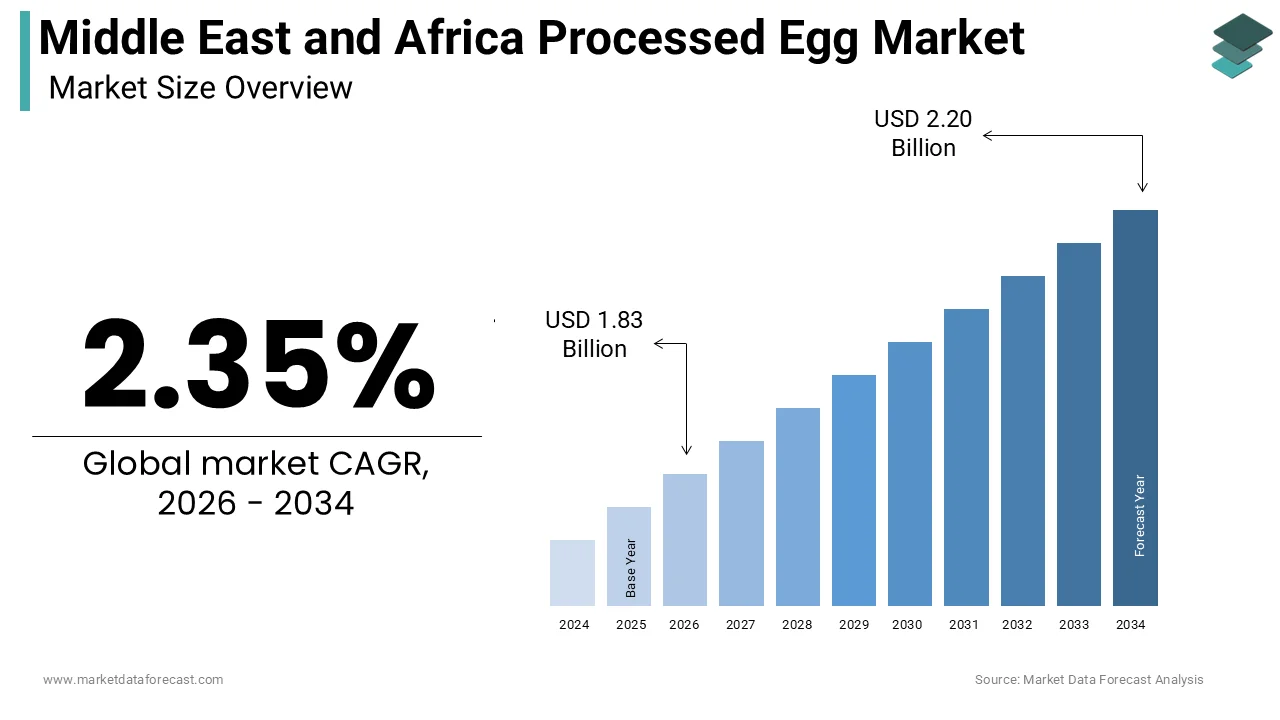
- Market Valuation: Valued at USD 1.79 billion (2025), estimated at USD 1.83 billion (2026), and projected to reach USD 2.20 billion by 2034, registering a steady CAGR of 2.35% (2026–2034).
- Primary Growth Drivers: Rising urbanization, convenience food demand, food service industry expansion, FAO-noted per capita egg consumption increases, shelf-stable product adoption, and government food security/local poultry initiatives. Restraints include high production costs and inadequate cold chain infrastructure.
Key Market Segment Metrics (2026–2034)
| Category | Leading Segment / Country (Position) | Fastest-Growing Segment |
|---|---|---|
| By Product Type | Liquid egg products (dominate market due to widespread application in food service, industrial baking, and institutional catering) | Customized liquid egg formulations and value-added processed egg variants |
| By Application | Industrial baking, food service, and institutional catering channels | Ready-to-eat and bakery application segments (fueled by urban convenience and QSR expansion) |
| By Region / Country | Saudi Arabia (leads regional market via strong domestic production >5.6B eggs/year), followed by South Africa and Kenya | Kenya and emerging East African urban hospitality and bakery sectors |
Major Market Players & Market Structure
Market Structure: Strategic regional agro-industrial and food processing ecosystem focused on expanding liquid egg production facilities, optimizing cold chain logistics, establishing bespoke QSR partnerships, and enhancing automated packaging to lower operational overheads.
Key Companies: Al Rawdah, Al Ain Poultry, National Food Company, Al Jazira Poultry, Al Kabeer Group, Saudia Dairy & Foodstuff Company (SADAFCO), Almarai Company, Nestlé Middle East, Savanna Ingredients, and RCL Foods.
Middle East and Africa Processed Egg Market Size
The size of the Middle East and African processed egg market was valued at USD 1.79 billion in 2025. The regional market is anticipated to grow at a CAGR of 2.35% from 2026 to 2034 and be valued at USD 2.20 billion by 2034 from USD 1.83 billion in 2026.
Processed eggs refer to egg products that are transformed into forms such as liquid, frozen, or powdered to enhance their shelf life and usability in various applications. The rapid urbanization and growing middle-class population of the Middle East and Africa have significantly contributed to the increased consumption of processed foods, including processed egg products. According to the Food and Agriculture Organization, per capita, egg consumption in the Middle East has risen by 15% over the past decade, which reflects changing dietary patterns in this region. Additionally, processed eggs are gaining popularity in food manufacturing due to their longer shelf life and reduced risk of contamination compared to raw eggs. South Africa and Saudi Arabia are among the leading markets in the region due to the advancements in food processing technologies and increased investment in the egg production sector.
MARKET DRIVERS
Rising Demand for Convenience and Processed Foods
The increasing demand for convenience foods is a major driver of the Middle East and African processed egg market. Urbanization and shifting lifestyles have fueled the consumption of ready-to-eat and processed food products, where processed eggs are a key ingredient. According to the Food and Agriculture Organization, urban populations in the region have grown by over 3% annually, which is boosting the demand for processed foods. Processed eggs that are known for their extended shelf life and versatility are widely used in bakery, confectionery, and pre-packaged meals. This trend is particularly evident in countries like South Africa and Saudi Arabia, where the fast-food industry is experiencing significant growth and further driving regional market expansion.
Growth of the Food Service Industry
The expansion of the food service industry across the Middle East and Africa is driving the demand for processed eggs in this region. Restaurants, bakeries and catering businesses prefer processed eggs due to their convenience, consistent quality and safety. According to the United Nations World Tourism Organization, tourism in the Middle East and Africa is recovering strongly, with international arrivals in the Middle East growing by 52% in 2022. This resurgence has increased the demand for processed eggs in food preparation. Moreover, the South African foodservice market grew by 4.5% in 2022 and this market relies heavily on processed egg products for large-scale production, which is further boosting the processed egg market in this region.
MARKET RESTRAINTS
High Costs of Production and Processing
The high costs associated with producing and processing eggs act as a significant restraint on the Middle Eastern and African processed egg market. Factors such as the rising prices of feed, energy, and packaging materials increase the overall cost of processed egg products. According to the Food and Agriculture Organization, feed costs account for up to 70% of poultry production expenses in Africa and directly impact egg prices. Additionally, the limited availability of advanced processing facilities in many parts of the region increases production costs. These high costs make processed eggs less affordable for consumers and less competitive compared to alternatives, particularly in price-sensitive markets.
Inadequate Cold Chain Infrastructure
The lack of robust cold chain infrastructure in the Middle East and Africa hinders the growth of the regional processed egg market. Many processed egg products, such as liquid and frozen eggs, require temperature-controlled storage and transportation to maintain quality and safety. According to the African Development Bank, more than 40% of perishable food products in the region are lost due to insufficient cold chain systems. Countries with vast rural areas, like Sudan and Ethiopia, face significant challenges in establishing reliable cold storage and transport networks. This limitation restricts the distribution and accessibility of processed egg products, particularly in remote and underserved markets.
MARKET OPPORTUNITIES
Expansion of Bakery and Confectionery Industries
The growing bakery and confectionery industries in the Middle East and Africa present a significant opportunity for the processed egg market in this region. Processed eggs, such as liquid and powdered forms, are essential in baking for their binding, emulsifying, and foaming properties. According to the United Nations Industrial Development Organization, the bakery sector in Africa is expanding at an annual growth rate of 6% owing to the increasing urbanization and consumer demand for ready-made baked goods. Similarly, the Middle East confectionery market is projected to grow steadily, with countries like Saudi Arabia and the UAE witnessing rising consumption of premium bakery products. These trends increase the demand for processed egg products and the regional market expansion.
Rising Focus on Export Opportunities
The Middle East and African processed egg market are poised to benefit from expanding export opportunities to international markets. Countries like South Africa and Kenya are enhancing their food processing capabilities to meet global standards for processed egg products. As per the Food and Agriculture Organization, egg production in Africa is growing by 3.8% annually and creating surplus capacity for exports. Additionally, the strategic location of the Middle East facilitates trade with Europe and Asia, where demand for processed egg products is increasing. By investing in advanced processing facilities and quality assurance, producers in the region can capitalize on these export opportunities to strengthen their market presence globally.
MARKET CHALLENGES
Limited Consumer Awareness and Market Penetration
One of the major challenges facing the Middle East and African processed egg market is the limited awareness among consumers about the availability and benefits of processed egg products. Many consumers in the region continue to rely on fresh eggs and are unaware of the convenience and longer shelf life offered by processed alternatives. According to the Food and Agriculture Organization, fresh eggs account for over 80% of egg consumption in Africa and leave little room for processed products. This low market penetration is further exacerbated in rural areas where traditional practices dominate.
Regulatory and Quality Control Challenges
Ensuring compliance with international food safety standards and quality control regulations poses a significant challenge to the processed egg market in the Middle East and Africa. Countries with developing food processing industries often face issues related to inconsistent standards, inadequate enforcement, and lack of certification infrastructure. According to the African Union Development Agency, only 30% of food processing facilities in Africa meet global quality benchmarks. This shortfall limits the ability of local producers to compete in international markets and affects consumer confidence in the safety of processed egg products.
REPORT COVERAGE
| REPORT METRIC | DETAILS |
| Market Size Available | 2025 to 2034 |
| Base Year | 2025 |
| Forecast Period | 2026 to 2034 |
| CAGR | 2.35% |
| Segments Covered | By Product, Application, And Region |
|
Various Analyses Covered | Global, Regional & Country Level Analysis; Segment-Level Analysis; DROC, PESTLE Analysis; Porter’s Five Forces Analysis; Competitive Landscape; Analyst Overview of Investment Opportunities |
| Regions Covered | KSA, UAE, Israel, Rest Of GCC Countries, South Africa, Ethiopia, Kenya, Egypt, Sudan, Rest Of MEA |
|
Market Leaders Profiled | Vril SCA, Cal-Maine Foods Inc., Eurovo S.R.L., Sanovo Technology Group, Moba B.V.Pulviver, Rose Acre Farms, Rembrandt Enterprises, Cal-Maine Foods, Inc, Daybreak Foods, Dr. Oetker and Actini Group. |
REGIONAL ANALYSIS
Saudi Arabia dominated the processed egg market in the Middle East region in 2023. The growth of the processed egg market in Saudi Arabia is majorly driven by the robust food processing industry and the rising demand for convenience foods. The Saudi Food and Drug Authority supports advanced food processing technologies to ensure high-quality processed egg products. According to the Saudi Ministry of Environment, Water, and Agriculture, the Kingdom produced over 5.6 billion eggs in 2022 due to the growing investments in poultry farming. Processed eggs are widely used in the bakery and confectionery sectors in Saudi Arabia to cater to the rising consumer demand for ready-to-eat and premium products. Additionally, Saudi Arabia's food export initiatives position it as a regional leader in processed egg production.
South Africa is a dominant player in the African processed egg market. The market growth in South Africa is driven by its advanced food manufacturing infrastructure. As per the reports of the South African Poultry Association, South Africa produces approximately 7.8 billion eggs annually with a growing portion allocated for processing. The South African food service industry grew by 4.5% in 2022, according to Statistics South Africa and processed egg products are widely used in the food service sector.
Kenya is a leading market for processed eggs in East Africa. According to the Kenya Agricultural and Livestock Research Organization, Kenya produced over 1.8 billion eggs in 2022, with increasing investments in processing facilities. Processed eggs are gaining popularity in the bakery and hospitality industries of Kenya, particularly in urban areas. Additionally, government initiatives promoting agribusiness innovation and value-added food products are boosting the market growth in Kenya. The strong focus of Kenya on enhancing food processing capabilities and improving rural livelihoods is further boosting the processed egg market in Kenya.
KEY MARKET PLAYERS
Some of the major companies dominating the market are Vril SCA, Cal-Maine Foods Inc., Eurovo S.R.L., Sanovo Technology Group, Moba B.V.Pulviver, Rose Acre Farms, Rembrandt Enterprises, Cal-Maine Foods, Inc, Daybreak Foods, Dr. Oetker and Actini Group.
MARKET SEGMENTATION
This research report on the processed egg market in the Middle East and Africa has been segmented and sub-segmented based on the following categories.
By Product Type
- Dried
- Liquid
- Frozen
By Application
- Confectionery
- Dairy Products
- Bakery
- Ready-To-Eat
- Soups And Sauces
- Others
By Country
- KSA
- UAE
- Israel
- Rest Of GCC Countries
- South Africa
- Ethiopia
- Kenya
- Egypt
- Sudan
- Rest OF MEA