- Product Description Description
- Table of Contents TOC
- List of Table & Figure LOT
- Get Free Sample PDF Sample PDF
Market Size, 2025
$1.21 BnMarket Estimate, 2026
$1.36 BnMarket Forecast, 2034
$3.43 BnCAGR, 2026–2034
12.25%Executive Summary: Middle East and Africa Refurbished Medical Devices Market
- Market Scope: Comprehensive regional evaluation of pre-owned medical equipment restored to "like new" condition through sanitization, parts replacement, calibration, and cosmetic restoration.
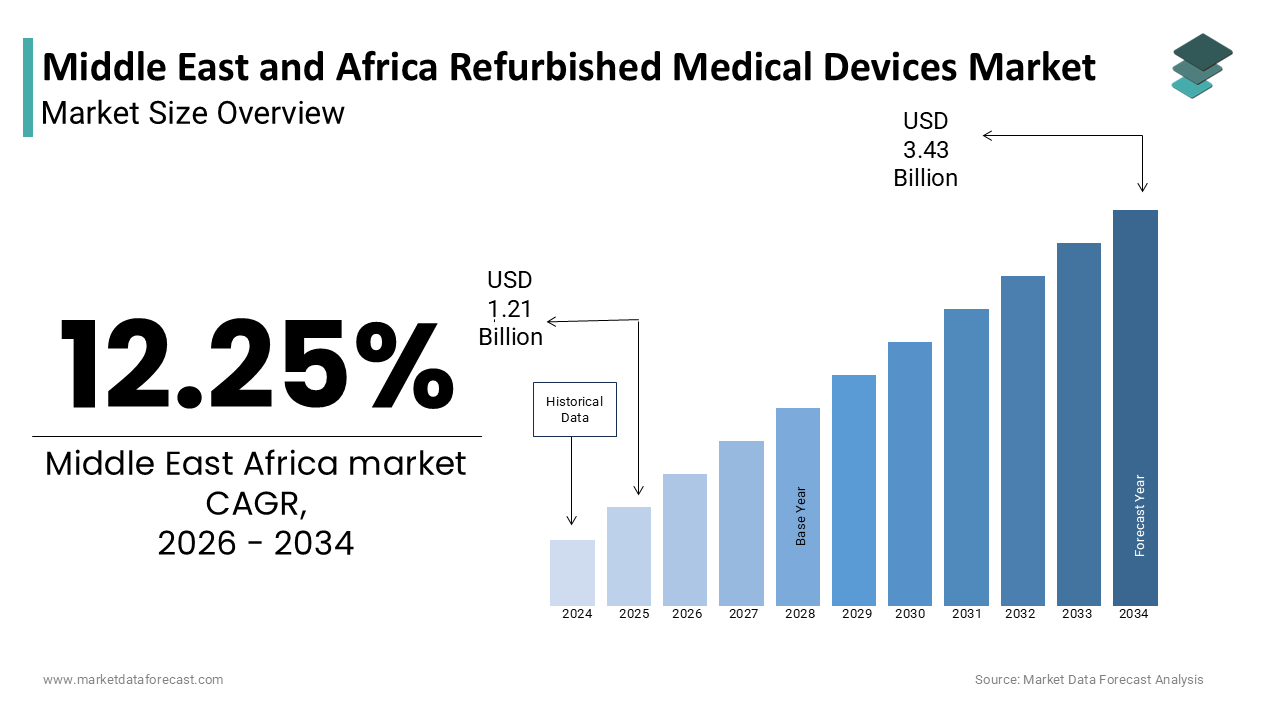
- Market Valuation: Valued at USD 1.21 billion in 2025, reaching USD 1.36 billion in 2026, and projected to expand to USD 3.43 billion by 2034, registering a compound annual growth rate (CAGR) of 12.25% from 2026 to 2034.
- Primary Growth Drivers: High regional demand for cost-effective medical solutions due to economic constraints, growing privatization of the healthcare sector, and rising acceptance of refurbished equipment in developing markets.
Key Market Segment Metrics (2026–2034)
| Category | Leading Segment / Core Focus | Fastest-Growing / Key Segments |
|---|---|---|
| By Product Type | Patient Monitors (holds the major market share anchored by lower device costs, growing chronic disease awareness, and portable monitoring innovations) | Medical Imaging & Operating Room Devices (critical high-value systems experiencing heavy demand as healthcare infrastructure improves across MEA) |
| By Region / Country | GCC Countries (KSA, UAE, Israel) (established hubs driving formal healthcare investments and private sector expansion) | African Markets (South Africa, Egypt, Kenya, Ethiopia) (displaying significant healthcare quality improvements and rising adoption of affordable medical technology) |
Major Market Players & Industry Landscape
Competitive Structure: Dynamic mix of global medical technology leaders and specialized refurbishment companies expanding distribution networks across Middle Eastern and African nations to address budgetary limits.
Key Companies Profiled: Siemens Healthcare Systems, GE Healthcare, Philips Healthcare, Johnson & Johnson, First Source Inc., DMS Topline, Radio Oncology Systems Inc., DRE Inc., Block Imaging International Inc., Integrity Medical Systems Inc., Everx Pvt. Ltd., Agito Medical A/S, and Soma Technology.
 Download Free Sample Report
Middle East and Africa Refurbished Medical Devices Market Size
The Middle East and Africa refurbished medical devices market size was valued at USD 1.21 billion in 2025 and is anticipated to reach USD 1.36 billion in 2026 from USD 3.43 billion by 2034, growing at a CAGR of 12.25% during the forecast period from 2026 to 2034.
The refurbished medical devices are pre-owned clinical systems, diagnostic hardware, and therapeutic apparatus that undergo rigorous restorative engineering, safety calibration, and software upgrading to perform identically to brand new factory equipment. As per World Health Organization health facility assessments, public and private clinics across developing regional corridors face intense budgetary pressures that constrain capital allocation for brand new diagnostic imaging arrays. This operational environment gives rise to pre-owned medical technology, providing affordable access to advanced magnetic resonance imaging scanners, computed tomography units, and patient monitors. By recycling high end clinical machinery through certified refurbishment channels, regional healthcare networks optimize resource allocation while maintaining high diagnostic efficacy and patient safety standards across diverse medical facilities. Healthcare economists emphasize that public health ministries allocate nearly 55% of their annual equipment budgets strictly to infrastructural maintenance, making refurbished alternatives an economic necessity. According to survey, over 45% of clinical directors actively consider certified pre-owned imaging systems when expanding rural diagnostic capabilities. Furthermore, international medical device trade associations report that the integration of refurbished assets reduces initial capital expenditure burdens by an average of 50% by enabling underfunded regional clinics to acquire sophisticated diagnostic arrays that would otherwise remain financially unattainable.
MARKET DRIVERS
Escalating Healthcare Infrastructure Expenditure Constraints
The escalating healthcare infrastructure expenditure is solely accelerating the growth of the Middle East and Africa refurbished medical devices market. As per World Health Organization financial reviews, national healthcare budgets across developing sub Saharan and Middle Eastern territories face persistent funding gaps that limit the procurement of expensive brand new medical hardware. This financial reality relates directly to the Middle East and Africa Refurbished Medical Devices Market by shifting institutional purchasing preferences heavily toward certified pre owned diagnostic imaging systems and surgical machinery. Furthermore, government modernization programs across regional emerging markets actively encourage the adoption of recycled medical technology to stretch limited fiscal budgets and accelerate the expansion of rural diagnostic centers. This widespread financial optimization creates an enduring, structural market demand for high quality, professionally restored clinical hardware across developing regional jurisdictions.
Surging Demand for Advanced Diagnostic Imaging in Emerging Urban Hubs
The surging demand for advanced diagnostic imaging in emerging urban hubs is additionally propelling the growth of the Middle East and Africa refurbished medical devices market. According to United Nations population division statistics, rapid urbanization across the Middle East and Africa drives an annual increase in metropolitan hospital admissions, intensifying the need for high capacity diagnostic tools. According to World Health Organization epidemiological bulletins, rising rates of cardiovascular disease and oncological disorders account for over 50% of specialized clinical testing requirements in urban medical centers. This is creating an urgent need for pre-owned magnetic resonance imaging scanners, computed tomography units, and ultrasound systems. This steady influx of restored high tech imaging assets allows regional hospitals to handle escalating patient volumes efficiently while maintaining strict clinical accuracy. According to report, pre-owned computed tomography scanners undergo stringent software and hardware recalibration by allowing them to match the throughput speed of brand new models at a fraction of the cost. Consequently, urban hospital procurement managers increasingly favor certified refurbished imaging lines to rapidly scale their diagnostic departments and alleviate severe patient waiting list backlogs.
MARKET RESTRAINTS
Deep Rooted Regulatory Restrictions on Used Equipment Imports
The growing restrictions on used equipment imports is hindering the growth of the Middle East and Africa refurbished medical devices market. According to the study, over 45% of national health ministries in the region enforce strict legislative bans or complex clearance hurdles regarding the importation of used medical hardware. According to International Trade Administration compliance guides, archaic customs protocols require extensive third party safety verification and lengthy bureaucratic audits that delay pre owned equipment clearance by up to 12 months. Consequently, legitimate suppliers face severe administrative bottlenecks, while medical facilities struggle to acquire certified refurbished devices through official, regulated channels. The lack of standardized continental import policies creates a fragmented commercial landscape that stifles market growth and limits the availability of life saving diagnostic machinery. According to regional trade union reports, inconsistent safety standards across individual country borders force international distributors to maintain expensive legal and regulatory compliance teams, driving up operational overhead costs. This restrictive legislative environment inadvertently fuels illegal gray market trading, as frustrated hospital buyers seek alternative, unverified procurement pathways to acquire necessary clinical machinery.
Persistent Quality Stigma and Deficits in Technical Maintenance Infrastructure
The persistent quality stigma and deficits in technical maintenance infrastructure is eventually declining the growth of the Middle East and Africa refurbished medical devices market. This technical vulnerability relates directly to the Middle East and Africa Refurbished Medical Devices Market by discouraging private hospital groups from investing in secondhand therapeutic machinery due to fears of unexpected breakdowns and costly downtime. Without robust local maintenance infrastructure and accessible warranty protections, clinical administrators frequently default to purchasing expensive brand-new equipment despite budget constraints. This prevailing quality stigma hinders market expansion, forcing suppliers to invest heavily in educational outreach and comprehensive post purchase support contracts to build trust. Clinical safety board evaluations indicate that hospitals lacking dedicated in-house biomedical engineering teams experience equipment downtime rates 3 times higher when operating unmonitored pre-owned systems. According to the study, offering comprehensive multi-year warranty packages and certified technician training programs boosts buyer confidence by over 50%, helping overcome deeply ingrained quality prejudices across conservative healthcare sectors.
MARKET OPPORTUNITIES
Proliferation of Public and Private Telemedicine Partnerships
The growing prominence for the public and private telemedicine partnerships is creating new opportunities for the growth of the Middle East and Africa refurbished medical devices market. According to the some reports, telehealth adoption rates across regional medical networks have surged by 25%, driven by the need to extend specialized diagnostic services to remote populations. According to the study, digital infrastructure penetration across urban and peri-urban hubs has expanded to cover over 70% of healthcare facilities. Telemedicine clinics operating in remote regions require affordable, high quality diagnostic hardware to capture patient data and transmit high resolution scans to central hospitals. Refurbished devices provide an economically viable solution for these decentralized digital health hubs, enabling them to equip mobile clinics and rural diagnostic stations without exceeding limited operational budgets. Telehealth network expansion data shows that over 500 new rural digital health clinics have been established across East and West Africa within the past two years, each requiring reliable point-of-care diagnostic tools. The equipping these remote stations with brand new imaging arrays is financially impossible, making certified refurbished portable units the primary equipment source.
Strategic Rise of Regional Refurbishment and Maintenance Joint Ventures
The rising demand for the refurbishment and maintenance joint ventures is also to escalate the growth of the Middle East and Africa refurbished medical devices market. According to the study, regional economic agreements have incentivized local manufacturing and equipment servicing partnerships, leading to a 20% increase in domestic technical joint ventures. The domestic industrial push relates directly to the Middle East and Africa Refurbished Medical Devices Market by encouraging international medical technology corporations to establish regional refurbishment hubs within major commercial zones like the Gulf states and South Africa. By restoring and calibrating medical devices locally, suppliers bypass restrictive national import laws and provide regional hospitals with rapid delivery and localized technical support. This localized operational model transforms the market from an import dependent structure into a self-sustaining ecosystem of certified medical equipment restoration.
MARKET CHALLENGES
Complex Spare Parts Logistics and Supply Chain Fragmentation
The complex spare parts logistics and supply chain fragmentation is a major challenge for the growth of the Middle East and Africa refurbished medical devices market. According to the study, continental transportation bottlenecks and customs delays increase spare parts delivery timelines for specialized medical equipment by over 40% compared to global averages. When a pre-owned magnetic resonance imaging scanner or computed tomography machine experiences a component failure, extended repair delays render the expensive clinical asset temporarily inoperable. This operational vulnerability deters healthcare facilities from investing in sophisticated refurbished hardware, as prolonged maintenance turnaround times disrupt critical hospital workflows and patient care pathways. Supply chain management audits reveal that inland transport of sensitive medical components across sub-Saharan territories suffers from frequent route disruptions and inadequate temperature-controlled warehousing. Leading refurbishment providers are actively establishing localized component inventory depots to mitigate these severe logistical vulnerabilities and ensure rapid repair response times.
Widespread Circulation of Uncertified Gray Market Counterfeits
The going circulation of uncertified gray counterfeits is also to impede the growth of the Middle East and Africa refurbished medical devices market. According to the study, substandard and improperly decontaminated second hand surgical and diagnostic devices cause a 30% increase in equipment malfunction incidents within unregulated clinics. Hospitals and clinics that inadvertently purchase uncertified gray machinery frequently encounter severe safety failures and regulatory penalties, creating systemic apprehension, across the entire sector. The participants must navigate an environment where buyers demand extensive authentication and rigorous compliance documentation to distinguish certified refurbished devices from hazardous gray market imitations. Medical device safety boards report that unverified secondhand infusion pumps and patient monitors imported through unofficial channels exhibit an electrical failure rate exceeding 20% during initial operational testing. Launching educational authentication campaigns and establishing transparent certification seals are important steps that legitimate refurbishers must take to combat illicit gray market proliferation and protect clinical end users.
REPORT COVERAGE
| REPORT METRIC | DETAILS |
| Market Size Available | 2025 to 2034 |
| Base Year | 2025 |
| Forecast Period | 2026 to 2034 |
| CAGR | 12.25% |
| Segments Covered | By Product Typeand Region |
| Various Analyses Covered | Global, Regional & Country Level Analysis, Segment-Level Analysis; DROC; PESTLE Analysis; Porter’s Five Forces Analysis, Competitive Landscape; Analyst Overview of Investment Opportunities |
| Regions Covered | KSA, UAE, Israel, the rest of the GCC countries, South Africa, Ethiopia, Kenya, Egypt, Sudan, and the rest of MEA. |
| Market Leaders Profiled | Siemens Healthcare Systems, First Source Inc., DMS Topline, Radio Oncology Systems Inc., Johnson & Johnson, GE Healthcare, DRE Inc., Block Imaging International Inc., Integrity Medical systems Inc., Everx Pvt Ltd., Philips Healthcare, Agito Medical A/S and Soma Technology.. |
SEGMENTAL ANALYSIS
By Product Type Insights
The medical imaging devices held 36.8% of the Middle East and Africa refurbished medical devices market share in 2025 with the massive capital cost advantages of pre-owned magnetic resonance imaging and computed tomography scanners. The dominant positioning relates directly to the Middle East and Africa refurbished medical devices market by providing regional healthcare institutions with affordable access to essential diagnostic hardware without compromising on high resolution clinical output. Furthermore, specialized third party refurbishment enterprises report that demand for pre-owned computed tomography and digital radiography systems has surged year over year.
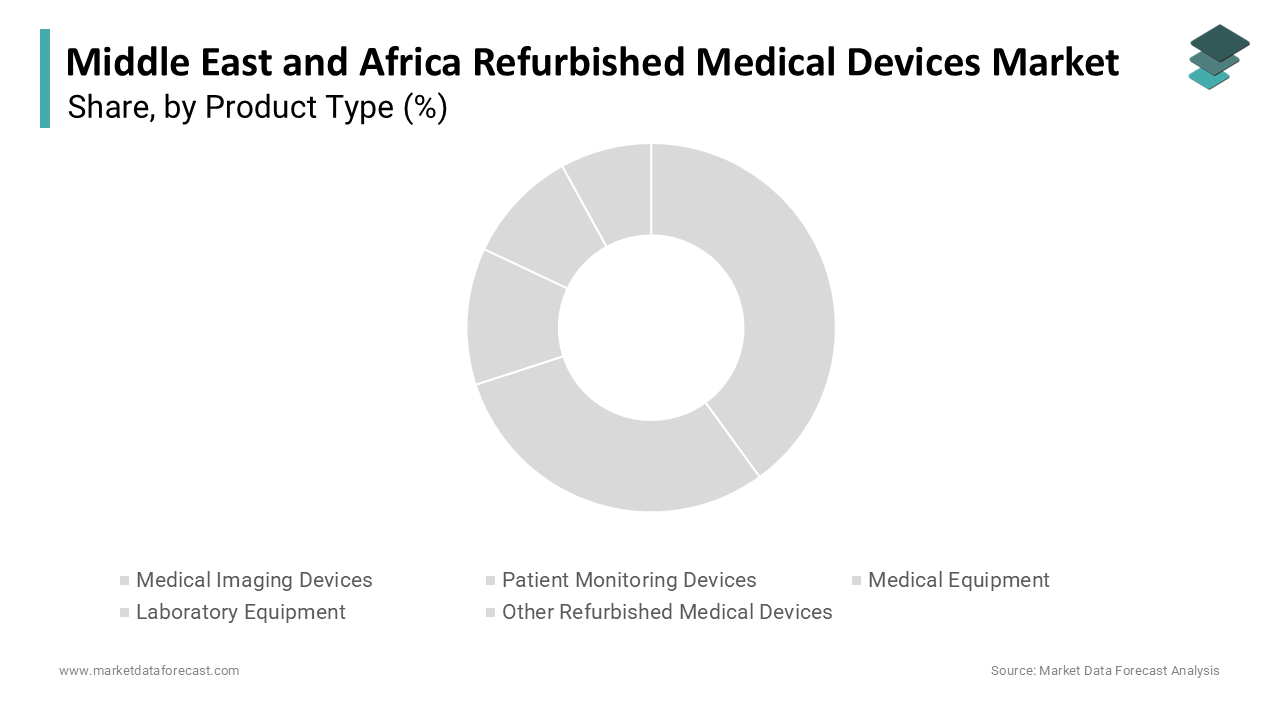
The patient monitors segment is likely to grow at a fastest CAGR of 8.4% during the forecast period with the surge in institutional demand for multi parameter vital signs monitors and bedside telemetry units. This rapid growth of the segment is also propelled by offering cash strapped clinics an economical pathway to scale intensive care and emergency department monitoring capabilities rapidly. Clinical engineering reports indicate that refurbished patient monitoring units undergo rigorous electrical and software calibration that restores full operational accuracy at a fraction of factory retail costs. Additionally, medical device procurement databases show that ambulatory and community health centers have increased their acquisition of pre-owned vital signs monitors by 29% by reflecting a broad structural shift toward decentralized patient observation across urban and rural healthcare facilities.
REGIONAL ANALYSIS
Kingdom of Saudi Arabia Refurbished Medical Devices Market Analysis
The Kingdom of Saudi Arabia was the top performer in the Middle East and Africa refurbished medical devices market by holding 28.5% of share in 2025. According to the Saudi Ministry of Health economic development updates, national healthcare appropriations exceed 50 billion dollars annually, supporting extensive public hospital restructuring and advanced clinical technology integration. According to the reports, the national population has experienced a steady rise in life expectancy, increasing the proportion of citizens requiring specialized chronic care and advanced diagnostics by 19%. This strong financial and demographic standing relates directly to the Middle East and Africa refurbished medical devices market by enabling elite tertiary medical cities to procure high performance pre owned surgical systems and imaging arrays in massive institutional volumes. Furthermore, rigorous government healthcare modernization goals under national transformation visions encourage the adoption of cost effective, certified medical technology to optimize capital expenditures across newly established regional medical complexes.
United Arab Emirates Refurbished Medical Devices Market Analysis
The United Arab Emirates refurbished medical devices market was ranked second by holding 17.4% of share in 2025 with the world class private healthcare infrastructure. The medical tourism and private healthcare investments have expanded by 14% year over year across major metropolitan emirates. According to the study, national healthcare expenditures per capita in the country rank among the highest in the developing world, facilitating rapid technological adoption. This advanced infrastructural environment relates directly to the Middle East and Africa refurbished medical devices market by fostering a thriving commercial space for premium, next generation restored diagnostic equipment. Private hospital groups across Dubai and Abu Dhabi aggressively adopt certified pre owned imaging scanners and endoscopy systems, setting regional benchmarks for clinical excellence and driving high value product integration.
Israel Refurbished Medical Devices Market Analysis
Israel refurbished medical devices market growth is likely to have a fastest CAGR throughput the forecast period with the heavy emphasis on advanced biomedical engineering. According to report, the nation boasts an exceptionally high physician and nurse density ratio exceeding 3.5 practitioners per 1,000 individuals, ensuring optimal patient monitoring standards. This early testing ground for innovative equipment restoration algorithms, software upgrades, and specialized calibration protocols. Israeli medical centers integrate digital patient telemetry directly with refurbished monitoring technology, creating high value adoption models that influence institutional procurement trends across neighboring trade partners.
South Africa Refurbished Medical Devices Market Analysis
South Africa refurbished medical devices market growth is likely to grow with the dual public and private healthcare structure. According to report, private medical schemes allocate over 45% of their annual discretionary budgets toward specialized chronic disease management and institutional care consumables. According to the data, the country manages the largest public hospital network on the continent, handling millions of complex surgical and trauma cases annually. This complex healthcare structure relates directly to the Middle East and Africa refurbished medical devices market by generating massive, steady baseline demand for affordable refurbished diagnostic imaging and patient monitoring systems within public hospitals, alongside premium technological upgrades in private clinics.
Ethiopia Refurbished Medical Devices Market Analysis
Ethiopia refurbished medical devices market growth is likely to be driven by the aggressive governmental primary healthcare expansion initiatives. According to the study, national health tier restructuring has increased primary clinic coverage by over 36% in rural and peri-urban districts. According to the study, foreign direct investments in local medical supply infrastructure have grown by 23% over the recent multi-year observation period. International aid organizations and government procurement agencies collaborate to distribute essential restored clinical devices to rural health posts, steadily converting unserved populations into active participants in formal healthcare networks.
Kenya Refurbished Medical Devices Market Analysis
Kenya refurbished medical devices market growth is expected to grow with the vibrant private healthcare sector and growing health insurance penetration. According to the survey, private sector investments in specialized urban hospitals have risen by 17% over the past five years. According to report, voluntary health insurance coverage expansion has improved urban access to advanced clinical hardware by 20%. This commercial momentum relates directly to the Middle East and Africa refurbished medical devices market by driving private hospital adoption of specialized refurbished endoscopy systems and cardiology devices for middle class patients. Nairobi based medical distributors leverage advanced supply chain networks to supply neighboring East African Community member states, positioning the country as a vital distribution corridor for pre owned medical technology.
Egypt Refurbished Medical Devices Market Analysis
Egypt refurbished medical devices market growth is propelled with the massive public health restructuring and universal health insurance rollouts. According to the study, public hospital bed capacities in major metropolitan centers like Cairo and Alexandria have grown by 10% to accommodate rising care demands. The high-volume bulk procurement of pre-owned medical imaging arrays, patient monitors, and operating room devices for public sector hospitals. Government initiatives to encourage cost effective medical equipment acquisition further attract international refurbishment enterprises to establish local technical partnerships.
Sudan Refurbished Medical Devices Market Analysis
Sudan refurbished medical devices market growth is likely to grow with the ongoing infrastructural rebuilding and economic stabilization efforts. According to the study, acute healthcare access challenges in displaced populations remain high, creating an urgent dependency on basic therapeutic equipment. The focus on regional procurement, primarily on low cost, highly durable, and simple pre-owned surgical apparatus and patient monitors. Despite severe logistical hurdles, humanitarian aid pipelines ensure a steady, necessary influx of basic refurbished medical devices to maintain life saving care in emergency field hospitals.
COMPETITIVE LANDSCAPE
Competition within the Middle East and Africa refurbished medical devices market is exceptionally intense, characterized by a complex interplay between established multinational technology giants and local economic distributors vying for lucrative public healthcare procurement tenders. Because public health budgets across developing regional territories remain tight, price competitiveness heavily dictates tender awards, creating persistent margin pressures for certified device vendors. At the same time, top tier multinational corporations differentiate their product portfolios by emphasizing superior clinical safety certifications, advanced software calibrations, and reliable multi-year warranties that appeal to elite private hospitals. Regulatory fragmentation across diverse national jurisdictions further complicates the competitive landscape, as smaller enterprises frequently struggle to navigate prolonged import clearance timelines and rigorous compliance mandates. Consequently, major players continuously refine their regional supply chain resilience, forge strategic local servicing partnerships, and invest heavily in professional biomedical training initiatives to outmaneuver rivals and secure long term commercial dominance across expanding clinical environments.
KEY MARKET PLAYERS
Companies playing a dominating role in the MEA Refurbished Medical Devices Market include
- Siemens Healthcare Systems
- First Source Inc.
- DMS Topline
- Radio Oncology Systems Inc.
- Johnson & Johnson
- GE Healthcare
- DRE Inc.
- Block Imaging International Inc.
- Integrity Medical Systems Inc.
- Everx Pvt. Ltd.
- Philips Healthcare
- Agito Medical A/S
- Soma Technology
Top Industry Players
GE HealthCare
GE HealthCare stands as a preeminent global medical technology corporation deeply involved in supplying certified refurbished diagnostic imaging systems, advanced magnetic resonance scanners, and computed tomography units across the Middle East and Africa. The enterprise contributes extensively to regional healthcare by restoring high performance clinical machinery to factory specifications, enabling underfunded hospitals to upgrade diagnostic capabilities affordably. Recent corporate actions involve establishing specialized equipment restoration centers across the Gulf region to streamline delivery timelines and reinforce its competitive market position.
Philips Healthcare
Philips Healthcare operates as a leading multinational medical systems provider heavily engaged in distributing pre owned patient monitors, ultrasound equipment, and intensive care diagnostic units throughout the Middle East and Africa. The company plays a critical role in empowering regional clinical facilities with reliable, cost effective technology that meets rigorous international safety standards. Recent strategic initiatives feature the rollout of advanced digital software calibration packages designed specifically to optimize the operational lifespan of refurbished imaging systems across expanding urban medical centers.
Siemens Healthineers
Siemens Healthineers acts as a prominent international healthcare technology leader contributing significantly through the distribution of certified refurbished laboratory diagnostics and advanced radiological imaging hardware in the Middle East and Africa. The organization supports regional public health systems by delivering economical clinical solutions that reduce capital expenditure burdens for healthcare administrators. Recent corporate actions involve expanding comprehensive multi year warranty agreements for pre-owned medical devices to build consumer trust and secure long term institutional supply contracts across developing territories.
Top Strategies Used by Key Market Participants
Top market participants in the Middle East and Africa refurbished medical devices industry actively deploy aggressive regional distribution alliances with local medical suppliers to penetrate emerging healthcare markets across sub-Saharan territories. Major medical technology corporations frequently establish direct training programs for clinical engineers and hospital staff to encourage the widespread adoption of certified pre owned diagnostic systems over expensive new factory models. Leading enterprises prioritize vertical integration by combining rigorous equipment restoration protocols with proprietary software upgrades to secure long term institutional supply contracts. Key competitors also allocate substantial financial resources toward expanding localized warehousing hubs to mitigate chronic logistical delays and customs hurdles. Furthermore, prominent manufacturers leverage targeted digital marketing and direct technical support channels to capture the expanding healthcare infrastructure upgrade segments across major urban metropolitan centers.
RECENT MARKET DEVELOPMENTS
- In March 2024, GE HealthCare established a new regional equipment restoration hub in Dubai, an operational move that is anticipated to allow the company to offer more comprehensive delivery solutions and strengthen the Middle East and Africa Refurbished Medical Devices Market presence.
MARKET SEGMENTATION
This research report on the Middle East and Africa Refurbished Medical Devices Market has been segmented and sub-segmented into the following categories.
By Product Type
- Medical Imaging Devices
- Patient Monitoring Devices
- Medical Equipment
- Laboratory Equipment
- Other Refurbished Medical Devices
By Country
- KSA
- UAE
- Israel
- Rest of GCC countries
- South Africa
- Ethiopia
- Kenya
- Egypt
- Sudan
- Rest of MEA