- Product Description Description
- Table of Contents TOC
- List of Table & Figure LOT
- Get Free Sample PDF Sample PDF
Market Size, 2025
$276.27 MnMarket Estimate, 2026
$329.67 MnMarket Forecast, 2034
$1355.43 MnCAGR, 2026–2034
19.33%Executive Summary: Middle East and Africa Wheelchair Market
- Market Scope: Comprehensive regional wheelchair market analysis covering product categories, application sectors, demographic segments, country leadership frameworks, and IoT-enabled mobility trends.
- Market Valuation: Valued at USD 276.27 million (2025), estimated at USD 329.67 million (2026), and projected to reach USD 1355.43 million by 2033, registering a robust CAGR of 19.33% (2025–2033).
- Primary Growth Drivers: Aging population (UN estimating 45% growth in those aged 60+ by 2030), rising disability prevalence, government initiatives like Saudi Arabia’s Vision 2030, and expanded insurance coverage.
Key Market Segment Metrics (2025–2033)
| Category | Leading Segment (Base Position) | Fastest-Growing Segment |
|---|---|---|
| By Product Type | Manual Wheelchairs (dominate product types with a 65.8% share in 2025 due to affordability) | Electric / Smart Wheelchairs (expected to grow at a promising CAGR) |
| By Application Sector | Homecare (represents the largest application at 45.9% for independent living) | Hospitals (fastest-growing application segment across regional healthcare systems) |
| By Category & User | Adults Segment (constitute 80% of the category segment) | Pediatric Solutions (showing steady growth across regional markets) |
| By Region / Country | Saudi Arabia and UAE (lead regional markets supported by Vision 2030) and South Africa (manufacturing lead) | Expanding MEA healthcare infrastructure and localized manufacturing hubs |
Major Market Players & Market Structure
Market Structure: Highly competitive regional assistive technology landscape where major mobility manufacturers establish local joint ventures, expand electric portfolios through regional distributors, and scale affordable customized production.
Key Companies: Invacare Corporation, Sunrise Medical Limited, Permobil AB, Drive Medical Design & Manufacturing, Carex Health Brands, Ottobock SE & Co. KGaA, Pride Mobility Products Corporation, GF Health Products Inc., and Shonaquip SE.
Middle East and Africa Wheelchair Market Size
The Middle East and Africa Wheelchair Market was valued at USD 276.27 million in 2025, is estimated to reach USD 329.67 million in 2026, and is projected to reach USD 1355.43 million by 2033, growing at a CAGR of 19.33% from 2025 to 2033.
The Middle East and Africa (MEA) wheelchair market encompasses manual and electric wheelchairs, essential mobility devices aiding individuals with disabilities, injuries, or age-related conditions. Manual wheelchairs require user or attendant propulsion, while electric variants use motorized systems to enhance autonomy. These devices significantly improve the quality of life by promoting independent living and social inclusion. Market demand is driven by an aging population, increasing disability prevalence, and rising awareness of mobility aids.
In this regional market, Saudi Arabia, the UAE, South Africa, Nigeria, Kenya and Israel are experiencing steady growth in wheelchair demand. Government initiatives aimed at improving healthcare services and access to mobility aids, alongside technological advancements in powered wheelchairs, are key market drivers. With unmet demand in both rural and urban areas, the wheelchair market in the MEA region is expected to witness substantial growth over the next decade.
MARKET DRIVERS
-
Aging Population
The aging demographic in the MEA region is a major factor driving wheelchair demand. Countries like Saudi Arabia and South Africa are experiencing significant population shifts, with the elderly facing increased mobility challenges. Projections from the United Nations estimate a 45% growth in the population aged 60 and above by 2030, leading to increased demand for mobility aids, including wheelchairs.
-
Rising Prevalence of Disabilities
Disability rates across the MEA region are rising due to congenital conditions, injuries, and chronic diseases like diabetes. Particularly in Africa, the prevalence of disabilities resulting from spina bifida, accidents, and conflict-related injuries is growing. The World Health Organization (WHO) estimates that 15% of the global population lives with disabilities, with a large portion residing in low- and middle-income countries. This trend further drives the demand for mobility aids.
-
Government Policies and Initiatives
Governments in the MEA region are actively implementing policies to promote disability rights and improve access to mobility solutions. In the UAE, initiatives under the Dubai Disability Strategy 2020 focus on enhancing mobility for disabled individuals. South Africa’s Integrated National Disability Strategy (INDS) aims to provide mobility aids like wheelchairs to low-income populations, improving access to healthcare and public transport.
-
Technological Advancements
Innovations in electric wheelchair design, such as improved battery life, enhanced suspension systems, and smart technology integration, are transforming the market. For example, in 2023, advanced electric wheelchairs with IoT-enabled features were launched, enabling users to monitor performance in real-time. These advancements are expected to further drive wheelchair adoption across the region.
MARKET RESTRAINTS
-
High Costs
The high cost of electric and advanced manual wheelchairs remains a significant barrier, particularly in low-income regions. Basic electric wheelchairs can range from $2,000 to $10,000, which poses affordability challenges in countries where a large portion of the population lives below the poverty line. Governments and NGOs are working to provide affordable or subsidized options, but cost remains a critical issue, especially in rural areas.
-
Lack of Supporting Infrastructure
The inadequate infrastructure in many parts of the MEA region limits accessibility for wheelchair users. In countries like Nigeria and Kenya, urban planning has not fully incorporated the needs of disabled individuals, creating significant barriers in public spaces. Although progress has been made in cities like Dubai, many areas still lack the necessary facilities, such as ramps and accessible public transport.
-
Limited Awareness in Rural Areas
Rural communities in countries like Ethiopia and Uganda have limited knowledge of available mobility aids and healthcare services. WHO reports indicate that awareness of mobility solutions is low in these areas, restricting access for disabled individuals. Governments and NGOs are working to address this gap, but challenges persist in expanding awareness and accessibility in rural regions.
MARKET OPPORTUNITIES
-
Emerging Technologies
The integration of AI-driven smart wheelchairs and IoT-enabled features represents a significant growth opportunity in the MEA wheelchair market. These technologies enhance customization and safety, providing a more personalized mobility experience.
-
Healthcare Reforms and Insurance
Healthcare reforms across the MEA region are expanding insurance coverage for mobility aids. In Saudi Arabia, the Ministry of Health, in collaboration with private insurance companies, is working to include electric wheelchair coverage in national health insurance plans. South Africa is exploring public-private partnerships to subsidize wheelchairs for low-income populations, making mobility aids more affordable.
-
Export Opportunities
Countries such as South Africa and Kenya are becoming hubs for low-cost wheelchair production, creating export opportunities across the region. In 2023, South Africa exported over 50,000 wheelchairs to neighboring nations, such as Namibia and Botswana, meeting the growing demand for affordable mobility solutions. Local manufacturers are leveraging government-backed export initiatives to expand into Middle Eastern markets, offering cost-effective solutions for developing regions.
MARKET CHALLENGES
-
Supply Chain Issues
The MEA wheelchair market faces significant supply chain constraints, particularly in countries like Nigeria and Kenya, where reliance on imported components drives up costs. Import taxes and shipping delays further increase the financial burden. South Africa experienced supply chain disruptions in 2023 due to a global shortage of key components, impacting availability and prices.
-
Regulatory Hurdles
The regulatory environment across the MEA region is complex, presenting a challenge for wheelchair manufacturers entering the market. Countries like Saudi Arabia and Egypt have stringent medical device regulations, requiring thorough testing and approval processes. Divergent regulatory frameworks across the region create additional compliance challenges for manufacturers aiming to operate in multiple countries.
-
Lack of Skilled Workforce
A shortage of skilled healthcare professionals and technicians in countries like Uganda and Kenya poses a barrier to the assembly, maintenance, and operation of advanced electric wheelchairs. Although training programs for healthcare workers and technicians are being developed, significant gaps remain, especially in providing support services to wheelchair users.
REPORT COVERAGE
| REPORT METRIC | DETAILS |
| Market Size Available | 2025 to 2034 |
| Base Year | 2025 |
| Forecast Period | 2026 to 2034 |
| CAGR | 19.33% |
| Segments Covered | By Product,Category, Application and Region. |
| Various Analyses Covered | Global, Regional and Country Level Analysis; Segment-Level Analysis; DROC, PESTLE Analysis; Porter’s Five Forces Analysis; Competitive Landscape; Analyst Overview of Investment Opportunities |
| Regions Covered | Saudi Arabia (KSA), the United Arab Emirates (UAE), Israel, the Rest of the GCC countries, South Africa, Ethiopia, Kenya, Egypt, Sudan, and the Rest of the Middle East and Africa (MEA). |
| Market Leaders Profiled | Invacare, Sunrise Medical, Permobil, and Drive Medical offer a range of manual and electric wheelchairs. Invacare Corporation, Carex Health Brands, Ottobock, Sunrise Medical Limited, Drive Medical Design & Manufacturing, Pride Mobility Products Corp., and GF Health Products, Inc. |
SEGMENTAL ANALYSIS
By Product Insights
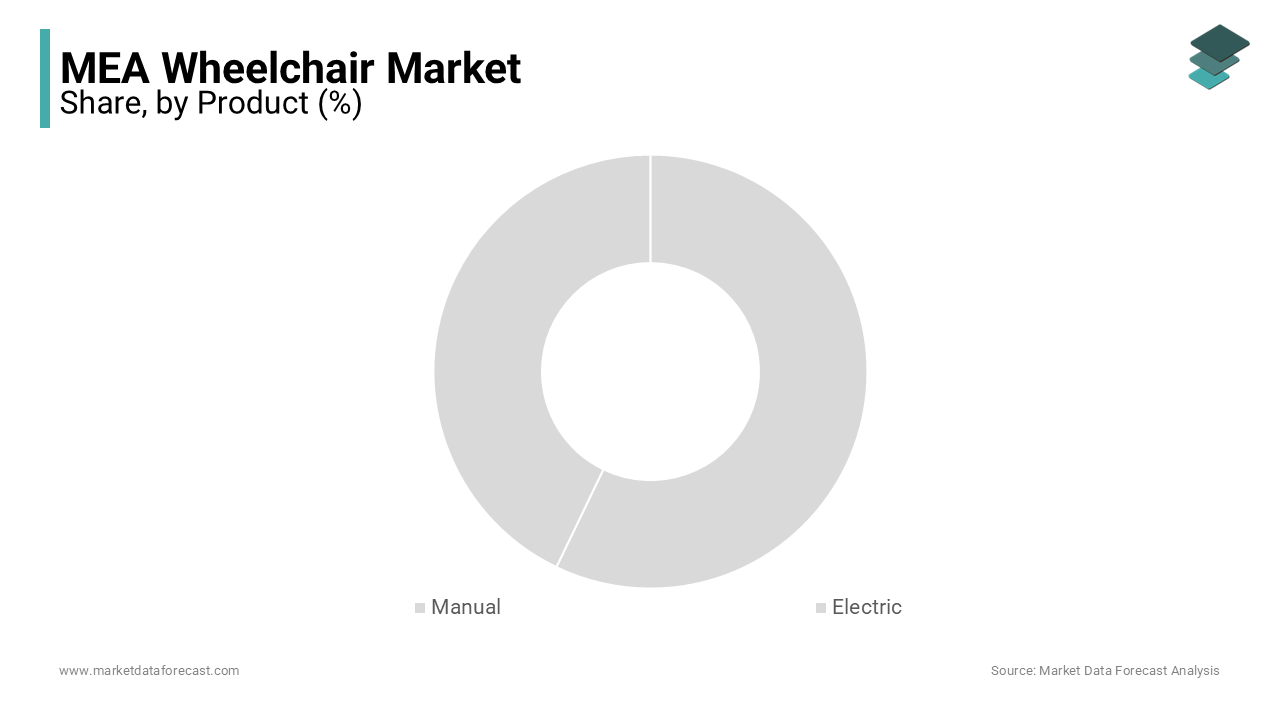
The manual wheelchairs dominate the MEA market, accounting for 65.8% of the market share in 2025, primarily due to their affordability and widespread use in lower-income regions like Sub-Saharan Africa. Manual wheelchairs are commonly employed in hospitals and rehabilitation centers. On the other hand, the electric wheelchairs segment is expected to grow at a promising CAGR during the forecast period, with adoption driven by technological advancements and more developed healthcare systems in countries such as Saudi Arabia and the UAE.
By Category Insights
The adults segment constitutes 80% of the MEA wheelchair market share, driven by the prevalence of mobility challenges related to aging. As the elderly population continues to grow, the demand for adult wheelchairs is anticipated to increase. The pediatric segment, while smaller, is growing at a steady CAGR, particularly as countries like South Africa and Egypt emphasize specialized mobility solutions for children with congenital disabilities and developmental disorders.
By Application Insights
The homecare segment represents the largest application segment, accounting for 45.9% of the market share in 2025. The rising demand for home-based care, particularly for elderly and disabled individuals, has fuelled the need for mobility solutions designed for home settings. The hospitals segment is the fastest-growing segment, driven by the increased deployment of advanced mobility aids in healthcare facilities, particularly in countries like Israel and Saudi Arabia.
REGIONAL ANALYSIS
Saudi Arabia and the UAE are key markets, bolstered by strong government initiatives and healthcare infrastructure development. Under Vision 2030, Saudi Arabia is prioritizing healthcare improvements for disabled individuals. In 2023, the UAE’s healthcare sector saw a 10% increase in mobility aid imports, driven by growing demand for electric wheelchairs. Both countries are investing in public infrastructure to enhance accessibility for wheelchair users.
Israel, known for its advanced healthcare system, is seeing increasing demand for innovative mobility solutions. By 2025, 80% of Israeli hospitals had upgraded their mobility aids, including electric wheelchairs with advanced features like voice activation. Israel’s focus on healthcare innovation positions it as a leader in high-tech wheelchair adoption.
South Africa is the leading market for wheelchairs in Africa, with established local manufacturers such as Shonaquip providing affordable mobility solutions. In 2023, the government initiated a program to distribute 100,000 free wheelchairs to low-income individuals, further driving market growth.
Nigeria and Kenya are emerging markets, with growing healthcare investments aimed at improving access to mobility aids. In 2022, Kenya allocated $20 million toward healthcare reforms, including assistive device subsidies. Nigeria is seeing increasing demand for electric wheelchairs, supported by heightened awareness and government programs. Africa faces challenges including high wheelchair costs, inadequate infrastructure, and limited local manufacturing capabilities. Wheelchair imports remain expensive, and local production is still developing. Governments, particularly in Kenya and Uganda, are addressing these challenges by supporting local manufacturing and expanding healthcare access in rural areas.
COMPETITIVE LANDSCAPE
The MEA wheelchair market is dominated by both global and local manufacturers. International companies such as Invacare, Sunrise Medical, Permobil, and Drive Medical offer a range of manual and electric wheelchairs. Invacare Corporation, Carex Health Brands, Ottobock, Sunrise Medical Limited, Drive Medical Design & Manufacturing, Pride Mobility Products Corp., and GF Health Products, Inc. are a few of the prominent companies operating in the MEA wheelchair market. These firms are expanding their presence in the region through strategic partnerships and collaborations. Local manufacturers like Shonaquip are playing a pivotal role in providing affordable, customized wheelchairs tailored to rural and low-income communities. By increasing local production, they are reducing costs and improving accessibility for underserved populations in Africa.
KEY MARKET PLAYERS
Some of the promising companies that are playing a dominating role in the global dialysis market include
- Invacare Corporation (U.S.)
- Sunrise Medical Limited (Germany)
- Permobil AB (Sweden)
- Drive Medical Design & Manufacturing (U.S.)
- Carex Health Brands (U.S.)
- Ottobock SE & Co. KGaA (Germany)
- Pride Mobility Products Corporation (U.S.)
- GF Health Products, Inc. (U.S.)
- Shonaquip SE (South Africa)
RECENT MARKET DEVELOPMENTS
- In 2023, Permobil partnered with a local distributor in Saudi Arabia to expand its electric wheelchair portfolio. Similarly, Drive Medical acquired Medline Industries' mobility division to scale production in the Middle East, while Invacare established a joint venture with Global Healthcare Group in South Africa, launching a local manufacturing unit. These developments highlight the trend of international companies collaborating with local players to strengthen their market position in the MEA region.
MARKET SEGMENTATION
This research report on the MEA wheelchair market has been segmented and sub-segmented into the following categories
By Product
- Manual
- Electric
By Category
- Adults
- Pediatric
By Application
- Homecare
- Hospitals
- Ambulatory Surgical Centers
- Rehabilitation Centers
By Country
- KSA
- UAE
- Israel
- rest of GCC countries
- South Africa
- Ethiopia
- Kenya
- Egypt
- Sudan
- rest of MEA