- Product Description Description
- Table of Contents TOC
- List of Table & Figure LOT
- Get Free Sample PDF Sample PDF
Market Size, 2025
$1.43 BnMarket Estimate, 2026
$1.49 BnMarket Forecast, 2034
$2.06 BnCAGR, 2026–2034
4.14%Global Medical Electrodes Market Size
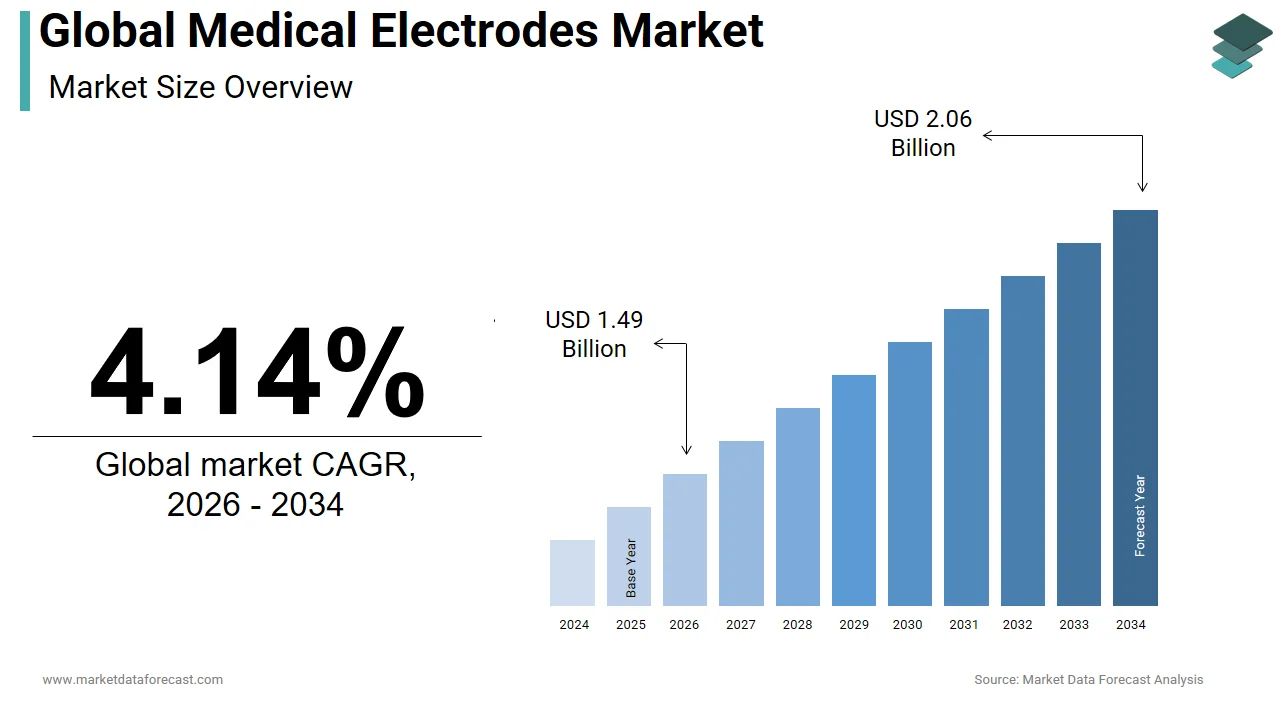
The global medical electrodes market was valued at USD 1.43 billion in 2025, is estimated to reach USD 1.49 billion in 2026, and is projected to reach USD 2.06 billion by 2034, growing at a CAGR of 4.14% from 2026 to 2034.
MARKET DRIVERS
Increasing global cardiology and neurology disease burden, increased focus on early diagnosis, and growing geriatric population are propelling the medical electrodes market worldwide.
The need for proper treatment of increased neurological and cardiovascular disorders to promote market growth. The incidence of neurological and cardiovascular diseases and sleep disorders has increased significantly over the years. According to the World Health Organization (WHO), cardiovascular disease (CVD) is one of the leading causes of death and disability worldwide. Globally, 17.9 million deaths from CVD were reported in 2016. The high mortality risk has increased the rate of frequent medical diagnoses, thereby increasing the compound annual growth rate of the market during the forecast period.
Medical electrodes are mainly implemented in electrocardiogram (ECG) monitoring devices to diagnose cardiac disorders. The ECG has been used as the most basic form of cardiovascular disease diagnosis, and test systems are evolving to meet today's technological demands. Such technological advancements in medical devices have fueled the market growth significantly over the analysis period.
Wearable medical devices are gaining attraction worldwide, providing benefits such as extended care and remote monitoring from doctor's clinics to patients' homes for chronic disease management. Through this, situations such as heart disease and diabetes are managed at cheap rates since they reduce the number of doctor or hospital visits, thereby driving the market growth over the forecast period. Additionally, growing demand for advanced diagnostic procedures and innovative products for diagnostic medical procedures globally are expected to drive market growth over the forecast period.
MARKET RESTRAINTS
Strict regulatory policies and guidelines offered by regulatory bodies associated with medical electrodes are expected to restrain market growth over the forecast period. Also, the problem related to the biocompatibility of medical electrodes and different approval processes in various countries is a significant impediment to the medical electrode market. Moreover, in some underdeveloped or developing countries, there is a lack of awareness about these devices' associated technological advancement and benefits. This is also hampering the expansion of this market during the forecast period.
REPORT COVERAGE
| REPORT METRIC | DETAILS |
| Market Size Available | 2025 to 2034 |
| Base Year | 2025 |
| Forecast Period | 2026 to 2034 |
| Segments Covered | By Usability, Product, Application, End-User & Region. |
| Various Analyses Covered | Global, Regional and Country-Level Analysis, Segment-Level Analysis, Drivers, Restraints, Opportunities, Challenges; PESTLE Analysis; Porter’s Five Forces Analysis, Competitive Landscape, Analyst Overview of Investment Opportunities |
| Regions Covered | North America, Europe, Asia Pacific, Latin America, Middle East & Africa |
| Market Leaders Profiled | CONMED, Dymedix Diagnostics, Ambu A/S, Cognionics Inc., Natus Medical Incorporated., General Electric Company, Medtronic PLC, CONMED Corporation, Compumedics Limited, Rhythmlink International LLC, Nihon Kohden Corporation, Medtronic PLC, Koninklijke Philips N.V., 3M Company and Lepu Medical Technology |
SEGMENTAL ANALYSIS
By Application Insights
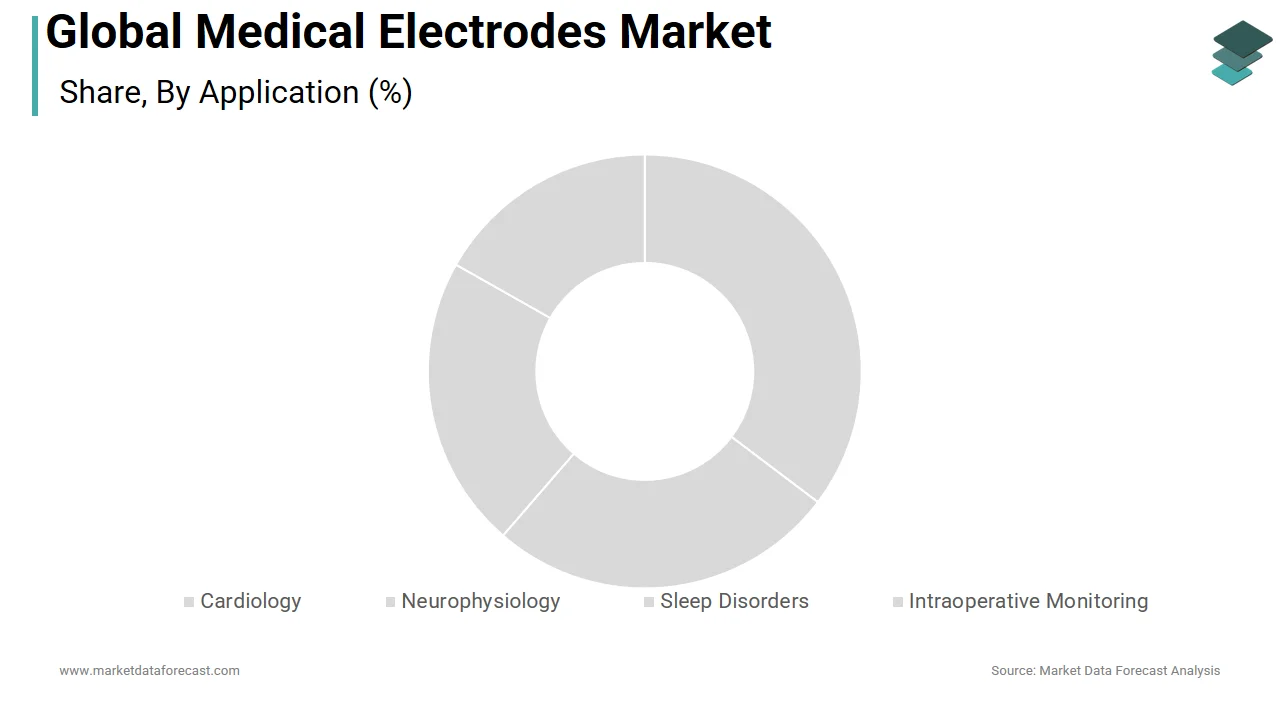
Cardiology application is expected to emerge as a significant profitable ground for the medical electrodes market. This is due to the increase in the cases of cardiovascular diseases worldwide. Nowadays, heart diseases such as coronary arteries, high blood pressure, cardiomyopathy, etc., gradually show rejuvenation. Therefore, early cardiovascular screening is essential to increase the success rate of treatment and reasonable control of the disease. ECG is the most widely used method in cardiovascular screening. Therefore, it is expected to dominate the market in the application of medical electrodes.
But due to the increase in neurophysiological disorders, the market is also expected to grow in neurophysiology. An EEG can also help diagnose or treat Brain tumors, one of the severe joint disorders.
By Modality Insights
Electrocardiography (ECG) by modality in medical electrodes market revenue is expected to dominate with the growing number of cardiological diseases worldwide. ECG electrodes are conductive, wearable, and adhesive. An ECG can help detect arrhythmias, where the heart beats too slowly, too fast, or irregularly. It is also helpful in detecting coronary artery disease, where the blood supply to the heart is blocked or interrupted by an accumulation of fatty substances. And the most common disorder, heart attacks, when the blood supply to the heart is suddenly blocked, are diagnosed through ECG. Therefore, the growing emphasis on early diagnosis is the leading cause for driving the market expansion.
However, EEG or Electroencephalography is also expected to dominate the market over the forecast period. EEG is most often used to diagnose epilepsy. It is also used to diagnose coma, encephalopathies, sleep disorders, depth of anesthesia, and brain death. One of the most excellent benefits of EEG is the ability to see brain activity as it happens in real-time, down to the millisecond level.
By Product Type Insights
According to the type of product in the medical electrodes market, surface electrodes are expected to dominate during the forecast period. Surface electrodes are being accepted more in physiological and clinical applications. The advantage of surface electrodes is that there is no need to anesthetize the patient before placing the electrode; they are also non-invasive. The operation is simple and painless. Non-invasive electrodes are applied to the subject's skin to record the EMG. Silver/silver chloride electrodes have been found to give an adequate signal-to-noise ratio and are electrically very stable. For this reason, surface electrodes are widely used.
However, needle or intramuscular wire electrodes are also expected to dominate the market. The concentric ring needle with a single monopolar electrode is the most widely used needle electrode. Additionally, they are preferable to surface electrodes because they more accurately assess upcoming action potentials and can directly enter individual motor units.
REGIONAL ANALYSIS
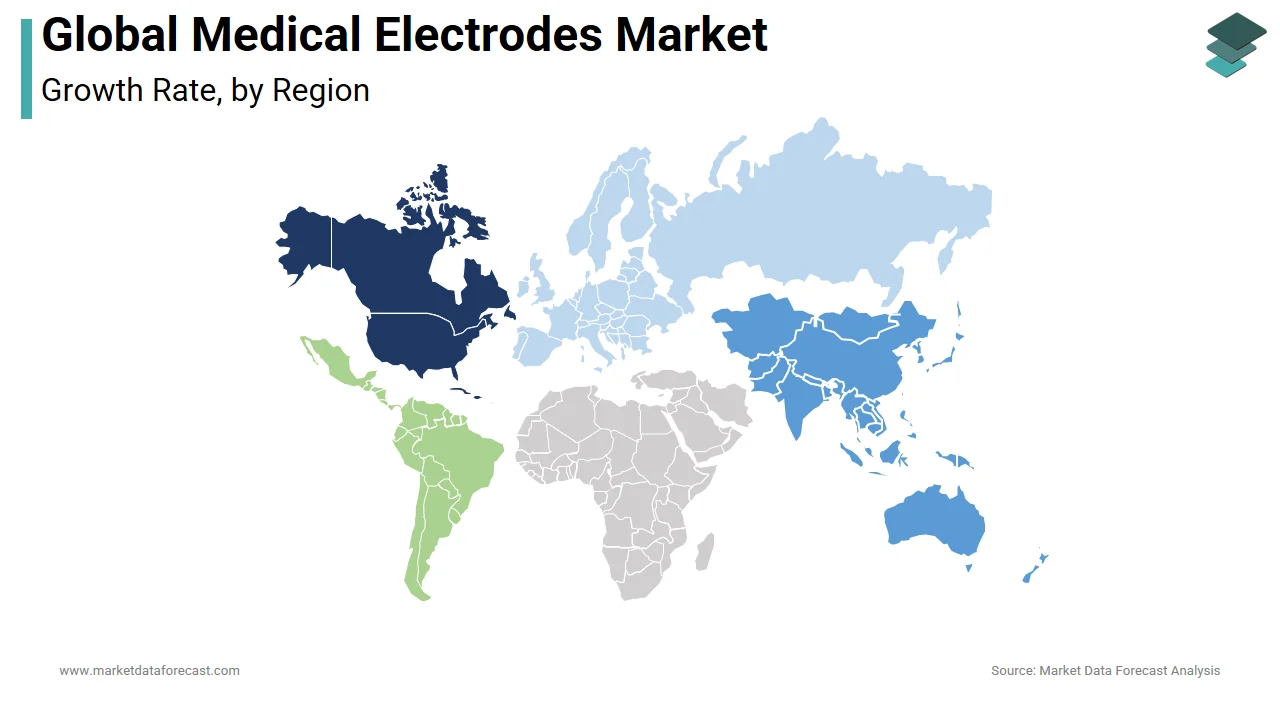
North America led the market, accounting for a significant share of the market in 2024 and doing the same over the forecast period owing to better healthcare, infrastructure, and efficient government. However, due to the growing interest in technological advancements in medical electrodes, the increasing geriatric population, the incidence of chronic diseases, and high healthcare expenditures in the region, North America gave way to skyrocketing healthcare costs in the region.
As far as Asia-Pacific is concerned, the market is expected to grow at a remarkable rate, owing to the growing number of vendors entering untapped emerging economies. In addition, increased spending related to health development in emerging countries will further boost regional growth.
Due to the presence of prominent vendors, the European market is expected to grow significantly during the forecast period.
KEY MARKET PARTICIPANTS
Some of the companies that are playing a dominating role in the global medical electrodes market include
- CONMED
- Dymedix Diagnostics
- Ambu A/S
- Cognionics Inc.
- Natus Medical Incorporated
- General Electric Company
- Medtronic PLC
- CONMED Corporation
- Compumedics Limited
- Rhythmlink International LLC
- Nihon Kohden Corporation
- Koninklijke Philips N.V.
- 3M Company
- Lepu Medical Technology
MARKET SEGMENTATION
This research report on the global medical electrodes market has been segmented and sub-segmented based on usability, product, application, end-user & region.
By Application
- Cardiology
- Neurophysiology
- Sleep Disorders
- Intraoperative Monitoring
By Modality
- Electromyography (EMG)
- Electrocardiography (ECG)
- Electroencephalography (EEG)
- Brainstem Auditory Evoked Potentials (BAEPS)
By Product Type
- Surface Electrodes
- Needle Electrodes
By Region
- North America
- Europe
- Asia-Pacific
- Latin America
- Middle East and Africa