- Product Description Description
- Table of Contents TOC
- List of Table & Figure LOT
- Get Free Sample PDF Sample PDF
Middle East and Africa Active, Smart, and Intelligent Packaging Market Size
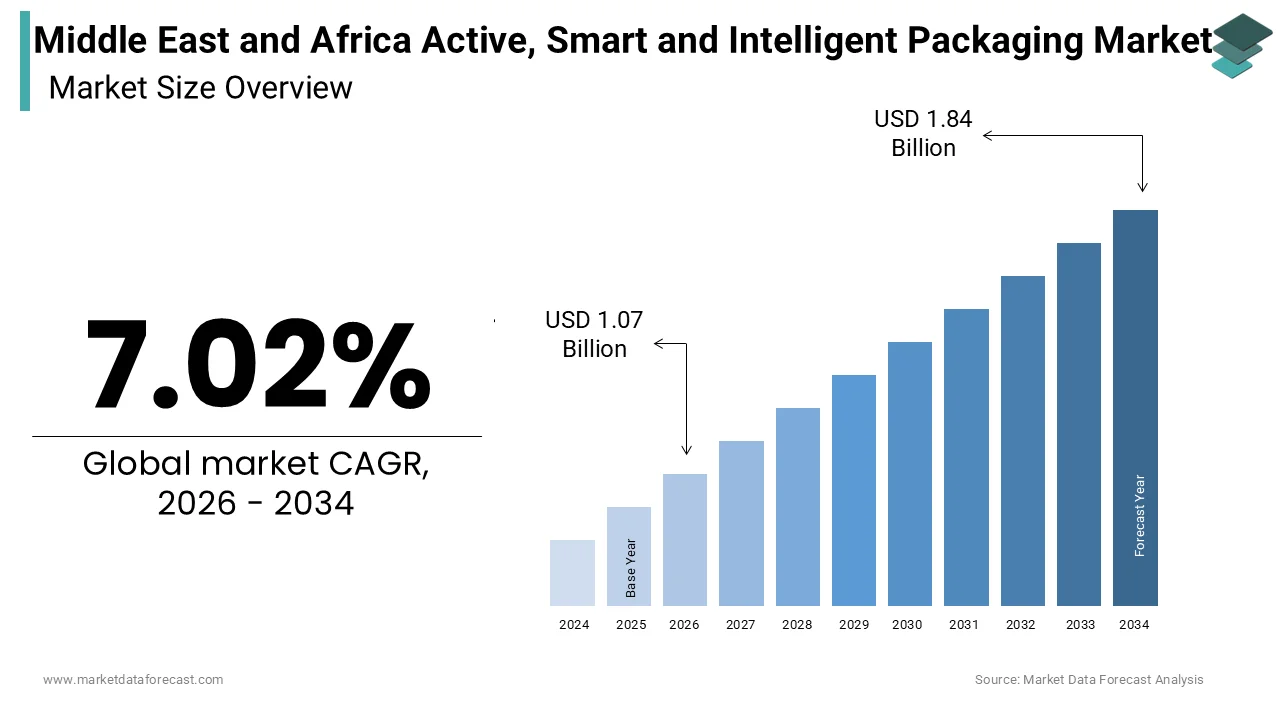
The Middle East and Africa Active, Smart, and Intelligent Packaging Market size was calculated to be USD 1 billion in 2025 and is anticipated to be worth USD 1.84 billion by 2034, from USD 1.07 billion in 2026, growing at a CAGR of 7.02% during the forecast period.
The active smart and intelligent packaging is a transformative shift in the preservation and monitoring of goods, integrating advanced technologies directly into packaging materials to extend shelf life and ensure product integrity. In the Middle East and Africa region, this innovation is gaining traction as supply chains expand across vast geographical distances with varying climatic conditions. Active packaging involves substances that interact with the product to maintain freshness, such as oxygen scavengers or moisture absorbers, while intelligent packaging utilizes indicators and sensors to communicate the status of the contents to consumers and retailers. According to the Food and Agriculture Organization of the United Nations, approximately 14% of food produced globally is lost between harvest and retail level,s with higher rates observed in developing regions due to inadequate storage and transportation infrastructure. The adoption of these advanced packaging solutions addresses critical issues related to food security and pharmaceutical safety. The substandard and falsified medical products pose a significant threat in low- and middle-income countries, where temperature-sensitive vaccines and medicines are prevalent. Governments in Gulf Cooperation Council nations are investing heavily in logistics modernization to support their vision of becoming global trade hubs. This regulatory and infrastructural push creates a fertile ground for the integration of smart packaging technologies.
MARKET DRIVERS
High Rates of Food Waste Drive Adoption of Active Preservation Technologies
The alarming rates of food waste for the adoption of active packaging technologies designed to extend the shelf life of perishable goods, which is a major factor promoting the growth of the Middle East and Africa active smart and intelligent packaging market. In many parts of the region, inadequate cold chain infrastructure and high ambient temperatures accelerate spoilage, leading to significant economic losses for farmers and retailers. According to the United Nations Environment Programme, the Middle East and North Africa region generates some of the highest per capita food waste rates globally, with estimates suggesting that up to 30% of food is wasted at the consumption stage. Active packaging solutions, such as ethylene absorbers and antimicrobial films, help mitigate this issue by slowing down the ripening process and inhibiting microbial growth. Retailers and distributors are increasingly adopting these technologies to minimize inventory losses and ensure that products remain fresh for longer periods. The economic incentive to reduce waste is particularly strong in import-dependent countries where food security is a strategic priority. This urgent need to preserve nutritional value and reduce environmental impact drives sustained demand for active packaging solutions across the region.
Counterfeit Pharmaceuticals Necessitate Intelligent Tracking and Authentication Systems
The pervasive issue of counterfeit pharmaceuticals in parts of Africa and the Middle East necessitates the implementation of intelligent packaging systems that provide robust tracking and authentication capabilities. The counterfeit pharmaceuticals necessitate intelligent tracking and authentication systems, which is also propelling the growth of the Middle East and Africa smart and intelligent packaging market. Fake medicines not only result in financial losses for legitimate manufacturers but also pose severe health risks to patients who receive ineffective or harmful treatments. According to the World Health Organization, approximately 10% of medical products in low and middle-income countries are substandard or falsified, with higher rates reported in certain African nations. Intelligent packaging technologies such as radio frequency identification tags, quick response codes, and near field communication labels enable end-to-end traceability from manufacturing to point of sale. These smart features allow consumers, healthcare providers, and regulators to verify the authenticity of drugs instantly using smartphones or specialized scanners. The integration of tamper-evident indicators further enhances security by revealing any unauthorized access to the packaging. Pharmaceutical companies are prioritizing these solutions to protect their brand reputation and ensure patient safety. Regulatory mandates in countries like South Africa and Egypt are increasingly requiring such measures for essential medicines.
MARKET RESTRAINTS
Limited Cold Chain Infrastructure Restrains Widespread Implementation
The limited availability of reliable cold chain infrastructure in many parts, with the widespread implementation of active and intelligent packaging solutions, is hindering the growth of the Middle East and Africa active, smart, and intelligent packaging market. While these technologies can extend shelf life, they often require specific storage conditions to function optimally, and their effectiveness is compromised if the ambient temperature exceeds certain thresholds. According to the study, less than 10% of perishable foods in sub-Saharan Africa are transported under controlled temperature conditions, leading to rapid degradation of quality. Active packaging components, such as time temperature indicators, rely on consistent thermal environments to provide accurate data regarding product freshness. A significant investment is needed to bridge the infrastructure gap, but progress remains slow due to high capital costs and energy reliability issues. In regions with frequent power outages, maintaining the cold chain becomes challenging, reducing the reliability of smart sensors that monitor temperature fluctuations.
High Initial Costs and Technical Complexity Impact Affordability
The high initial costs and technical complexity associated with active and intelligent packaging impact affordability and limit their adoption among small and medium-sized enterprises, which is also hindering the growth of the Middle East and Africa smart and intelligent packaging market. These advanced packaging solutions involve expensive materials, such as nanocomposite sensors and printed electronics, which significantly increase the unit cost compared to traditional packaging. Many businesses in the Middle East and Africa operate on thin margins and lack the financial resources to absorb these additional costs without passing them on to consumers. The lack of local manufacturing capabilities for smart packaging components means that most materials must be imported, leading to higher prices due to tariffs and logistics expenses. The technical expertise required to integrate these systems into existing production lines is also scarce, requiring extensive training and consultancy services. Small-scale farmers and local food processors, who constitute a large portion of the regional economy, find it difficult to justify the investment given the price sensitivity of their target markets. Consumers in lower-income segments are often unwilling to pay a premium for packaged goods even if they offer enhanced safety or freshness. This economic barrier restricts the market to multinational corporations and high-end brands, leaving a significant portion of the population underserved.
MARKET OPPORTUNITIES
Expansion of E-Commerce and Digital Retail Creates New Avenues
The rapid expansion of e-commerce and digital retail is driving the adoption of intelligent packaging technologies that enhance the online shopping experience, which is likely to foster new opportunities for the growth of the Middle East and Africa smart and intelligent packaging market. As consumers increasingly purchase groceries and pharmaceuticals online, there is a growing need for packaging that ensures product integrity during last-mile delivery and provides proof of authenticity. Intelligent packaging features, such as tamper-evident seals and quick response codes, allow customers to verify that their orders have not been compromised during transit. The digital transformation initiatives are encouraging retailers to adopt smart logistics solutions that include real-time tracking and condition monitoring. Brands are using smart packaging to engage consumers through interactive content such as recipes or usage instructions accessible via scanned codes. This digital engagement builds brand loyalty and provides valuable data on consumer behavior. The convenience of home delivery combined with the assurance of product quality offered by smart packaging drives its adoption in the retail sector.
Government Initiatives for Food Security and Safety Promote Adoption
The government initiatives focused on enhancing food security and safety are promoting the adoption of active and intelligent packaging technologies, which is another attribute to fuel the growth of the Middle East and Africa smart and intelligent packaging market. Many nations in the region are implementing strict regulations to reduce food waste and ensure the quality of imported and locally produced goods. National strategies prioritize the reduction of food loss through technological innovation, including advanced packaging solutions. These policies encourage manufacturers to adopt active packaging that extends shelf life and reduces reliance on preservatives. The efforts to combat counterfeit drugs include mandates for serialization and track and trace systems, which rely on intelligent packaging technologies. Public-private partnerships are being formed to develop sustainable packaging solutions that align with national environmental goals. The emphasis on achieving self-sufficiency in food production drives investment in post-harvest technologies, including smart storage and packaging.
MARKET CHALLENGES
Integration with the Internet of Things Poses Technical Challenges
The integration of active and intelligent packaging with the Internet of Things poses significant technical challenges due to connectivity issues and a lack of standardized protocols, is to restrict the growth of the Middle East and Africa active smart and intelligent packaging market. Smart packaging relies on seamless data transmission between sensors, cloud platforms, and user devices, which requires robust and ubiquitous internet infrastructure. According to the International Telecommunication Union, while mobile broadband coverage has improved in urban areas of the Middle East and Africa, rural regions still face significant connectivity gaps. This limitation hinders the real-time monitoring capabilities of intelligent packaging systems, particularly in remote agricultural areas. As per the GSMA Association, the fragmentation of mobile networks and varying data costs complicate the deployment of large-scale IoT solutions for packaging. Additionally, the lack of universal standards for data exchange between different packaging suppliers and logistics providers creates interoperability issues. Companies struggle to integrate smart packaging data into their existing enterprise resource planning systems due to incompatible formats. The complexity of managing large volumes of data generated by millions of smart packages requires advanced analytics capabilities, which are often lacking in local firms. Cybersecurity concerns also arise as connected packaging becomes a potential entry point for digital attacks. Addressing these technical hurdles requires substantial investment in infrastructure and standardization efforts, which are currently lagging behind market demand.
Recycling and Disposal of Complex Materials Create Environmental Concerns
The recycling and disposal of complex materials used in active and intelligent packaging create environmental concerns that are specifically added as a challenge for the growth of the Middle East and Africa smart and intelligent packaging market. These packaging solutions often combine traditional materials like paper or plastic with electronic components, sensors, and chemical agents, making them difficult to separate and recycle using existing waste management systems. According to the United Nations Environment Programme, waste management infrastructure in many African countries is inadequate, with low rates of formal recycling and high levels of informal dumping. The presence of non-biodegradable electronic elements in smart packaging exacerbates the problem of electronic waste, which is already a growing concern in the region. Consumers and regulators are increasingly demanding eco-friendly packaging solutions, but current active and intelligent options often fail to meet these criteria. The conflict between the functional benefits of smart packaging and its environmental footprint creates a dilemma for manufacturers. Developing biodegradable sensors and easily separable components is technically challenging and costly.
REPORT COVERAGE
| REPORT METRIC | DETAILS |
| Market Size Available | 2025 to 2034 |
| Base Year | 2025 |
| Forecast Period | 2026 to 2034 |
| CAGR | 7.02% |
| Segments Covered | By Application, Technology, And Country |
| Various Analyses Covered | Regional and Country Level Analysis; Segment-Level Analysis; DROC; PESTLE Analysis; Porter’s Five Forces Analysis; Competitive Landscape; Analyst Overview of Investment Opportunities |
| Regions Covered | KSA, UAE, Israel, the rest of GCC countries, South Africa, Ethiopia, Kenya, Egypt, Sudan, and the Rest of MEA |
| Market Leaders Profiled | M&G USA Corporation, Sysco Corporation, Sealed Air Corporation, Eastman Chemical Company, Timestrip P, nd Paksense Incorporated, Multisorb Technologies, Ball Corporation, Amcor Limited. |
SEGMENTAL ANALYSIS
By Application Insights
The meat and poultry segment was the largest by holding 44.3% of the Middle East and Africa active smart and intelligent packaging market share in 2025 due to the high perishability of these products and the significant economic losses associated with spoilage in hot climates. The region experiences elevated ambient temperatures for much of the year, which accelerates bacterial growth and degradation of protein-rich foods. Active packaging solutions, such as oxygen scavengers and antimicrobial films, are critical in extending the shelf life of fresh and processed meats by inhibiting microbial activity and oxidation. The kingdom imports a substantial portion of its meat supply, necessitating robust preservation technologies to ensure quality during long-distance transportation. Consumers in Gulf Cooperation Council countries have high purchasing power and demand premium quality fresh meat, driving retailers to adopt advanced packaging to maintain freshness and visual appeal. Intelligent indicators that monitor temperature abuse provide assurance to buyers regarding product safety. The cultural preference for fresh rather than frozen meat in many Middle Eastern households further increases the reliance on active packaging to bridge the gap between slaughter and consumption.
The pharmaceuticals segment is likely to witness the fastest CAGR of 11.2% throughout the forecast period, with the urgent need to combat counterfeit medicines and ensure drug efficacy. The prevalence of falsified medical products in the region poses severe public health risks and undermines confidence in healthcare systems. Many medical products in low and middle-income countries are substandard or falsified, with higher rates in certain African nations. Intelligent packaging solutions such as serialization, holograms, and near-field communication tags provide robust authentication mechanisms that allow patients and pharmacists to verify drug authenticity instantly. The distribution of temperature-sensitive vaccines and biologics in remote areas requires active packaging with time-temperature indicators to ensure potency is maintained. Governments in countries like South Africa and Egypt are investing in digital health infrastructure that integrates with smart packaging data. The rising burden of chronic diseases increases the volume of pharmaceutical shipments requiring secure and monitored packaging.
By Technology Insights
The modified atmosphere packaging segment was the largest by holding 33.2% of the Middle East and Africa active smart and intelligent packaging market share in 2025 due to its proven effectiveness in preserving the freshness and quality of perishable foods, such as fruits, vegetables, and meats. This technology involves replacing the air inside a package with a protective gas mixture typically consisting of carbon dioxide, nitrogen, and oxygen to slow down respiration and microbial growth. In regions with limited cold chain infrastructure, this technology provides a cost-effective alternative to refrigeration for short to medium distance transport. The guidelines for food safety encourage the use of approved packaging methods that enhance product stability without chemical preservatives. The widespread availability of machinery for modified atmosphere packaging in large processing facilities in countries like Egypt and South Africa facilitates its adoption. Retailers prefer this technology because it maintains the visual appeal of products, which is crucial for consumer purchasing decisions. The ability to customize gas mixtures for different types of produce allows for versatile applications across various food categories.
The intelligent packaging segment is deemed to grow at the fastest CAGR of 10.8% throughout the forecast period, with the broader digital transformation of supply chains and increasing consumer engagement strategies. This technology includes indicator sensors and data carriers that provide information about the condition of the product or its environment. Brands are leveraging this connectivity to offer personalized experiences such as recipe suggestions, authenticity verification, and loyalty rewards. The emirate is positioning itself as a global hub for innovation, including the adoption of Internet of Things technologies in logistics and retail. Intelligent packaging allows companies to gather valuable data on consumer behavior and supply chain performance, optimizing inventory management and marketing strategies. The rise of e-commerce further boosts demand for smart labels that provide proof of delivery and condition monitoring. Regulatory mandates for traceability in pharmaceuticals and high-value foods also contribute to this growth.
REGIONAL ANALYSIS
United Arab Emirates Active, Smart, and Intelligent Packaging Market Insights
The United Arab Emirates' active smart and intelligent packaging market held second position by holding 22.1% of share in 2025, with its status as a global logistics and trade hub connecting East and West. The country’s advanced infrastructure and pro-business policies attract multinational corporations that require sophisticated packaging solutions for re-export and local distribution. The presence of major airports and seaports facilitates the import of high-value perishable goods that require active preservation technologies. The initiatives to promote innovation include support for startups developing smart packaging technologies. The high disposable income of residents drives demand for premium packaged foods and pharmaceuticals with enhanced safety features. The government’s commitment to sustainability encourages the adoption of eco-friendly smart packaging options. The integration of digital technologies in the retail and healthcare sectors further accelerates market growth.
Saudi Arabia Active, Smart, and Intelligent Packaging Market Insights
Saudi Arabia's active smart and intelligent packaging market was the top performer by capturing 22.3% of the share in 2025 with its ambitious Vision 2030 initiatives, which prioritize economic diversification and technological innovation. The kingdom is investing heavily in modernizing its food and pharmaceutical supply chains to reduce waste and enhance self-sufficiency. The non-oil sector is seeing significant foreign direct investment in manufacturing and logistics, including advanced packaging solutions. The large population and high consumption of imported fresh foods create a substantial demand for preservation technologies. The strict regulations on food safety and drug authenticity mandate the use of traceable and secure packaging systems. The development of new industrial cities and logistics hubs facilitates the local production and distribution of smart packaging materials. Government subsidies for small and medium enterprises encourage the adoption of innovative technologies. The cultural emphasis on hospitality and high-quality food service further drives demand for premium packaging.
South Africa Active, Smart, and Intelligent Packaging Market Insights
South Africa's active smart and intelligent packaging market growth is likely to grow with the relatively advanced industrial base and well-developed retail sector. The country has a mature manufacturing industry capable of producing and distributing advanced packaging materials to neighboring nations. In South Africa, the formal retail sector is highly concentrated with major chains demanding high standards for product quality and safety. The prevalence of counterfeit goods in the region drives the adoption of intelligent packaging for pharmaceuticals and luxury items. The regulations requiring serialization and track and trace systems are being implemented to combat fake medicines. The agricultural export sector benefits from active packaging technologies that extend the shelf life of fruits and meats for international markets. Local research institutions collaborate with industry to develop solutions tailored to regional challenges.
COMPETITION OVERVIEW
The competition in the Middle East and Africa active smart and intelligent packaging market is characterized by the presence of global multinational corporations alongside emerging regional players who leverage local insights and agility. Major international firms dominate due to their advanced technological capabilities, extensive product portfolio,s and established global supply chains. These companies benefit from economies of scale, allowing them to offer competitive pricing and comprehensive technical support. Regional competitors focus on niche segments, such as halal-certified smart packaging or solutions for specific agricultural exports, often benefiting from lower operational costs and faster response times. The market features high barriers to entry due to the significant capital investment required for research and development of smart technologies. Competition is driven by innovation in sustainability traceability, and ease of use rather than price alone. Strategic alliances with local distributors are crucial for navigating complex regulatory environments and cultural nuances. The lack of standardized infrastructure in some areas creates opportunities for companies that offer robust and adaptable solutions. Continuous innovation in material science and digital integration differentiates leading brands.
KEY MARKET PLAYERS
Major Players of the Middle East and Africa Active smart and Intelligent Packaging Market include
- M&G USA Corporation
- Sysco Corporation
- Sealed Air Corporation
- Eastman Chemical Company
- Timestrip PL
- DPaksense Incorporated
- Multisorb Technologies
- Ball Corporation
- Amcor Limited.
TOP STRATEGIES USED BY KEY MARKET PARTICIPANTS
Key players in the Middle East and Africa active smart and intelligent packaging market primarily employ strategic partnerships with local manufacturers and logistics providers to enhance distribution networks and market penetration. Companies invest heavily in research and development to create cost-effective solutions tailored to regional climatic conditions and infrastructure limitations. Product localization involves adapting smart packaging technologies to comply with diverse regulatory frameworks and cultural preferences across different countries. Expansion of production facilities in key hubs like South Africa and the United Arab Emirates improves supply chain resilience and reduces lead times. Digital integration strategies focus on connecting smart packaging data with enterprise resource planning systems for real-time monitoring. Sustainability initiatives drive the development of recyclable and biodegradable smart materials to meet environmental standards.
LEADING PLAYERS IN THE MIDDLE EAST AND AFRICA ACTIVE, SMART, AND INTELLIGENT PACKAGING MARKET
- Amcor plc maintains a significant presence in the Middle East and Africa by providing innovative packaging solutions that enhance product safety and shelf life. The company leverages its global expertise to deliver active packaging technologies, such as modified atmosphere systems for fresh produce and meats. Amcor focuses on collaborating with local food producers to develop customized solutions that address specific climatic challenges. These initiatives strengthen its market position by ensuring reliable supply chains and high-quality standards. The company also invests in research and development to create recyclable smart packaging materials.
- Sonoco Products Company contributes significantly to the MEA market through its comprehensive portfolio of protective packaging solutions, including active and intelligent systems. The company serves various industries, such as food and beverage and healthcare, with technologies that monitor product condition and extend freshness. Recent actions involve partnering with logistics providers in the United Arab Emirates to integrate smart tracking features into supply chain operations. Sonoco emphasizes customer-centric innovation by developing tamper-evident and temperature-sensitive indicators for pharmaceutical exports. These efforts enhance operational efficiency and reduce waste for clients.
- Mondi plc plays a vital role in the MEA active smart and intelligent packaging sector by offering sustainable paper-based packaging with integrated smart features. The company combines its strong forestry assets with advanced technology to create eco-friendly solutions that appeal to environmentally conscious consumers. Recent actions include launching new recycled packaging lines in Egypt that incorporate quick response codes for traceability and consumer engagement. Mondi collaborates with retail chains to implement intelligent labeling systems that improve inventory management and reduce spoilage. These strategies enhance brand loyalty and operational transparency for partners. The company also invests in digital printing technologies to enable personalized packaging experiences.
MARKET SEGMENTATION
This research report on the Middle East and Africa Active, Smart, and Intelligent Packaging Market has been segmented and sub-segmented based on application, technology, & region.
By Application
- Frozen Processed Food
- Chilled Processed Food
- Dried Processed Food
- Dairy
- Packaged Food
- Meat And Poultry
- Sea Food
By Technology
- Active Packaging
- Modified Atmosphere Packaging
- Intelligent Packaging
By Region
- KSA
- UAE
- Israel
- The rest of the GCC countries
- South Africa
- Ethiopia
- Kenya
- Egypt
- Sudan
- Rest of MEA