- Product Description Description
- Table of Contents TOC
- List of Table & Figure LOT
- Get Free Sample PDF Sample PDF
Market Size, 2025
$2.69 BnMarket Estimate, 2026
$2.82 BnMarket Forecast, 2034
$4.15 BnCAGR, 2026–2034
4.925%Middle East and Africa Agricultural Films Market Size, Share, Trends & Forecast (2026–2034)
- Market Scope: Regional analysis of the Middle East and Africa (MEA) agricultural films sector, evaluating polymer film types (LLDPE, LDPE, Reclaim, EVA, HDPE), core application areas (greenhouse films, mulch films, silage films), and key country markets across KSA, UAE, Israel, GCC nations, South Africa, and North/East African economies.
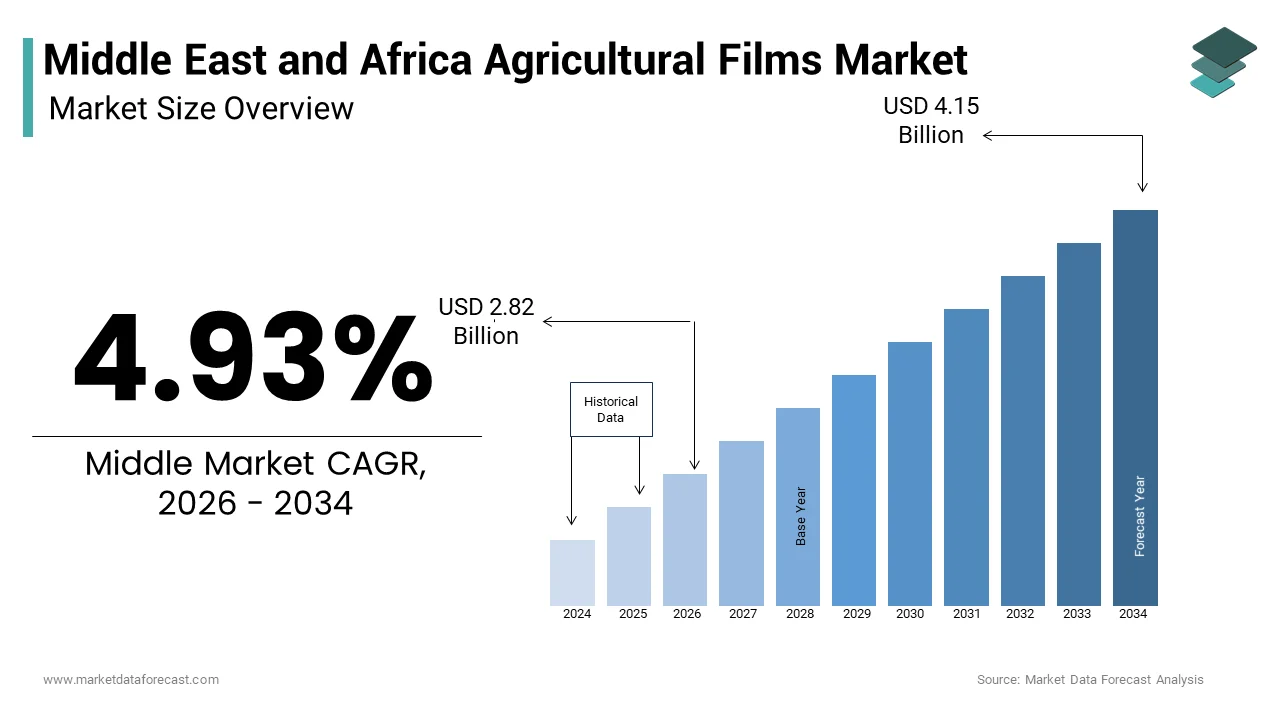
- Market Valuation: Valued at USD 2.69 billion in 2025, estimated at USD 2.82 billion in 2026, and projected to reach USD 4.15 billion by 2034, expanding at a compound annual growth rate (CAGR) of 4.92% during the forecast period from 2026 to 2034.
- Primary Growth Drivers: Acute shortage of arable land and water scarcity in the Middle East accelerating protected greenhouse agriculture, favorable government policies promoting food security, and the largely untapped agricultural potential across African nations.
Middle East and Africa Agricultural Films Market Segment Metrics (2026–2034)
| Category | Leading Segment / Baseline Position | Fastest-Growing Segment |
|---|---|---|
| By Type / Material | Linear Low-Density Polyethylene (LLDPE) (commands major market share due to high durability, tensile strength, and enhanced thermal properties) | LLDPE & Biodegradable Polymer Blends (driven by climate adaptation needs and sustainable agricultural practices) |
| By Application | Mulch Film (leads regional application demand for soil moisture conservation and weed control in arid conditions) | Greenhouse Films (projected to witness the fastest growth, propelled by commercial greenhouse expansion across the Middle East) |
| By Country / Region | GCC Countries (KSA & UAE lead regional adoption via state-backed food security and protected agriculture initiatives) | Africa & Rest of MEA (demonstrating high growth potential through commercialization and untapped agricultural development) |
Major Industry Players & Market Structure
Market Structure: Competitive regional landscape dominated by international polymer giants and local packaging converters supplying high-performance protective covers for extreme climates.
Key Companies: The Dow Chemical Company, BASF SE, ExxonMobil Corporation (U.S.), RKW SE, Berry Plastic Group, Inc., Grupo Armando Alvarez, British Polythene Industries Plc., and Barbier Group.
 Download Free Sample Report
Middle East and Africa Agricultural Films Market Size
The Middle East and Africa agricultural films market size was valued at USD 2.69 billion in 2025 and is anticipated to reach USD 2.82 billion in 2026 to reach USD 4.15 billion by 2034, growing at a CAGR of 4.925% from 2026 to 2034.
Agricultural films are used for covering greenhouses and are used to cover soil or wrapped around fodder. They aid in the improvement of crop quality and raise overall productivity. The increasing need to raise agricultural productivity to fulfill the daily requirements of the population has led to the commercialization of these specialty coverings.
Growing requirements for food owing to the rise in population, coupled with the increasing requirement for optimum agricultural productivity, are expected to drive market growth. The rise in the requirement for high-quality crops and the decline in arable land are projected to raise product requirements over the coming years. Various innovations in the industry, including Ultra Violet (UV) blocking, fluorescent, NIR blocking, and ultra-thermic films, are expected to impact product requirements positively over the coming years. However, environmental concerns regarding product disposal and strict government regulations regarding plastics and polyethylene are expected to hamper growth ishortlyand affect the agricultural films market growth. However, the introduction of biodegradable and bio-based polymer films is expected to create lucrative opportunities for industry participants over the next few years. Biodegradable agricultural films are getting popular in eco-friendly regions. Technological advancements in horticulture, coupled with the development of particle, multi-layer, and UV protection films to increase agricultural productivity, are expected to raise product requirements over the foreseeable future.
REPORT COVERAGE
| REPORT METRIC | DETAILS |
| Market Size Available | 2025 to 2034 |
| Base Year | 2025 |
| Forecast Period | 2026 to 2034 |
| CAGR | 4.92% |
| Segments Covered | By Type, Application, Region. |
| Various Analyses Covered | Global, Regional & Country Level Analysis, Segment-Level Analysis, DROC, PESTLE Analysis, Porter’s Five Forces Analysis, Competitive Landscape, Analyst Overview of Investment Opportunities |
| Regions Covered | KSA, UAE, Israel, rest of GCC countries, South Africa, Ethiopia, Kenya, Egypt, Sudan, rest of MEA |
| Market Leaders Profiled | Dow Chemical Company, BASF SE, ExxonMobil Corporation (U.S.), RKW SE, Berry Plastic Group, Inc., Grupo Armando Alvarez, British Polythene Industries Plc., and Barbier Group. |
SEGMENT ANALYSIS
By Type Insights
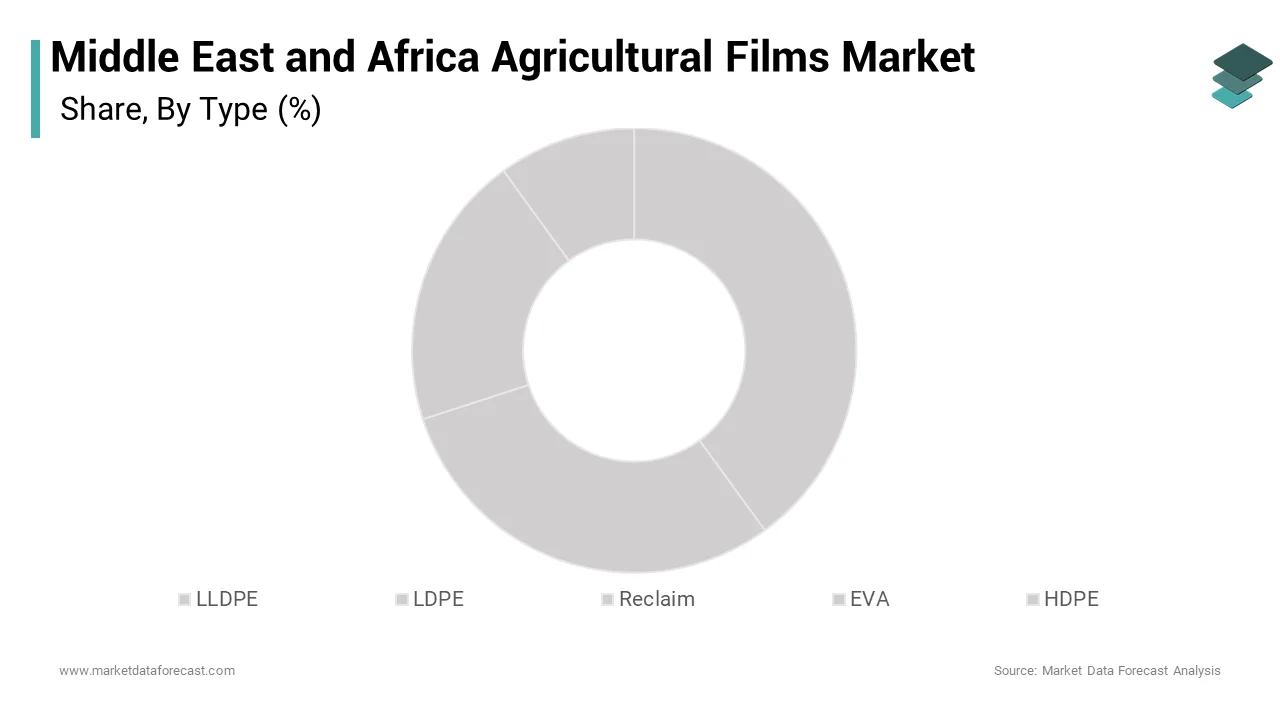
LLDPE has the major market share in this segment and is expected to witness the fastest growth. Factors such as high durability, the extended shelf life of finished products with high tensile strength, and improved thermal properties are expected to drive market growth. Meanwhile, LLDPE and LDPE are expected to witness high requirements in the Asia Pacific, especially in China, due to their applications being highly beneficial in areas with a limited water supply and harsh climatic conditions. HDPE and EVA/EBA films are used in agricultural applications, where rigidity is desired. PVC and EVOH have low market penetration owing to non-competitive prices and low durability of finished products, coupled with the non-biodegradable nature of the products.
By Application Insights
Mulch film emerged as the leading application segment and accounted for the largest share of the market. Factors such as a rise in th requirement for high-quality crops and a rise in disposable incomes are expected to drive the industry. The greenhouse is projected to witness the fastest growth. Growing greenhouse agriculture in Asia, the Middle East, and Western Europe is expected to have a positive impact on the market growth. Increasing requirements for floriculture & horticulture and uncertain climatic conditions are expected to increase market penetration. Greenhouse films also help in increasing productivity and plant cultivation.
COUNTRY ANALYSIS
Based on geography, the market is analyzed under various regions, namely the Middle East and Africa. Lack of arable land in the Middle East is a major constringent to the development of the market. However, favorable regimes and government policy are poised to increase the growth of the market. Furthermore, Africa’s untapped potential is among the key reasons boosting the market in this region.
KEY PLAYERS MARKET
Some of the major companies dominating the market are The
- Dow Chemical Company
- BASF SE
- ExxonMobil Corporation (U.S.)
- RKW SE
- Berry Plastic Group, Inc.
- Grupo Armando Alvarez
- British Polythene Industries Plc.
- Barbier Group.
MARKET SEGMENTATION
This research report on the Middle East and Africa Agricultural Films Market size is segmented and sub-segmented into the following categories.
By Type
- LLDPE
- LDPE
- Reclaim
- EVA
- HDPE
By Application
- Greenhouse Film
- Mulch Film
- Silage Film
By Country
- KSA
- UAE
- Israel
- Rest Of GCC Countries
- South Africa
- Ethiopia
- Kenya
- Egypt
- Sudan
- Rest Of MEA