- Product Description Description
- Table of Contents TOC
- List of Table & Figure LOT
- Get Free Sample PDF Sample PDF
Market Size, 2025
$502 MnMarket Estimate, 2026
$514.30 MnMarket Forecast, 2034
$624.13 MnCAGR, 2026–2034
2.45%Executive Summary: Middle East and Africa Air Traffic Control Market
- Market Scope: Comprehensive analysis of the Middle East and Africa air traffic control (ATC) sector, evaluating airspace configurations, applications (CNS+A), offerings (hardware, software, services), airport sizes, sectors, and country-level adoption across the GCC and broader MEA region.
- Market Valuation: Valued at USD 502 million in 2025, reaching USD 514.30 million in 2026, and projected to scale up to USD 624.13 million by 2034, registering a steady CAGR of 2.45% during the forecast period from 2026 to 2034.
- Primary Growth Drivers: Escalating passenger traffic, continuous modernization of air traffic management (ATM) infrastructure, introduction of new flight routes, and heavy investments in airport expansions across key hubs like the UAE, KSA, and South Africa.
Key Market Segment Metrics
| Category | Leading Segment (Base Year Position) | Fastest-Growing / High-Impact Segment |
|---|---|---|
| By Application / Solution | Communication & Surveillance (dominant baseline categories essential for radar coverage and pilot-controller connectivity) | Automation & Software Solutions (high-impact growth segments driven by digital air traffic management upgrades) |
| By Sector & Airport Size | Commercial Sector & Large Airports (leading market share driven by major international aviation hubs in the Gulf) | Medium Airports & Remote Towers (expanding segments focused on regional connectivity and operational cost-efficiency) |
| By Country | GCC Countries (UAE & KSA) (leading regional market share anchored by massive aviation investments and mega-airport projects) | South Africa & Rest of MEA (high-potential markets upgrading aging navigation infrastructure to handle rising tourist and cargo traffic) |
Major Market Players & Market Structure
Market Structure: Highly specialized global defense and aerospace landscape featuring tier-one international systems integrators competing through advanced ATM software, cybersecurity compliance, and long-term government contracts.
Key Companies: Thales Group, Indra Sistemas, Raytheon Company, Frequentis AG, Leonardo S.p.A., Saab AB, Harris Corporation, BAE Systems, Honeywell Inc., Northrop Grumman Corporation, Adacel Technologies, and NATS Holding.
 Download Free Sample Report
Middle East and Africa Air Traffic Control Market Size
The Middle East and Africa air traffic control market size was valued at USD 502 million in 2025 and is anticipated to reach 514.30 million in 2026 to reach USD 624.13 million by 2034, growing at a CAGR of 2.45% during the forecast period 2026 to 2034.
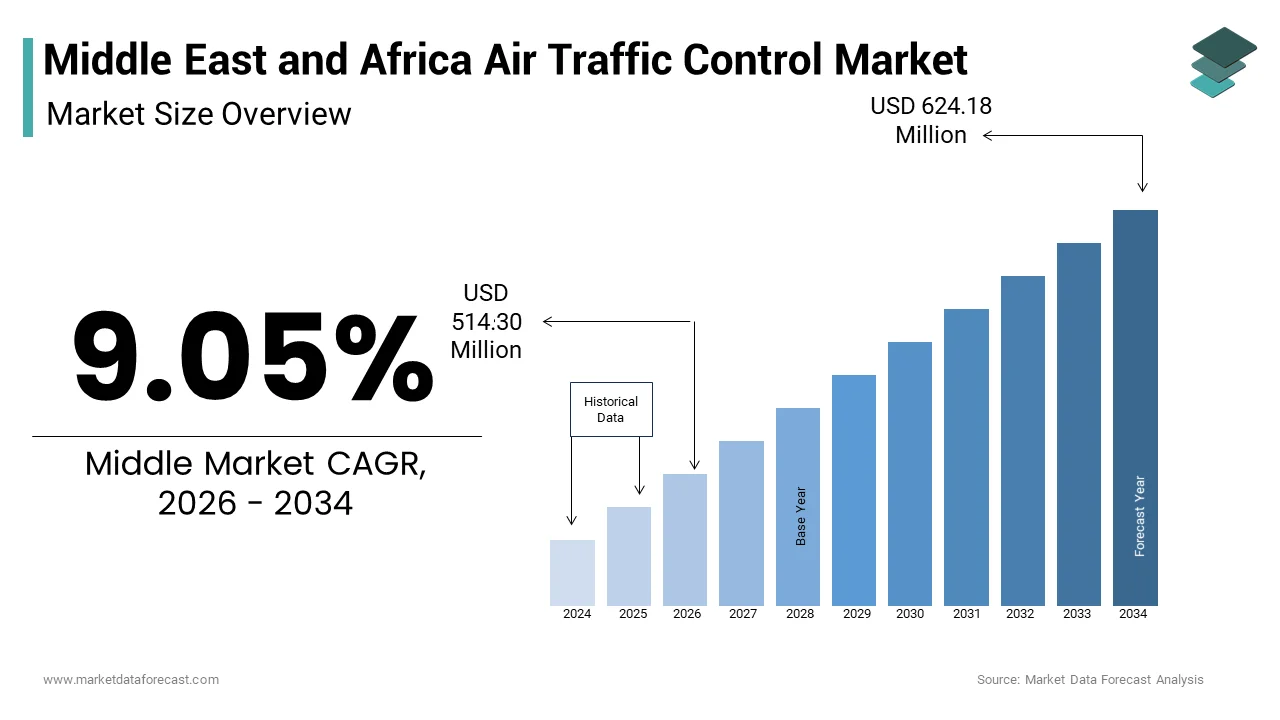
Growing emphasis on the modernization of air traffic management infrastructure is one factor that propels the Air Traffic control market in the Middle East and Africa region. Increasing passenger traffic coupled with growing investments helps the development of the market for Air traffic control management in the Middle East and Africa region. Growth in demand for aerial connectivity and air travel to introduce new routes and increase flight movements are some of the primary growth factors of the Air Traffic Control market in the Middle East and Africa region. In addition, increasing up-gradation of existing airport infrastructure with new and advanced air traffic management systems, which were used to provide more efficient air traffic services, is another major growth factor of the Air Traffic Control market in the Middle East and Africa region.
The high cost of the equipment and various operational challenges in air traffic management are some of the significant growth affecting factors in the Middle East and Africa air traffic control market.
REPORT COVERAGE
| REPORT METRIC | DETAILS |
| Market Size Available | 2025 to 2034 |
| Base Year | 2025 |
| Forecast Period | 2026 to 2034 |
| CAGR | 2.45% |
| Segments Covered | By Solutions, Type, End User, and Region |
| Various Analyses Covered | Country Level Analysis, Segment-Level Analysis, DROC, PESTLE Analysis, Porter’s Five Forces Analysis, Competitive Landscape, Analyst Overview on Investment Opportunities |
| Regions Covered | KSA, UAE, Israel, Rest Of GCC Countries, South Africa, Ethiopia, Kenya, Egypt, Sudan, Rest Of MEA |
| Market Leaders Profiled | Indra Sistemas (Spain), Frequentis AG (Australia), Harris Corporation (US), Adacel Technologies (Australia), Raytheon Company (US), BAE System (UK), Thales Group (France), Leonardo S.p.A (Italy), Honeywell Inc (US), Saab AB (Sweden), Northrop Grumman Corporation (US), and NATS Holding (UK). |
REGIONAL ANALYSIS
The Middle East and Africa region are expected to account for a single-digit percentage of the global market during the forecast period. The growing emphasis on the modernization of air traffic management infrastructure, and increasing passenger traffic, coupled with growing investments that resulted in an increased aircraft movement at airports, are expected to favor the market in this region.
KEY MARKET PLAYERS
Companies playing a promising role in the Middle East and Africa Air Traffic Control market are
- Indra Sistemas (Spain)
- Frequentis AG (Australia)
- Harris Corporation (US)
- Adacel Technologies (Australia)
- Raytheon Company (US)
- BAE System (UK)
- Thales Group (France)
- Leonardo S.p.A (Italy)
- Honeywell Inc (US)
- Saab AB (Sweden)
- Northrop Grumman Corporation (US)
- NATS Holding (UK).
MARKET SEGMENTATION
This research report on the middle east and africa air traffic control market has been segmented and sub-segmented into the following categories.
By Airspace
- ARTCC
- TRACON
- ATCT
- Remote Tower
By Application
- Communication
- Navigation
- Surveillance
- Automation
By Offering
- Hardware
- Software & Solutions
- Services
By Airport Size
- Large
- Medium
- Small
By Sectors
- Commercial
- Military & Defense
By Country
- KSA
- UAE
- Israel
- rest of GCC countries
- South Africa
- Ethiopia
- Kenya
- Egypt
- Sudan
- Rest of MEA