- Product Description Description
- Table of Contents TOC
- List of Table & Figure LOT
- Get Free Sample PDF Sample PDF
Market Size, 2025
$18.25 BnMarket Estimate, 2026
$18.82 BnMarket Forecast, 2034
$24.10 BnCAGR, 2026–2034
3.14%Executive Summary: Middle East and Africa Beta Carotene Market
- Market Scope: Regional analysis of the Middle East and Africa beta-carotene sector, detailing sources, application segments, and country-level profiles spanning 2026 to 2034.
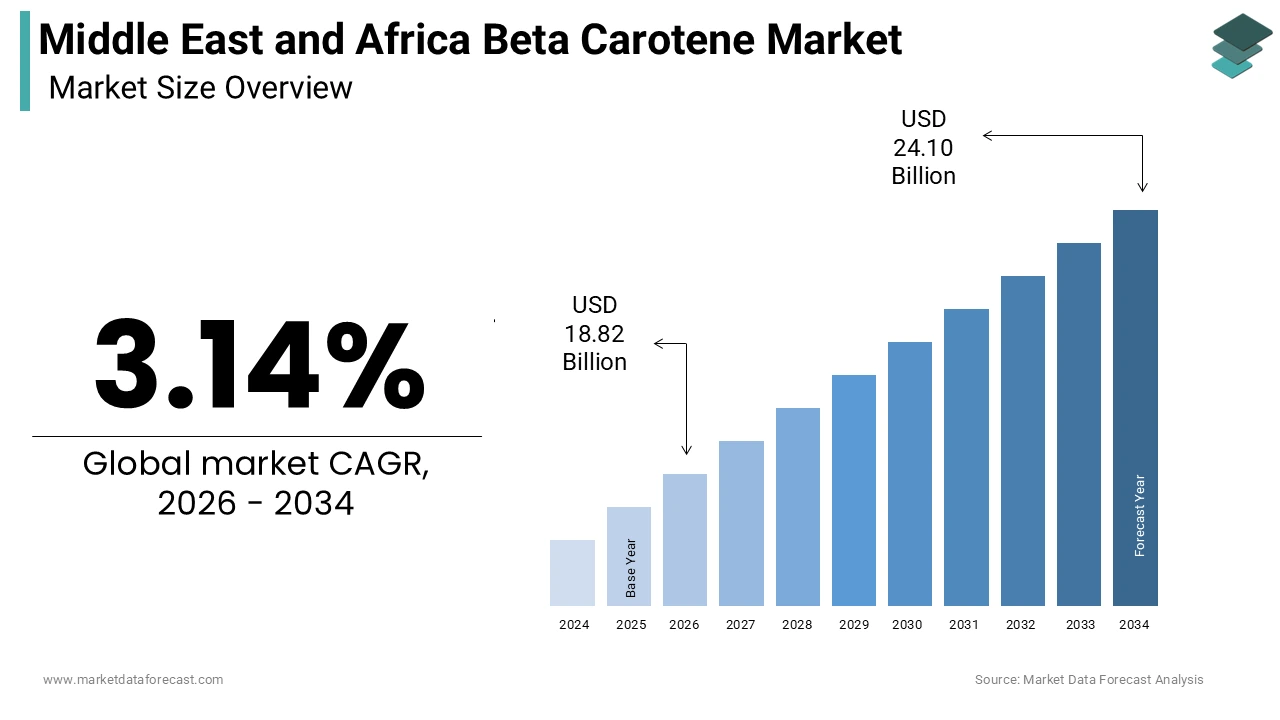
- Market Valuation: Valued at USD 18.25 billion in 2025, reaching USD 18.82 billion in 2026, and projected to expand to USD 24.10 billion by 2034, growing at a robust CAGR of 3.14% from 2026 to 2034.
- Primary Growth Drivers: Rising consumer health awareness (such as immune support, eye health, and chronic disease prevention), growing utilization as a natural food and beverage coloring agent, and increased demand in functional dietary supplements.
Key Market Segment Metrics
| Category | Leading Segment (Base Position) | Fastest-Growing / High-Growth Segment |
|---|---|---|
| By Source | Algae-Derived Beta Carotene (held the major revenue share, supported by consumer preference for natural ingredients and proven health benefits) | Synthetic & Fungi-Based Variants (high-growth segments driven by cost-effective mass production and scalable industrial applications) |
| By Application | Food & Beverages (captured the largest sales share, backed by extensive use of beta-carotene as a natural coloring and fortifying agent) | Dietary Supplements & Pharmaceuticals (fastest-growing application segments propelled by rising health consciousness and preventive wellness trends) |
| By Region | UAE (market leader with the largest regional share, backed by high disposable incomes and advanced retail infrastructure) | KSA & South Africa (key high-growth regional markets driven by expanding urban consumer bases and health supplement adoption) |
Major Market Players & Industry Landscape
Market Structure: Highly competitive environment characterized by specialized biotechnology firms and chemical manufacturers scaling production capacities and natural extraction techniques throughout the 2026-2034 forecast period.
Key Companies: Chr. Hansen Holding A/S, Zhejiang Medicine Co., Ltd, Lycored, Foodchem International Corporation, and Parry Nutraceuticals.
 Download Free Sample Report
Middle East and Africa Beta Carotene Market Size
The Middle East and Africa Beta Carotene Market size was calculated to be USD 18.25 billion in 2025 and is anticipated to be worth USD 24.10 billion by 2034 from USD 18.82 billion In 2026, growing at a CAGR of 3.14% during the forecast period.
Carotenoids are colourful pigments that exhibit preventative properties against various dreadful diseases. A few carotenoids are converted by the body into Vitamin A. Some carotenoids exhibit antioxidant behaviour that protects the lining of arteries. They play a vital role in cancer prevention. Carotenes offer protection from heart diseases. Beta Carotene is used to treat skin problems caused due to excessive exposure to the sun. Beta-Carotene holds the maximum market share in carotenoids, due to its skin-protective properties.
Beta carotene possess many features such as it lowers the risk of lung cancer, heart diseases, and skin problems. Moreover it also helps in controlling age related eye disorders and enables proper functioning of immune system. Thus, awareness among the consumers for the benefits of beta carotene is fuelling its growth across the globe. Moreover increased usage of beta carotene in food and beverages industry to provide colour to their final product is also fuelling its growth during the forecast period.
However, excessive usage of these products for a long term has various side effects it can cause loss of stools, bruising, & joint pain, and turn skin orange or yellow. Through various researches, it has been found that taking high doses of these supplements for long term might cause a higher risk for certain cancer. Consumption of these supplements by smokers increases the risk of colon, prostate and lung cancer among them.
SEGMENTAL ANALYSIS
Middle East and Africa Beta Carotene Market By Source
- Algae
- Fungi
- Palm oil
- Synthetic
- Others
Algae derived beta-carotene accounted for over 35% of total revenue in 2018. The algae-based product is expected to witness steady growth trend over the forecast period owing to its various advantages over other sources.
Middle East and Africa Beta Carotene Market By Application
- Food & Beverage
- Animal Feed
- Dietary Supplements
- Pharmaceuticals
- Others
Among all these segments food and beverages is expected to account for the major market share as compared to others in the near future.
Middle East and Africa Beta Carotene Market By Region
- KSA
- UAE
- Israel
- rest of GCC countries
- South Africa
- Ethiopia
- Kenya
- Egypt
- Sudan
- Rest of MEA
It is last in terms of market share. UAE is the leading market in this region.
Key Players in the Market
Major Key Players in the MEA Beta Carotene Market are Chr. Hansen Holding A/S, Foodchem International Corporation, Flavorchem Corporation, Lycored, D.D. Williamson & Co., Inc, BioExtract, Nutralliance, Zhejiang Medicine Co., Ltd, Sensient Cosmetic Technologies, and Parry Nutraceuticals