- Product Description Description
- Table of Contents TOC
- List of Table & Figure LOT
- Get Free Sample PDF Sample PDF
Market Size, 2025
$18.60 MnMarket Estimate, 2026
$19.25 MnMarket Forecast, 2034
$25.31 MnCAGR, 2026–2034
3.48%Middle East and Africa Coffee Roaster Market Size
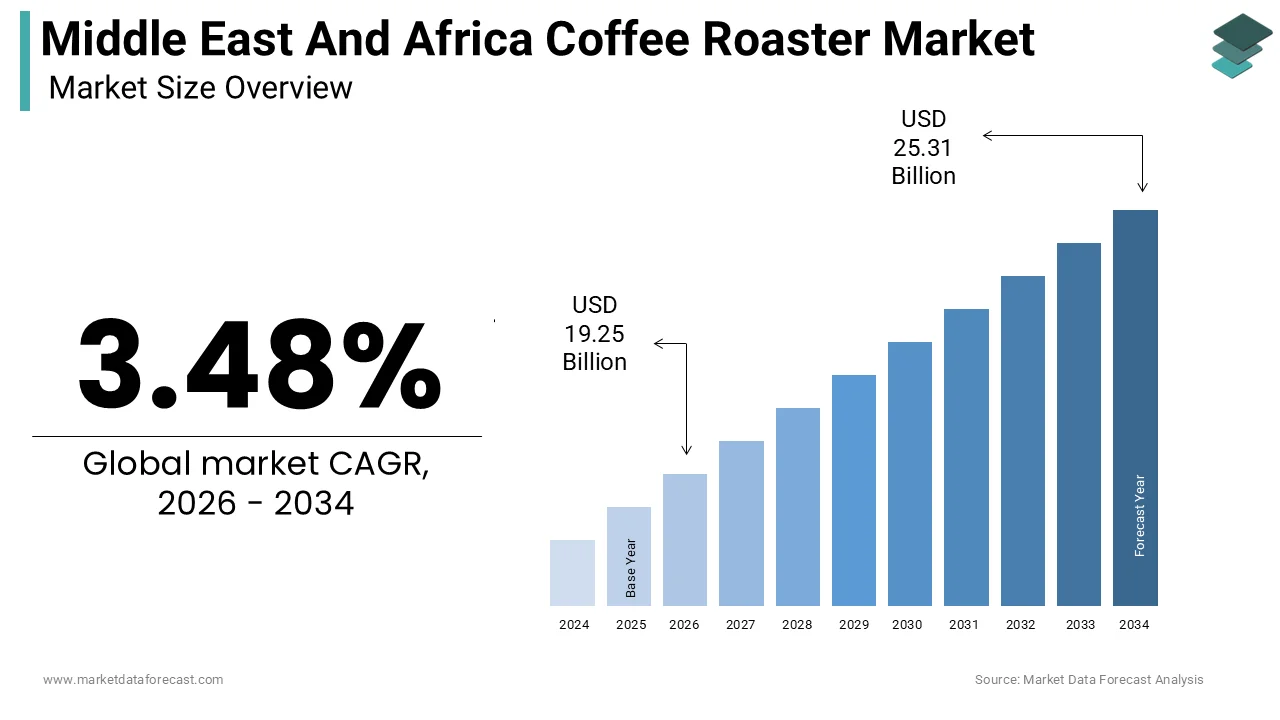
The size of the Middle East and Africa coffee roaster market was calculated to be USD 18.60 million in 2025 and is anticipated to be worth USD 25.31 million by 2034 from USD 19.25 million In 2026, growing at a CAGR of 3.48% during the forecast period.
Roasting coffee beans changes the chemical and physical properties of green coffee beans. Roasting helps in bringing out the flavour of the beans by causing them to expand and to change colour, taste and smell. As green coffee is more stable than roasted, the roasting process tends to take place close to where it will be consumed. This reduces the time that roasted coffee spends in distribution, giving it a longer shelf life. The vast majority of coffee is roasted commercially on a large scale, but some coffee drinkers roast coffee at home in order to have more control over the freshness and flavour profile of the beans.
Many consumers are now switching to home roasting the beans as they want to experience the complete freshness of the coffee bean. Home roasting has the advantage of being able to roast smaller volumes of coffee to match consumption so that the roasted coffee can be used before it goes stale.
The major driver for the coffee roaster market is the increasing consumer base demanding fresh and aromatic coffee using the roasting process. Mostly the coffee roasting is performed at large scale, but in the past few years small scale coffee roasting shops have grown significantly. A major restraint is the limited and short shelf life of these beans as they start loosing flavour after a certain period of time. Moreover, wide usage of instant coffee powders barricades the market growth, as they reduce the time of roasting and grinding.
This research report on the Middle East and Africa coffee roaster market is segmented and sub-segmented into the following categories.
Middle East and Africa Coffee Roaster Market By Energy source
- Electric
- Gas
Middle East and Africa Coffee Roaster Market By Volume capacity
- Large
- Medium
- Small Scale
- Home Use
Middle East and Africa Coffee Roaster Market By Product Type
- Drum
- Hot Air
- Stove Top
- Others
Middle East and Africa Coffee Roaster Market By Application
- Factory
- Coffee Shop
- Household
Middle East and Africa Coffee Roaster Market By Region
- KSA
- UAE
- Israel
- rest of GCC countries
- South Africa
- Ethiopia
- Kenya
- Egypt
- Sudan
- Rest of MEA
KEY MARKET PLAYERS
Major Key Players in the MEA Coffee Roaster Market are Giesen, Toper, Genio, Probat, Nesco, Sonofresco, Ambex, Behmor, Discaf, and Hottop