- Product Description Description
- Table of Contents TOC
- List of Table & Figure LOT
- Get Free Sample PDF Sample PDF
Market Size, 2025
$0.61 BnMarket Estimate, 2026
$0.64 BnMarket Forecast, 2034
$0.93 BnCAGR, 2026–2034
4.76%Executive Summary: Middle East and Africa CT Market
- Market Scope: Comprehensive regional analysis of the Middle East and Africa (MEA) computed tomography (CT) market covering slice configurations, end-user segments, country-level insights, and technological innovations in multi-slice imaging.
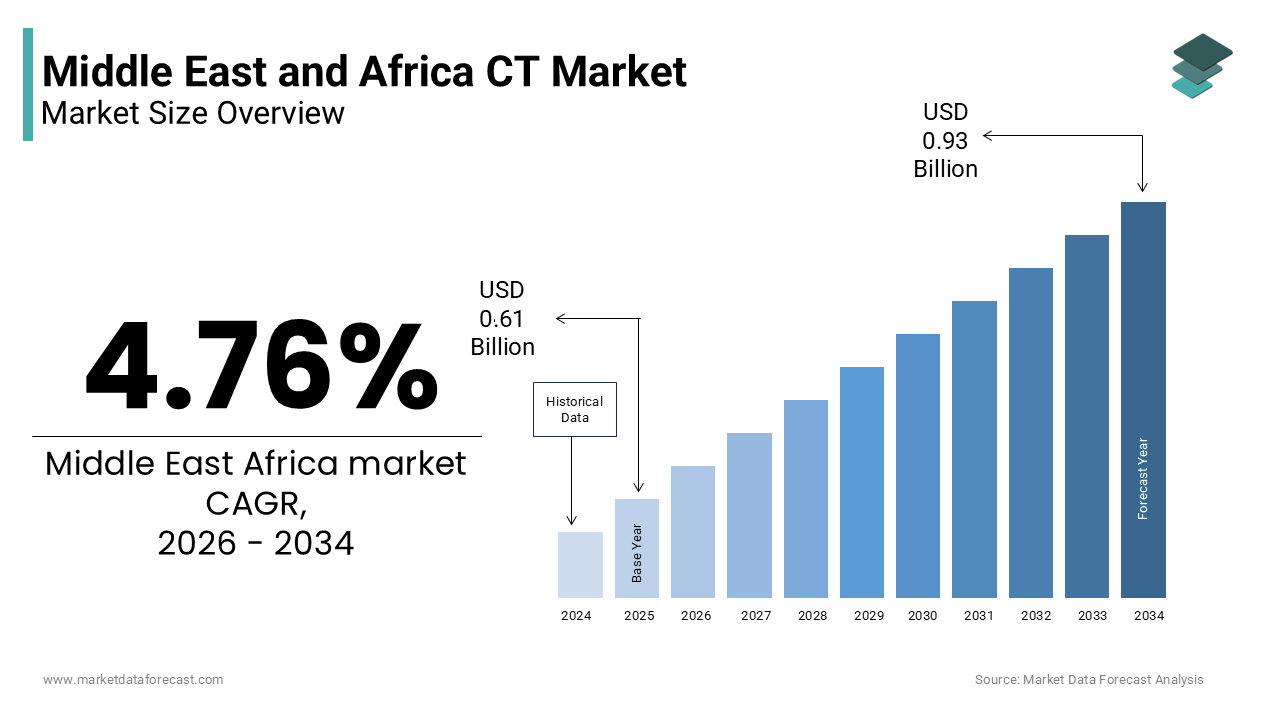
- Market Valuation: Valued at USD 0.61 billion in 2025, estimated at USD 0.64 billion in 2026, and projected to reach USD 0.93 billion by 2034, registering a steady CAGR of 4.76% from 2026 to 2034.
- Primary Growth Drivers: High-speed multi-slice and high-slice CT scanner advancements (e.g., 256-slice systems); rising prevalence of chronic conditions like cancer, cardiovascular, and orthopedic disorders; and growing demand for bedside and home healthcare diagnostic solutions.
Key Market Segment Metrics (2026–2034)
| Category | Leading Segment / Position | Segment Details / Breakdown |
|---|---|---|
| By Low-slice Type | Single Slice & Dual Slice | Addresses basic cross-sectional diagnostic requirements across cost-sensitive or localized healthcare settings. |
| By Slice Type | 6 Slice, 10 Slice, 16 Slice & 32 Slice | Mid-range slice configurations deliver a balanced clinical utility for routine scans and emergency departments. |
| By High-slice Type | 40 Slice, 64 Slice, Open Versions & Cardiac CT | High-slice configurations experience massive growth driven by advanced diagnostic precision, rapid single-rotation cardiac and organ scans, and CAD software integration. |
| By End User | Hospitals and Clinics, Imaging Centers & Others | Hospitals and specialized imaging centers form the primary revenue backbone due to high patient throughput and intensive capital investment capabilities. |
| By Country / Region | KSA, UAE, Israel, South Africa & Egypt | GCC economies and key African hubs lead regional infrastructure investments. Additional coverage includes rest of GCC countries, Ethiopia, Kenya, Sudan, and Rest of MEA. |
Major Market Players & Market Structure
Market Structure: Highly consolidated medical imaging landscape driven by leading multinational diagnostics and radiology system manufacturers.
Key Companies: GE Healthcare, Hitachi Medical Corporation, Hitachi Medical Systems America, Inc., NeuroLogica Corporation, Neusoft Medical Systems Co. Ltd., Philips Healthcare, Shenzhen Anke High-Tech Co., Siemens Healthcare, and Toshiba Medical Systems Corporation.
Middle East and Africa CT Market Size
The CT market size in the Middle East and Africa was worth USD 0.61 billion in 2025. The regional market size is estimated to be growing at a CAGR of 4.76% from 2026 to 2034 and be worth USD 0.93 billion by 2034 from USD 0.64 billion in 2026.
CT Scan (Computed Tomography) imaging of the body uses tomography and digital geometry to generate a 3D image of the internal organs of a body. It uses a series of two-dimensional X-rays, which are taken around a single axis of rotation and then generated to form the 3D image.
The CT is advanced computed tomography imaging system across clinical facilities, diagnostic centers, and specialized research institutions. This medical imaging sector involves multi-slice hardware, software applications, and servicing components designed to capture cross-sectional anatomical scans for dia gnosing cardiovascular pathologies, oncological disorders, and traumatic injuries. As per the World Health Organization, noncommunicable diseases account for roughly 54% of total deaths in the broader Eastern Mediterranean region, heavily influencing public health expenditure toward advanced diagnostic modalities.
MARKET DRIVERS
Rapid Epidemiological Transition Toward Chronic Illnesses
The rising prevalence of lifestyle related pathologies and chronic conditions, which is majorly accelerating the growth of the Middle East and Africa CT market. According to the International Diabetes Federation, the Middle East and Africa region witnessed an adult diabetes prevalence rate exceeding 16% in multiple focal nations, establishing a direct correlation with surging cardiovascular complications that necessitate high-resolution diagnostic mapping. The global cancer observatory metrics, new annual cancer diagnoses across the region crossed 850,000 cases, scaling the operational demand for precise tumor staging and oncology-focused computed tomography scans. These epidemiological realities force local hospital networks to continuously expand their diagnostic capacities to manage complex morbidities.
Accelerated Healthcare Infrastructure Modernization and Hospital Investments
The aggressive government-led healthcare infrastructure revamps and massive capital injections into public and private medical facilities is also escalating the growth of the Middle East and Africa CT market. According to the study, government healthcare allocations in key Gulf Cooperation Council economies regularly capture over 20% of national developmental budgets, which is directly funding state-of-the-art medical city projects that require fully equipped radiology departments. The large-scale facility expansion directly correlates with rising procurement volumes for stationary and mobile computed tomography units. State-backed healthcare privatization initiatives that further amplify this momentum by encouraging private equity groups to establish advanced diagnostic clinics equipped with premium imaging technology.
MARKET RESTRAINTS
Substantial Capital Acquisition and Operational Maintenance Expenditures
The prohibitive initial purchasing costs and ongoing service overheads associated with advanced diagnostic hardware is hindering the growth of the Middle East and Africa CT market. As per World Health Organization health technology assessment guidelines, annual maintenance and lifecycle servicing contracts can consume up to 10% of the original equipment value, heavily straining operational budgets. This fiscal friction directly restricts smaller clinics from acquiring high-slice units, confining advanced diagnostics primarily to major metropolitan medical centers. Consequently, budgetary limitations slow down the market penetration rate across resource-constrained subregions.
Acute Shortage of Specialized Radiological Personnel
A severe deficit of trained radiologists, clinical technologists, and specialized technicians constrains the optimal utilization of sophisticated imaging systems. The acute shortage of specialied radiological personnel is limiting the growth of the Middle East and Africa CT market. As per the study, higher education pipelines graduate a limited number of certified medical imaging technicians annually, creating a severe talent gap that directly impairs clinical workflow efficiency. This human capital shortage means that even when facilities manage to procure advanced hardware, machines often operate below maximum capacity.
MARKET OPPORTUNITIES
Integration of Artificial Intelligence and Advanced Software Applications
The incorporation of artificial intelligence algorithms and automated workflow software by optimizing diagnostic precision that is ascribed to foster the growth of the Middle East and Africa CT market. According to the World Intellectual Property Organization, patent filings related to artificial intelligence applications in medical diagnostics originating from or applied within regional research hubs have surged by 28% over recent evaluation cycles. These technological developments help mitigate the regional radiologist shortage by accelerating image reconstruction and reducing scan evaluation times. Consequently, software upgrades elevate the clinical utility of existing scanner fleets, driving lucrative recurring revenue streams for vendors.
Expansion of Mobile and Portable Diagnostic Units in Remote Regions
The rising deployment of mobile imaging units and portable scanning technology creates transformative pathways for reaching underserved rural populations. The expansion of mobile and portable diagnostic units in remote regions is also to promote the growth of the Middle East and Africa CT market. According to the United Nations Population Fund, rural communities account for nearly 45% of the total demographic spread in the broader region, suffering from restricted physical access to centralized urban hospitals. As per World Bank rural development metrics, targeted public-private partnerships deploying mobile health clinics have expanded by 11.3% across expansive geographical terrains. These mobile solutions rely heavily on compact, ruggedized computed tomography systems to deliver frontline diagnostic capabilities directly to remote settlements.
MARKET CHALLENGES
Stringent Regulatory Compliance and Bureaucratic Import Delays
The complex regulatory frameworks and extended customs clearance procedures obstruct the seamless introduction and distribution of medical imaging hardware, which is a major challenge for the growth of the Middle East and Africa CT market. According to the study, cross-border medical device shipments into select regional ports face average administrative clearance delays exceeding 3 weeks. As per International Trade Administration regulatory overviews, compliance mandates enforced by local health authorities require rigorous, time-consuming product dossier verifications before commercialization approval is granted. These lengthy bureaucratic hurdles directly disrupt supply chain timelines and inflate inventory holding costs for international original equipment manufacturers. Consequently, administrative friction slows down product life cycles and delays the commercial availability of cutting-edge scanning technology.
Heightened Public Radiation Safety Concerns and Regulatory Scrutiny
The growing public anxiety regarding ionizing radiation exposure during diagnostic scans creates consumer hesitancy and invites stricter institutional oversight. Heightened public radiation safety concerns and regulatory scrutiny are also to decline the growth of the Middle East and Africa CT market. As per World Health Organization radiation protection guidelines, healthcare facilities are subjected to mandatory audits regarding patient dose optimization, compelling hospitals to invest in dose-reduction software features. This heightened safety awareness forces manufacturers to allocate substantial research capital toward low-dose imaging innovations to comply with stricter statutory limits.
REPORT COVERAGE
| REPORT METRIC | DETAILS |
| Market Size Available | 2025 to 2034 |
| Base Year | 2025 |
| Forecast Period | 2026 to 2034 |
| CAGR | 4.76% |
| Segments Covered | By Low-slice Type, Slice Type, High-slice Type, End-Users and Region. |
| Various Analyses Covered | Global, Regional & Country Level Analysis, Segment-Level Analysis, DROC, PESTLE Analysis, Porter’s Five Forces Analysis, Competitive Landscape, Analyst Overview of Investment Opportunities |
| Regions Covered | KSA, UAE, Israel, the rest of GCC countries, South Africa, Ethiopia, Kenya, Egypt, Sudan, and Rest of MEA. |
| Market Leaders Profiled | GE Healthcare, Hitachi Medical Corporation, Hitachi Medical Systems America, Inc., NeuroLogica Corporation, Neusoft Medical Systems Co. Ltd., Philips Healthcare, Shenzhen Anke High-Tech Co., Siemens Healthcare, and Toshiba Medical Systems Corporation |
SEGMENTAL ANALYSIS
By Low-slice Type Insights
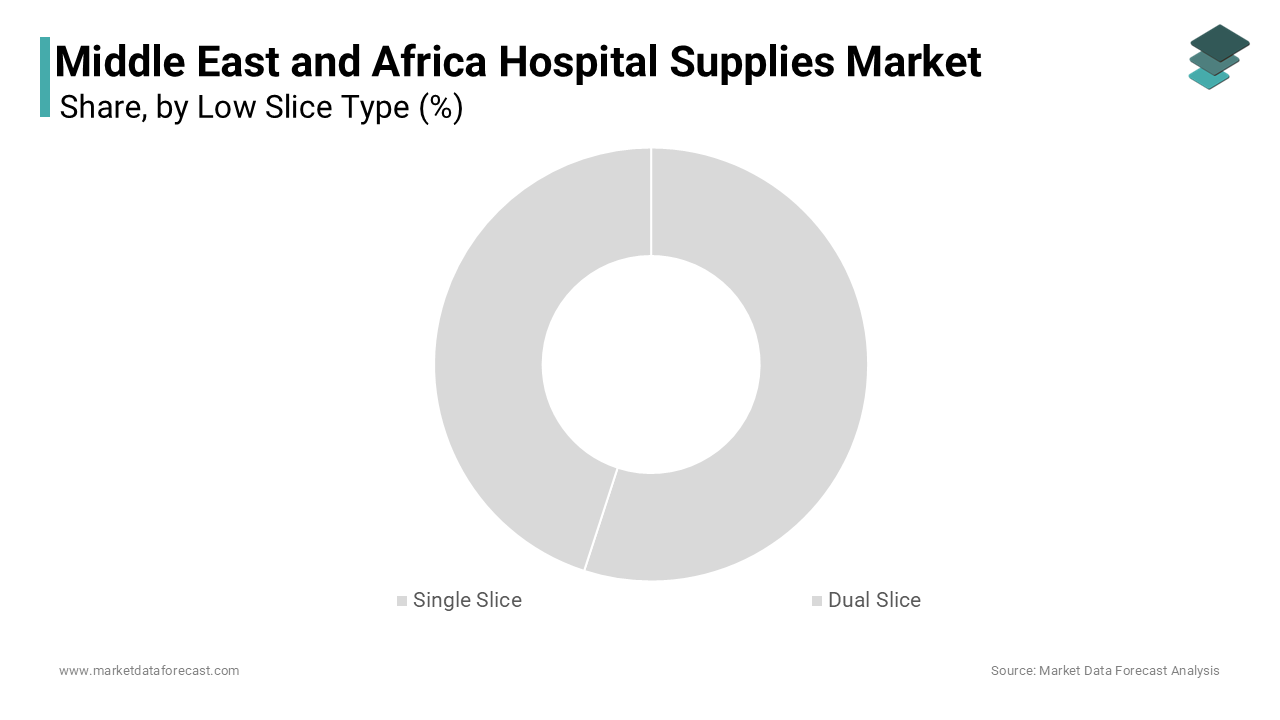
The dual slice category segment is deemed to witness a fastest CAGR of 8.1% during the forecast period. According to the International Finance Corporation, growing demand for moderately upgraded diagnostic accuracy has driven a 15.4% surge in secondary hospital equipment modernizations. As per International Trade Administration medical technology briefs, facility operators increasingly transition toward dual slice architecture to secure improved spatial resolution without incurring the massive capital outlays demanded by high-end multi-detector machinery. This accelerated growth pattern directly correlates with the strategic need for regional community hospitals to bridge the gap between basic trauma screening and advanced multi-slice diagnostic capabilities.
By Slice Type Insights
The 16-slice category segment held a prominent share of the Middle East and Africa CT market. As per World Health Organization clinical equipment surveys, the high reliability and adaptable software profiles of these mid-range units ensure seamless integration into busy emergency departments. This widespread operational reliance directly correlates with the heavy daily patient throughput handled by major public hospital networks across the Middle East and African territory.
The 32-slice category segment is anticipated to register a fastest CAGR of 5.84% from 2026 to 2034. Escalating regional rates of metabolic disorders require higher temporal resolution to detect early vascular complications accurately. As per data, private diagnostic chains have expanded their procurement of thirty-two slice systems by 18.2% annually to reduce patient waiting times and enhance cardiovascular imaging fidelity. This rapid expansion directly correlates with the rising consumer preference for faster, non-invasive cardiac evaluations within private outpatient diagnostic centers.
By End-User Insights
The hospitals and clinics segment is likely to grow at a fastest CAGR of 11.3% during the forecast period with the primary revenue engine for advanced imaging device acquisitions. According to the World Health Organization health service statistics, public and private hospital networks account for more than 65% of total regional patient admissions requiring emergency and trauma computed tomography interventions. As per International Trade Administration healthcare sector reviews, government-backed hospital expansion projects inject billions of dollars into state-of-the-art radiology departments equipped with heavy diagnostic hardware. This massive concentration of institutional capital and continuous clinical demand directly correlates with the undisputed leadership of hospitals in driving overall hardware procurement volumes.
The imaging centers segment is likely to grow at a fastest CAGR of 6.25% throughout the forecast period. According to the reports, independent diagnostic facilities have experienced an 18.5% surge in venture capital investments aimed at decentralizing outpatient imaging services. As per World Bank demographic development figures, urban migration trends have spiked the demand for accessible, fast-turnaround outpatient diagnostic services outside traditional hospital walls. This rapid retail health expansion directly correlates with the proliferation of specialized standalone imaging centers catering to routine elective scans and specialized outpatient screenings.
COUNTRY ANALYSIS
Kingdom of Saudi Arabia CT Market Analysis
The Kingdom of Saudi Arabia CT market was the largest contributor by accounting for 46.2% of share in 2025 with the massive national health transformation initiatives and substantial capital investments. According to the study, government health and social development allocations in the kingdom regularly exceed 15% of the federal budget, driving large-scale medical city construction. As per report, ambitious modernization blueprints under national strategic visions have accelerated advanced diagnostic equipment procurement by 8.4% annually.
United Arab Emirates CT Market Analysis
The United Arab Emirates CT market was next by capturing 33.2% of share in 2025 with the advanced technological adoption and world-class private healthcare infrastructure. According to the World Health Organization, private health insurance penetration in the federation exceeds 80% of the resident population, stimulating high-frequency utilization of premium diagnostic scans. As per the study, advanced hospital networks in the Emirates allocate nearly 12% of their operational budgets toward smart medical technology integration. This robust financial framework directly correlates with the swift deployment of cutting-edge multi-slice computed tomography hardware across Dubai and Abu Dhabi clinical centers.
Israel CT Market Analysis
Israel CT market growth is driven by the advanced clinical research capabilities and high per capita diagnostic device density. National healthcare expenditure accounts for roughly 7.5% of gross domestic product by ensuring continuous technological refreshment in hospital imaging fleets. As per reports, local research institutions generate a high volume of digital health patents that directly enhance advanced computed tomography software applications. This strong emphasis on medical research and development directly correlates with the widespread clinical utilization of premium imaging modalities across Israeli medical centers.
South Africa CT Market Analysis
South Africa CT market growth is likely to grow with the dual-tier healthcare system featuring sophisticated private medical networks. According to the study, the private healthcare sector serves roughly 16% of the population but commands over 50% of total national health expenditure by fueling high-end diagnostic technology sales. As per World Health Organization epidemiological updates, rising local burdens of chronic lifestyle diseases necessitate continuous hardware upgrades in major urban radiological departments. This dual economic structure directly correlates with the heavy concentration of multi-slice computed tomography scanners within private metropolitan hospital groups.
Kenya CT Market Analysis
Kenya CT market growth is anticipated to grow with the modernized radiological diagnostic equipment. According to the Kenya National Bureau of Statistics economic surveys, private sector investments in specialized outpatient medical centers have risen by 11.2% over recent evaluation periods. As per World Bank health financing indicators, public-private partnerships focused on specialized diagnostic service delivery have widened geographic access to cross-sectional imaging technologies. This commercial expansion directly correlates with the rising acquisition of sixteen-slice and thirty-two slice systems across Nairobi diagnostic clinics.
COMPETITIVE LANDSCAPE
Competition in the Middle East and Africa computed tomography market is intensely contested among a select group of global medical technology heavyweights who continuously vie for institutional contracts and hospital tenders. Established multinational vendors leverage their extensive brand legacy and robust financial stability to secure high-value procurement agreements with well-funded public health systems in the Gulf Cooperation Council region. Meanwhile, nimble competitors attempt to capture market share within cost-sensitive sub-Saharan territories by offering competitively priced entry-level systems and flexible financing structures.
KEY MARKET PLAYERS
A few of the prominent companies operating in the MEA CT market include
- GE Healthcare
- Hitachi Medical Corporation
- Hitachi Medical Systems America, Inc.
- NeuroLogica Corporation
- Neusoft Medical Systems Co. Ltd.
- Philips Healthcare
- Shenzhen Anke High-Tech Co.
- Siemens Healthcare
- Toshiba Medical Systems Corporation
Leading Market Participants and Contributions
Siemens Healthineers
Siemens Healthineers operates as a prominent titan in the medical technology sector, delivering advanced computed tomography systems equipped with cutting-edge spectral imaging and artificial intelligence capabilities. Their hardware solutions are widely deployed across major tertiary care hospitals throughout the Middle East and Africa, directly supporting critical diagnostic workflows. Furthermore, the corporation continuously enhances its clinical support infrastructure, expanding technical training programs for local radiologic technologists to ensure optimal equipment utilization and sustained customer loyalty.
GE HealthCare
GE HealthCare maintains a commanding presence in the regional diagnostic imaging domain through its versatile portfolio of multi-slice and mobile computed tomography devices. The company provides reliable radiological hardware tailored to handle high patient volumes in both public trauma centers and private diagnostic facilities. In order to strengthen its market position, the enterprise focuses on deploying cloud-connected service platforms that enable remote diagnostic monitoring and predictive equipment maintenance for regional hospitals. Additionally, the firm leverages strategic distribution networks across emerging African and Middle Eastern territories by ensuring accelerated delivery timelines and comprehensive after-sales technical support for healthcare providers.
Philips Healthcare
Philips Healthcare stands out as an influential industry leader by offering highly efficient computed tomography systems centered on low-dose radiation technology and advanced clinical reconstruction software. Their medical imaging solutions are extensively integrated into specialized oncology and cardiology departments across the territory, facilitating precise patient management. The organization actively reinforces its competitive standing by forming strategic alliances with regional private healthcare groups to supply state-of-the-art diagnostic suites. Moreover, the business invests heavily in localized clinical education workshops, empowering regional practitioners to maximize the diagnostic potential of advanced imaging software applications.
Top Strategies Used by Key Market Participants
Key market participants deploy aggressive geographic expansion initiatives by establishing direct sales offices and localized service hubs across high-growth emerging economies in the Middle East and Africa. Vendors heavily emphasize strategic distribution partnerships with regional medical equipment distributors to penetrate underserved secondary healthcare tiers. Companies prioritize advanced product differentiation by integrating proprietary artificial intelligence algorithms and low-dose radiation reduction software directly into their multi-slice hardware platforms. Leading manufacturers also secure long-term service and maintenance contracts with large public hospital networks to lock in recurring revenue streams and build deep institutional trust.
MARKET SEGMENTATION
This research report on the Middle East and Africa CT market is segmented & sub-segmented into the following categories
By Low-slice Type
- Single Slice
- Dual Slice
By Slice Type
- 6 Slice
- 10 Slice
- 16 Slice
- 32 Slice
By High-slice Type
- 40 Slice
- 64 Slice
- Open Versions
- Cardiac CT
By End-Users
- Hospitals and Clinics
- Imaging Centers
- Others
By Region
- KSA
- UAE
- Israel
- rest of GCC countries
- South Africa
- Ethiopia
- Kenya
- Egypt
- Sudan
- Rest of MEA