- Product Description Description
- Table of Contents TOC
- List of Table & Figure LOT
- Get Free Sample PDF Sample PDF
Executive Summary: Middle East and Africa Food Flavors Market
- Market Scope: Comprehensive regional analysis of the Middle East and Africa (MEA) food flavors sector, detailing flavor types, natural and synthetic origins, application industries, and country-level profiles.
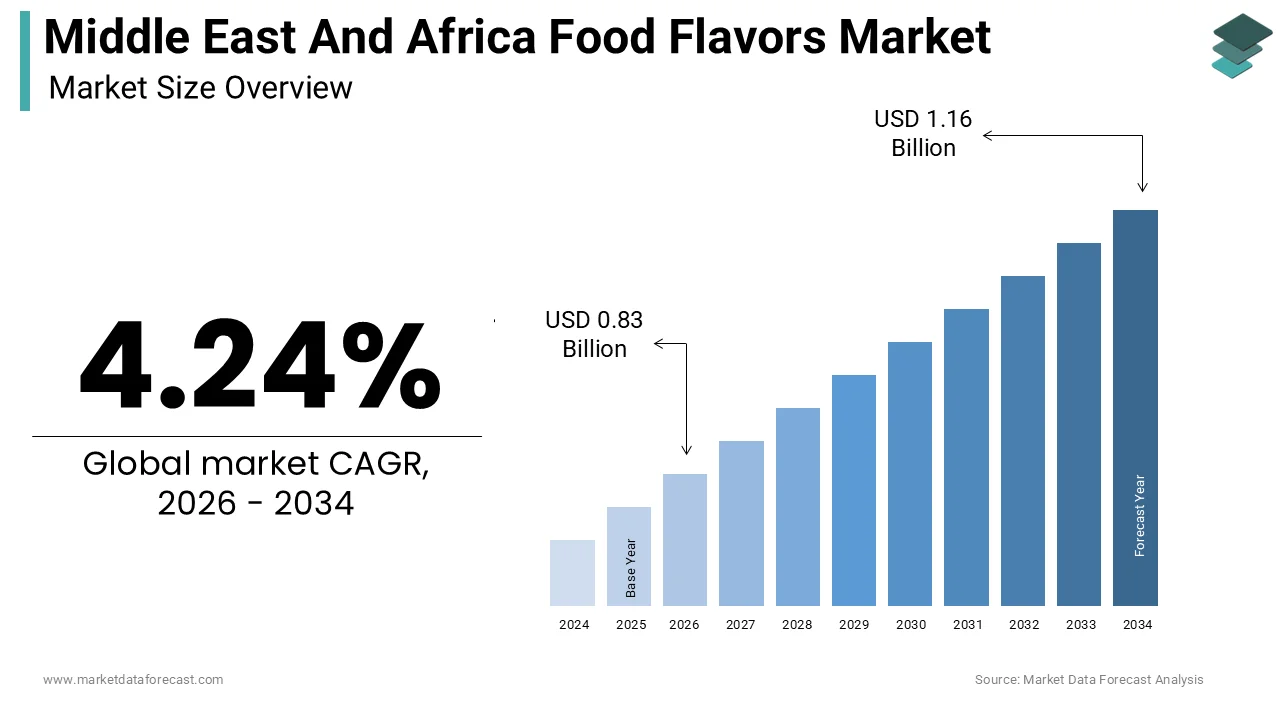
- Market Valuation: Valued at USD 0.80 billion in 2025, reaching USD 0.83 billion in 2026, and projected to expand to USD 1.16 billion by 2034, growing at a robust CAGR of 4.24% from 2026 to 2034.
- Primary Growth Drivers: Pioneering new technologies for advanced fruit and vegetable-derived ingredients, growing demand for health and wellness foods, and increasing consumer preference for convenience and ready-to-eat meals.
Key Market Segment Metrics
| Category | Leading Segment (Base Position) | Fastest-Growing / High-Growth Segment |
|---|---|---|
| By Type | Fruits & Nuts / Chocolate (anchored by widespread integration in confectionery, beverages, and regional dessert profiles) | Vanilla & Exotic Profiles (anticipated to grow at a high CAGR, fueled by premium dessert and bakery trends) |
| By Origin | Synthetic (held significant market share due to cost-effectiveness and stable flavor profiles in large-scale food processing) | Natural (projected at the fastest CAGR, driven by clean-label movements and health-conscious consumer shifts) |
| By Application | Beverages (largest segment in terms of revenue, closely followed by bakery & confectionery and savory & snacks) | Dairy & Frozen Products (fastest-growing application segment, driven by high demand for meat and specialized dairy flavor products) |
| By Region | GCC / KSA & UAE (market leaders with high urban retail penetration and extensive processed food consumption) | South Africa & Rest of MEA (fastest-growing regional hubs driven by high penetration of global market players into untapped regions) |
Major Market Players & Industry Landscape
Market Structure: Competitive and dynamic flavor ingredient landscape featuring major global multinational corporations expanding footprints and introducing fitness and wellness flavor solutions across MEA.
Key Companies: Kerry Group, Givaudan, Firmenich, Sensient Technologies Corporation, Symrise AG, Frutarom Industries, Archer Daniels Midland Company, DöhlerGroup, AGRANA Group, SVZ International B.V., and SunOpta Inc.
 Download Free Sample Report
Middle East and Africa Food Flavors Market Size
The size of the Middle East and Africa food flavors market was calculated to be USD 0.80 billion in 2025 and is anticipated to be worth USD 1.16 billion by 2034 from USD 0.83 billion In 2026, growing at a CAGR of 4.24% during the forecast period.
Flavors are a type of food additive added to food and beverages to make products tastier and more appealing. Flavors can be broadly classified as natural and synthetic flavors, where natural flavors are produced from edible substances such as fruits, vegetables, leaves; and synthetic flavors are prepared by the mixture of volatile chemicals. They are essential part of the food processing industry to maintain the taste of a product.
The market for food flavors in Middle-East and Africa is mainly driven due to new technologies that are pioneered the outgrowth of advanced ingredients derived from fruits & vegetables, which are used as food flavors. Also, growing demand for health & wellness foods, technological innovation, and increasing consumer preference towards convenience and ready-to-eat meals are driving the food flavors market. But, the market growth can be hampered due to rising health awareness in people, high costs of food flavor raw materials and regulations on the amount of consumption.
This research report on the middle east and africa food flavors market is segmented and sub-segmented into the following categories.
Middle East and Africa Food Flavors Market By Type
- Chocolate
- Vanilla
- Fruits & Nuts
Middle East and Africa Food Flavors Market By Origin
- Natural
- Synthetic
Middle East and Africa Food Flavors Market By Application
- Beverages
- Savory & Snacks
- Bakery & Confectionery
- Dairy & Frozen Products
- Others
Beverage flavor products segment is the largest in terms of revenue, closely followed by bakery & confectionery and savory & snacks flavors segments. Growth for dairy and frozen product flavors due to high demand of meat flavor products.
Middle East and Africa Food Flavors Market By Region
- KSA
- UAE
- Israel
- rest of GCC countries
- South Africa
- Ethiopia
- Kenya
- Egypt
- Sudan
- Rest of MEA
MEA region is mainly growing in the market due to high penetration of global market players into the untapped regions. Also, increased consumption of fitness and wellness flavor solutions is also driving the market in these regions.
KEY MARKET PLAYERS
Major Key Players in the MEA Food Flavors Market are Kerry Group, Givaudan, Firmenich, Sensient Technologies Corporation, Symrise AG, Frutarom Industries, Archer Daniels Midland Company, DohlerGroup, AGRANA Group, SVZ International B.V, and SunOpta, In