- Product Description Description
- Table of Contents TOC
- List of Table & Figure LOT
- Get Free Sample PDF Sample PDF
Market Size, 2025
$0.85 BnMarket Estimate, 2026
$0.92 BnMarket Forecast, 2034
$1.77 BnCAGR, 2026–2034
8.48%Executive Summary: Middle East and Africa Greenhouse Grow Light Market
- Market Scope: Comprehensive regional assessment covering spectrum types (partial spectrum, full spectrum), installation types (new installations, retrofit installations), lighting technologies (LED, LEP, HID, fluorescent), and targeted country analyses across the Middle East and Africa.
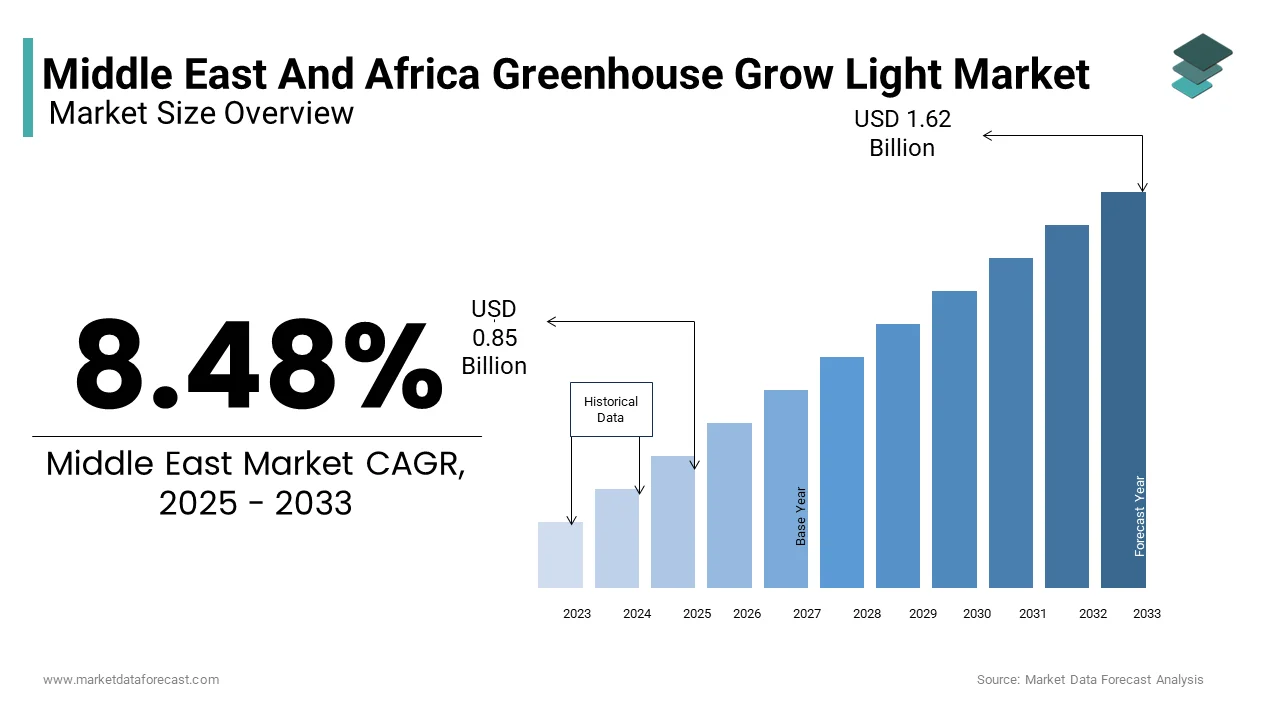
- Market Valuation: Valued at USD 0.85 billion (2025), estimated at USD 0.92 billion (2026), and projected to reach USD 1.77 billion by 2034, registering a robust CAGR of 8.48% (2026–2034).
- Primary Growth Drivers: Escalating expansion of controlled environment agriculture (CEA) to combat arid climate constraints, rising government-led agritech funding, and national food security initiatives across the GCC and North Africa.
Key Market Segment Metrics (2026–2034)
| Category | Leading Segment (2025 Position) | Fastest-Growing / Key Segment Trends |
|---|---|---|
| By Spectrum | Partial Spectrum Grow Lights (captured 55.1% of total share in 2025 due to lower power consumption and optimized efficiency for commercial crops like tomatoes) | Full Spectrum Grow Lights (projected to register the highest CAGR of 16.7% driven by medical cannabis cultivation and urban indoor farming requirements) |
| By Installation | New Installations (accounted for 62% in 2025 anchored by large-scale smart greenhouse infrastructure projects and GCC food security initiatives) | Retrofit Installations (fastest-growing segment with a 15.9% CAGR fueled by regional modernization mandates and international funding for energy-efficient upgrades) |
| By Technology | LED Grow Lights (led the market with 54.1% share in 2025 owing to superior energy efficiency, low heat generation, and custom spectral outputs) | Light Emitting Plasma (LEP) (projected to record the highest CAGR of 17.5% driven by high-value medicinal plant cultivation and long-term durability) |
| By Region | United Arab Emirates (UAE) (dominated with an estimated 29.5% share in 2025 backed by national food strategies and heavy investments in CEA) | Saudi Arabia & South Africa (exhibiting aggressive market expansion supported by Vision 2030 smart cities, renewable agrivoltaics, and urban farming) |
Major Market Players & Market Structure
Market Structure: A dynamic competitive landscape featuring global horticultural lighting manufacturers, specialized agritech corporations, and vertical farming pioneers collaborating closely with regional governments and research institutions.
Key Companies: Royal Philips (Signify), General Electric Company, Osram Licht AG, Gavita Holland B.V., Lumigrow Inc., Heliospectra AB, Iwasaki Electric Co., Ltd., Illumitex Inc., Hortilux Schreder B.V., and AeroFarms.
Middle East and Africa Greenhouse Grow Light Market Size
The Middle East and Africa greenhouse growth light market size was valued at USD 0.85 billion in 2025 and is anticipated to reach a valuation of USD 0.92 billion in 2026 and USD 1.77 billion by 2034 growing at a CAGR of 8.48% from 2026 to 2034.
Greenhouse Grow Light is an agricultural technology that involves the use of artificial lighting systems within greenhouse structures to support plant growth, particularly in regions where natural sunlight is either excessive or insufficient for optimal cultivation. These grow lights are designed to supplement or replace natural light, enabling year-round crop production regardless of external climatic conditions. The market encompasses a variety of lighting technologies such as LEDs, high-intensity discharge (HID), fluorescent, and emerging plasma-based systems tailored to meet the unique horticultural demands of greenhouses across the region.
In recent years, the sector has gained momentum due to increasing concerns over food security, rapid urbanization, and the need to optimize land use in arid environments. Countries like the UAE, Saudi Arabia, and Israel have pioneered the adoption of greenhouse farming with integrated grow light systems, aiming to reduce dependency on food imports. Also, South Africa has seen a rise in greenhouse farming in peri-urban areas, driven by water scarcity and the need for efficient resource utilization.
MARKET DRIVERS
The expansion of controlled environment agriculture (CEA) in response to climate constraints is one of the key drivers of the Middle East and Africa Greenhouse Grow Light Market. The harsh climatic conditions prevalent in much of the MEA region, such as extreme temperatures, erratic rainfall patterns, and prolonged droughts, have significantly limited traditional open-field farming. According to the World Bank, approximately 60% of the Middle East and North Africa is classified as arid or hyper-arid, making it unsuitable for conventional agriculture. This has led to an increased reliance on greenhouse farming, which allows for precise control over environmental variables, including temperature, humidity, and light exposure. To ensure consistent crop yields, especially during periods of low sunlight or extreme heat, growers increasingly depend on artificial grow lights to maintain photosynthetic activity.
In countries like Egypt and Morocco, where desertification continues to encroach on fertile lands, greenhouse farming supported by grow lights has become a strategic solution for sustaining agricultural output. As per the Moroccan Ministry of Agriculture, between 2019 and 2023, the number of commercial greenhouses equipped with artificial lighting systems increased by nearly 35% driven by government-backed agritech initiatives. Similarly, in the Gulf Cooperation Council (GCC) countries, where summer temperatures often exceed 45°C, the integration of grow lights within cooled greenhouse structures has enabled farmers to cultivate crops without relying solely on unpredictable weather cycles. The growing emphasis on food security, coupled with the need to mitigate climate-induced agricultural risks, continues to fuel demand for greenhouse grow light systems across the MEA region.
The rising investment in agritech startups and innovation hubs focused on smart farming solutions is another significant driver of the Middle East and Africa Greenhouse Grow Light Market. Governments, venture capital firms, and international development agencies have increasingly recognized the potential of technology-driven agriculture to address food supply gaps and enhance productivity in resource-limited settings. According to the Dubai Future Foundation, more than 70 agritech startups were enrolled in this program within its first two years, many of which specialize in LED grow lighting and IoT-enabled greenhouse monitoring systems.
Similarly, in South Africa, the Department of Science and Innovation has been actively promoting agritech innovation through partnerships with universities and research institutions. As per a 2023 report by the South African Agribusiness Association, over USD 80 million had been invested in local agritech ventures since 2020, with a notable portion directed toward greenhouse lighting and climate control technologies. Apart from these, international players such as Netafim, Signify, and OSRAM have expanded their presence in the MEA region by collaborating with these startups to develop localized grow light solutions tailored for smallholder and commercial greenhouse farms. This surge in agritech funding not only enhances access to advanced lighting technologies but also fosters knowledge transfer and technical capacity building among regional farmers, further accelerating the adoption of greenhouse grow lights.
MARKET RESTRAINTS
The high initial capital expenditure associated with setting up technologically advanced greenhouse systems is one of the major restraints affecting the Middle East and Africa Greenhouse Grow Light Market. Establishing a fully functional greenhouse equipped with energy-efficient grow lights, climate control systems, and automated irrigation requires significant upfront investment. Many small-scale farmers and cooperatives in the region lack access to sufficient financial resources or credit facilities to afford such infrastructure. According to the International Fund for Agricultural Development (IFAD), only 30% of smallholder farmers in sub-Saharan Africa have access to formal financing, limiting their ability to adopt modern greenhouse technologies. Even in wealthier Gulf nations, where government subsidies exist, the cost of importing high-quality grow light systems remains a barrier for independent growers.
Moreover, the complexity of integrating grow lights into existing greenhouse frameworks can be daunting for less technically skilled operators. In rural parts of Ethiopia, Kenya, and Sudan, where electricity access is inconsistent and technical expertise is limited, the deployment of advanced lighting systems faces logistical hurdles. As per a 2023 report by the African Development Bank, nearly 60% of rural populations in Sub-Saharan Africa remain without reliable grid electricity, making the operation of energy-intensive grow lights challenging.
The lack of awareness and technical expertise regarding the optimal use of grow lighting technologies among local farmers and agricultural workers is another critical restraint influencing the Middle East and Africa Greenhouse Grow Light Market. Despite the increasing availability of advanced lighting solutions, many growers in the region still rely on outdated practices and lack proper training on how to effectively integrate artificial lighting into greenhouse operations. This knowledge gap leads to inefficient usage, improper installation, and premature equipment failure, ultimately discouraging further investment. According to a 2023 study conducted by the International Center for Biosaline Agriculture (ICBA), less than 20% of greenhouse operators in the GCC region had received formal training on horticultural lighting systems, highlighting the urgent need for capacity-building initiatives.
Besides, there is a shortage of locally trained technicians who can provide after-sales support, troubleshooting, and maintenance services for grow light systems. This challenge is particularly pronounced in remote farming communities across North Africa and the Horn of Africa, where access to technical education and extension services remains limited. As per a report by the United Nations Industrial Development Organization (UNIDO), only 15% of agricultural vocational training programs in Sub-Saharan Africa include modules on precision farming technologies, including grow lighting.
MARKET CHALLENGES
The growing emphasis on urban and peri-urban agriculture to address food security challenges in rapidly expanding cities is one of the major opportunities shaping the Middle East and Africa Greenhouse Grow Light Market. With urban populations across the MEA region projected to increase significantly over the next decade, the pressure to produce fresh, locally sourced food close to consumption centers is intensifying. According to the United Nations Department of Economic and Social Affairs (UN DESA), more than 50% of the population in North Africa and the Gulf already resides in urban areas, and this figure is expected to surpass 65% by 2035. This demographic shift is driving interest in compact, high-yield greenhouse farming models that integrate grow light systems to maximize productivity within limited spaces.
Cities such as Nairobi, Cape Town, Riyadh, and Dubai are witnessing a surge in rooftop and indoor greenhouse projects designed to supply fresh vegetables and herbs to local markets without relying on long-distance transportation. In the UAE, for instance, the Dubai Municipality has approved over 150 urban farming permits since 20, many of which involve greenhouse structures equipped with LED grow lights. Similarly, in South Africa, urban farming cooperatives in Johannesburg and Pretoria are leveraging greenhouse technology to overcome soil degradation and erratic weather conditions.
MARKET OPPORTUNITY
The increasing integration of renewable energy sources to power grow light systems, enhancing sustainability and reducing operational cos,, ts is another promising opportunity influencing the Middle East and Africa Greenhouse Grow Light Market. Given the high energy consumption of artificial lighting, particularly in large-scale greenhouse operations, the reliance on fossil fuels presents both economic and environmental challenges. However, the declining cost of solar photovoltaic (PV) technology and the expansion of off-grid renewable energy infrastructure are enabling growers to transition toward cleaner and more affordable power sources. According to the International Renewable Energy Agency (IRENA), the cost of solar PV modules in the MEA region has fallen by more than 70% since 2010, making solar-powered grow light systems increasingly viable.
Countries like Morocco and Egypt have emerged as leaders in solar-powered agriculture, with government-backed initiatives promoting hybrid greenhouse systems that combine solar energy generation with LED grow lighting. In 2023, the Moroccan Ministry of Energy announced a national agrivoltaics program aimed at deploying 10,000 solar-greenhouse units by 2027, each equipped with energy-efficient grow lights. Similarly, in Kenya, several pilot projects supported by the African Development Bank are testing the feasibility of off-grid greenhouse farms powered entirely by solar energy. These developments not only make greenhouse farming more economically accessible to small and medium-sized enterprises but also align with global sustainability goals.
MARKET CHALLENGES
The limited availability of standardized regulations and quality certification frameworks for grow light products is one of the major challenges facing the Middle East and Africa Greenhouse Grow Light Market. Unlike mature markets in Europe and North America, where lighting systems undergo rigorous testing and compliance procedures before reaching consumers, the MEA region lacks a unified regulatory structure governing the performance, safety, and efficiency of grow lights used in greenhouse applications.
This regulatory fragmentation results in a wide disparity in the performance and durability of available grow light systems, with some products failing to deliver the promised efficiency or spectral output required for optimal plant growth. Farmers and greenhouse operators often struggle to identify reliable suppliers, leading to hesitation in investment.
To address this issue, several regional organizations and national agricultural departments are working toward harmonizing technical specifications and encouraging third-party certification.
The inconsistent availability and affordability of grid electricity, particularly in rural and semi-urban areas, is another pressing challenge impacting the Middle East and Africa Greenhouse Grow Light Market. While greenhouse farming supported by grow lights offers a viable alternative to traditional agriculture, its effectiveness is heavily dependent on a stable power supply to maintain optimal growing conditions. Across many parts of the MEA region, especially in Sub-Saharan Africa, electricity outages are frequent and unpredictable, disrupting the continuous operation of artificial lighting systems necessary for year-round cultivation. According to the World Bank’s “Africa’s Pulse” report, nearly 60% of the population in Sub-Saharan Africa lacks access to reliable electricity, severely limiting the feasibility of energy-intensive greenhouse operations.
Even in countries with relatively better-developed power infrastructures, such as Egypt and Saudi Arabia, peak-hour electricity tariffs can be prohibitively expensive, making it financially unviable for smaller greenhouse operators to run grow lights continuously. In response, some growers have turned to diesel generators or battery storage solutions, but these alternatives come with high operational costs and environmental drawbacks.
REPORT COVERAGE
| REPORT METRIC | DETAILS |
| Market Size Available | 2025 to 2034 |
| Base Year | 2025 |
| Forecast Period | 2026 to 2034 |
| CAGR | 8.48% |
| Segments Covered | By Spectrum, Installation, Technology, and Region. |
| Various Analyses Covered | Global, Regional, Country-Level Analysis, Segment-Level Analysis, DROC, PESTLE Analysis, Porter’s Five Forces Analysis, Competitive Landscape, Analyst Overview of Investment Opportunities |
| Regions Covered | KSA, UAE, Israel, the rest of GCC countries, South Africa, Ethiopia, Kenya, Egypt, Sudan, the rest of MEA |
| Market Leaders Profiled | Royal Philips, General Electric Company, Osram Licht AG, Gavita Holland B.B.V.Lumigrow Inc., Heliospectra AB, Iwasaki Electric Co., Ltd., Illumitex Inc., Hortilux Schreder B.V., and Sunlight Supply Inc. |
SEGMENT ANALYSIS
By Spectrum Insights
Partial Spectrum Grow Lights
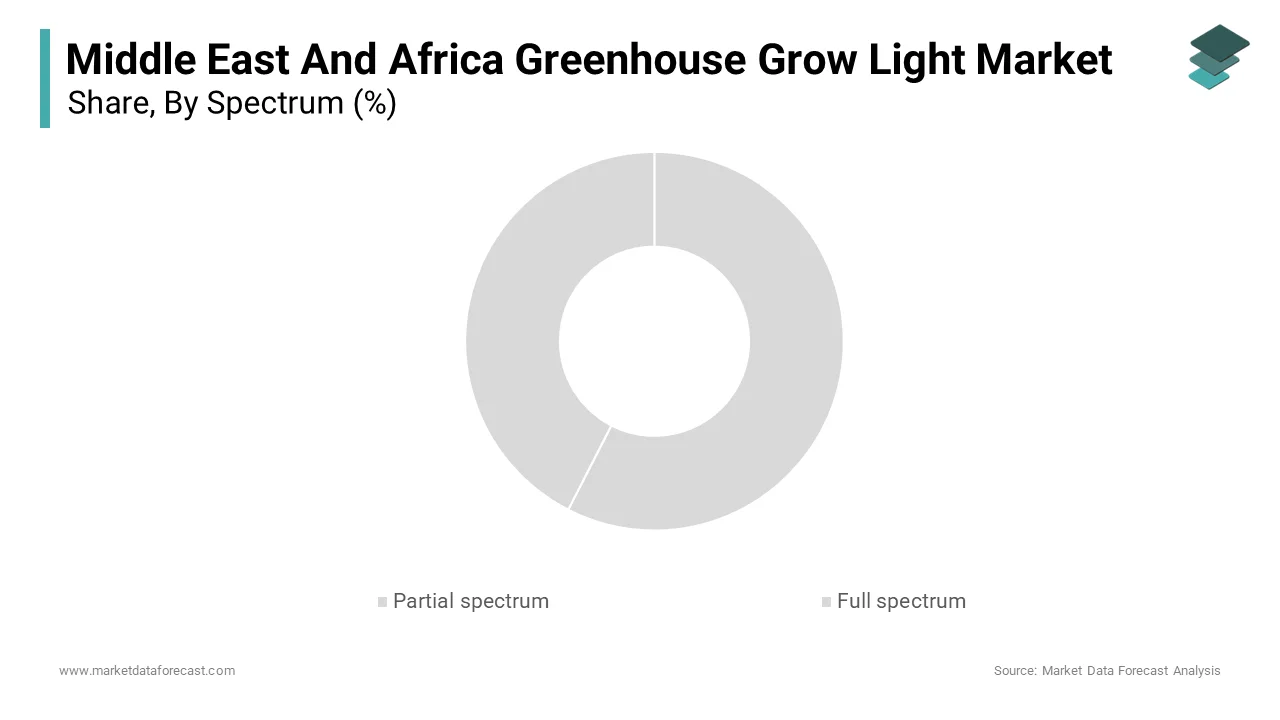
The partial spectrum grow lights segment dominated the Middle East and Africa greenhouse grow light market by capturing 55.1% of total share in 2025. The high electricity costs in Gulf countries, particularly in the UAE and Saudi Arabia, are one key driver behind the widespread use of partial spectrum lights. Partial spectrum LEDs consume less power while still delivering high yields for crops like tomatoes, cucumbers, and let, which is making them an economically viable choice. These lighting systems are designed to emit specific wavelengths, primarily red and blue, that are most effective for photosynthesis and plant development. Their dominance stems from their cost-effectiveness and targeted efficiency, making them ideal for large-scale commercial greenhouses where energy consumption and operational costs must be optimized. Moreover, the growing preference for monochromatic lighting in hydroponic systems has reinforced the dominance of this segment. Hydroponic setups often require precise control over light wavelengths to enhance root development and flowering cycles. In Israel, where advanced greenhouse farming is well-established, agricultural research institutions have endorsed partial spectrum lighting for its ability to increase biomass production without excessive energy usage.
Full Spectrum Grow Lights
The full spectrum grow lights segment is projected to register the highest CAGR of 16.7% between 2025 and 2033. The rising demand for cannabis cultivation in South Africa and Israel, where regulatory frameworks are increasingly accommodating medical cannabis production, is one major factor fueling the growth of the full spectrum grow lights segment. Though currently holding a smaller market share compared to partial spectrum options, full spectrum lighting is gaining traction due to its ability to replicate natural sunlight, offering benefits for a broader range of crops, including medicinal plants and ornamentals. Like, over 25,000 patients were registered under the national medical cannabis program in 203, necessitating optimal growing environments that full spectrum lighting provides. Unlike partial spectrum alternatives, full spectrum lights support all stages of plant growth, from germination to flowering, ensuring higher potency and yield consistency. Moreover, urban greenhouse projects in cities like Nairobi and Cape Town are adopting full spectrum lighting to cultivate diverse produce indoors throughout the year. Urban farmers benefit from the broader wavelength coverage which supports a variety of leafy greens, herbs, and specialty crops in compact spaces. As per a 2023 study by the University of Pretoria, full-spectrum LED systems increased herb biomass by up to 30% compared to narrow-spectrum alternatives.
By Installation Insights
New Installations
The new installations segment represented the largest category in the Middle East and Africa greenhouse grow light market by accounting for 62% in 2025. This trend is largely attributed to the expansion of smart greenhouse infrastructure, especially in the Gulf Cooperation Council (GCC) nations, where governments are investing heavily in modernizing agriculture to reduce reliance on imports. In the United Arab Emirates, the government’s National Food Security Strategy 2051 has spurred the construction of over 200 new greenhouse farms since 2020, all equipped with state-of-the-art grow lighting systems. Dubai alone has seen the establishment of several high-tech vertical greenhouses such as those operated by Madar Farms and Pure Harvest Smart Farms, which integrate LED-based grow lights from day one. According to the UAE Ministry of Climate Change and Environment, these new facilities contribute to more than 10% of the country’s fresh vegetable supply, demonstrating the strategic importance of new installations. Similarly, in Saudi Arabia, the NEOM Smart City initiative includes plans for fully automated indoor farms utilizing AI-driven grow light systems. The combination of government-backed agritech investments, urbanization trends, and desalination-powered irrigation ensures that new installations remain the dominant force in the MEA greenhouse grow light market.
Retrofit Installations
The retrofit installations segment is emerging as the fastest-growing segment, with a projected CAGR of 15.9% through 2033. The need to upgrade aging greenhouse infrastructure in North Africa and parts of Sub-Saharan Africa, where many facilities were originally equipped with outdated fluorescent or HID lighting, is one of the primary drivers of retrofit adoption. While starting from a smaller base, retrofitting existing greenhouses with modern grow lighting systems is gaining momentum due to economic viability, policy mandates, and technological accessibility. In Egypt, for instance, the Ministry of Agriculture launched a greenhouse modernization program in 20, mandating upgrades to energy-efficient LED systems by 2027. Further, financing initiatives from international development banks are accelerating retrofit adoption. The Islamic Development Bank partnered with Moroccan cooperatives in 2023 to fund USD 15 million worth of retrofitting projects, allowing small and medium-scale growers to transition to LED grow lights without significant upfront investment. The increasing awareness among farmers about the long-term benefits of efficient lighting, including reduced maintenance, better yield consistency, and lower energy bills, is another contributing factor.
By Technology Insights
LED Grow Lights
The LED grow lights segment led the Middle East and Africa greenhouse grow light market by capturing 54.1% in 2025. The widespread adoption of LED technology is driven by its superior energy efficiency, long lifespan, and customizable spectral output, which aligns well with the needs of greenhouse operators facing extreme climatic conditions and high energy costs. In the Gulf region, where summer temperatures regularly exceed 45°C, traditional lighting systems generate excessive heat, increasing cooling demands and energy consumption. LEDs, on the other hand, operate at lower temperatures and allow for precise light tuning, enabling farmers to optimize photosynthesis without overheating greenhouse structures. Government policies also play a pivotal role in promoting LED adoption. Similarly, in Saudi Arabia, Vision 2030 includes targets for vertical farming expansion with LED lighting being the preferred choice for new installations. Leading global manufacturers such as Signify Holding and OSRAM Licht AG have introduced modular LED systems tailored for desert climates, further enhancing their appeal. These systems can be integrated with smart controls and IoT-enabled sensors, allowing real-time adjustments to light intensity and spectrum, features that further improve productivity and resource efficiency.
Light Emitting Plasma (LEP)
The Light Emitting Plasma (LEP) grow lights segment is projected to experience the highest CAGR of 17.5% during the forecast period. Its full-spectrum white light output closely resembling natural sunlight, ht is one of the key reasons for LEP’s rapid growth. This makes it highly suitable for cultivating high-value crops such as cannabis, ginseng, and certain ornamental plants that require broad-spectrum illumination for optimal growth. Although LEP remains a niche segment, its unique properties are attracting attention in specialized greenhouse applications, particularly in medicinal plant cultivation and urban farming. In Israel, where the medical cannabis industry is booming, LEP lighting has gained popularity for its ability to enhance cannabinoid concentration and uniform flowering as per the Hebrew University Faculty of Agriculture in 2023. Additionally, LEP lights offer exceptional durability with lifespans reaching up to 20,000 hours and minimal lumen depreciation over time. This reliability is particularly beneficial in remote regions of Ethiopia and Kenya, where access to replacement components and technical support is limited. Furthermore, the rise of multi-tiered urban greenhouse farms in cities like Dubai and Johannesburg is driving interest in LEP lighting. Its compact size and omnidirectional light distribution make it ideal for stacked plant layers, improving space utilization and yield consistency.
COUNTRY ANALYSIS
United Arab Emirates (UAE)
The UAE led the Middle East and Africa greenhouse grow light market, holding an estimated share of 29.5% in 2025. Positioned as a regional leader in agritech innovation, the UAE has aggressively pursued strategies to bolster domestic food production amid extreme climatic conditions and limited arable land. The UAE’s leadership in the grow light market is primarily driven by its National Food Security Strategy 20, which prioritizes the adoption of smart agriculture technologies. Under this initiative, the government has invested over USD 1.5 billion in controlled-environment agriculture (CEA), including indoor and vertical farming systems. Dubai alone hosts more than 200 smart farms, many of which utilize LED grow lights to cultivate high-value crops such as lettuce, tomatoes, and strawberries. In addition to policy support, the UAE benefits from a highly developed infrastructure and favorable investment climate, attracting global agritech firms like Netafim Signify, and AeroFarms to establish regional headquarters and pilot farms. The Abu Dhabi Investment Office (ADIO) offers financial incentives, including grants covering up to 50% of setup costs, encouraging startups and international players to scale their operations in the country. Moreover, the UAE’s desalination-based water supply system ensures stable irrigation for indoor farms, complementing the use of grow lights.
Saudi Arabia
Saudi Arabia is a significant player in the MEA greenhouse grow light market. The country’s strategic pivot toward food security and agricultural diversification under Vision 2030 has catalyzed the adoption of advanced grow light technologies. Central to this transformation is the National Center for Agricultural Technology (NCAT), established in 2021 to drive innovation in farming practices. NCAT has funded several pilot projects involving vertical farming and hydroponics, all relying on LED-based grow lighting. For instance, the NEOM Smart City project plans to integrate fully automated indoor farms powered by renewable energy and grow lights, aiming to serve over 500,000 residents sustainably. Water scarcity remains a critical challenge, yet the country’s advanced irrigation infrastructure and desalination capabilities enable large-scale indoor farming. Hydroponic farms using LED grow lights can save a significant portion of water compared to traditional farming, making them ideal for deployment in arid regions. Private-sector participation is also rising.
Israel
Israel is known for its world-class agricultural technology ecosystem. Israel leverages decades of expertise in precision farming, irrigation, and controlled environment agriculture to lead in grow light adoption. The country’s advanced research institutions and startup culture foster continuous innovation in grow light technologies. Universities such as the Hebrew University of Jerusalem and Technion-Israel Institute of Technology collaborate with agritech firms to develop next-generation lighting systems optimized for high-yield indoor farming. Israeli companies like Nextlight Agritech and Growlight Technologies Ltd. export customized LED grow lights to markets across the Middle East and Africa. Israel’s medical cannabis industry also drives grow light demand. Moreover, the export-oriented nature of Israeli agriculture encourages the use of high-efficiency grow lighting to ensure year-round production of premium-quality fruits and vegetables. These combined factors cement Israel’s position as a key player in the MEA greenhouse grow light landscape.
South Africa
South Africa serves as a regional hub for agritech innovation in sub-Saharan Africa, benefiting from a relatively mature economy and growing urban farming movement. One of the primary growth drivers is the rising prevalence of food insecurity and unemployment, particularly in urban townships. Organizations like AgriSETA and GreenCape are supporting the development of urban farms using grow lights to create jobs and improve access to fresh produce. In Cape Town, for example, the City Food Gardens Network has facilitated the establishment of over 150 community-based indoor farms, many of which use LED lighting. Additionally, the South African government’s Renewable Energy Independent Power Producer Procurement Programme (REIPPPP) indirectly supports grow light adoption by promoting clean energy integration in agriculture. Solar-powered grow light systems are becoming increasingly common in rural and peri-urban areas, reducing reliance on grid electricity. The country’s expanding horticulturesectorr coupled with increasing investments in greenhouse and vertical farming, further strengthens its position in the MEA greenhouse grow light market.
Egypt
Egypt captures a notable share of the MEA greenhouse grow light market. With a population exceeding 100 million and growing at a rate of 2.1% annually, Egypt faces mounting pressure to enhance food production in the face of declining arable land and water shortages. The Nile Delta, once the breadbasket of Egypt, is experiencing severe salinization and urban encroachment, reducing fertile farmland. In response, the government has launched the National Project for Sustainable Agriculture, which promotes the use of smart greenhouses and LED grow lights to increase productivity on limited land. The Ministry of Agriculture estimates that adopting controlled environment agriculture could double vegetable yields while conserving water. Egypt is also leveraging international partnerships to boost its grow light sector. In 2023, the Dutch-Egyptian AgriTech Partnership facilitated the transfer of advanced Dutch greenhouse technologies, including LED lighting systems, to Egyptian farmers. Apart from these, private sector investment in agritech startups is rising, with companies like FarmShots and VeggieGrow introducing affordable LED grow kits tailored for smallholder farmers.
KEY MARKET PLAYERS
Royal Philips, General Electric Company, Osram Licht AG, Gavita Holland B.V., Lumigrow Inc., Heliospectr., Iwasaki Electric Co., Ltd., Illumitex Inc., Hortilux Schreder B.V., and Sunlight Supply Inc. are the market players that are dominating the Middle East and Africa greenhouse grow light market.
Top Players In The Market
Signify N.V., formerly known as Philips Lighting, is a global leader in horticultural LED lighting and a dominant force in the Middle East and Africa greenhouse grow light market. The company is renowned for its innovative spectrum-tuned lighting solutions that enhance plant growth, improve yield, and reduce energy consumption. Signify has been instrumental in supporting large-scale greenhouse farming in the Gulf, particularly in the UAE and Saudi Arabia, where it collaborates with agritech firms and government bodies to deploy smart lighting systems tailored for desert agriculture. Its commitment to sustainability and digital integration in farming has positioned it as a key enabler of the region’s food security goals.
OSRAM Licht AG is another major player with a strong presence in the MEA greenhouse grow light market. Known for its high-quality lighting technologies, OSRAM offers a broad portfolio of LED and specialized grow lights designed to optimize photosynthesis in controlled environments. The company has been actively involved in supplying customized lighting solutions to greenhouse operators across the Middle East, working closely with agricultural technology providers to enhance productivity. OSRAM’s expertise in lighting innovation and its focus on energy-efficient systems have made it a trusted partner in the development of modern greenhouse infrastructure in the region.
AeroFarms, a U.S.-based vertical farming company, plays a strategic role in shaping the greenhouse grow light landscape in the Middle East and Africa. While primarily known for its farming operations, AeroFarms utilizes proprietary LED grow light systems that are being studied and adopted by regional partners. The company’s technology enables high-yield, resource-efficient farming, aligning with the MEA region’s growing focus on food security and climate-resilient agriculture. AeroFarms’ influence extends beyond its operations, inspiring startups and investors to adopt similar models across the region, particularly in urban and peri-urban settings.
Top Strategies Used By Key Market Participants
Key players in the Middle East and Africa greenhouse grow light market employ several strategic approaches to solidify their presence and expand their reach. One major strategy is technology innovation and customization, where companies focus on developing advanced LED and spectrum-specific lighting systems tailored for regional agricultural needs. These innovations enhance plant growth efficiency and cater to the unique climatic and infrastructural conditions of the MEA region.
Another key approach is strategic partnerships and collaborations with local governments, agritech startups, and research institutions. By working closely with regional stakeholders, market leaders gain insights into local demands, secure government-backed projects, and accelerate the adoption of grow light technologies in emerging markets.
Lastly, market expansion through localized distribution and service networks plays a crucial role. Companies are establishing regional offices, warehouses, and technical support centers to ensure faster delivery, after-sales service, and customer engagement, thereby strengthening their foothold in the MEA market.
COMPETITION OVERVIEW
The Middle East and Africa greenhouse grow light market is characterized by a mix of global leaders and emerging regional players striving to capture a growing demand driven by food security concerns and technological advancements in agriculture. As governments across the region push for sustainable farming solutions, the competition among grow light providers intensifies, particularly in countries like the UAE, Saudi Arabia, and Israel, where investment in agritech is substantial. Established players leverage their technological expertise and brand reputation to maintain dominance, while local startups and regional distributors offer cost-effective alternatives, targeting small and medium-sized farms. The market also sees increasing collaboration between lighting companies and agricultural technology firms to develop integrated solutions that optimize plant growth and resource efficiency. With rising awareness of controlled environment agriculture and supportive policy frameworks, the competitive landscape is evolving rapidly, with companies focusing on innovation, strategic partnerships, and localized market penetration to gain an edge. As the region continues to invest in smart farming infrastructure, the competition is expected to grow further, fostering a dynamic and innovation-driven market environment.
RECENT HAPPENINGS IN THE MARKET
- In February 2024, Signify N.V. launched a new line of horticultural LED grow lights specifically designed for desert farming conditions in the Middle East. This product rollout was accompanied by a partnership with a leading UAE-based agritech firm to integrate the lights into commercial vertical farms.
- In June 2023, OSRAM Licht AG established a regional distribution and technical support center in Riyadh, Saudi Arabia, aimed at improving accessibility and after-sales service for agricultural clients across the Gulf and North Africa.
- In November 2023, AeroFarms announced a strategic collaboration with a Dubai-based investment group to deploy its proprietary indoor farming and grow light technology in the region, focusing on urban agriculture and food security initiatives.
- In September 2024, Netafim, a global leader in precision irrigation, expanded its offerings to include integrated grow light solutions for greenhouse operators in Egypt and Kenya, enhancing its position in the agritech value chain.
- In March 2024, Ujala Cygnatue, an Indian lighting company with a growing presence in Africa, entered into a joint venture with a Moroccan agricultural cooperative to supply affordable LED grow lights for greenhouse farming in North Africa.
MARKET SEGMENTATION
This research report on the Middle East and Africa greenhouse grow light market is segmented and sub-segmented and sub-segmented into the following categories.
By Spectrum
- Partial spectrum
- Full spectrum
By Installation
- New installations
- Retrofit
By Technology
- High-intensity discharge
- Fluorescent lighting
- Led
- Others
By Application
- Indoor farming
- Vertical farming
- Commercial greenhouse
- Turf and landscaping
- Research
- Other applications
By Country
- KSA
- UAE
- Israel
- Rest of the GCC countries
- South Africa
- Ethiopia
- Kenya
- Egypt
- Sudan
- Rest of MEA