- Product Description Description
- Table of Contents TOC
- List of Table & Figure LOT
- Get Free Sample PDF Sample PDF
Market Size, 2025
$1.18 BnMarket Estimate, 2026
$1.23 BnMarket Forecast, 2034
$1.73 BnCAGR, 2026–2034
4.37%Middle East and Africa Malt Extracts and Ingredients Market Size
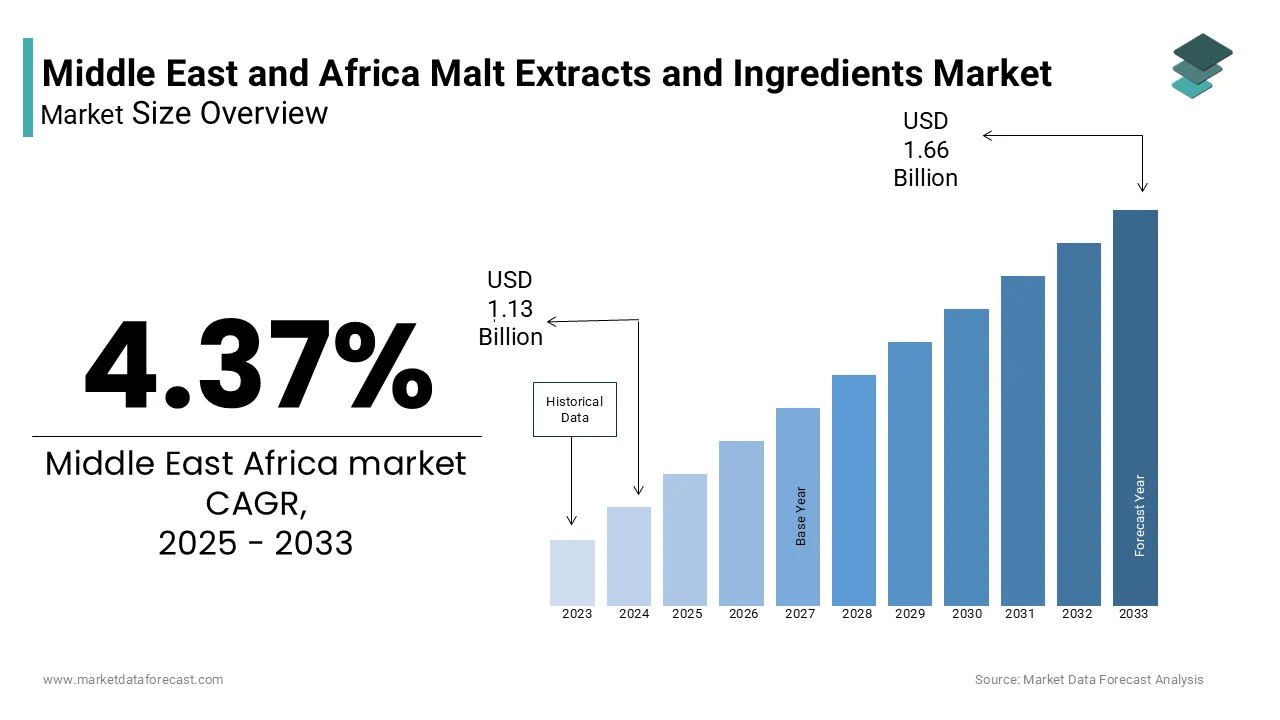
The Middle East and Africa malt extracts and ingredients market size was calculated to be USD 1.18 billion in 2025 and is anticipated to be worth USD 1.73 billion by 2034, from USD 1.23 billion in 2026, growing at a CAGR of 4.37% during the forecast period. Most food processors in the region use malt ingredients for food processing, leading the market for Malt Extracts and Ingredients in Middle East and Africa during the forecast period.
Malt Extracts and Ingredients are derived from germinated barley or alternative cereals such as sorghum and millet, serve critical functional roles including fermentation support, flavor enhancement, and natural sweetening. In recent years, evolving dietary preferences and a surge in artisanal brewing have intensified demand for high-quality malt components.
Concurrently, urbanization has reshaped consumption patterns; as per the United Nations, over 43% of Africans lived in urban centers by 2023, fostering greater access to processed foods and premium beverages reliant on malt ingredients. Moreover, non-alcoholic malt beverages, culturally aligned with regional norms, are gaining traction. This confluence of agrarian development, shifting consumer behavior, and religious-cultural alignment underpins the strategic importance of malt extracts and ingredients in shaping regional food systems.
MARKET DRIVER
Rising Demand for Craft and Non-Alcoholic Malt Beverages Driving Ingredient Adoption
The escalating consumer preference for craft and non-alcoholic malt-based beverages, particularly in alignment with cultural and religious values is a pivotal driver fueling the Middle East and Africa Malt Extracts and Ingredients Market. Across the Gulf Cooperation Council (GCC) nations, where alcohol consumption is restricted, malt-derived non-alcoholic beers and flavored malt drinks have emerged as socially acceptable alternatives. This trend is mirrored in Egypt, where companies like Al-Ahram Beverages have expanded their Barbican malt drink production lines since 2021 to meet rising domestic and export demand. Furthermore, the craft beverage movement is gaining momentum in urban hubs such as Cape Town, Nairobi, and Dubai, where microbreweries increasingly utilize specialty malt extracts to differentiate flavor profiles. These developments are supported by growing disposable incomes. As consumers seek sophisticated taste experiences without contravening cultural norms, malt extracts have become indispensable, reinforcing their centrality in product innovation and market expansion strategies.
Expansion of Local Malting Capacity to Reduce Import Dependence
The strategic investment in domestic malting infrastructure aimed at reducing reliance on imported malt products and enhancing food security is another significant driver. Historically, many countries in the Middle East and Africa imported the majority of their malt requirements, exposing supply chains to global price volatility and logistical disruptions. However, governments and private enterprises are now prioritizing localized production. For instance, Ethiopia inaugurated its first large-scale malting plant in Dire Birhan, capable of processing 40,000 metric tons of barley annually, as confirmed by the Ethiopian Ministry of Agriculture. This expansion is further supported by improved agricultural extension services. By vertically integrating barley farming with malting operations, nations like Morocco and Kenya are not only securing raw material supply but also creating rural employment. Such investments underscore a structural shift toward self-reliance, positioning malt extracts as key enablers of industrial and agricultural transformation.
MARKET RESTRAINTS
Limited Availability and Quality Variability of Domestic Barley Supply
The inconsistent availability and suboptimal quality of locally grown barley, the primary raw material for malt production is one of the most pressing restraints impeding the growth of the Middle East and Africa Malt Extracts and Ingredients Market. Despite efforts to boost cereal cultivation, yields remain below international standards due to climatic adversities, outdated farming practices, and fragmented landholdings. In countries like Tanzania and Uganda, lesser share of cultivated barley meets the protein and moisture specifications required for malting. This forces processors to either import high-grade barley, increasing costs, or blend low-quality local stocks with imported grain, compromising efficiency. Additionally, inadequate cold chain logistics and post-harvest storage facilities result in grain loss before processing, as highlighted by the World Food Programme. The absence of standardized grading systems further complicates procurement, discouraging long-term contracts between farmers and malting companies. Without coordinated interventions in seed development, irrigation infrastructure, and farmer training, the region’s malt industry will continue to face bottlenecks in scaling sustainably, undermining both cost competitiveness and product consistency.
Stringent Regulatory Frameworks and Sanitary-Phytosanitary Barriers
The presence of complex and often divergent regulatory frameworks governing food safety, labeling, and cross-border trade of agricultural commodities is a critical restraint affecting the Middle East and Africa Malt Extracts and Ingredients Market. While some nations have advanced food standards authorities, others lack harmonized compliance mechanisms, creating obstacles for regional market integration. Moreover, import licensing procedures in countries like Algeria and Oman can take up to six months, delaying supply chains and increasing inventory costs. This deficiency undermines trust in regional sourcing and compels multinational beverage producers to rely on certified European or Australian suppliers. Even within regional economic blocs such as the East African Community, disparities in labeling requirements for allergens and additives hinder seamless distribution of malt-based products. Until regulatory coherence improves and technical capacity is strengthened across borders, the scalability of the malt ingredients sector will remain constrained by compliance inefficiencies and market fragmentation.
MARKET OPPORTUNITIES
Growth of Functional Foods and Nutritional Supplements Using Malt Bases
The integration of malt into functional foods and fortified nutritional products targeting public health challenges is a transformative opportunity emerging within the Middle East and Africa Malt Extracts and Ingredients Market. Malt extracts, rich in soluble fibers, B-vitamins, and easily digestible carbohydrates, are increasingly leveraged as carrier bases for micronutrient fortification in infant formulas, maternal supplements, and ready-to-use therapeutic foods. In addition, companies like Cipla Nutrition and Promasidor have launched malt-based weaning foods enriched with iron, zinc, and vitamin A across Nigeria, Kenya, and South Africa. Additionally, the demand for plant-based energy boosters is rising among working professionals and athletes. Innovations such as extruded malt granules and instant malt blends are being adopted by startups in Egypt and South Africa to create shelf-stable, nutrient-dense solutions.
Adoption of Sustainable and Climate-Resilient Malting Cereals
The shift toward climate-resilient cereal crops such as sorghum, millet, and drought-tolerant barley variants for sustainable malting applications is an emerging opportunity reshaping the Middle East and Africa Malt Extracts and Ingredients Market. As climate change intensifies arid conditions across the Sahel and Horn of Africa, traditional barley cultivation faces mounting pressure, prompting research institutions and agribusinesses to explore alternative grains. Similarly, sorghum, naturally resistant to water stress and compatible with gluten-free formulations, is being enzymatically modified to mimic malt characteristics. Breweries like Nile Breweries in Uganda and Delta Corporation in Zimbabwe have begun pilot production of sorghum-based malt drinks to cater to gluten-sensitive consumers and reduce environmental footprints. With sustainability certifications becoming a competitive differentiator, brands leveraging eco-friendly malt sources are gaining favor among environmentally conscious urban consumers. This transition not only enhances supply chain resilience but also aligns with global ESG benchmarks, opening doors to green financing and export markets in Europe and Asia.
MARKET CHALLENGES
Inadequate Cold Chain and Post-Harvest Infrastructure
The deficiency in cold chain logistics and post-harvest handling systems essential for preserving barley and malt quality is one of the foremost challenges confronting the Middle East and Africa Malt Extracts and Ingredients Market. Once harvested, barley must be rapidly dried and stored under controlled humidity to prevent mold growth and sprouting, yet much of the region lacks adequate drying facilities and hermetic storage. Malt, being hygroscopic, deteriorates quickly when exposed to tropical humidity, necessitating climate-controlled warehousing, an asset scarce outside major industrial zones. Even in relatively advanced markets like South Africa, rural malting facilities struggle with unreliable power supply, disrupting kilning and roasting processes. Refrigerated truck fleets remain minimal. Without substantial investment in electrified silos, solar-powered dryers, and refrigerated rail networks, the integrity of malt ingredients cannot be assured throughout the value chain. This infrastructural gap not only inflates operational risks but also deters foreign investors seeking consistent product standards.
Skilled Labor Shortage in Malting Technology and Process Engineering
The acute shortage of technically trained personnel in malting science, fermentation technology, and process engineering is a persistent challenge undermining the advancement of the Middle East and Africa Malt Extracts and Ingredients Market. Malting is a precision-driven biological process requiring expertise in germination control, kilning profiles, and enzyme management—skills largely absent from local vocational curricula. In emerging malting hubs like Ethiopia and Senegal, new facilities often rely on expatriate engineers for commissioning and troubleshooting, increasing operational costs. Technical universities in the region offer limited specialized programs. This skills deficit extends to quality assurance, where automated analyzers for moisture, protein, and diastatic power remain underutilized due to operator inexperience. Moreover, retention is problematic, as skilled workers migrate to higher-paying industries or overseas markets. Without targeted investments in technical education, apprenticeship models, and international knowledge transfer partnerships, the region’s ability to innovate and maintain consistent malt quality will remain compromised, ultimately constraining industrial maturity and global competitiveness.
REPORT COVERAGE
| REPORT METRIC | DETAILS |
| Market Size Available | 2025 to 2034 |
| Base Year | 2025 |
| Forecast Period | 2026 to 2034 |
| CAGR | 4.37% |
| Segments Covered | By Product, Source, Grade, Application, Form, and Region |
| Various Analyses Covered | Global, Regional, & Country Level Analysis; Segment-Level Analysis; DROC; PESTLE Analysis; Porter’s Five Forces Analysis; Competitive Landscape; Analyst Overview of Investment Opportunities |
| Regions Covered | KSA, UAE, Israel, rest of GCC countries, South Africa, Ethiopia, Kenya, Egypt, Sudan and Rest of MEA |
| Market Leaders Profiled | Rahr Corporation, Malteurop, GrainCorp, Groupe Soufflet, Holland Malt, Maltexco, Barmalt, IREKS, Muntons PLC, and Simpsons, and others. |
SEGMENTAL ANALYSIS
By Product Insights
The malt extracts segment commanded a 65.3% of the Middle East and Africa Malt Extracts and Ingredients Market and established themselves as the dominant product category in 2025. This supremacy is primarily anchored in their extensive application across beverage manufacturing, particularly in non-alcoholic malt drinks and craft brewing. In countries like Egypt and South Africa, malt extract forms the foundational fermentable base for popular traditional beverages such as boza and umqombothi, which have seen a revival due to cultural branding and urban nostalgia. The versatility of malt extracts, available in syrup, powder, and spray-dried forms, enables seamless integration into high-speed bottling and canning lines, making them indispensable for industrial-scale production. Besides, multinational beverage companies such as PepsiCo and Diageo have increasingly incorporated natural malt derivatives into functional drink formulations, citing consumer preference for clean-label ingredients. Furthermore, advancements in enzymatic hydrolysis now allow producers to customize extract profiles for specific sweetness, color, and fermentability, enhancing formulation precision. These converging factors underscore the entrenched leadership of malt extracts in shaping regional consumption dynamics.
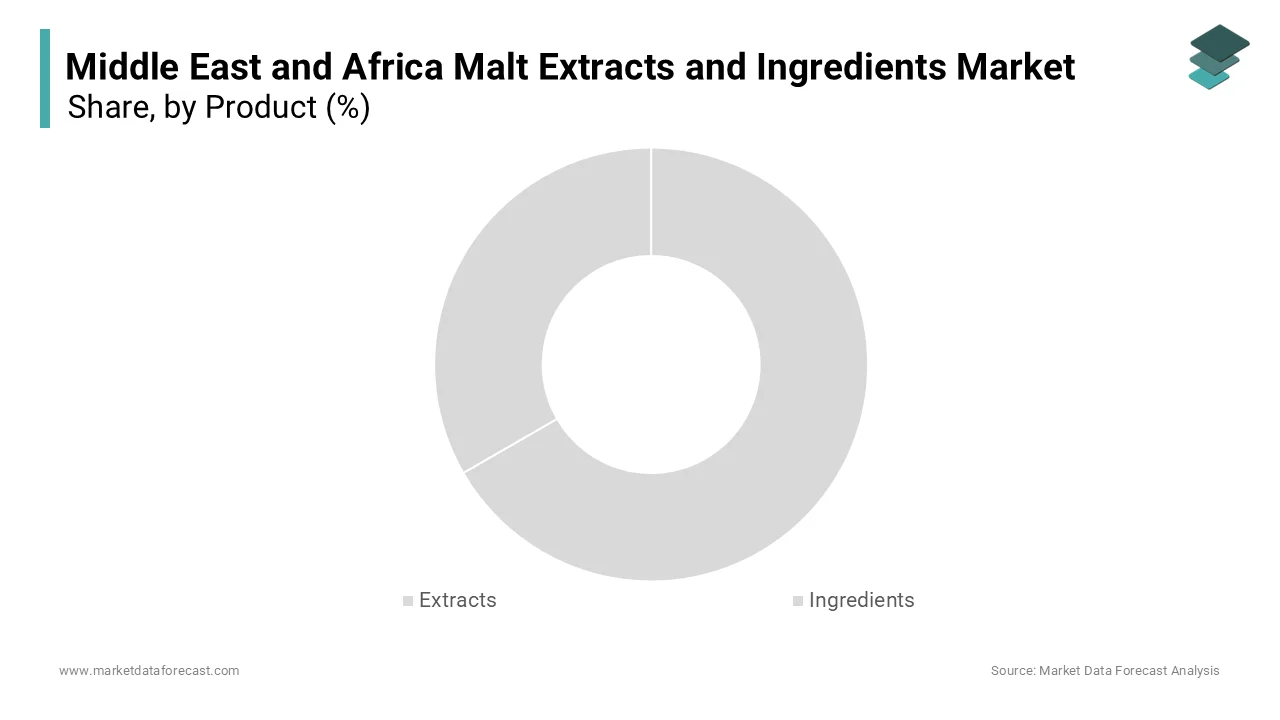
The malt ingredients segment is projected to grow at a CAGR of 9.4% from 2026 to 2034 which is outpacing malt extracts due to rising innovation in food formulation and health-oriented product development. The increasing use of malt-based ingredients in gluten-free and infant nutrition products, where modified malt fractions serve as digestible carbohydrate sources is a primary driver. A further critical factor is the surge in artisanal baking and premium bakery goods across urban centers. Moreover, pharmaceutical applications are emerging; researchers at Cairo University have developed maltodextrin-based excipients derived from barley malt for tablet binding, reducing reliance on imported starch derivatives. With the African Continental Free Trade Area (AfCFTA) facilitating cross-border movement of processed foods, manufacturers are reformulating products to meet diverse regulatory and sensory expectations, further boosting demand for standardized malt ingredients.
By Source Insights
The wheat segment constituted the largest source in the Middle East and Africa Malt Extracts and Ingredients Market by capturing an estimated 54.2% share in 2025. It is driven by its deep-rooted presence in staple diets and favorable agronomic adaptability across arid zones. Unlike barley, which requires cooler germination conditions, certain durum and hard red wheat varieties thrive in the semi-arid climates of North Africa and the Levant, enabling localized cultivation and reduced import dependency. The dominance of wheat is further reinforced by consumer familiarity; in countries like Iran and Iraq, malted wheat porridge (samoonak ) is a culturally significant winter delicacy, sustaining year-round demand for artisanal malt powders. Commercially, wheat malt extracts are increasingly blended with barley malt to enhance foam stability and mouthfeel in non-alcoholic beers. Additionally, wheat’s higher starch content yields greater extract efficiency during mashing, lowering production costs for beverage manufacturers. These agronomic, cultural, and economic advantages collectively cement wheat’s preeminence as the leading source material in the regional malt ecosystem.
The rye-based malt ingredients segment is registering the highest growth within the Middle East and Africa Malt Extracts and Ingredients Market and is expanding at a CAGR of 10.2% from 2026 to 2034. It is propelled by rising interest in functional grains and niche brewing innovations. Though historically marginal in the region, rye cultivation has gained traction due to its exceptional resilience to saline soils and low rainfall, conditions prevalent across the Arabian Peninsula and the Horn of Africa. The agro-ecological advantage is prompting governments to explore rye as a strategic alternative crop. Concurrently, craft brewers in South Africa and Israel are adopting rye malt to create distinctive flavor profiles, spicy, earthy notes, that differentiate premium products in competitive markets. From a nutritional standpoint, rye malt contains higher levels of soluble fiber and lignans than barley, aligning with growing demand for gut-health-promoting ingredients. As research institutions like the University of Pretoria advance enzymatic modification techniques to improve rye’s diastatic power, its viability as a standalone malting grain continues to strengthen, positioning it as a high-potential segment in the evolving malt landscape.
By Grade Insights
The Standard grade malt extracts and ingredients accounted for a substantial share of the Middle East and Africa Malt Extracts and Ingredients Market. It maintained dominance due to their widespread use in mass-market beverage and food production. These grades, characterized by consistent enzymatic activity, moderate color values (EBC 5–10), and cost-effective pricing, are the backbone of large-scale non-alcoholic malt drink manufacturing across Egypt, Nigeria, and South Africa. The affordability of standard malt is particularly crucial in price-sensitive markets; in Sudan and Ethiopia, where per capita GDP remains below $1,000, manufacturers prioritize input cost control without compromising basic functionality. Additionally, government-regulated food fortification programs often specify standard malt as a carrier for micronutrients due to its uniform composition and availability. Even in more advanced markets like the UAE, standard malt remains integral to mainstream soft drink production, with brands like Mecca Cola relying on it for natural caramelization and body enhancement. The prevalence of vertically integrated breweries, such as Castel Group operations in Central Africa, that operate their own malting units further entrenches standard grade usage, as these facilities are optimized for volume rather than variety. Until consumer demand shifts decisively toward premiumization, standard grade will continue to dominate both in volume and accessibility.
The specialty grade malt extracts and ingredients segment is experiencing the most rapid expansion in the Middle East and Africa Malt Extracts and Ingredients Market and is growing at a CAGR of 11.6% from 2026 to 2030. It is driven by the ascent of premiumization, craft production, and sensory-driven consumer preferences. These malts, including roasted, caramel, smoked, and high-diastatic variants, are increasingly sought after for their ability to impart complex flavors, deeper hues, and enhanced mouthfeel in artisanal beverages and baked goods. A further key driver is the rise of export-oriented production; Ethiopian and Moroccan maltsters have begun supplying smoked and honey-roasted malts to European craft brewers seeking unique terroir expressions. With global trends favoring authenticity and experiential consumption, specialty malts are transitioning from niche inputs to strategic differentiators, accelerating their penetration across MEA’s evolving food ecosystem.
By Application Insights
The Food & Beverages segment prevailed in the Middle East and Africa Malt Extracts and Ingredients Market with an 89% share in 2025. Malt serves as a foundational ingredient in a wide array of regional staples, from fermented porridges in West Africa to non-alcoholic malt drinks in the Arab world, making it indispensable in daily dietary patterns. Beyond beverages, malt flour is widely used in bread, biscuits, and infant cereals due to its natural sweetness and browning properties. Many commercial bread produced in Kenya and Uganda incorporates malt additives to improve crust color and shelf life. Urbanization amplifies this trend. Additionally, multinational food processors such as Nestlé and Unilever have reformulated several breakfast and snack products across the region to include malt for clean-label appeal. Given the scale of consumption, infrastructural entrenchment, and cultural embeddedness, the Food & Beverages segment remains overwhelmingly dominant, dwarfing other applications in both volume and reach.
The Pharmaceuticals segment is emerging as the fastest-growing application area for malt extracts and ingredients in the Middle East and Africa and is recording a CAGR of 12.8% from 2026 to 2034. It is fueled by rising demand for natural excipients and pediatric formulations. Malt-derived compounds, particularly maltodextrin and maltol, are increasingly utilized as binders, fillers, and flavor enhancers in tablets, syrups, and chewable supplements due to their biocompatibility and solubility. Local API manufacturers like Hikma Pharmaceuticals and Pharco Corporation have begun sourcing malt extracts from domestic processors to reduce import dependency. A further catalyst is the regional push toward pharmaceutical self-sufficiency. As regulatory bodies streamline approval pathways for plant-based excipients and chronic disease prevalence rises, the pharmaceutical sector is poised to become a transformative growth vector for malt ingredient suppliers.
REGIONAL ANALYSIS
South Africa
South Africa stood as the most advanced malt extracts and ingredients market in sub-Saharan Africa by commanding a 25.3% of the regional share in 2025. Its growth is due to a mature brewing industry, sophisticated agricultural supply chains, and robust food processing infrastructure. The country hosts major malting facilities operated by AB InBev and Grain Processing Services (GPS), with combined annual capacity exceeding 450,000 metric tons. Urbanization plays a pivotal role. In South Africa, craft beer sales grew annually from 2020 to 2023, driven by premiumization and experiential consumption. Besides, South Africa is a pioneer in sorghum-based malt development. Export activity is also expanding. With strong R&D linkages, regulatory clarity, and access to international markets, South Africa remains the technological and commercial nucleus of the MEA malt industry.
Egypt
Egypt is distinguished by its massive domestic consumption of non-alcoholic malt drinks and state-supported cereal processing. Brands like Barbican, produced locally by Al-Ahram Beverages, dominate retail shelves. The government’s strategic emphasis on food security has led to the establishment of integrated malting zones in Beni Suef and Ismailia, supported by subsidies for barley farmers. Moreover, Egypt’s proximity to Gulf markets enables export-oriented production. Domestic innovation is also accelerating. With a population exceeding 110 million and growing urban middle class, Egypt’s scale ensures its continued prominence in the regional malt hierarchy.
Saudi Arabia
Saudi Arabia is distinguished not by volume but by high per-unit value and rapid adoption of premium, functional beverages. As alcohol is prohibited, malt-based drinks serve as socially acceptable alternatives, with consumption increasing alongside disposable incomes and lifestyle modernization. Multinationals like PepsiCo and Haleon have introduced fortified malt tonics targeting energy and immunity, capitalizing on Vision 2030’s wellness agenda. Additionally, the Kingdom imports a significant share of its malt requirements, primarily from Europe, indicating untapped potential for local production. With NEOM and other giga-projects fostering demand for premium F&B offerings, Saudi Arabia is evolving into a high-margin growth engine for specialty malt ingredients.
Kenya
Kenya is emerging as a strategic hub for both malt consumption and localized production in East Africa. Nairobi’s urban population, with combined sales surpassing notable million liters in 2023. The country’s first dedicated malting plant, operated by EABL in Nakuru, processes 80,000 metric tons of barley annually, reducing import reliance. Furthermore, Kenya is a leader in sorghum and millet malting research. With regional trade liberalization under the East African Community, Kenyan malt products are gaining access to Uganda, Tanzania, and Rwanda, solidifying its role as an East African gateway.
Ethiopia
Ethiopia commands a notable share of the MEA malt market, notable for its aggressive expansion of domestic malting capacity and cereal self-sufficiency goals. Barley output has surged due to government extension programs. Additionally, traditional fermented beverages like tella and korefe are being commercialized with standardized malt inputs, bridging informal and formal markets. With strong policy backing and demographic momentum, Ethiopia is rapidly ascending as a key player in the regional malt value chain.
KEY MARKET PLAYERS AND COMPETITIVE LANDSCAPE
Major Key Players in the MEA Malt Extracts and Ingredients Market are Rahr Corporation, Malteurop, GrainCorp, Groupe Soufflet, Holland Malt, Maltexco, Barmalt, IREKS, Muntons PLC, and Simpsons.
The competitive landscape of the Middle East and Africa Malt Extracts and Ingredients Market is characterized by a dynamic interplay between multinational ingredient giants and regionally rooted processors, each vying for influence through distinct value propositions. Global firms leverage technological superiority, extensive R&D networks, and scalable supply chains to introduce standardized, high-performance malt solutions, often targeting large beverage and food manufacturers. At the same time, domestic and regional players capitalize on their proximity to raw materials, cultural understanding of traditional applications, and agility in responding to local market nuances. Competition is not solely price-driven but increasingly revolves around innovation, sustainability credentials, and the ability to deliver customized functionalities such as improved fermentability, flavor complexity, or nutritional enhancement. Emerging entrants from the craft brewing and functional food sectors are redefining demand patterns, pushing established players to diversify beyond conventional malt extracts into specialty grades and novel cereal bases. Regulatory diversity across countries adds another layer of complexity, requiring companies to maintain flexible compliance frameworks. Moreover, the rising emphasis on food sovereignty encourages national champions to expand malting infrastructure, fostering a more fragmented yet resilient ecosystem. As urbanization accelerates and consumer expectations evolve, the battleground shifts toward formulation expertise, supply chain transparency, and alignment with public health objectives, making competition less about volume dominance and more about strategic relevance and adaptive capability.
TOP PLAYERS IN THE MARKET
Barry Callebaut AG
Barry Callebaut operates at the intersection of specialty ingredient innovation and sustainable sourcing, extending its influence into malt-based formulations for functional foods and premium confectionery. While globally recognized for chocolate, the company leverages its extensive R&D infrastructure to develop malt-enhanced nutritional matrices tailored for African and Middle Eastern dietary needs. Its integration of plant science with food technology enables customized solutions for energy-dense, micronutrient-rich applications, particularly in infant nutrition and clinical supplements. By aligning with regional agricultural development initiatives, Barry Callebaut fosters long-term supply chain resilience while promoting climate-smart cereal cultivation. The company’s collaborative model with local cooperatives supports traceability and quality standardization, positioning it as a strategic partner in advancing the technical maturity of the malt ingredients sector across emerging markets.
Cargill Incorporated
Cargill plays a pivotal role in shaping the global malt extracts landscape through its integrated agri-food network, connecting grain origination with advanced ingredient processing. In the Middle East and Africa, the company focuses on stabilizing supply chains by partnering with regional millers and beverage manufacturers to deliver consistent, high-purity malt derivatives. Its expertise in starch modification and fermentation science allows for the development of clean-label, non-GMO malt solutions that meet evolving consumer expectations. Cargill emphasizes sustainability-driven practices, supporting farmers with agronomic training and post-harvest handling techniques to improve barley quality. Through technological collaboration and infrastructure investment, the company strengthens the link between smallholder production and industrial-scale processing, enabling greater localization of malt ingredient manufacturing while maintaining international benchmarks for safety and performance.
Archer Daniels Midland Company (ADM)
ADM has established itself as a leader in transforming cereal grains into value-added ingredients, with a growing footprint in malt extract innovation across developing regions. The company applies its deep knowledge in bioprocessing and enzyme technology to optimize malting efficiency and functional properties of barley, sorghum, and alternative cereals. In the Middle East and Africa, ADM collaborates with public and private stakeholders to advance food security through nutrient-enriched malt formulations used in fortified foods and emergency rations. Its research initiatives focus on enhancing digestibility, shelf life, and sensory attributes of malt-based products, catering to both traditional consumption patterns and modern health trends. By integrating digital tools into grain sourcing and quality monitoring, ADM ensures consistency and transparency across the value chain. The company’s commitment to inclusive growth and environmental stewardship further reinforces its position as a forward-looking contributor to the evolution of the regional malt ingredients industry.
TOP STRATEGIES USED BY KEY MARKET PLAYERS
One major strategy employed by leading players is vertical integration across the cereal value chain, from farm-level grain sourcing to finished ingredient production. By establishing direct relationships with farmers and investing in agronomic support programs, companies ensure consistent raw material quality while mitigating supply volatility. This approach also enables better control over sustainability metrics and traceability, which are increasingly important for global buyers and regulatory compliance.
Another key strategy is product differentiation through technological innovation, particularly in developing specialty malt fractions with enhanced functional properties. Companies are focusing on clean-label, non-GMO, and gluten-free formulations that align with shifting consumer preferences for natural and health-oriented ingredients. Investments in enzymatic processing, roasting precision, and fermentation optimization allow producers to offer tailored solutions for diverse applications in beverages, baked goods, and pharmaceuticals.
A third critical strategy involves strategic partnerships with local processors, governments, and research institutions to adapt global expertise to regional contexts. These collaborations facilitate knowledge transfer, accelerate product localization, and support policy alignment on food fortification and safety standards. By embedding themselves in regional development agendas, market leaders strengthen brand credibility, expand market access, and contribute to long-term industrial capacity building in emerging malt-producing nations.
RECENT HAPPENINGS IN THE MARKET
- In March 2023, Cargill announced the launch of a regional innovation hub in Nairobi focused on cereal-based ingredients, aiming to co-develop malt formulations tailored for East African food and beverage applications.
- In June 2023, Archer Daniels Midland partnered with the Ethiopian Institute of Agricultural Research to support the development of high-yielding, malting-grade barley varieties adapted to local climatic conditions.
- In September 2023, Barry Callebaut initiated a farmer engagement program in Sudan to promote sustainable barley farming practices and establish a traceable supply chain for premium malt production.
- In January 2025, Grain Processing Services (GPS) of South Africa expanded its malting facility in Paarl to include a dedicated line for specialty roasted and caramel malts, targeting craft brewers and gourmet food manufacturers.
- In May 2025, Nestlé Middle East collaborated with regional malt suppliers in Egypt and Kenya to reformulate its breakfast cereals and milk-based drinks with locally sourced, fortified malt ingredients to enhance nutritional profiles and reduce import dependency.
MARKET SEGMENTATION
This research report on the middle east and africa malt extracts and ingredients market has been segmented and sub-segmented based on the following categories.
By Product
- Extracts
- Ingredients
By Application
- Food & Beverages
- Pharmaceuticals
By Source
- Soy
- Wheat
- Rye
By Grade
- Standard
- Specialty
By Form
- Dry
- Liquid