Middle East and Africa Masterbatch Market Research Report - Segmented Based on Resin Type (Color, White, Additive, Filler etc.), Polymer (PP, LDPE, LLDPE, PVC, PUR, PS etc.), Application (Household, Personal Care, Building and Construction, Paper and Cardboards, Consumer Goods, Automotive, Textile, Others), And Region - Analysis on Size, Share, Trends & Growth Forecast from 2026 to 2034
Market Size, 2025
$1.99 BnMarket Estimate, 2026
$2.11 BnMarket Forecast, 2034
$3.39 BnCAGR, 2026–2034
6.10%Middle East and Africa Masterbatch Market Size
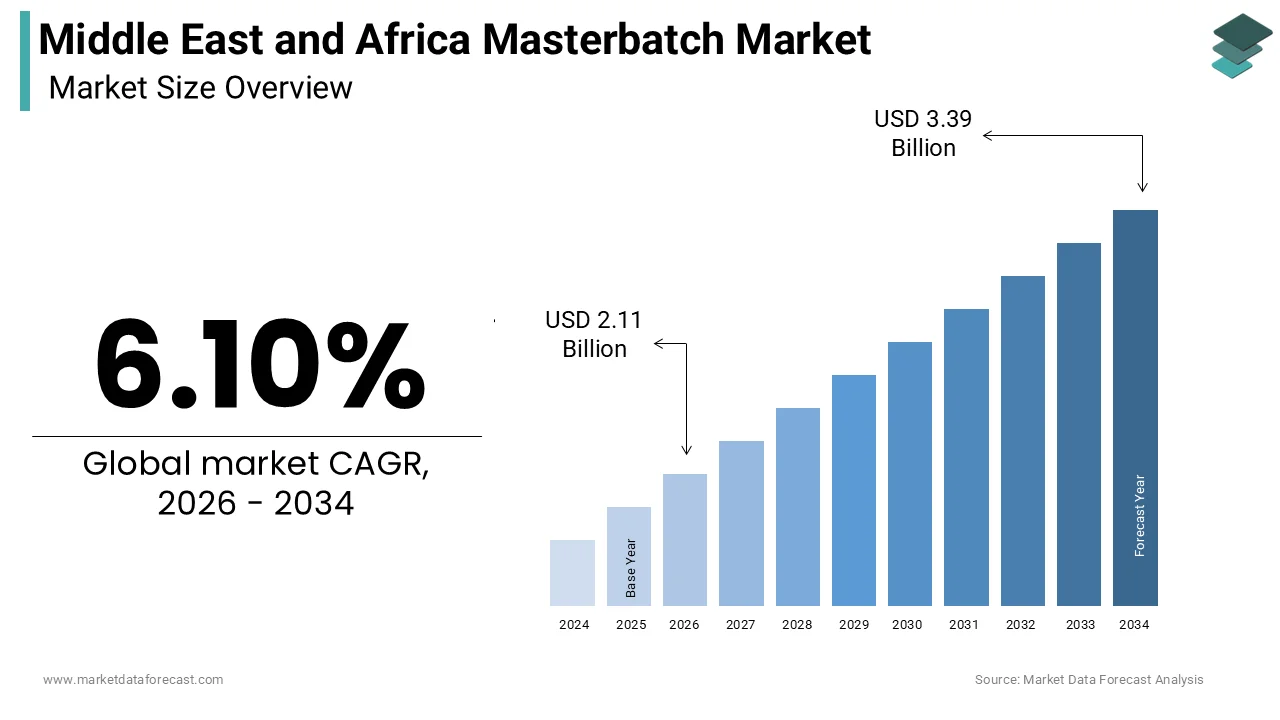
The Middle East and Africa Masterbatch Markets size was calculated to be USD 1.99 billion in 2025 and is anticipated to be worth USD 3.39 billion by 2034, from USD 2.11 billion in 2026, growing at a CAGR of 6.10% during the forecast period.
Market Drivers and Restraints
The use of plastics as a replacement for metals has been the driving aspect of the growth of the MEA masterbatch market. The demand for high-performing, advanced materials is continuously growing, and the masterbatch market has been on the positive side of the growth. The call for colored pigments has also increased across various sectors, further improving the growth opportunities for the masterbatch color segment market. The growth of the construction sector in the Middle East countries such as Qatar and Saudi Arabia, and rapid urbanization in the African region, have spiked the demand for composite materials and colored pigments. This is one of the major driving factors for the Masterbatch industry in the Middle East and African region.
However, there are some limitations in the growth of the MEA masterbatch market, such as the high cost and complexity of color masterbatches, along with the demand for large types of machinery, huge production space, long lead times, and others. The African region sees a very low spending power of the consumers, and thus, bio-plastics are not so popular in these regions due to their high costs. On the other hand, Middle Eastern countries have socio-economic problems that result in civil war and regions plagued by terrorism, which drains a lot of the country’s resources, preventing investments in other sectors.
Impact of COVID-19 on the Middle East and African Masterbatch Market
COVID-19 has exposed severe challenges for the masterbatch market in the MEA. Major economies of the Middle East and Africa are affected due to the pandemic, despite this region being the least affected by the pandemic. The Masterbatch market also suffered huge losses due to the halt in production and manufacturing activities across the continent. On top of this, foreign investments in African regions were halted, and this hindered the growth of the Masterbatch industry. Experts believe that the recovery of the market is expected to start in late 2021 with an expected growth rate of 7% CAGR.
This research report on the Middle East and Africa Masterbatch market has been segmented and sub-segmented based on the following categories.
Middle East and Africa Masterbatch Market By Type
- Color
- White
- Filler
- Additive
The color segment is also expected to grow during the outlook period of 2020 to 2026. This is because colored pigments are heavily used in the packaging, consumer goods, and construction sectors.
Middle East and Africa Masterbatch Market By Polymers
- PP
- LDPE
- HDPE
- PVC
- PUR
- PS
Middle East and Africa Masterbatch Market By Application
- Building and Construction
- Paper and Cardboards
- Consumer Goods
- Automotive
- Textile
- Household
- Personal Care
The building and construction sector has grown rapidly in the Middle East and the African region. The personal care sector has flourished in these times, and as a consequence, the masterbatch industry has also gained a lot.
Middle East and Africa Masterbatch Market By Country
Israel and Turkey are also key players who are investing a lot in bio-plastics and will experience positive results in the upcoming years. The African region accounts for the largest market in terms of size and volume. GCC countries are not far behind their African counterparts in the masterbatch market.
KEY MARKET PLAYERS
- Tosaf Compounds
- A Schulman Inc.
- CabotPlasticss International
- Penn Color Inc.
- Clariant Masterbatches
RECENT HAPPENINGS IN THE MARKET
- In 2020, Israeli-based company Tosaf opened its first operation plant in a North American country, expanding its business outside the Middle East region.
- In January 2020, Cabot International bought a Chinese nanotube supplier in a deal worth 115 million USD. Shenzhen Sanshun Nano New Materials was the leading carbon nanotube producer in China.
- In March’2019, Ampacet started a new production line situated in Belgium, aiming to improve the overall consumer experience through their expansion.
Frequently Asked Questions
1. What are the key types of masterbatch in the MEA market?
The main types include color masterbatch, additive masterbatch, white masterbatch, black masterbatch, and filler masterbatch, with black and color masterbatches widely used due to their versatility
2. What are the key drivers of the MEA masterbatch market?
The market is driven by rising demand for plastics in packaging, automotive, construction, and consumer goods, along with increasing industrialization and infrastructure development.
3. Which application segment dominates the market?
The packaging segment dominates the market, as masterbatch is extensively used to improve the appearance and functionality of plastic packaging materials.
4. How is the construction sector influencing the market?
The construction industry boosts demand through applications in pipes, fittings, insulation, and building materials, where masterbatch enhances durability and UV resistance.
5. What role does the automotive industry play in this market?
The automotive sector uses masterbatch in lightweight plastic components to improve aesthetics, performance, and fuel efficiency, contributing to market growth.
6. What are the major trends in the MEA masterbatch market?
Key trends include increasing demand for bio-based and sustainable masterbatches, product customization, and innovations in additive technologies for enhanced performance.
7. What are the challenges faced by the market?
Challenges include environmental concerns related to plastic waste, fluctuating raw material prices, lack of awareness about advanced products, and regional economic instability.
8. What are the main end-use industries for masterbatch?
Key end-use industries include packaging, construction, automotive, agriculture, consumer goods, and electrical & electronics, all of which require enhanced plastic materials.
9. What opportunities exist in the MEA masterbatch market?
Opportunities include growth in sustainable plastics, expansion of local manufacturing, rising demand for high-performance polymers, and increasing investments in infrastructure.
10. Who are the key players in the MEA masterbatch market?
Leading companies include Clariant AG, Ampacet Corporation, Astra Polymers, Cabot Corporation, and LyondellBasell.
Related Reports
Access the study in MULTIPLE FORMATS
Purchase options starting from
$ 1600
Didn’t find what you’re looking for?
TALK TO OUR ANALYST TEAM
Need something within your budget?
NO WORRIES! WE GOT YOU COVERED!
Call us on: +1 888 702 9696 (U.S Toll Free)
Write to us: sales@marketdataforecast.com