- Product Description Description
- Table of Contents TOC
- List of Table & Figure LOT
- Get Free Sample PDF Sample PDF
Market Size, 2025
$4.87 BnMarket Estimate, 2026
$5.5 BnMarket Forecast, 2034
$14.57 BnCAGR, 2026–2034
12.95%Executive Summary: Middle East & Africa Monoclonal Antibodies Market
- Market Scope: Regional market analysis covering antibody source classifications, disease indications, end-user settings, and country-level leadership dynamics.
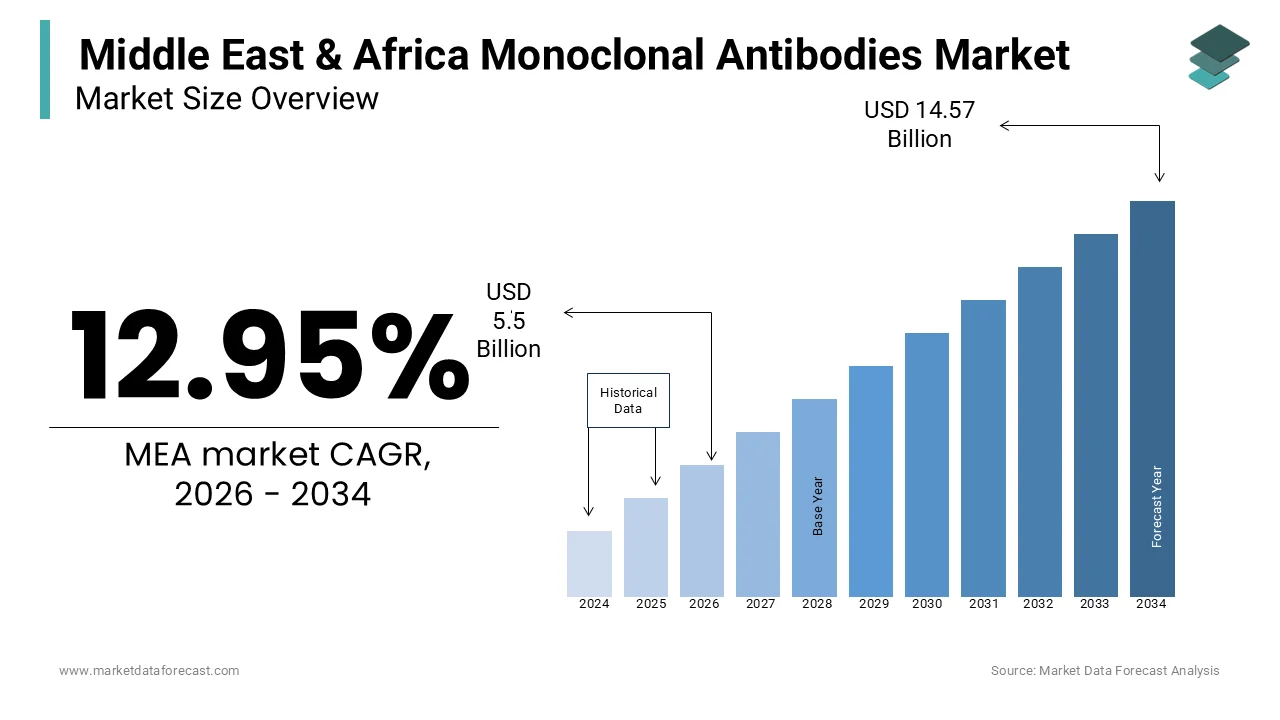
- Market Valuation: Valued at USD 4.87 billion (2025), estimated at USD 5.50 billion (2026), and projected to reach USD 14.57 billion by 2034, growing at a robust CAGR of 12.95% (2026–2034), adding ~USD 9.70 billion overall.
- Primary Growth Drivers: High demand for personalized medicine and targeted therapies, rising research collaborations, government-backed initiatives supporting cost-effective mAb production, and technological innovations in immunoassays. Primary restraints include high development/production infrastructure costs, counterfeit-drug risks, and strict regulatory requirements.
Key Market Segment Metrics (2026–2034)
| Category | Leading Segment (2025 Position) | Fastest-Growing Segment |
|---|---|---|
| By Source & Indication | Segmented by Murine, Chimeric, Humanized, and Human sources; Indications span Cancer, Autoimmune, Infectious, Cardiovascular, and CNS disorders | — |
| By End User | Hospitals / Clinics, Research Institutes, and Diagnostic Laboratories | — |
| By Region / Country | Saudi Arabia (dominant regional market, supported by infrastructure, reimbursement policies, and cancer R&D) | United Arab Emirates / UAE (projected to exhibit lucrative growth, backed by life-sciences expansion and funding) |
Major Market Players & Market Structure
Market Structure: Highly competitive pharmaceutical and biotechnology landscape dominated by key global leaders focusing on therapeutic target specificity, clinical research collaborations, advanced biologic manufacturing capabilities, and regional healthcare expansion.
Key Companies: GlaxoSmithKline plc, Novartis AG, Pfizer Inc., Thermo Fisher Scientific Inc., Eli Lilly and Company, Seattle Genetics, Bristol-Myers Squibb, F. Hoffmann-La Roche Ltd., and Biogen Inc.
Middle East & Africa Monoclonal Antibodies Market Size
The Middle East & Africa Monoclonal Antibodies Market is projected to grow from USD 4.87 billion in 2025 to USD 5.50 billion in 2026 and reach USD 14.57 billion by 2034, registering a CAGR of 12.95% from 2026 to 2034.
Monoclonal is a class of antibodies with the identical progeny of a hybridoma, derived by cell division from a single ancestral cell.
MARKET DRIVERS
The growing demand for personalized medicine is a vital factor responsible for developing therapeutic antibodies to provide targeted therapies, as each individual responds differently to a particular treatment. Furthermore, the advantages associated with using monoclonal antibodies for therapeutic purposes, including reducing adverse effects, homogeneity, specificity, and large-scale production, contribute to significant market growth. Moreover, increasing research collaborations to develop a strong drug portfolio is an important factor that is expected to drive the MEA monoclonal antibodies market growth during the forecast period.
In addition, government initiatives aimed at enabling the cost-effective production of monoclonal antibodies are expected to foster the emergence of this sector during the forecast period. For example, the National Institute of Standards and Technology's Biologic Manufacturing Initiative provides scientifically sound regulatory guidance to ensure the efficient and safe manufacture of protein therapies and help biopharmaceutical manufacturers deliver high-quality protein drugs for a low-cost region-wide. In addition, technological advancements in immunoassay offer a growth opportunity in the market.
The growing number of coronavirus cases increases the need for precise treatment options, leading to the development of monoclonal antibodies and, therefore, would help the monoclonal antibody market grow significantly in the years to come. Unlimited production and identification of specific clones against a particular antigen make this a unique product designed with ease in laboratories.
MARKET RESTRAINTS
A disadvantage of drugs formulated from monoclonal antibodies is that they are particular in nature and have limited purposes. This is because they interact with cells and do not penetrate them. To some extent, this has hampered the global monoclonal antibody market. Another difficulty in using monoclonal antibodies is that they must be injected, unlike small molecule drugs. The growth of the MEA monoclonal antibodies market would be challenged by the high cost involved in developing therapeutic monoclonal antibodies, the threats associated with counterfeit drugs, and the legal regulations required for the identification of molecules, which are limiting the growth of the market. The production and maintenance of infrastructure are expensive and often difficult, especially in low-income, underdeveloped countries.
REGIONAL ANALYSIS
Saudi Arabia is the most dominant regional market in the monoclonal antibody therapeutics market in the Middle East and Africa. It can be attributed to the presence of a well-established healthcare infrastructure. In addition, its large patient population base, well-established reimbursement policies, high disease awareness, government support for infection control and management, increasing incidence of lifestyle-associated diseases, and increased investment in R&D activities by the government for cancer contribute to the growth of Middle Eastern participation.
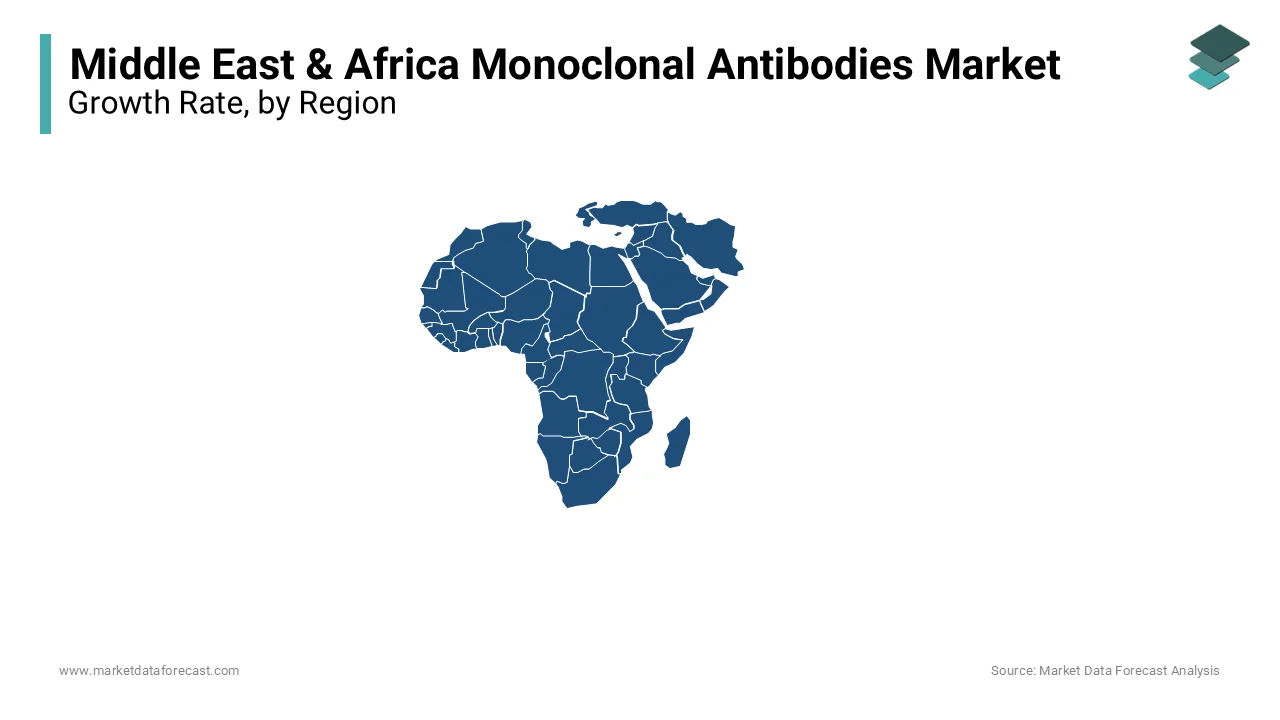
The United Arab Emirates monoclonal antibodies market is predicted to showcase a lucrative growth rate. The market is growing due to the significant growth in the life sciences industry and the availability of funds from the government and non-government sectors for clinical diagnostics.
KEY MARKET PLAYERS
GlaxoSmithKline plc, Novartis AG, Pfizer Inc., Thermo Fisher Scientific Inc., Eli Lilly and Company, Seattle Genetics, Bristol-Myers Squibb, F. Hoffmann-La Roche Ltd., and Biogen Inc. are expected to account for the majority of the MEA Monoclonal Antibodies Market share during the forecast period.
MARKET SEGMENTATION
This research report on the Middle East & Africa monoclonal antibodies market is segmented & sub-segmented into the following categories.
By Source
- Murine
- Chimeric
- Humanized
- Human
By Indication
- Cancer
- Blood Cancer
- Breast Cancer
- Colorectal Cancer
- Lung Cancer
- Pancreatic Cancer
- Others
- Autoimmune Diseases
- Infectious Diseases
- Cardiovascular Diseases
- CNS Disorders
- Others (Inflammatory, Microbial Diseases, & Other)
By End-User
- Hospitals/Clinics
- Research Institute
- Diagnostic Laboratories
By Application
- Medical
- Experimental
- Western Blot
- ELISA
- Radioimmune Assays
- Immunofluorescence
- Others
By Country
- KSA
- UAE
- Israel
- Rest of GCC countries
- South Africa
- Ethiopia
- Kenya
- Egypt
- Sudan
- Rest of MEA