- Product Description Description
- Table of Contents TOC
- List of Table & Figure LOT
- Get Free Sample PDF Sample PDF
Market Size, 2025
$13.37 BnMarket Estimate, 2026
$14.76 BnMarket Forecast, 2034
$32.62 BnCAGR, 2026–2034
10.42%Middle East and Africa Organic Food Market Size, Growth, Trends & Forecast (2026–2034)
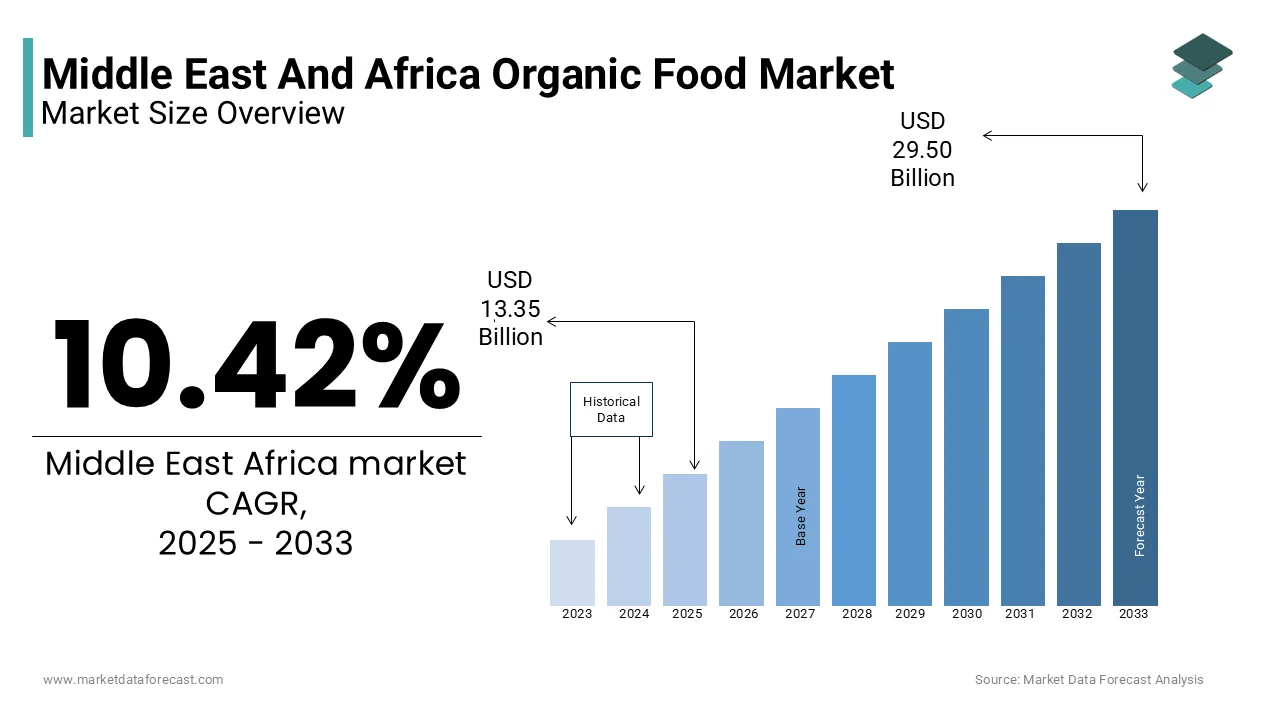
The Middle East and Africa organic food market size was valued at USD 13.37 billion in 2025, reached USD 14.76 billion in 2026, and is projected to expand up to USD 32.62 billion by 2034, registering a compound annual growth rate (CAGR) of 10.42% during the forecast period from 2026 to 2034. Driven by increasing health consciousness, rising chronic disease awareness, growing household spending on food, and government initiatives promoting organic farming, the market continues robust regional expansion.
Key Executive Metrics (At-a-Glance)
- 2025 Base Valuation: USD 13.37 Billion
- 2026 Current Valuation: USD 14.76 Billion
- 2034 Forecast Valuation: USD 32.62 Billion
- Compound Annual Growth Rate (CAGR): 10.42% (2026–2034)
- Leading Product Type Segment: Fruits and Vegetables (Occupying the largest market share due to dietary preferences and widespread accessibility)
- Fastest-Growing Product Type Segment: Meats and Poultry (Expands rapidly owing to shifting consumer diets and demand for clean-label protein sources)
- Key Countries Covered: UAE, Israel, KSA (Saudi Arabia), North Africa, Egypt, Kenya, Ethiopia
Core Market Drivers
- Health & Wellness Shift: Rising concerns about chronic illnesses, changing lifestyles, and growing consumer demand for chemical-free, nutrient-dense foods.
- Retail Accessibility & Standards: Expansion of small-to-medium-scale retailers making organic products more accessible alongside manufacturers adopting international standards.
Primary Market Restraints & Challenges
- Resource Constraints: Lack of skilled professionals and high-cost equipment required for sustainable organic farming.
- Macroeconomic & Regional Instability: Regional conflicts and economic volatility presenting hurdles to steady agricultural market growth.
Middle East and Africa Organic Food Market Segmentation Highlights
| Segment Category | Leading / Dominant Segment | Fastest-Growing / Prominent Segment |
|---|---|---|
| By Product Type | Fruits and Vegetables (Largest market share) | Meats and Poultry (Fastest-growing segments) |
| By Country | UAE, KSA, and Israel (Key regional hubs) | Egypt, North Africa, Kenya, and Ethiopia |
Major Industry Players Profiled
Key operators leading the Middle East and Africa organic food market include White Wave Foods, Spartan Stores Inc, Hain Celestial, United Natural Foods Inc., General Mills, AMCON Distributing Co., Sprouts Farmers Market, Amy’s Kitchen, Cliff Bar & Company, Whole Foods Market Inc., Dean Foods, and Organic Valley.
Middle East and Africa Organic Food Market Size
The Middle East and Africa organic food market size was valued at USD 13.37 billion in 2025, and the market size is expected to grow from USD 14.76 billion in 2026 to USD 32.62 billion in 2034, with a CAGR of 10.42% between 2026 and 2034.
MARKET OVERVIEW
Food produced without the use of pesticides and fertilizers is called organic food, and this type of farming is called organic farming. Organic farming techniques may vary worldwide,e buthey they promote ecological balance and conserve biodiversity. Generally, organic foods contain large levels of antioxidants and certain micronutrients such as zinc, iron, and vitamin C. Foods covered under current organic standards are fruits and vegetables, including mushrooms, grains, legumes, nuts and seeds, dairy products and eggs, livestock feed, meats, and poultry. Organic food is processed by certain standards of organic farming. These standards prohibit the use of most synthetic fertilizers and pesticides, sewer sludge fertilizers, genetic engineering, growth hormones, irradiation, antibiotics, artificial ingredients, and many synthetic additives. Organic livestock are raised for dairy products, eggs, and meat. The animals have access to the outdoors and are given organic feed. They are not fed with growth hormones, antibiotics, or any animal by-products.
Rising concerns about the environment and health benefits associated with organic foods are mainly driving the Middle East and Africa organic food. In addition, increasing average household annual spending on food, increase in chronic diseases, greater accessibility of these products through small to medium scale retailers, changing lifestyles, implementation of initiatives to encourage farmers to switch to organic farming, rising working women population base, rise in several organic food manufacturers are also complying with international standards and are labeling their products are also driving the market. However, the lack of skilled professionals and high-cost equipment for farming re hindering the growth of the market.
REPORT COVERAGE
| REPORT METRIC | DETAILS |
| Market Size Available | 2025 to 2034 |
| Base Year | 2025 |
| Forecast Period | 2026 to 2034 |
| CAGR | 10.42% |
| Segments Covered | By Product Type, and Region |
| Various Analyses Covered | Global, Regional, & Country Level Analysis; Segment-Level Analysis; DROC, PESTLE Analysis; Porter’s Five Forces Analysis; Competitive Landscape; Analyst Overview of Investment Opportunities |
| Regions Covered | UAE, Israel, KSA, North Africa, Egypt, Kenya, Ethiopia, Saudi Arabia |
| Market Leaders Profiled | White Wave Foods, Spartan Stores Inc, Hain Celestial, United Natural Foods Inc., General Mills, AMCON Distributing Co., Sprouts Farmers Market, Amy’s Kitchen, Cliff Bar & Company, Whole Foods Market Inc., Dean Foods, and Organic Valley |
MARKET SEGMENTATION
This Research Report on the Middle East and Africa organic food market is segmented and sub-segmented into the following categories.
By Product Type
- Fruits And Vegetables
- Grains
- Meats
- Poultry
- Dairy Products
- Livestock Feed
- Others
Fruits and Vegetables have the largest market while meats and poultry are the fastest-growing segments. The market has been geographically segmented into the Middle East and Africa. The market is growing slowly because of many problems the region faces, in terms of battles and also, the unstable economy.
By Country
- UAE
- Israel
- KSA
- North Africa
- Egypt
- Kenya
- Ethiopia
- Saudi Arabia
However, countries like the USA, China, and the UK are investing in the region, and this increased financial revenue will aid the agriculture sectors in this region.
KEY MARKET PLAYERS
Key Players In The Middle East And Africa Organic Food Market are White Wave Foods, Spartan Stores Inc, Hain Celestial, United Natural Foods Inc., General Mills, AMCON Distributing Co., Sprouts Farmers Market, Amy’s Kitchen, Cliff Bar & Company, Whole Foods Market Inc., Dean Foods, and Organic Valley.