- Product Description Description
- Table of Contents TOC
- List of Table & Figure LOT
- Get Free Sample PDF Sample PDF
Market Size, 2025
$0.94 BnMarket Estimate, 2026
$0.98 BnMarket Forecast, 2034
$1.42 BnCAGR, 2026–2034
4.73%Executive Summary: Middle East and Africa Rum Market
- Market Scope: Comprehensive regional analysis of the rum market covering product types, distribution channels, country-level insights, tourism and expatriate demands, and regulatory environments.
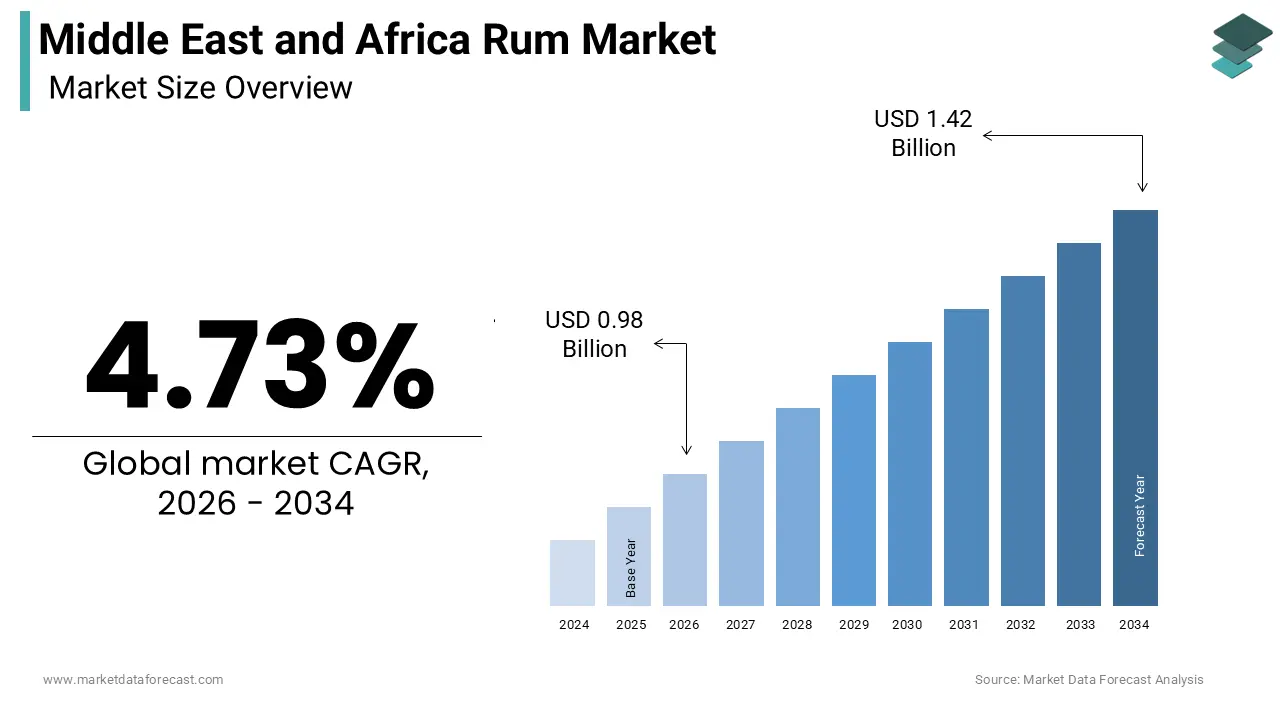
- Market Valuation: Valued at USD 0.94 billion (2025), estimated at USD 0.98 billion (2026), and projected to reach USD 1.42 billion by 2034, registering a steady CAGR of 4.73% (2026–2034).
- Primary Growth Drivers: Rising urbanization and growing disposable incomes in key African economies (such as Nigeria and Kenya); strong expatriate populations and post-pandemic tourism rebounds across GCC nations (like the UAE and Qatar).
Key Market Segment Metrics (2026–2034)
| Category | Leading Segment (2025 Position) | Fastest-Growing Segment / Country |
|---|---|---|
| By Product Type | Golden & Dark Rum (historically favored across traditional segments and hospitality mixes) | Spiced & Flavored Rums (surging in popularity among youthful urban demographics and cocktail culture) |
| By Distribution Channel | Off-trade (comprising retail stores, supermarkets, and duty-free hubs like Dubai International Airport) | On-trade (experiencing rapid revitalization through upscale hospitality, hotels, bars, and tourism spots) |
| By Region / Country | United Arab Emirates (dominated the MEA market with 25.3% share in 2025 due to tourism and liberal licensing) & South Africa (22.1% share) | Kenya & Sub-Saharan Urban Centers (emerging as fast-growing frontiers driven by middle-class expansion and nightlife culture) |
Major Market Players & Market Structure
Market Structure: Highly competitive landscape featuring global spirit giants and regional powerhouses leveraging local bottling infrastructure, duty-free visibility, and digital experiential marketing.
Key Companies: Bacardi, Diageo plc, Pernod Ricard, East African Breweries Limited (EABL), Tanduay, Amrut Distilleries, Beam Suntory, Gruppo Campari, Matusalem, Mohan Meakin, Patron Spirits, Pusser's, Radico Khaitan, Ron Bermudez, and Ron Edmundo Dantes.
Middle East and Africa Rum Market Size
The Middle East and Africa Rum Market size was calculated to be USD 0.94 billion in 2025 and is anticipated to be worth USD 1.42 billion by 2034, from USD 0.98 billion in 2026, growing at a CAGR of 4.73% during the forecast period.
Rum is traditionally associated with Caribbean production and Western consumption patterns, is gaining traction in select markets across this region due to growing disposable incomes, tourism, and a rising middle class in certain African economies. While cultural and religious norms restrict alcohol consumption in many parts of the Middle East, specific jurisdictions such as the United Arab Emirates and Qatar permit regulated sales, which is primarily catering to expatriate communities and international tourists. Meanwhile, Sub-Saharan Africa presents a contrasting scenario, where countries like Nigeria and Kenya exhibit growing interest in spirits, including rum. As per Euromonitor International, Nigeria recorded a 6.2% increase in spirits consumption between 2020 and 2023, with local and imported rum brands capitalizing on youth-driven urban markets.
MARKET DRIVERS
Rising Urbanization and Disposable Incomes in Select African Economies
One of the primary drivers fueling the growth of the Middle East and Africa rum market is the increasing rate of urbanization coupled with higher disposable incomes, particularly in key African economies such as Nigeria, Kenya, and South Africa. This demographic shift has led to greater exposure to global drinking cultures and an emerging middle class with more discretionary spending power. In Nigeria, for example, the average per capita income rose by 12.4% between 2020 and 2023, as reported by the National Bureau of Statistics. A study by BMI Research indicates that Nigeria’s spirits market grew by 7.1% in volume terms during 2022, with rum contributing significantly to this trend. Brands such as Captain Morgan and local variants have capitalized on this demand through aggressive marketing and pricing strategies tailored to local tastes. Moreover, improved retail infrastructure, including modern liquor stores and online delivery platforms, has made rum more accessible to urban dwellers. In Nairobi and Cape Town, for instance, convenience-based purchasing habits have been reinforced by the proliferation of supermarkets and licensed beverage outlets.
Tourism Growth and Expatriate Demand in the Gulf Cooperation Council (GCC) Countries
Tourism and expatriate populations play a crucial role in sustaining demand for rum in the Middle East, particularly within the Gulf Cooperation Council (GCC) nations such as the United Arab Emirates, Qatar, and Bahrain. These regions maintain a significant foreign workforce, which accounts for over 80% of the population in cities like Dubai and Doha, according to data released by the UAE Federal Competitiveness and Statistics Authority in 2023. Many expatriates hail from countries where alcohol consumption is culturally accepted, thereby creating a consistent base of consumers. Additionally, tourism has rebounded sharply post-pandemic, with the UAE recording over 14.9 million international visitors in 2023 alone, as per Dubai’s Department of Economy and Tourism. Hotels, bars, and lounges in these cities offer a wide variety of alcoholic beverages, with rum being a popular choice due to its mixability and affordability. Furthermore, major events such as Expo 2020 Dubai and the FIFA World Cup 2022 in Qatar boosted short-term demand for alcoholic beverages, including rum. These developments have encouraged both domestic and international distillers to strengthen their distribution networks in the region.
MARKET RESTRAINTS
Stringent Alcohol Regulations and Cultural Norms Across Islamic Nations
A significant restraint on the Middle East and Africa rum market is the prevalence of strict alcohol regulations and deeply ingrained cultural norms rooted in Islamic teachings. In several countries, including Saudi Arabia, Libya, Sudan, and Yemen, alcohol consumption is either fully prohibited or heavily restricted under sharia law. According to the Pew Research Center, nearly 42% of the population across the Middle East and North Africa resides in countries with outright bans on alcohol, severely limiting potential market reach. Even in countries where alcohol is legal, access is often tightly controlled. For example, in Kuwait, only non-Muslim residents holding valid liquor licenses can purchase alcohol, and the number of licensed individuals has remained stagnant at around 12,000 since 2020, as reported by the Kuwaiti Ministry of Commerce and Industry. These regulatory barriers directly impact the availability and visibility of rum products, making it difficult for producers to establish a foothold in key markets. Additionally, social stigma surrounding alcohol consumption persists even in partially liberalized environments, discouraging public consumption and hindering brand development efforts. Consequently, despite growing interest among expatriate and urban youth segments, regulatory constraints continue to pose a formidable challenge to the broader expansion of the rum market in the region.
Competition from Local Spirits and Religious Beverage Alternatives
Another critical restraint impacting the Middle East and Africa rum market is the dominance of traditional and locally produced spirits, as well as the emergence of non-alcoholic alternatives that cater to religious and health-conscious consumers. In many African countries, indigenous alcoholic beverages such as burukutu in Nigeria, pombe in Kenya, and kaffir beer in South Africa remain widely consumed due to their affordability, cultural significance, and accessibility in informal markets. According to a 2023 report by Euromonitor International, informal alcohol sales account for over 30% of total spirits consumption in Nigeria, where homemade brews often undercut commercial brands in price and availability. In the Middle East, the rise of halal-certified mocktails and non-alcoholic spirits further complicates the market landscape. Companies such as Seedlip and Lyre’s have introduced sophisticated zero-proof alternatives that appeal to both Muslim consumers and those seeking healthier lifestyle choices.
MARKET OPPORTUNITIES
Expansion of Premium and Craft Rum Segments in Urban Centers
An emerging opportunity for the Middle East and Africa rum market lies in the growing demand for premium and craft rums, particularly among affluent urban consumers and expatriate communities. As disposable incomes rise and global taste preferences influence local markets, there is a noticeable shift toward high-quality, aged, and flavored rums that offer unique flavor profiles and storytelling elements. In Nairobi and Cape Town, boutique bars and upscale restaurants are increasingly featuring artisanal rums from Latin America and the Caribbean, attracting discerning customers willing to pay a premium for authenticity and craftsmanship. Brands such as Appleton Estate, Diplomático, and Mount Gay have intensified their presence in these markets through strategic partnerships with local distributors and participation in lifestyle events. Moreover, digital marketing campaigns and social media engagement have allowed niche rum producers to connect directly with younger, tech-savvy consumers who prioritize experiential consumption.
Leveraging Duty-Free Sales and Airport Retail Channels
Another promising avenue for growth in the Middle East and Africa rum market is the robust duty-free and airport retail sector in major aviation hubs such as Dubai International Airport, Hamad International Airport in Qatar, and OR Tambo International Airport in South Africa. These airports rank among the busiest in the world, serving millions of transit passengers annually who often take advantage of tax-free shopping opportunities. According to Airports Council International, Dubai International handled over 86 million passengers in 2023 by making it the third-busiest airport globally by international passenger traffic. Brands are capitalizing on this trend by offering travel-exclusive editions, limited releases, and promotional bundles tailored to international travelers. Moreover, airlines operating from these hubs, such as Emirates and Qatar Airways, frequently stock premium rum variants in their onboard beverage selections, which is further reinforcing brand awareness and trial.
MARKET CHALLENGES
Volatile Currency Exchange Rates and Import Costs
One of the most pressing challenges facing the Middle East and Africa rum market is the volatility of local currencies against the US dollar and euro, which significantly impacts import costs and pricing stability. Many African countries, including Nigeria, Kenya, and Ghana, have experienced sharp currency depreciations in recent years, making imported alcoholic beverages, including rum, increasingly expensive for local consumers. In addition to exchange rate fluctuations, tariffs and import duties further inflate the cost of bringing rum into the region. This financial instability creates uncertainty for both distributors and consumers by potentially stifling long-term investment in brand development and market expansion.
Regulatory Uncertainty and Political Instability in Key Markets
Political instability and inconsistent regulatory frameworks pose another major challenge to the Middle East and Africa rum market. Several countries in the region experience frequent policy shifts regarding alcohol taxation, licensing, and distribution, often influenced by changes in government dominance or prevailing religious sentiments. In Egypt, for example, the government intermittently enforces stricter controls on alcohol advertising and availability, impacting consumer access and brand visibility. Similarly, in Zimbabwe, political unrest and currency instability have disrupted supply chains and hindered the regular importation of foreign spirits. In the Middle East, while the UAE maintains a relatively stable regulatory environment, other countries like Oman and Kuwait periodically revise alcohol licensing rules, making it difficult for businesses to plan effectively.
REPORT COVERAGE
| REPORT METRIC | DETAILS |
| Market Size Available | 2025 to 2034 |
| Base Year | 2025 |
| Forecast Period | 2026 to 2034 |
| CAGR | 4.73% |
| Segments Covered | By Product Type, Distribution Channel, And Region |
| Various Analyses Covered | Global, Regional & Country Level Analysis; Segment-Level Analysis; DROC, PESTLE Analysis; Porter’s Five Forces Analysis; Competitive Landscape; Analyst Overview of Investment Opportunities |
| Regions Covered | KSA, UAE, Israel, rest of GCC countries, South Africa, Ethiopia, Kenya, Egypt, Sudan and Rest of MEA |
| Market Leaders Profiled | Bacardi, Diageo, Pernod Ricard, Tanduay, Amrut Distilleries, Beam Suntory, Gruppo Campari, Matusalem, Mohan Meakin, Patron Spirits, Pusser's, Radico Khaitan, Ron Bermudez, and Ron Edmundo Dantes |
REGIONAL ANALYSIS
United Arab Emirates Rum Market Insights
The UAE dominated the MEA rum market with 25.3% of share in 2025. Duty-free sales at Dubai International Airport are the world’s busiest for international passenger traffic also contribute substantially to rum exports. The UAE's liberal licensing system allows licensed retailers and hotels to sell alcohol, supporting a thriving hospitality sector. Moreover, increasing tourism, rising disposable incomes, and a growing F&B industry drive consistent demand.
South Africa Rum Market Insights
South Africa rum market was accounted in holding 22.1% of the share in 2025. The country’s established beverage alcohol industry, coupled with relatively high per capita income and urbanization levels, supports robust domestic consumption. Local brands like Van der Hum and James Sedgwick Distillery play a pivotal role in shaping consumer preferences. SABMiller (now part of AB InBev) reported in its 2023 annual report that spirits, including rum, contributed over 17% of total alcoholic beverage sales in South Africa. Increasing youth engagement with cocktails and mixers further boosts rum consumption in urban centers like Cape Town and Johannesburg.
Saudi Arabia Rum Market Insights
Saudi Arabia rum market strict alcohol regulations that have historically limited legal consumption. However, recent socio-economic reforms under Vision 2030 have spurred changes, particularly in entertainment and tourism sectors, indirectly influencing consumer behavior. While alcohol remains officially banned for public sale and consumption, reports suggest a growing black market and discreet private imports among expatriate communities.
Egypt Rum Market Insights
Egypt rum market growth is driven primarily by tourism and a young, increasingly open-minded demographic (Euromonitor, 2023). While alcohol consumption is legally restricted to licensed venues catering to foreigners and tourists, resorts in Sharm El Sheikh, Hurghada, and Luxor offer significant opportunities for rum sales. The country’s population of over 104 million includes a large youth cohort, with more than 60% under the age of 30 (UNDP Egypt, 2023), creating long-term potential for brand loyalty and experimentation. Additionally, duty-free sales at Cairo and Sharm El Sheikh airports bolster export figures. Diageo and Pernod Ricard have expanded their presence in Egypt’s hospitality sector, capitalizing on rising disposable incomes and increased international travel. Although conservative norms persist, urban areas show growing openness to imported spirits, especially among affluent consumers and expatriates.
Kenya Rum Market Insights
Kenya rum market is emerging as one of the fastest-growing markets in Sub-Saharan Africa (BMI Research, 2023). The country benefits from a dynamic nightlife culture, expanding middle class, and increasing tourism. Nairobi, Mombasa, and coastal resort towns serve as key consumption centers. Kenya’s legal framework permits alcohol sales in licensed establishments, fostering a conducive environment for rum marketing. Local production and bottling operations by global players like Diageo and East African Breweries Limited (EABL) have enhanced availability and affordability. EABL’s 2023 financial report indicated a 9% year-on-year increase in spirit sales, with rum contributing significantly.
LEADING PLAYERS IN THE MIDDLE EAST AND AFRICA RUM MARKET
Diageo plc
Diageo is a dominant force in the MEA rum market, leveraging its global brand portfolio to influence regional consumption patterns. Known for iconic labels like Captain Morgan, Diageo combines strong distribution networks with strategic marketing to maintain relevance across diverse consumer segments. In the MEA region, the company focuses on both premium and value-driven offerings, tailoring products to local tastes while maintaining global quality standards. Its investments in responsible drinking campaigns and digital engagement strategies have helped build long-term brand loyalty.
Pernod Ricard
Pernod Ricard holds a significant presence in the MEA rum sector through brands such as Havana Club (distributed under joint ventures) and Brugal, which cater to both traditionalists and modern consumers. The company's emphasis on heritage, craftsmanship, and mixability has resonated well in urban centers and tourist hubs. Pernod Ricard actively engages in sustainability initiatives and partnerships with local distributors to enhance shelf visibility and consumer trust across key markets like South Africa, Egypt, and the UAE.
East African Breweries Limited (EABL)
EABL, a subsidiary of Diageo, plays a pivotal role in driving rum consumption in Sub-Saharan Africa. With localized production and bottling capabilities, EABL ensures affordability and availability of both international and homegrown rum brands. The company’s deep understanding of regional preferences allows it to effectively position products in both on-trade and off-trade channels.
MAJOR STRATEGIES USED BY KEY PLAYERS IN THE MEA RUM MARKET
Localization of Product Offerings
Leading companies adapt their rum portfolios to suit regional taste preferences, cultural norms, and price sensitivities. This includes introducing flavored variants, locally inspired packaging, and entry-level pricing models that cater to a broader demographic base.
Expansion of Distribution Networks
Players are aggressively expanding their reach through partnerships with on-trade establishments, retail chains, and duty-free outlets. Strengthening logistics infrastructure ensures consistent product availability even in remote or emerging markets.
Digital and Experiential Marketing
Brands are increasingly using digital platforms and immersive experiences such as music festivals, beach parties, and influencer collaborations to engage younger consumers and build brand affinity in socially vibrant environments.
KEY MARKET PLAYERS AND COMPETITION OVERVIEW
Major Players of the Middle East and Africa Rum Market include Bacardi, Diageo, Pernod Ricard, Tanduay, Amrut Distilleries, Beam Suntory, Gruppo Campari, Matusalem, Mohan Meakin, Patron Spirits, Pusser's, Radico Khaitan, Ron Bermudez, and Ron Edmundo Dantes
The competition in the Middle East and Africa rum market is intensifying as global and regional players vie for dominance across diverse regulatory and cultural landscapes. While the Gulf Cooperation Council (GCC) countries offer mature, high-value markets driven by expatriate demand and tourism, Sub-Saharan Africa presents growth opportunities fueled by youthful demographics and rising disposable incomes. Multinational beverage giants leverage scale, brand equity, and established distribution systems to maintain a stronghold, while local producers capitalize on familiarity with regional tastes and cost advantages. Innovation in flavor profiles, packaging formats, and promotional tactics is becoming crucial to stand out in an increasingly crowded space. Additionally, the rise of e-commerce and social media marketing has enabled smaller entrants to challenge established players. However, regulatory scrutiny around alcohol consumption, particularly in conservative markets, continues to pose challenges. Companies must navigate these complexities with responsible marketing practices, stakeholder collaboration, and adaptive business models to sustain competitive advantage.
RECENT HAPPENINGS IN THE MARKET
- In January 2025, Diageo launched a new digital campaign in Kenya targeting young adults, focusing on cocktail culture and promoting rum-based mixed drinks via influencer partnerships and interactive content.
- In March 2025, East African Breweries Limited (EABL) expanded its bottling facility in Nairobi to increase production capacity and improve supply chain efficiency across East Africa.
- In June 2025, Pernod Ricard partnered with leading hotel chains in the UAE to introduce exclusive rum tasting experiences and curated menus, enhancing brand presence in premium on-trade venues.
- In September 2025, Rémy Cointreau entered into a strategic distribution agreement with a major South African wholesaler to boost its premium rum portfolio visibility in upscale bars and restaurants.
- In November 2025, Heineken N.V., through its spirits division, introduced a line of spiced rums in Egypt, aligning with growing consumer interest in flavored spirits and aiming to capture a niche segment of the market.
DETAILED SEGMENTATION OF THE MIDDLE EAST AND AFRICA RUM MARKET INCLUDED IN THIS REPORT
This research report on the Middle East and Africa Rum Market has been segmented and sub-segmented based on product type, distribution channel & region.
By Product Type
- Golden
- Dark
- White
- Spiced
By Distribution Channel
- On-trade
- Off-trade
By Region
- KSA
- UAE
- Israel
- Rest of GCC countries
- South Africa
- Ethiopia
- Kenya
- Egypt
- Sudan
- Rest of MEA