- Product Description Description
- Table of Contents TOC
- List of Table & Figure LOT
- Get Free Sample PDF Sample PDF
Market Size, 2025
$3.61 BnMarket Estimate, 2026
$3.81 BnMarket Forecast, 2034
$5.91 BnCAGR, 2026–2034
5.63%Executive Summary: Middle East and Africa Whiskey Market
- Market Scope: Comprehensive regional analysis of the Middle East and Africa whiskey sector, tracking product categories, premium pricing tiers, and developments across developing economies within the region.
- Market Valuation: Valued at USD 3.61 billion in 2025, reaching USD 3.81 billion in 2026, and projected to expand to USD 5.91 billion by 2034, growing at a solid CAGR of 5.63% from 2026 to 2034.
- Primary Growth Drivers: Evolving consumer lifestyles, increasing liquor consumption habits, growing disposable incomes, and the positioning of whiskey as an affordable luxury item driving premium brand introductions.
Key Market Segment Metrics
| Category | Leading Segment (Base Position) | Fastest-Growing / High-Growth Segment |
|---|---|---|
| By Product | Blended Whisky (dominated base market share anchored by broad commercial availability and smooth flavor profiles) | Malt & Rye Whisky (high-growth segments propelled by rising demand for craft distillation and specialty expressions) |
| By Premium Tier | Premium & High-End Premium Whiskey (held primary base share balancing accessibility with luxury brand appeal) | Super-Premium Whiskey (fastest-growing tier driven by affluent consumer preference for elite and imported spirits) |
| By Region | Middle East Markets (market leaders backed by high urban purchasing power, tourism, and hospitality sectors) | Developing African Economies (key high-growth regional hubs driven by rising middle-class populations and modern retail expansion) |
Major Market Players & Industry Landscape
Market Structure: Competitive and developing landscape featuring major multinational beverage corporations expanding distribution footprints across emerging regional markets.
Key Companies: Accolade Wines, Allied Blenders & Distillers, Asahi Breweries, Bacardi Ltd., Beam Suntory, Diageo, John Distilleries, Pernod Ricard, and Smirnoff.
 Download Free Sample Report
Middle East and Africa Whiskey Market Size
The Middle East and Africa Whiskey Market size was calculated to be USD 3.61 billion in 2025 and is anticipated to be worth USD 5.91 billion by 2034 from USD 3.81 billion In 2026, growing at a CAGR of 5.63% during the forecast period.
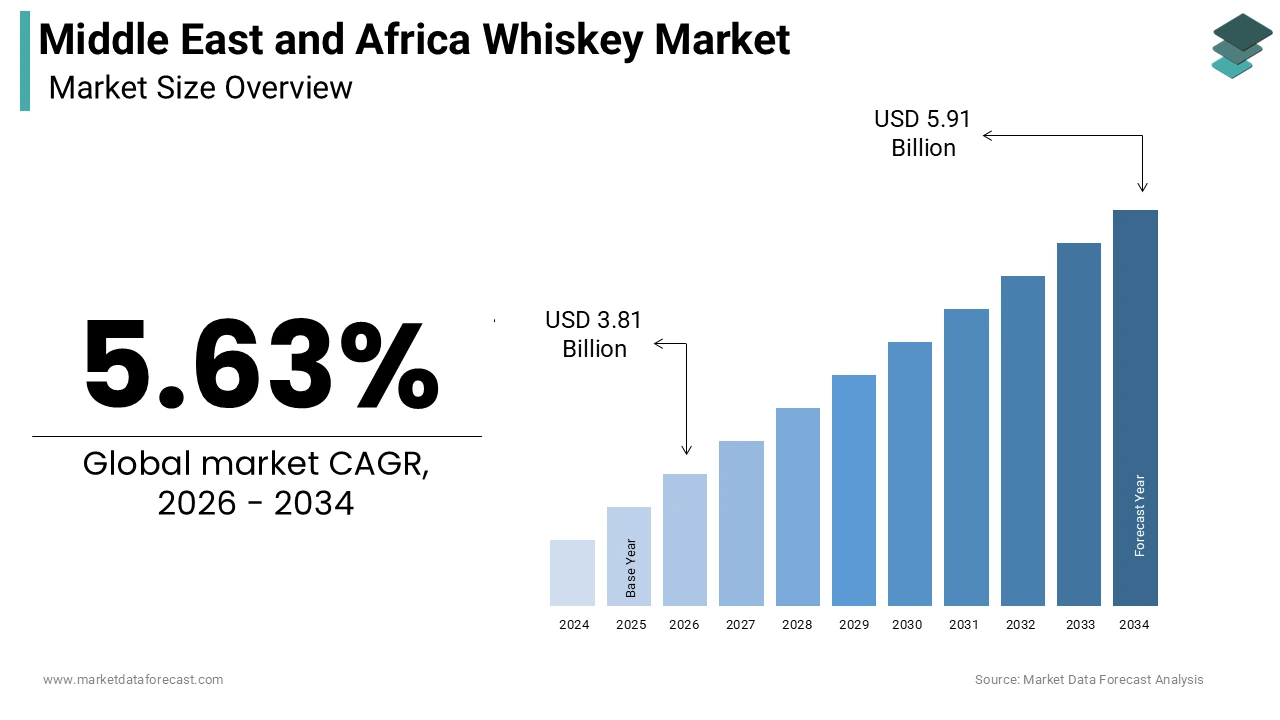
The market is showcasing evident potential in the mentioned forecasting period. The market continues to gain momentum with the rapid development in the industry. Whiskey comes under the category of affordable luxury items, resulting in many whiskey producing companies to launch more premium and super premium whiskies in the market. As an innovation, the brewing sector is launching an organic whiskey which does not have any artificial colours.
Market Drivers
The Middle East and Africa whiskey market is majorly driven by the recent change in lifestyles, increasing habit of consuming liquor, growing disposable income, and rising affordability of whiskey.
Market Restraints
However, some of the restraints hamper the growth of the industry, like heavy taxes, strict regulations by the governments, and health hazards associated with whiskey consumption.
Segmental Analysis
Middle East and Africa Whiskey Market By Product
- Malt Whisky
- Wheat Whisky
- Rye Whisky
- Corn Whisky
- Blended Whisky
- Others
Middle East and Africa Whiskey Market By Premium
- Premium
- High End Premium
- Super Premium
Middle East and Africa Whiskey Market By Region
On the basis of geography, the Middle East and Africa market is analysed under the regions Middle East and Africa. This region consists of many developing economies and thus is expected to grow at a decent rate in the future years to come.
Key Players in the Market
Some of the major companies dominating the market, by their products are Accolade Wines, Allied Blenders & Distillers, Asahi Breweries, Bacardi Ltd., Beam Suntory, Diageo, John Distilleries, Pernod Ricard, and Smirnoff.