- Product Description Description
- Table of Contents TOC
- List of Table & Figure LOT
- Get Free Sample PDF Sample PDF
Market Size, 2025
$18.52 BnMarket Estimate, 2026
$19.45 BnMarket Forecast, 2034
$28.80 BnCAGR, 2026–2034
5.03%Executive Summary: Middle East and Africa Wine Market
- Market Scope: Comprehensive regional analysis of the Middle East and Africa wine sector, covering taste profiles, wine styles, color classifications, and country-level developments.
- Market Valuation: Valued at USD 18.52 billion in 2025, reaching USD 19.45 billion in 2026, and projected to expand to USD 28.80 billion by 2034, growing at a CAGR of 5.03% from 2026 to 2034.
- Primary Growth Drivers: Evolving consumer lifestyles, increasing frequency of liquor consumption, rising disposable incomes, and the positioning of wine as an affordable luxury item.
Key Market Segment Metrics
| Category | Leading Segment (Base Position) | Fastest-Growing / High-Growth Segment |
|---|---|---|
| By Taste | Dry Wine (held the primary market share backed by traditional pairing habits and mainstream consumption) | Medium & Sweet Wine (experiencing higher traction driven by changing palates among emerging demographics) |
| By Wine Style | Still Wine (accounted for the dominant market share across regional production and retail distribution) | Sparkling Wine (expanding at the fastest pace driven by premiumization and celebratory occasions) |
| By Colour | Red Wine (captured the major market share anchored by extensive regional imports and traditional preferences) | Rosé Wine (projected to register accelerated growth propelled by seasonal appeal and lifestyle marketing) |
| By Region | UAE & Israel (established market leaders with robust hospitality sectors and cosmopolitan consumer bases) | KSA & Rest of GCC (key emerging hubs showcasing significant growth driven by tourism and retail modernization) |
Major Market Players & Industry Landscape
Market Structure: Highly competitive landscape featuring prominent domestic and international wine producers expanding portfolio offerings, leveraging cross-border trade, and adapting to modern retail channels.
Key Companies: Caviro, Concha y Toro, Constellation Brands, Diageo, E & J Gallo, Grupo Penaflor, and Johnnie Walker.
 Download Free Sample Report
Middle East and Africa Wine Market Size
The size of the Middle East and Africa wine market was calculated to be USD 18.52 billion in 2025 and is anticipated to be worth USD 28.80 billion by 2034 from USD 19.45 billion In 2026, growing at a CAGR of 5.03% during the forecast period.
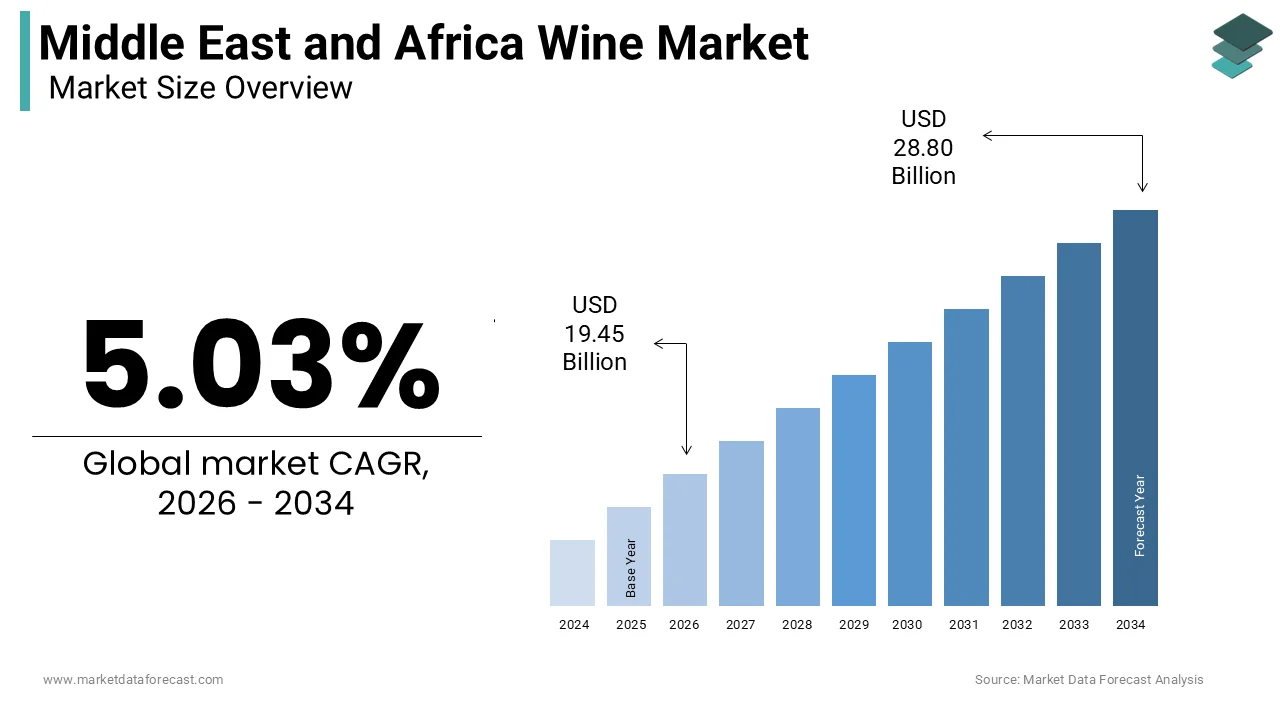
The market is showcasing evident potential in the mentioned forecasting period. The market continues to gain momentum with the rapid development in the industry. Wine comes under the category of affordable luxury items, resulting in many Wine producing companies to launch more types of wines in the market.
The Middle East and Africa Wine market is majorly driven by the recent change in lifestyles, increasing habit of consuming liquor, growing disposable income, and rising affordability of Wine. However, some of the restraints hamper the growth of the industry, like heavy taxes, strict regulations by the governments, and health hazards associated with Wine consumption.
This research report on the Middle East and Africa wine market is segmented and sub-segmented into the following categories.
Middle East and Africa Wine Market By Taste
- Dry
- Medium
- Sweet Wine
Middle East and Africa Wine Market By Wine Style
- Still Wine
- Sparkling Wine
- Dessert Wine
- Fortified Wine
Middle East and Africa Wine Market By Colour
- Red Wine
- White Wine
- Rose Wine
Middle East and Africa Wine Market By Region
- KSA
- UAE
- Israel
- Rest Of GCC Countries
On the basis of geography, the Middle East and Africa market is analysed under regions namely Middle East and Africa. Developing countries in this region are expected to drive the growth for Wine market.
KEY MARKET PLAYERS
Some of the major companies dominating the market, by their products are Caviro, Concha y Toro, Constellation Brands, Diageo, E & J Gallo, Grupo Penaflor, and Johnnie Walker.