Middle East And Africa Wood Vinegar Market By Pyrolysis Method (Slow Pyrolysis, Fast Pyrolysis, And Intermediate Pyrolysis), Application (Agriculture, Animal Feed, Food, Medicinal, And Consumer Products) And By End User and By Country (KSA, UAE, Israel, rest of GCC countries, South Africa, Ethiopia, Kenya, Egypt, Sudan and Rest of MEA) – Size, Share, Trends, Growth, Forecast (2026 to 2034)

ID: 3347
Pages: 125

Market Size, 2025

$0.23 Bn

Market Estimate, 2026

$0.24 Bn

Market Forecast, 2034

$0.38 Bn

CAGR, 2026–2034

5.92%

Middle East and Africa Wood Vinegar Market Size

The Middle East and Africa Wood Vinegar Market was calculated to be USD 0.23 billion in 2025 and is anticipated to be worth USD 0.38 billion by 2034 from USD 0.24 billion In 2026, growing at a CAGR of 5.92% during the forecast period.
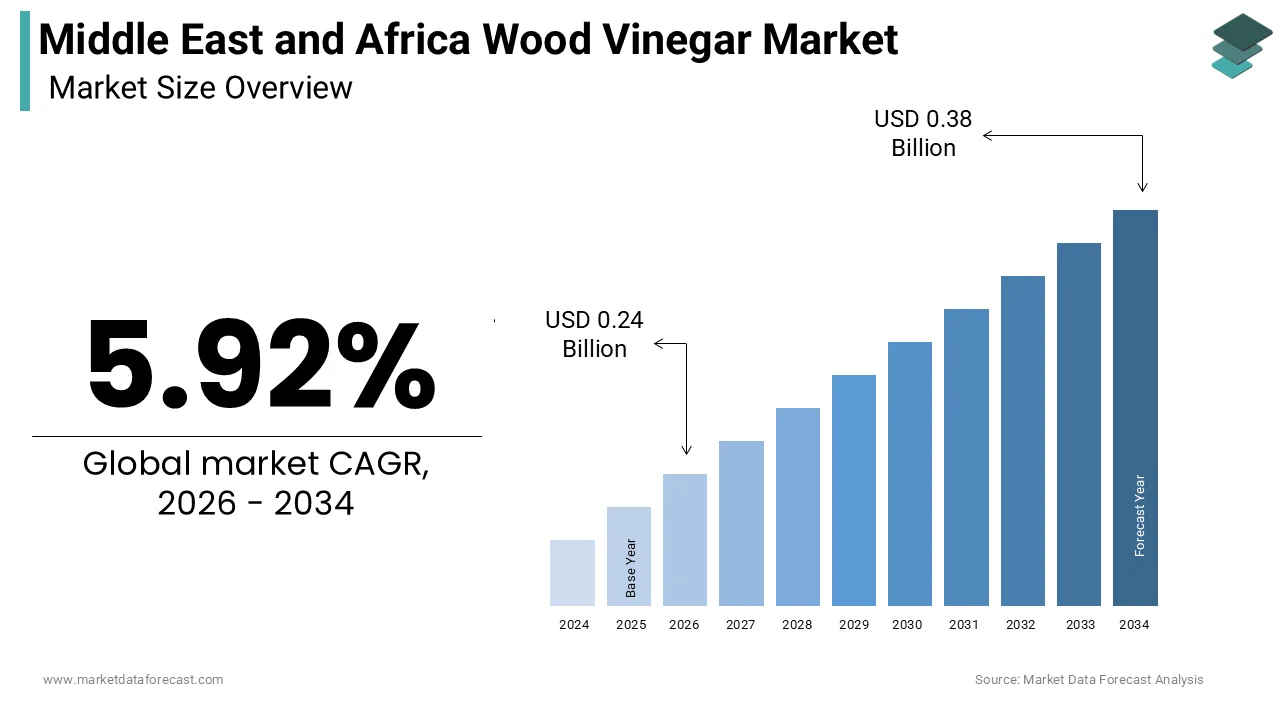
The Middle East and Africa Wood Vinegar Market was calculated to be USD 0.23 billion in 2025 and is anticipated to be worth USD 0.38 billion by 2034

The Middle East and Africa Wood Vinegar market is developing at an exceptionally quick pace. Wood vinegar is a natural substance which is extracted from wood and is also known as pyroligneous acid or liquid smoke. Wood vinegar is also a biodegradable and non-toxic material that is used in animal feeds and agriculture, and considered as a good option for organic farming. Wood vinegar aids in stimuLating plant & fruit growth, reduce odor, enriches soil fertility, prevents pests, weeds, roots from rotting and enhance seeds for germination. Wood vinegar is produced via the process of carbonization, in which the wood is heated in an airless container.

Market Drivers

The significant drivers for Wood Vinegar are improved crop yield, increasing government initiative for bio-based products, increasing base of end-use industries, stringent environment regulations etc. Also surge in use of wood vinegar the applications in agricultural practices such as increased disease resistance in plants, improved seed germination, soil enrichment and root growth stimulation.

Market Restraints

Limited manufacturers for the production of wood vinegar and stringent policies limits this industry.

SEGMENTAL ANALYSIS

Middle East and Africa Wood Vinegar Market By Pyrolysis Method

  • Slow Pyrolysis
  • Fast Pyrolysis
  • Intermediate Pyrolysis

Fast and intermediate pyrolysis method of wood vinegar production is mainly used by domestic producers in small scale where in slow pyrolysis is used by small as well as large manufacturers for higher yield of the products.

Middle East and Africa Wood Vinegar Market By Application

  • Agriculture
  • Animal Feed
  • Food
  • Medicinal
  • Consumer Products

Middle East and Africa Wood Vinegar Market By Region

  • KSA
  • UAE
  • Israel
  • Rest of GCC countries
  • South Africa
  • Ethiopia
  • Kenya
  • Egypt
  • Sudan
  • Rest of MEA

Middle East and Africa has an untapped market and key players are slowly expanding to this region which is the main reason for the growth of market in this region.

Key Players in the Market

Major Key Players in the MEA Wood Vinegar Market are Canada Renewable Bioenergy Corp, Nettenergy BV (Netherlands), ACE (Singapore) Pte Ltd, TAGROW CO., LTD. (China), and Byron Biochar (Australia)

Trusted by 500+ companies. We respect your privacy and never share your data.

Please wait. . . . Your request is being processed

Frequently Asked Questions

1. What factors are driving the growth of this market?

Growth is driven by increasing adoption of organic farming, rising demand for bio-based agricultural inputs, and growing environmental awareness.

2. What is wood vinegar and how is it produced?

Wood vinegar is a liquid byproduct obtained through the pyrolysis (heating without oxygen) of wood and biomass materials.

3. What are the main applications of wood vinegar?

It is widely used in agriculture, animal feed, food processing, pharmaceuticals, and consumer products.

4. Which segment dominates the market by application?

The agriculture segment dominates due to its use as a natural pesticide, soil enhancer, and plant growth promoter.

5. What are the key benefits of wood vinegar?

It improves soil fertility, enhances crop yield, controls pests, reduces odors, and supports sustainable farming practices.

6. What are the different production methods of wood vinegar?

Major methods include slow pyrolysis, fast pyrolysis, and intermediate pyrolysis, with slow pyrolysis being the most widely used.

7. What are the key trends in this market?

Key trends include growing organic farming practices, increased use of eco-friendly inputs, and expansion into non-agricultural applications.

8. What challenges does the market face?

Challenges include limited awareness among farmers, underdeveloped supply chains, regulatory barriers, and higher costs compared to chemical alternatives

9. What opportunities exist in this market?

Opportunities include expansion of organic farming, government support for sustainable practices, and increased demand for natural agricultural inputs.

10. What is the future outlook of the MEA wood vinegar market?

The market is expected to grow steadily due to rising demand for sustainable and eco-friendly agricultural solutions, along with increasing adoption across multiple industries.

Related Reports

Access the study in MULTIPLE FORMATS
Purchase options starting from $ 1600

Didn’t find what you’re looking for?
TALK TO OUR ANALYST TEAM

Need something within your budget?
NO WORRIES! WE GOT YOU COVERED!

REACH OUT TO US

Call us on: +1 888 702 9696 (U.S Toll Free)

Write to us: sales@marketdataforecast.com

Click for Request Sample