Middle East Aviation Market Size, Share, Trends, COVID-19 Impact & Growth Analysis Report – Segmented By Application (Commercial Aircraft, Military Aircraft, General Aviation) & Country (KSA, UAE, Israel Rest of GCC Countries Rest of Middle East) - Industry Analysis From 2024 to 2033
Middle East Aviation Market Size
The Middle East Aviation Market was valued at USD 25.63 billion in 2024, is estimated to reach USD 26.73 billion in 2025, and is projected to reach USD 37.43 billion by 2033, growing at a CAGR of 4.30% from 2025 to 2033.
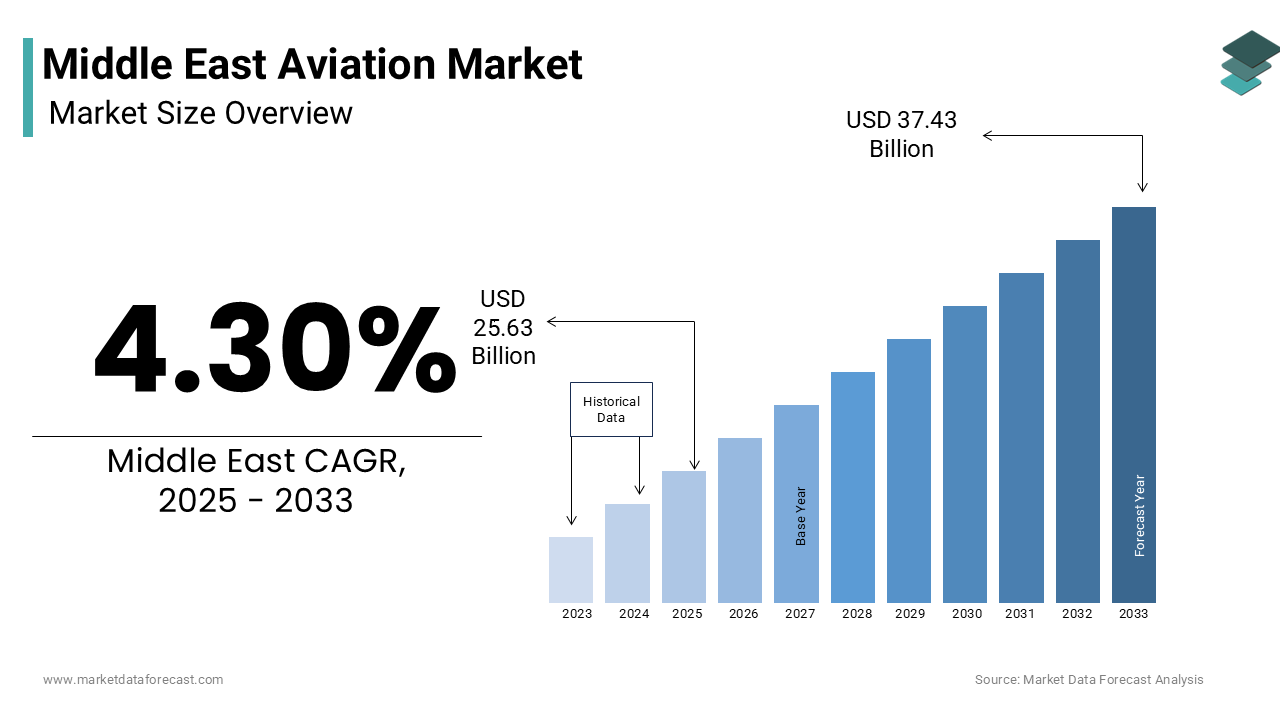
The aviation industry is a strategically vital and geographically optimized air transport ecosystem, which is serving as a global nexus for intercontinental passenger and cargo movements between Asia, Europe, and Africa.
MARKET DRIVERS
Strategic Geographic Positioning as a Global Air Bridge
The unparalleled geographic location by enabling airlines to capture a disproportionate global transit traffic is also driving the growth of the Middle East aviation market. Positioned at the crossroads of major trade and travel corridors, the region allows for non-stop connectivity between high-demand city pairs such as Sydney–London, Mumbai–New York, and Johannesburg–Tokyo. This centrality reduces flight times and fuel consumption compared to polar or transatlantic detours, which is making it economically advantageous for both full-service carriers and cargo operators. Emirates, for instance, operates flights to 130 destinations with an average connecting time of under 90 minutes in Dubai, a feat enabled by spatial efficiency and advanced ground handling.
Government-Led Economic Diversification and Infrastructure Investment
The national economic transformation initiatives in Saudi Arabia and the UAE are fueling unprecedented investment in aviation infrastructure and ecosystem development, which is accelerating the growth of the Middle East aviation market. Similarly, the UAE’s Al Maktoum International Airport expansion aims to handle 260 million passengers annually by 2050.
MARKET RESTRAINTS
Overreliance on Transit Traffic and Vulnerability to Global Disruptions
The heavy dependence on international connecting passengers, which exposes carriers to external shocks beyond regional control is restricting the growth of the Middle East aviation market. This model, while efficient under stable conditions, becomes vulnerable during global disruptions such as pandemics, geopolitical conflicts, or shifts in international travel policies. For example, during the 2020 airspace closures, passenger volumes at Dubai International plummeted by 75%, as per the Dubai Airports Company. Unlike airlines in North America or Europe with strong origin-and-destination (O&D) traffic, Gulf carriers lack a deep local travel base. Additionally, rising protectionism in aviation rights such as the U.S. opposition to open skies agreements threatens route expansion.
Environmental Regulatory Pressure and Carbon Emissions Scrutiny
The rapid expansion of long-haul operations in the Middle East is increasing scrutiny from global environmental regulators due to high carbon emissions per passenger-kilometer on ultra-long-haul routes, which is additionally hampering the growth of the Middle East aviation market. Gulf airlines face escalating operational costs with the European Union enforcing stricter CORSIA (Carbon Offsetting and Reduction Scheme for International Aviation) compliance and potential carbon border taxes.
MARKET OPPORTUNITIES
Expansion of Air Cargo and E-Commerce Logistics Networks
The surge in cross-border e-commerce and high-value freight to expand their air cargo dominance is major factor showcasing new opportunities for the growth of the Middle East aviation market. The rise of digital marketplaces such as Noon and Amazon.ae has amplified demand for express logistics for electronics, pharmaceuticals, and luxury goods. Additionally, the UAE’s establishment of the Dubai South Logistics District a 27-square-kilometer dedicated logistics zone that enables seamless integration of air, land, and sea freight.
Development of Domestic and Regional Tourism Aviation Markets
The deliberate push to cultivate domestic and intra-regional tourism to reduce reliance on transit passengers and build sustainable origin-and-destination traffic is additionally to enhance the growth of the Middle East aviation market. Saudi Arabia aims to increase domestic travel to 100 million trips annually by 2030, as outlined by the Ministry of Tourism, which is supported by the development of 14 tourism megaprojects including NEOM and the Red Sea Global destinations. This shift is accompanied by the launch of new low-cost carriers such as flyadeal and Riyadh Air that designed to stimulate affordable air travel within the Kingdom and across the GCC. Enhanced visa facilitation such as Saudi Arabia’s recent introduction of e-visas for 56 countries will further boosts the growth of the Middle East aviation market.
MARKET CHALLENGES
Intensifying Competition from Emerging Aviation Hubs and Legacy Carriers
The resurgent legacy carriers and emerging aviation hubs is posing a new challenge for the growth of the Middle East aviation market. Turkish Airlines surpassed 80 million passengers in 2023, as reported by the Directorate General of Civil Aviation of Turkey. Ethiopian Airlines has expanded its African connectivity, which is positioning Addis Ababa as a pan-continental hub with direct flights to 65 African destinations. These carriers benefit from lower operating costs and stronger intra-regional demand. According to OAG Aviation Worldwide, direct flights between Europe and Southeast Asia increased by 40% in 2023 compared to 2019.
Workforce Localization and Talent Retention in a High-Skill Industry
The developing and retaining a skilled, locally sourced workforce amid rapid expansion and technological modernization is also degrading the growth of the Middle East aviation market. As per the International Civil Aviation Organization, only 18% of pilots and 22% of aircraft maintenance engineers in the GCC are local nationals, with most senior technical and operational roles filled by expatriates. This dependency creates vulnerabilities in labor continuity and increases long-term personnel costs. Moreover, the demand for advanced skills in AI-driven air traffic management, cybersecurity, and sustainable operations outpaces local training capacity. Bridging this talent gap requires deeper integration between educational institutions, regulatory bodies, and airlines to ensure a sustainable pipeline of qualified professionals.
SEGMENTAL ANALYSIS
By Application Insights
The commercial aircraft segment dominated the Middle East aviation market share in 2024 with the region’s role as a global air travel intermediary, with Gulf carriers operating some of the world’s largest fleets of long-haul wide-body aircraft. As of 2023, Emirates operated a fleet of 254 aircraft, including 119 Airbus A380s and Boeing 777s by enabling ultra-high-density configurations on routes like Dubai–London and Dubai–Sydney, according to the airline’s annual fleet report.
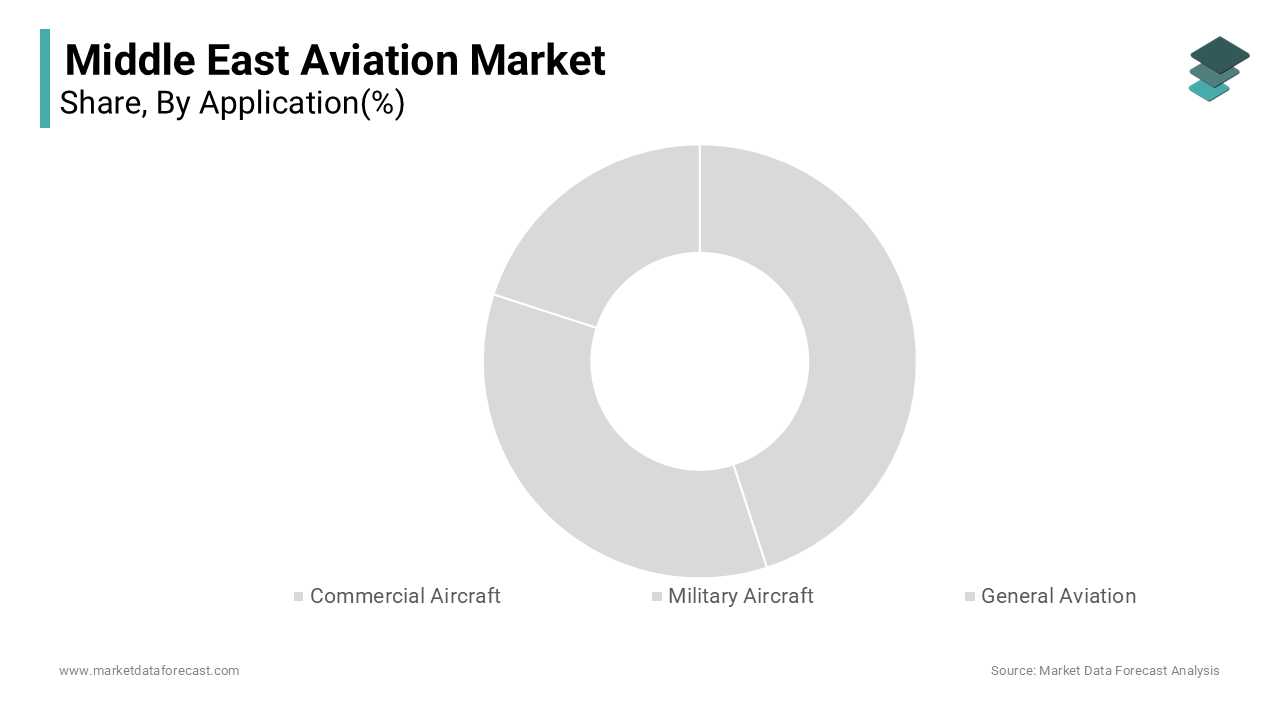
The military aircraft segment is likely to register a CAGR of 7.9% during the forecast period with the escalating regional security concerns and large-scale defense modernization programs. Several countries are upgrading aging fleets with advanced multirole fighters, surveillance platforms, and unmanned aerial systems (UAS). The increasing adoption of indigenous defense manufacturing and technology integration is accelerating the growth of the Middle East aviation market. Additionally, drone warfare capabilities are being prioritized, with Turkey and the UAE deploying combat UAVs in regional operations.
REGIONAL ANALYSIS
Saudi Arabia was the top performer of the Middle East aviation market by capturing 31.2% of share in 2024. The government has allocated $30 billion to modernize 27 airports, with King Salman International Airport in Riyadh set to become one of the world’s largest aviation complexes, which is designed to handle 120 million passengers annually by 2030, as announced by the Ministry of Transport and Logistics Services. Additionally, the Public Investment Fund owns 49% of the airline, signaling deep state commitment.
The United Arab Emirates was positioned second by capturing 27.3% of share in 2024. Emirates, the region’s largest airline, operates one of the youngest and most fuel-efficient long-haul fleets, with plans to induct 120 Boeing 777X aircraft by 2030. The UAE’s open skies policy has enabled partnerships with over 150 airlines, while its investment in Al Maktoum International aims to shift future capacity to a next-generation smart airport. Moreover, the country leads in aviation innovation, launching the world’s first AI-powered air traffic control tower in Abu Dhabi in 2023, as reported by the General Civil Aviation Authority.
Top Players in the Middle East Aviation Market
Emirates has its position as a defining force in global aviation through its aggressive long-haul network and premium service model. Based in Dubai, the airline operates one of the world’s largest fleets of Boeing 777 and Airbus A380 aircraft, enabling high-capacity operations on routes linking the Asia-Pacific region with Europe and the Americas. Emirates has been instrumental in facilitating transit traffic between emerging Asian economies and Western markets, offering seamless connections via Dubai. In recent years, it has strengthened its Asia-Pacific presence by restoring pre-pandemic frequencies to cities like Sydney, Mumbai, and Singapore, while launching seasonal services to destinations such as Bali and Osaka. The airline also invested in cabin modernization, introducing next-generation suites in First Class and upgrading inflight entertainment with AI-curated content. Additionally, Emirates partnered with Indian Railways in 2023 to offer integrated rail-air ticketing, enhancing last-mile connectivity for passengers across South Asia.
Qatar Airways has emerged as a connector between the Middle East and the Asia-Pacific, leveraging Doha’s strategic location to build a dense network across South, Southeast, and East Asia. The carrier operates daily flights to over 30 destinations in the Asia-Pacific region, including key economic hubs such as Tokyo, Shanghai, Sydney, and Jakarta. Known for its award-winning service and state-of-the-art fleet, Qatar Airways introduced the Airbus A350-1000 on high-demand routes to Melbourne and Hong Kong, optimizing fuel efficiency and passenger comfort. In 2023, the airline launched a codeshare agreement with Japan Airlines, expanding its reach into regional Japanese cities.
Saudi Arabian Airlines (Saudia) is undergoing a transformative expansion to elevate its role in regional and international aviation, including growing engagement with the Asia-Pacific market. As the national carrier of Saudi Arabia, Saudia has increased frequencies to major Asian destinations such as Kuala Lumpur, Jakarta, and Karachi, while resuming services to Bangkok and Manila in 2023. In 2024, Saudia launched a new digital platform offering multilingual support and e-visa integration for travelers from Indonesia and India. It also introduced a modernized cabin configuration on its Boeing 787 fleet by enhancing long-haul comfort.
Top Strategies Used by Key Market Participants
Key players in the Middle East aviation market are prioritizing fleet modernization, strategic route expansion, and digital transformation to maintain competitive advantage. Airlines are investing in next-generation aircraft such as the Boeing 777X and Airbus A350 to improve fuel efficiency and extend range. There is a strong emphasis on enhancing passenger experience through cabin innovation, AI-driven personalization, and seamless connectivity. Expansion into high-growth regions like Africa and South Asia is being pursued through new routes and codeshare partnerships. Sustainability is a growing focus, with carriers adopting sustainable aviation fuel and carbon offset programs. Additionally, integration with tourism and logistics ecosystems is enabling airlines to diversify revenue streams and strengthen national economic positioning.
KEY MARKET PLAYERS AND COMPETITIVE LANDSCAPE
Emirates Group, Qatar Airways Group, Etihad Airways, Saudia Group, Air Arabia PJSC, Oman Air, Gulf Air, Kuwait Airways, El Al, Arkia, Mahan Air, Iran Air, Royal Air Maroc, The Boeing Company, Airbus SE, Embraer S.A., Bombardier Inc., Leonardo S.p.A., Lockheed Martin Corporation, Thales Group, Textron Inc., and General Dynamics Corporation.
Competition in the Middle East aviation market is characterized by a strategic interplay of state-backed expansion, technological innovation, and geopolitical maneuvering. Incumbent carriers such as Emirates, Qatar Airways, and Saudia are leveraging national resources to dominate global transit routes, while new entrants like Riyadh Air are preparing to disrupt the regional landscape. The race to modernize airports and adopt smart aviation technologies has intensified, with Dubai and Doha investing in AI-driven air traffic systems and automated terminals. Airlines are also competing on service differentiation, with premium cabins, inflight wellness, and digital concierge services becoming key differentiators.
RECENT MARKET DEVELOPMENTS
- In January 2023, Emirates resumed daily A380 services to Sydney, reinforcing its commitment to premium long-haul operations and enhancing connectivity between Australia and Europe via Dubai.
- In June 2023, Qatar Airways launched a strategic codeshare agreement with Japan Airlines, which is expanding access to 20 regional destinations in Japan and strengthening its footprint in the Asia-Pacific market.
- In November 2023, Saudia introduced a new digital travel platform with integrated e-visa processing for passengers from India and Indonesia, streamlining access for religious and leisure travelers.
- In March 2024, Emirates announced a $500 million cabin retrofit program to upgrade over 120 aircraft with next-generation suites, premium economy seating, and advanced inflight entertainment systems.
- In May 2024, Qatar Airways took delivery of its first Boeing 777F freighter by marking the beginning of a fleet expansion aimed at doubling cargo capacity to Asia by 2026.
MARKET SEGMENTATION
This research report on the Middle East Aviation Market has been segmented and sub-segmented based on application and region.
By Application
- Commercial Aircraft
- Passenger Aircraft
- Freighter
- Military Aircraft
- Combat Aircraft
- Non-combat Aircraft
- General Aviation
- Helicopter
- Piston Fixed-wing Aircraft
- Turboprop Aircraft
- Business Jet
By Country
- KSA (Kingdom of Saudi Arabia)
- UAE (United Arab Emirates)
- Israel
- Rest of GCC Countries
- Rest of the Middle East
Frequently Asked Questions
What is the Middle East Aviation Market?
The Middle East Aviation Market refers to the commercial and defense aviation industry in the region, covering airlines, airport infrastructure, aircraft manufacturing, maintenance, repair, overhaul (MRO), and aviation services.
What are the key drivers of the Middle East Aviation Market?
The market is driven by increasing air passenger traffic, expanding airport infrastructure, growing tourism, rising investment in fleet modernization, and strategic geographic positioning as a global aviation hub.
Which countries lead the Middle East Aviation Market?
The leading countries include the United Arab Emirates (UAE), Qatar, Saudi Arabia, and Turkey, due to their strong airline networks and investments in aviation infrastructure.
What challenges does the Middle East Aviation Market face?
Challenges include geopolitical instability, fluctuating oil prices, regulatory hurdles, environmental concerns, and competition from global airlines.
What are the growth opportunities in the Middle East Aviation Market?
Growth opportunities lie in low-cost carrier expansion, airport infrastructure development, adoption of advanced aircraft technologies, sustainable aviation initiatives, and increasing regional connectivity.
What is the future outlook for the Middle East Aviation Market?
The market is expected to witness steady growth with expanding passenger traffic, new route additions, infrastructure investments, and a strong focus on sustainability and innovation.
Related Reports
Access the study in MULTIPLE FORMATS
Purchase options starting from
$ 1200
Didn’t find what you’re looking for?
TALK TO OUR ANALYST TEAM
Need something within your budget?
NO WORRIES! WE GOT YOU COVERED!
Call us on: +1 888 702 9696 (U.S Toll Free)
Write to us: sales@marketdataforecast.com